
Article
Why Fast Hiring Decisions Matter: A Recruiter's Guide

Why Fast Hiring Decisions Matter: A Recruiter’s Guide
TL;DR:
- Moving quickly in hiring increases offer acceptance, reduces vacancy costs, and boosts employer brand perception. Implementing structured processes and pre-authorized offers helps teams make faster decisions without compromising quality, ultimately securing top candidates and lowering costs. Tracking key metrics like time-to-hire and offer-acceptance rates validates the impact of speed and guides continuous improvement.
Fast hiring decisions directly increase offer-acceptance rates, cut vacancy costs, and protect your employer brand — and the gap between a good process and a slow one is often measured in hours, not weeks.
The core case is straightforward. Top candidates move fast. Research from Enboarder’s expert panel establishes that silence past 72 hours after a final interview is one of the leading causes of candidate drop-off in frontline and volume hiring. If your team hasn’t communicated a yes, a no, or a clear next date within that window, you’re likely losing candidates to employers who did. This is where time-to-hire, the metric that measures days from application to accepted offer, becomes a strategic lever rather than just an HR dashboard number.
Here’s what faster decisions actually deliver:
- Secure top talent first. High-demand candidates typically hold multiple offers. The employer who moves first wins more often.
- Reduce vacancy cost. Every open day carries a real dollar cost in lost productivity, overtime, and agency spend.
- Improve candidate experience. A fast, clear process signals organizational competence and raises interview satisfaction scores.
Table of Contents
- Why fast hiring decisions matter for your business outcomes
- How slow hiring hurts performance, finances, and DEI goals
- Which KPIs actually prove that hiring speed matters?
- A practical playbook for shortening time-to-decision
- When moving fast becomes risky — and how to guard quality
- What research and practitioners say about hiring speed
- Key Takeaways
- The one change that actually moves the needle
- Jobsai Enterprise cuts the admin friction that slows your decisions
- Useful sources
- FAQ
Why fast hiring decisions matter for your business outcomes
Speed in hiring isn’t about cutting corners. It’s about capturing value before a competitor does. Dr. John Sullivan’s analysis shows that a first-to-offer strategy correlates with higher acceptance rates and fewer vacancy days, particularly for mission-critical roles where every open week carries measurable revenue impact.
Think about a senior software engineer search. The candidate finishes final rounds with three companies on a Friday. The company that sends a written offer Monday morning wins the weekend’s mental deliberation. The two that schedule an internal debrief for Thursday lose. That’s not a hypothetical — it’s the pattern that plays out across technical, sales, and frontline hiring every week.
The operational benefits stack up quickly. Fewer vacancy days means preserved team productivity. When a role sits open for six weeks instead of three, the existing team absorbs the workload, overtime costs climb, and morale takes a quiet but measurable hit. Forbes Human Resources Council members consistently cite reduced costs, stronger candidate experience, and competitive advantage as the top outcomes from organizations that shorten hiring cycles.
Candidate experience is where employer brand enters the equation. A recruiter who follows up within 24 hours, schedules efficiently, and delivers a decision promptly creates a fundamentally different impression than one who goes quiet for two weeks. Candidates talk. A fast, respectful process generates referrals; a slow, opaque one generates Glassdoor reviews.

How slow hiring hurts performance, finances, and DEI goals
Delay has a price, and it’s larger than most hiring managers calculate.
Direct costs include:
- Lost productivity from the unfilled role (often estimated as a fraction of the role’s annual salary per vacancy week)
- Overtime paid to team members covering the gap
- Agency premiums when urgency forces a staffing escalation
- Hiring manager time spent re-reviewing candidates, re-scheduling, and re-briefing stakeholders
Indirect costs are harder to see but often more damaging. Stalled projects, reduced team morale, and burnout among the employees absorbing extra work all compound over a long search. When a team watches a critical role stay open for months, the signal they receive is that leadership isn’t prioritizing the problem. That perception drives turnover risk among the people you already have.
The diversity and inclusion impact is underappreciated. Slow, disorganized processes disproportionately disadvantage candidates who can’t afford to wait out a six-week decision cycle — including candidates from underrepresented groups who may be juggling multiple job searches with fewer financial buffers. Hunt Scanlon’s reporting documents cases where scheduling delays and slow offers caused strong candidates to accept elsewhere, narrowing the final pool to whoever happened to still be available.

A simple vacancy-cost framework: Take the role’s annual salary, divide by 52 to get a weekly cost, then apply a productivity multiplier (commonly 0.5 to 1.5x depending on role criticality). A $120,000 engineer role open for eight extra weeks at a 1.0x multiplier costs roughly $18,500 in lost output alone, before overtime or agency fees. Run that number for your five most common open roles and the urgency of faster decisions becomes concrete.
Which KPIs actually prove that hiring speed matters?
Tracking the right metrics turns a gut feeling about speed into a defensible business case. Here are the core ones, what they measure, and who should own them.
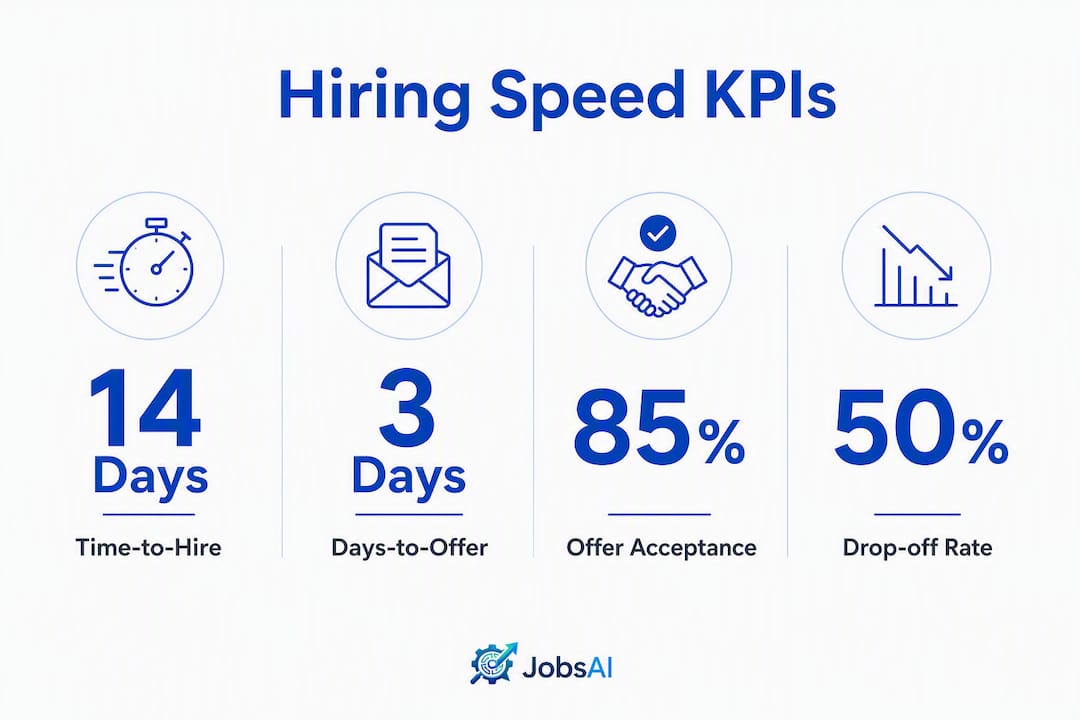
| Metric | What it measures | Who tracks it |
|---|---|---|
| Time-to-hire | Days from application to accepted offer | TA lead, HRIS |
| Time-to-fill | Days from req open to offer accepted | TA lead, hiring manager |
| Days-to-offer | Days from final interview to written offer | Recruiting coordinator |
| Offer-acceptance rate | % of offers accepted vs. extended | TA lead, HR director |
| Candidate drop-off rate | % who disengage before offer stage | TA lead |
| Days-to-productivity | Days from start date to full output | Hiring manager, L&D |
Time-to-hire lives in your ATS. Days-to-offer is often calculated manually from interview-completion timestamps to offer-sent timestamps, which is why many teams miss it entirely. That gap is worth closing — it’s where you’ll find the clearest evidence of internal bottlenecks.
For benchmarks, Jobsai Enterprise’s US staffing industry benchmarks recommend setting targets by role tier rather than applying a single universal number. A frontline hourly role and a VP of Engineering have fundamentally different search timelines. What matters is relative improvement: if your current time-to-hire for mid-level technical roles is 42 days, a realistic 90-day target might be 30 days, not an arbitrary 14.
Surface offer-acceptance rate and days-to-offer to executives. Hiring managers need time-to-hire and candidate drop-off. Recruiting coordinators should own days-to-offer as an operational SLA.
A practical playbook for shortening time-to-decision
Most of the time lost in a hiring process disappears between steps, not during them. A debrief that could happen the day after interviews gets scheduled for next Thursday. An offer that could go out Monday waits for a compensation review that should have happened before the search opened. Fixing these gaps is where the biggest gains are.
-
Pre-search alignment. Before posting the role, define what a “hire” decision looks like, set a formal SLA (example: decision or explicit next-date within 72 hours of final interview), and pre-authorize the offer range so the final decision can execute immediately after debrief. This single step eliminates the most common delay: waiting for compensation approval after you’ve already found the person.
-
Structured interviews with scorecards. Structured interviews convert subjective impressions into defensible scorecard ratings, which means debrief conversations are shorter and decisions are faster. Book the debrief at the same time you schedule the interview. Don’t wait until after.
-
Parallel workflows. Run background check initiation, reference outreach, and compensation modeling simultaneously rather than sequentially. Sequential steps add days with no quality benefit.
-
Automated scheduling and candidate updates. Calendar blocking and automated reminders remove the back-and-forth that costs two to three days per interview round. Automated status updates keep candidates warm without requiring recruiter time on every touchpoint.
-
Time-limited offers. Set offer expiration windows of three to five days. This prevents candidates from using your offer as leverage in a prolonged negotiation and reduces the open-ended delays that hurt your backup pipeline.
Pro Tip: Book the hiring team debrief before the final interview happens. When the debrief is already on the calendar, the decision conversation starts the next morning instead of waiting for a scheduling window that opens two weeks later.
When moving fast becomes risky — and how to guard quality
Speed without structure produces bad hires. The goal isn’t to rush; it’s to remove administrative delay while keeping every quality checkpoint intact.
Common risks in accelerated hiring include:
- Skipping or rushing reference checks because the offer is already extended
- Conducting inconsistent interviews when different panelists use different criteria
- Narrowing the candidate pool prematurely because the team is impatient
- Relying on gut feel instead of scorecard data when time pressure is high
The guardrails that protect quality without reintroducing delay are specific. Require a minimum scorecard completion before any offer is approved. Run diversity-focused pipeline checks at the top of the funnel, not after you’ve already narrowed to finalists. Build compliance checkpoints (background check authorization, reference completion) into the workflow as parallel steps, not sequential gates.
A fast process and a rigorous process are not opposites. The teams that hire well and hire quickly are the ones that have done the preparation work before the search opens — defined the role, aligned on criteria, and pre-cleared the offer. Speed is the output of that preparation, not a shortcut around it.
Red flags that should pause a fast decision: conflicting references on a core competency, a background check with unresolved discrepancies, or a candidate whose stated expectations don’t match the role scope. These aren’t reasons to slow down the process generally. They’re specific signals that require resolution before an offer goes out.
What research and practitioners say about hiring speed
The evidence for moving faster is consistent across practitioner research, academic work, and industry reporting.
Enboarder’s expert panel establishes the 72-hour rule as a practical standard: communicate a yes, a no, or an explicit next date within 72 hours of the final interview. For frontline and volume hiring, where candidates are often evaluating multiple opportunities simultaneously, silence past that window is a primary driver of drop-off. The panel frames this not as a courtesy but as a competitive necessity.
Dr. John Sullivan’s first-to-offer research makes the business case directly. When employers extend offers before competitors, acceptance rates rise and vacancy days fall. The candidates most likely to drive business results are also the most likely to have options — and they tend to choose the employer that mirrors their own decisiveness.
Speed is often a symptom of good process, not reckless shortcuts. When a team can move from final interview to offer in 48 hours, it’s usually because they defined the role clearly, aligned on criteria before the search started, and built a process that doesn’t require three rounds of internal approval to send a letter.
This framing, drawn from Aplin’s practitioner perspective, reorients the conversation. Slow hiring usually isn’t careful hiring. It’s administrative friction masquerading as diligence.
Management Science research analyzing millions of real-world marketplace transactions confirms that reply speed materially affects hiring outcomes. Providers who respond quickly to employer messages are substantially more likely to be selected. The same dynamic applies in reverse: employers who respond quickly to candidates signal competence and attract more committed acceptances.
For tooling, the categories that produce the most measurable reduction in time-to-hire are ATS platforms with built-in scheduling automation, structured-interview tooling with scorecard templates, and screening automation that eliminates manual resume review at the top of the funnel.
Key Takeaways
Fast hiring decisions are a measurable competitive advantage: teams that communicate within 72 hours of a final interview, pre-authorize offers, and use structured scorecards consistently secure better candidates in fewer vacancy days.
| Point | Details |
|---|---|
| The 72-hour rule | Communicate a yes, no, or next date within 72 hours of the final interview to prevent candidate drop-off. |
| Vacancy cost is real | Calculate weekly vacancy cost by role to make the financial case for faster decisions to leadership. |
| Speed requires preparation | Pre-authorize offer ranges and align on role criteria before the search opens — this is where most time is recovered. |
| Structured scorecards protect quality | Mandatory scorecard completion before offer approval keeps speed from becoming a quality risk. |
| Jobsai Enterprise operationalizes the playbook | AI screening, workflow automation, and the Hiring Manager Workspace reduce the admin friction that causes most delays. |
The one change that actually moves the needle
Most hiring teams already know they should move faster. The problem isn’t awareness — it’s that the process has too many handoffs that nobody owns on a deadline.
The single highest-impact change I’ve seen teams make is booking the debrief before the final interview happens. Not after. Not “we’ll find time this week.” Before. When the debrief is already on every panelist’s calendar for the morning after the final round, the decision conversation starts in hours, not days. Offers that used to take a week to generate go out in 48 hours. Candidates who would have accepted a competing offer on day four are still in your pipeline on day two.
The next step is concrete: identify your current days-to-offer metric, then email your recruiting coordinator today to establish a standing rule that debriefs are booked at the same time as final interviews. That’s one calendar block, one email, and a measurable improvement in your time-to-hire within the next 30 days.
Jobsai Enterprise cuts the admin friction that slows your decisions
Hiring teams that want to move faster usually don’t have a motivation problem. They have a process problem: too many manual steps, too much back-and-forth on scheduling, and no system enforcing the SLAs they’ve agreed to in theory.
Jobsai Enterprise is built to close that gap. AI screening automatically ranks and filters applicants against your job criteria, cutting manual resume review from hours to minutes. The Hiring Manager Workspace gives decision-makers a single view of scorecards, candidate profiles, and debrief notes so offer decisions happen in one place, not across five email threads. Workflow automation enforces your 72-hour SLA with reminders and escalations, and offer letter generation with e-signature gets a written offer in front of a candidate the same day the decision is made.
For a recruiting agency filling 50 frontline roles a month, that means fewer candidates lost to silence and more placements per recruiter. For a corporate TA team closing a mission-critical engineering hire, it means a written offer on Monday instead of Thursday.
See how Jobsai Enterprise fits your team or take the product tour to see the workflow in action.
Useful sources
The articles below are the primary research behind this guide. Where to start depends on your role:
-
TA leads and recruiting managers: — Start with the Enboarder 72-hour rule and Dr. Sullivan’s first-to-offer analysis, then move to the Hunt Scanlon piece on process costs.
-
Staffing firms: — The Jobsai Enterprise benchmarks guide and the screening bottlenecks post are the most operationally relevant starting points.
-
The Business Impacts From Fast Hiring (Why you should adopt a first-to-offer strategy) | Dr. John Sullivan
-
20 Ways Companies Can Benefit From Speed Hiring | Forbes Human Resources Council
-
Speed Is a Signal: When Faster Replies Increase Hiring Likelihood | Management Science
-
US Staffing Industry Benchmarks 2026: Hiring Manager’s Guide | Jobsai Enterprise
-
Where teams lose time-to-hire — and how to win it back | Jobsai Enterprise
-
Structured interviews: the highest-ROI change in your hiring process | Jobsai Enterprise
FAQ
Is a quick hiring process a red flag for candidates?
A fast process is not a red flag when it includes structured interviews, clear communication, and a written offer. Candidates interpret speed as organizational competence; what raises concern is a process that skips evaluation steps or pressures candidates to decide without adequate information.
What is the 72-hour rule in hiring?
The 72-hour rule, recommended by Enboarder’s expert panel, states that hiring teams should communicate a yes, a no, or an explicit next date within 72 hours of a candidate’s final interview. Silence past that window is a leading cause of candidate drop-off, particularly in frontline and volume hiring.
Does hiring fast mean sacrificing quality?
Not when speed comes from preparation rather than shortcuts. Teams that pre-align on role criteria, use structured scorecards, and pre-authorize offer ranges consistently hire faster and maintain quality. The risk is rushing administrative steps like reference checks, not moving decisively after a thorough evaluation.
What metrics should I track to measure hiring speed?
Start with time-to-hire (application to accepted offer), days-to-offer (final interview to written offer), and offer-acceptance rate. These three metrics, tracked together, give you a clear picture of where decisions are stalling and where candidates are dropping off.
Recommended
See it in your workflow
JobsAI Enterprise runs sourcing, AI screening, and the whole interview pipeline in one place. Book a walkthrough tailored to your team.
Book a demo