
Article
Why Screening Bottlenecks Hurt Hiring Efficiency

Why Screening Bottlenecks Hurt Hiring Efficiency
TL;DR:
- Screening bottlenecks delay evaluations, reduce candidate quality, and increase hiring costs. Automating screening with validated scorecards and AI can improve consistency and speed. Leadership alignment on criteria and clear processes are essential to eliminate delays and protect employer brand reputation.
Screening bottlenecks are defined as the delays and inefficiencies that occur when candidate applications pile up faster than recruiters can evaluate them. These bottlenecks are the single most common reason hiring takes longer than it should, and they do far more damage than most hiring managers realize. Recruiters spend an average of 23 hours manually screening resumes per hire, with 88% of those resumes not meeting basic job requirements. That is more than half a standard workweek spent before a single interview is scheduled. The result is slower decisions, weaker candidate pools, and a recruiting process that consistently underperforms.
Why screening bottlenecks hurt hiring quality and speed
The core problem with manual screening is volume. At 6–8 minutes per resume, processing 200 applications consumes 20–26 hours before interviews even begin. That time cost alone is enough to push strong candidates out of reach, since top performers typically accept offers within 10 days of starting their search.
Inconsistency compounds the time problem. Decision fatigue sets in after reviewing roughly 40 resumes, causing recruiter evaluation quality to decline significantly. A candidate reviewed in the morning gets a different assessment than an equally qualified candidate reviewed late in the afternoon. This inconsistency is not a recruiter failure. It is a process failure.
Delays also drive candidate drop-off. When screening stalls, candidates do not wait. Slow screening erodes candidate experience and reduces your available talent supply. Candidates facing long silences assume rejection and accept competing offers. The employer brand takes a hit every time a qualified candidate disappears from the pipeline without a clear reason.
- Recruiters lose over half a workweek to manual resume review before interviews start
- Evaluation quality drops sharply after 40 resumes, creating inconsistent hiring outcomes
- Candidate drop-off accelerates when screening delays exceed a week
- Rigid filters eliminate high-potential candidates before a human ever sees their application
- Poor candidate experience from slow screening damages employer reputation over time
Pro Tip: Implement automated scoring at the top of your funnel. Assign weighted scores to validated criteria before any human review begins. This keeps early-stage evaluation consistent regardless of volume or time of day.
What are the real business costs of slow screening?
Hiring delays are strategic failures with compounding effects on revenue, operations, and team morale. They are not just operational inconveniences. The financial exposure is larger than most organizations account for in their recruitment budgets.
Vacant technical roles can cost 100–200% of annual salary when you factor in lost productivity and overtime. Understaffed teams absorb the work, billing more hours at higher rates while delivering less output. Projects stall. Deadlines slip. Revenue-generating work gets delayed because the team does not have the capacity to execute.
“Hiring delays due to screening bottlenecks lead to revenue losses as stalled projects and understaffed teams cost 20–30% more in labor expenses from overtime.” — Britechgroup
The morale cost is just as serious. Slow hiring increases burnout by 30–50% in understaffed departments, raising turnover rates that cost employers 150% of annual salaries on replacements. That means a bottleneck in screening does not just delay one hire. It risks triggering a second and third vacancy through attrition. The cycle compounds quickly.
Employer brand damage is harder to quantify but equally real. Candidates talk. A slow, opaque screening process generates negative reviews on platforms like Glassdoor and LinkedIn. Those reviews affect future candidate quality and volume, making the next hiring cycle harder before it even starts.
What causes screening bottlenecks in the hiring process?
Most screening bottlenecks trace back to a small set of recurring process failures. Identifying them is the first step toward fixing them.
- Rigid keyword filters. Unrealistic experience thresholds and hard keyword gates eliminate high-potential candidates with non-traditional backgrounds. A filter requiring “10 years of experience” for a role that has only existed for six years is a common example.
- Unstructured manual processes. When screening relies entirely on individual recruiter judgment with no standardized scorecard, quality and speed both suffer at scale.
- Poor alignment between recruiters and hiring managers. Unclear decision ownership and multiple approval layers stall screening progression. When hiring managers and recruiters disagree on criteria, every candidate becomes a debate.
- No data-driven evaluation criteria. Without validated scorecards, recruiters default to subjective signals like formatting and school prestige, which correlate poorly with job performance.
- AI-generated application materials. AI fraud ranks among the top three hiring stressors in 2026. When resumes are AI-generated at scale, traditional keyword matching loses its signal value entirely, and teams without structured verification processes are left guessing.
Each of these causes is fixable. None of them require a complete overhaul of your recruiting function. They require clearer criteria, better tools, and tighter alignment between the people making screening decisions.
How do you fix screening bottlenecks in your recruitment process?
Fixing recruitment bottlenecks requires both process changes and the right technology. The two work together. Technology without clear process produces fast but inconsistent results. Process without technology cannot scale.
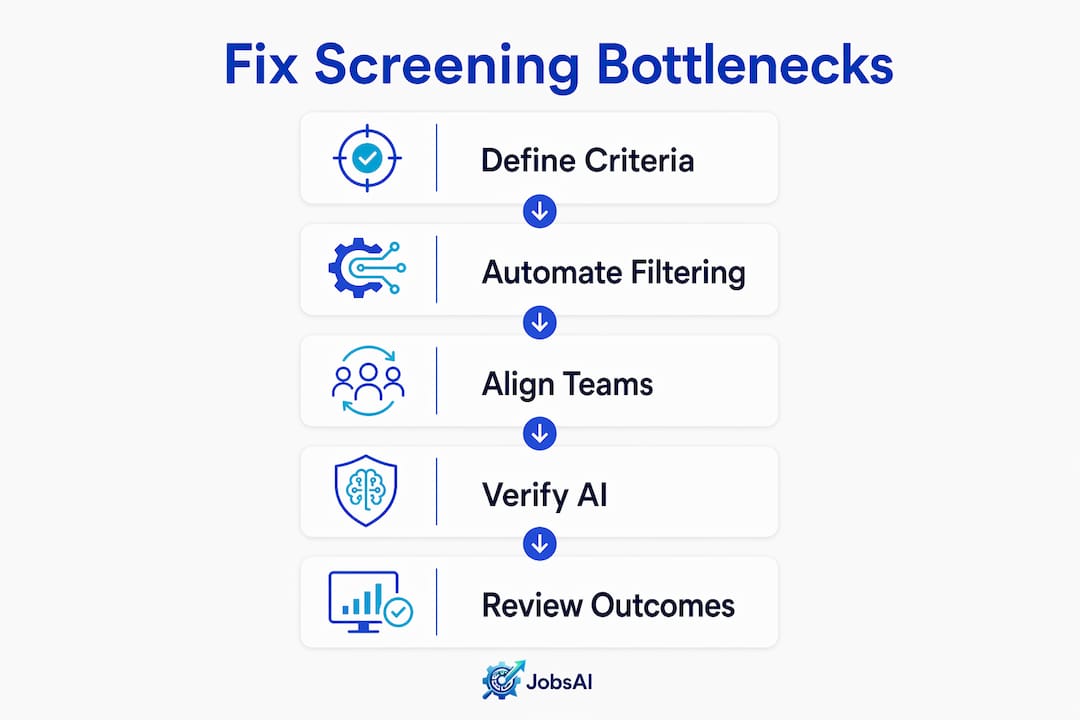
1. Replace hard gates with validated scorecards
Stop using years of experience as a proxy for competence. Build scorecards around the specific skills, behaviors, and outcomes the role requires. Validated, data-driven scorecards improve screening quality over hard gates by evaluating what actually predicts performance. Review your criteria with hiring managers before each search opens, not after the first batch of resumes arrives.
2. Automate first-pass filtering
Automated tools can rank and score applicants against job requirements before a recruiter opens a single resume. Jobsai Enterprise, for example, screens and ranks applicants automatically, matching resumes against validated job criteria. This reduces the manual review burden and keeps evaluation consistent across high-volume pipelines. Recruiters then focus their time on the candidates who already meet the threshold.

3. Align hiring managers and recruiters upfront
Schedule a 30-minute kickoff before every search. Define the must-have criteria, the nice-to-have criteria, and the explicit disqualifiers. Document them. When everyone agrees on the scorecard before screening starts, approval cycles shrink and candidate debates disappear. Communication gaps cause screening delays and extended hiring cycles. Removing those gaps is free.
4. Build structured verification for AI-generated content
Recruiting leaders are moving from static resume reviews to AI-driven, structured verification to maintain quality in 2026’s complex hiring environment. Add a brief skills-based screen or structured async question early in the process. This filters AI-generated applications that pass keyword matching but lack genuine competency signals.
Screening approach comparison
| Approach | Speed | Consistency | Candidate quality |
|---|---|---|---|
| Manual keyword review | Slow | Low | Variable |
| Structured scorecard (manual) | Moderate | Moderate | Higher |
| AI-assisted scoring with scorecard | Fast | High | Highest |
Pro Tip: Build a feedback loop between your screening criteria and hiring outcomes. Every 90 days, review which screened-in candidates performed well and which did not. Adjust your scorecard weights accordingly. Static criteria become outdated fast.
Key takeaways
Screening bottlenecks reduce hiring speed, candidate quality, and business performance simultaneously. Fixing them requires validated criteria, aligned teams, and AI-assisted scoring.
| Point | Details |
|---|---|
| Manual screening is unsustainable | Recruiters spend over 23 hours per hire on manual review, consuming more than half a workweek. |
| Decision fatigue creates inconsistency | Evaluation quality drops after 40 resumes, making automated scoring a necessity for fairness. |
| Delays cost more than time | Vacant roles cost 100–200% of annual salary in lost productivity and overtime expenses. |
| Rigid filters exclude strong candidates | Replace keyword gates with validated scorecards that reflect actual job performance predictors. |
| Alignment prevents bottlenecks | Upfront recruiter-manager alignment on criteria eliminates approval delays and candidate debates. |
Screening bottlenecks are a leadership problem, not just a process one
I have worked with enough recruiting teams to say this clearly: most screening bottlenecks are not caused by lazy recruiters or bad software. They are caused by leadership failing to define what a good hire actually looks like before the search opens.
When hiring managers hand recruiters a vague job description and a wish list of credentials, the screening process becomes a negotiation that never ends. Every candidate is “close but not quite.” Every batch of resumes triggers another conversation about criteria that should have been settled on day one. That is where time disappears.
The teams I have seen fix this problem fastest share one habit. They treat the pre-search alignment meeting as non-negotiable. Thirty minutes of clarity at the start saves weeks of back-and-forth in the middle. Automated tools matter, and they matter a lot. But they work best when the criteria they are scoring against are actually correct.
A fast, fair screening process also does something that is easy to overlook. It signals to candidates that your organization is organized and respectful of their time. That signal affects offer acceptance rates. It affects referrals. It affects the quality of your next pipeline before you have even posted the next role. Screening is not just an internal efficiency problem. It is a public-facing representation of how your organization operates.
— Hippolyte A.
How Jobsai Enterprise addresses screening bottlenecks
Hiring teams that want to move faster without sacrificing quality need a system that handles the volume problem automatically. Jobsai Enterprise is built specifically for that.
Jobsai Enterprise screens and ranks applicants with AI, matching resumes against your validated job criteria before a recruiter opens a single application. It reduces manual review time, keeps scoring consistent across high-volume pipelines, and organizes your entire hiring workflow in one place. Teams using Jobsai Enterprise also get structured candidate follow-up tools that reduce drop-off during screening delays. You can review Jobsai Enterprise pricing to find the plan that fits your team’s volume, or take a product tour to see the screening and ranking features in action.
FAQ
Why do screening bottlenecks hurt hiring outcomes?
Screening bottlenecks slow candidate evaluation, increase drop-off from qualified applicants, and create inconsistent hiring decisions due to decision fatigue. The combined effect is a weaker candidate pool and a longer, more expensive hiring cycle.
How much time does manual resume screening actually take?
Recruiters spend an average of 23 hours manually screening resumes per hire. At 6–8 minutes per resume, a pool of 200 applications consumes more than half a standard workweek before interviews begin.
What is the financial cost of a slow screening process?
Vacant roles cost 100–200% of annual salary in lost productivity and overtime. Understaffed teams also face burnout increases of 30–50%, raising turnover risk and compounding the original hiring cost.
How do you reduce screening bottlenecks without lowering standards?
Replace rigid keyword filters with validated, data-driven scorecards that reflect actual job performance predictors. Pair those scorecards with AI-assisted scoring to maintain consistency at scale without sacrificing evaluation quality.
How does poor candidate experience during screening affect employer brand?
Candidates who experience slow or opaque screening assume rejection and accept competing offers. Negative experiences generate reviews on platforms like Glassdoor that reduce future candidate volume and quality, making each subsequent hiring cycle harder.
Recommended
See it in your workflow
JobsAI Enterprise runs sourcing, AI screening, and the whole interview pipeline in one place. Book a walkthrough tailored to your team.
Book a demo