
Article
US Staffing Industry Benchmarks 2026: Hiring Manager's Guide

US Staffing Industry Benchmarks 2026: Hiring Manager’s Guide
TL;DR:
- US staffing industry benchmarks in 2026 focus on key metrics like time-to-fill, requisitions per recruiter, and profit margins to measure efficiency. Agencies embracing operational maturity practices and AI adoption outperform peers by improving speed, quality, and profitability. Tracking these standards helps staffing firms identify operational gaps and adapt strategies for sustained growth.
US staffing industry benchmarks in 2026 are defined as the measurable performance standards that hiring managers use to evaluate recruitment efficiency, profitability, and workforce quality against industry peers. The most critical metrics include median time-to-fill, net profit margin, requisitions per recruiter, and fill rate. These figures come from sources like SHRM’s annual recruiting benchmarking research and sector-specific staffing reports. Tracking these numbers is not optional for competitive agencies. It is the difference between making informed decisions and managing by instinct.
1. Median time-to-fill has dropped to 39 days
The median time-to-fill for nonexecutive positions has decreased to 39 calendar days as of june 2026. That is a meaningful improvement, but it does not mean hiring is getting easier. Over 2 in 3 organizations still report significant difficulty filling open roles, which means speed alone is not solving the talent gap.

Hiring managers who benchmark against 39 days can identify where their pipeline is losing time. The delay is usually not in the offer stage. It is in sourcing, screening, and the handoff between recruiter and hiring manager.
Pro Tip: Track time-to-fill by job category, not just as a single company-wide number. A 39-day average can mask a 70-day drag in one department that skews your entire hiring operation.
2. Requisitions per recruiter surged 67% for large firms
Extra-large organizations saw a 67% increase in median requisitions per recruiter in 2026. That is a workload shift that directly affects fill rates, candidate quality, and recruiter burnout. When one recruiter manages too many open roles, response times slow and screening quality drops.
This benchmark matters because it tells you whether your team is structurally set up to succeed. If your requisitions per recruiter are climbing past industry norms, adding headcount or AI-assisted screening is not a luxury. It is a capacity fix.
3. Net profit margins run 3%–6% across agency sizes
Net profit margins for staffing agencies typically fall between 3% and 6% as of 2025–2026. That range is narrow, which means operational inefficiency has an outsized impact on profitability. A firm running at 3% margin has almost no buffer for slow fill rates or high accounts receivable days.
Agencies that consistently hit the upper end of this range tend to have tighter cost controls, faster billing cycles, and lower recruiter turnover. Margin compression is most visible in healthcare and light industrial staffing, where bill rates are under pressure.
4. Operational maturity separates growth firms from stagnant ones
Growth-oriented staffing agencies in 2026 share three specific practices: weekly KPI reviews, scorecard ownership assigned to individual team members, and documented standard operating procedures (SOPs). These are not aspirational habits. They are measurable indicators of operational maturity that correlate directly with revenue growth.
Firms without SOPs rely on tribal knowledge. When a top recruiter leaves, their process leaves with them. Documented workflows protect institutional knowledge and make onboarding faster and more consistent.
Pro Tip: Assign scorecard ownership to specific recruiters, not teams. Shared accountability is no accountability. When one person owns a metric, performance gaps surface faster and get resolved faster.
The operational maturity checklist for 2026 looks like this:
- Weekly KPI review meetings with attendance tracked
- Individual scorecards tied to fill rate, time-to-fill, and submission-to-hire ratio
- Documented SOPs for sourcing, screening, and client communication
- Defined escalation paths when a role exceeds the 39-day benchmark
- Monthly margin review by practice area or vertical
5. AI adoption is now a revenue driver, not a differentiator
AI adoption is no longer optional for staffing agencies that want to sustain growth. Agencies using AI-powered sourcing and skills-based hiring tools are closing roles faster and with better candidate-to-role alignment. The firms still relying on manual resume review are falling behind on both speed and quality metrics.
Skills-based hiring, in particular, is changing how fill rates are calculated. When you match candidates on verified competencies rather than job title history, your submission-to-hire ratio improves. That directly affects your cost-per-hire benchmark.
6. Sourcing mix determines fill rate efficiency
The sourcing channels that high-performing agencies rely on in 2026 are referrals, direct sourcing, and internal candidate databases. These three channels consistently outperform job board sourcing on both speed and quality. Referrals convert at higher rates. Direct sourcing reduces time-to-screen. Internal databases eliminate cold outreach entirely for repeat placements.
Agencies that track sourcing channel performance by fill rate and cost-per-hire can reallocate budget away from low-converting channels. Most agencies do not track this at the channel level. That is a missed opportunity to cut cost-per-hire without reducing candidate volume.
7. Healthcare staffing faces a Days Sales Outstanding problem
Healthcare staffing firms are dealing with Days Sales Outstanding (DSO) averaging 42–44 days. That means revenue sits uncollected for over six weeks after a placement is made. For agencies operating on 3%–6% margins, a 44-day DSO creates real cash flow pressure.
Fixing DSO is an operational problem, not a sales problem. Agencies that invest in billing accuracy, faster invoice submission, and client payment term negotiation see DSO drop without losing client relationships.
8. The pre-COVID staffing model is officially obsolete
The staffing industry has permanently shifted away from the pre-COVID operating model. Remote work normalization, demographic aging, and blended workforces are now baseline conditions, not temporary disruptions. Agencies still built around in-person placement workflows are structurally misaligned with how clients hire.
This shift demands higher-level operational efficiency at every stage of the talent acquisition process. Agencies that adapted early are now setting the benchmarks that others are trying to match.
9. Verified company-level data is a competitive requirement
Access to verified, company-level data has become a mandatory strategic edge for winning new business in 2026. Knowing which companies are actively using staffing agencies, at what volume, and in which job categories gives business development teams a targeting advantage that cold outreach cannot replicate.
Agencies without this data are competing on price. Agencies with it are competing on fit, timing, and relationship. That is a fundamentally different and more profitable sales motion.
10. AI and specialization drive revenue in 2026
AI-powered sourcing, skills-based hiring, and healthcare staffing demand are the three primary revenue drivers for staffing agencies in 2026. Agencies that act early on all three are capturing market share from generalist firms that have not yet specialized or invested in technology.
Specialization also improves margin. A niche agency in healthcare IT or light industrial manufacturing can command higher bill rates than a generalist firm competing on volume. Specialization and technology investment are not separate strategies. They reinforce each other.
11. How to apply these benchmarks to your recruitment strategy
Applying US recruitment benchmarks in 2026 starts with knowing your current numbers. You cannot benchmark against 39 days time-to-fill if you do not know your own average. Pull your last 90 days of data by role category before setting any targets.
The table below maps each benchmark to the decision it should drive:
| Benchmark | Current Standard | Decision It Drives |
|---|---|---|
| Median time-to-fill | 39 days (nonexecutive) | Pipeline stage audit to find delays |
| Requisitions per recruiter | 67% increase for large firms | Capacity planning and AI tool investment |
| Net profit margin | 3%–6% | Cost control and billing cycle review |
| Days Sales Outstanding | 42–44 days (healthcare) | Accounts receivable process improvement |
| Operational maturity score | Weekly KPIs, SOPs, scorecards | Management structure and training priorities |
Use this table as a gap analysis tool. Where your numbers fall outside the benchmark range, that is where your operational attention belongs.
Key takeaways
The most effective approach to US staffing benchmarks in 2026 is combining operational maturity practices with AI-assisted recruitment tools to close the gap between current performance and industry standards.
| Point | Details |
|---|---|
| Time-to-fill benchmark | The 39-day median for nonexecutive roles is your baseline for pipeline audits. |
| Recruiter workload | A 67% surge in requisitions per recruiter signals a structural capacity problem. |
| Margin management | Net margins of 3%–6% leave no room for slow billing or high DSO. |
| Operational maturity | Weekly KPIs, SOPs, and scorecard ownership directly correlate with agency growth. |
| AI adoption | AI-powered sourcing and skills-based hiring are now core revenue drivers, not optional upgrades. |
Why I think most agencies are benchmarking the wrong things
Most staffing agencies track time-to-fill and cost-per-hire because those are the easiest numbers to pull. They are not the most useful numbers to act on.
The agencies I see outperforming their peers in 2026 are not obsessing over a single metric. They are building operational systems where every recruiter owns a scorecard, every process has a documented SOP, and every sourcing channel is evaluated on fill rate, not just volume. That is a fundamentally different approach to performance management.
The 67% surge in requisitions per recruiter is the number that concerns me most. That kind of workload increase does not just affect speed. It affects the quality of every interaction a recruiter has with a candidate. When a recruiter is managing too many roles, they stop nurturing relationships and start processing applications. That is when candidate experience deteriorates and your quality-of-hire metric quietly gets worse.
AI adoption is real, but I would caution against treating it as a silver bullet. The agencies getting the most from AI tools are the ones that already had clean data, documented workflows, and clear ownership structures. AI accelerates what is already working. It does not fix a broken process.
The most underrated benchmark in this entire list is Days Sales Outstanding. A 44-day DSO in healthcare staffing is a cash flow crisis in slow motion. Fix your billing infrastructure before you invest in growth.
— Hippolyte A.
Jobsai Enterprise helps you act on these benchmarks
Tracking benchmarks is only useful if your hiring infrastructure can respond to what the data shows. Jobsai Enterprise is an AI-powered talent acquisition platform built for recruiting agencies and hiring teams that need to screen, rank, and manage candidates faster without adding headcount.
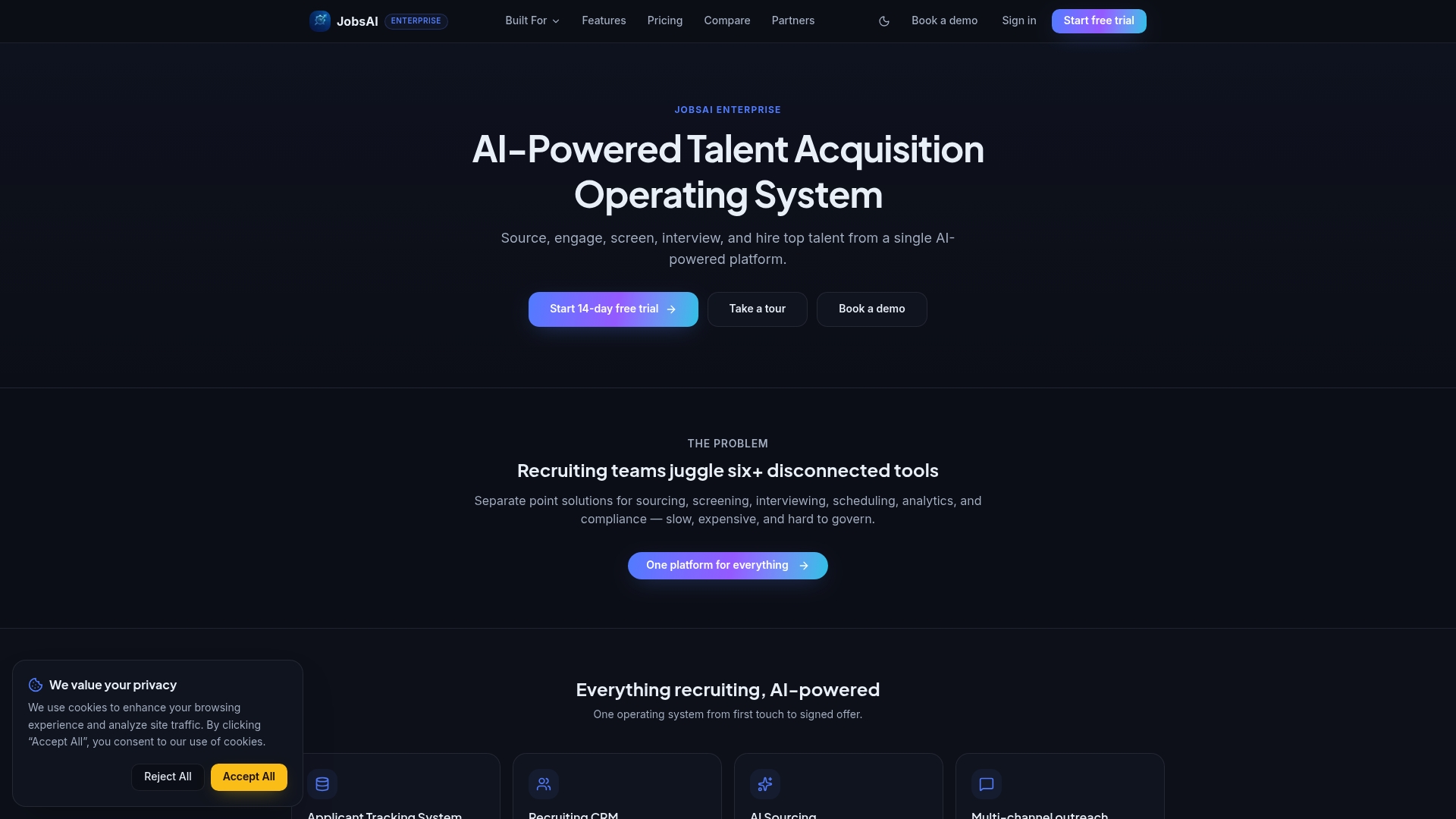
When requisitions per recruiter are climbing and time-to-fill is under pressure, Jobsai Enterprise handles the manual screening load automatically. It matches resumes against job requirements, ranks applicants, and organizes your hiring workflow in one place. You get faster decisions with less manual review. Check platform pricing or take the tour to see how it fits your operation.
FAQ
What is the median time-to-fill for 2026?
The median time-to-fill for nonexecutive positions is 39 calendar days as of june 2026, according to SHRM’s recruiting benchmarking research. Over two-thirds of organizations still report significant difficulty filling roles despite this improvement.
What net profit margin should a staffing agency target?
Staffing agency net profit margins typically range between 3% and 6% in 2025–2026. Agencies at the upper end of that range tend to have tighter billing cycles and lower operational overhead.
How does AI affect staffing performance benchmarks?
AI-powered sourcing and skills-based hiring directly improve submission-to-hire ratios and reduce time-to-fill. Agencies that adopt AI tools alongside documented workflows see the strongest performance gains.
What is Days Sales Outstanding and why does it matter for staffing?
Days Sales Outstanding (DSO) measures how long it takes to collect payment after a placement. Healthcare staffing firms average 42–44 days DSO, which creates cash flow pressure for agencies already operating on thin margins.
What operational practices separate high-growth staffing agencies?
High-growth agencies in 2026 run weekly KPI reviews, assign individual scorecard ownership, and maintain documented SOPs. These three practices are the clearest indicators of operational maturity and correlate directly with revenue growth.
Recommended
See it in your workflow
JobsAI Enterprise runs sourcing, AI screening, and the whole interview pipeline in one place. Book a walkthrough tailored to your team.
Book a demo