
Article
Why Recruiters Miss Qualified Candidates: 2026 Guide

Why Recruiters Miss Qualified Candidates: 2026 Guide
Recruiters miss qualified candidates for reasons that have little to do with talent and everything to do with process. The core culprits are consistent: job intake sessions that skip success criteria, AI screening tools that reward familiarity over ability, time pressure that pushes recruiters toward easy-to-read resumes, and communication gaps that let strong applicants slip through without a decision. Here is a direct breakdown of where things break down:
- Poor job intake: Sourcing starts before the role is clearly defined, so the search targets the wrong profile from day one.
- AI and ATS limitations: Keyword-based filters eliminate candidates whose experience is real but phrased differently.
- Time pressure: Recruiters scan for “evidence of fit” rather than proof of ability, discarding strong but non-obvious candidates fast.
- Communication failures: Delays between recruiters and hiring managers cause qualified applicants to age out or withdraw.
Why recruiters miss qualified candidates: the core process failures
Most hiring errors are not random. They follow predictable patterns that compound across the recruitment cycle.
Poor job intake is usually where it starts. Recruiter Jacco Valkenburg has noted that rushing into candidate searches before clarifying job success criteria is one of the most damaging mistakes in the field. Without a thorough intake session, recruiters source against incomplete or outdated assumptions, which means the entire search is misaligned before a single resume is reviewed.
Outdated job descriptions make it worse. Many postings are recycled from prior years, listing skills that no longer reflect the actual role. The result is a mismatched candidate search that filters out practical talent while attracting applicants who fit the template, not the job.

ATS and AI filters create blind spots. Many Fortune 500 companies use an applicant tracking system, and most recruiters never scroll past the first page of ranked results. A candidate who writes “customer relationship management” instead of “CRM” may rank too low to be seen, despite identical skills. LinkedIn saw a significant rise in applications in a single year, which only amplifies how much qualified talent gets buried in the queue.
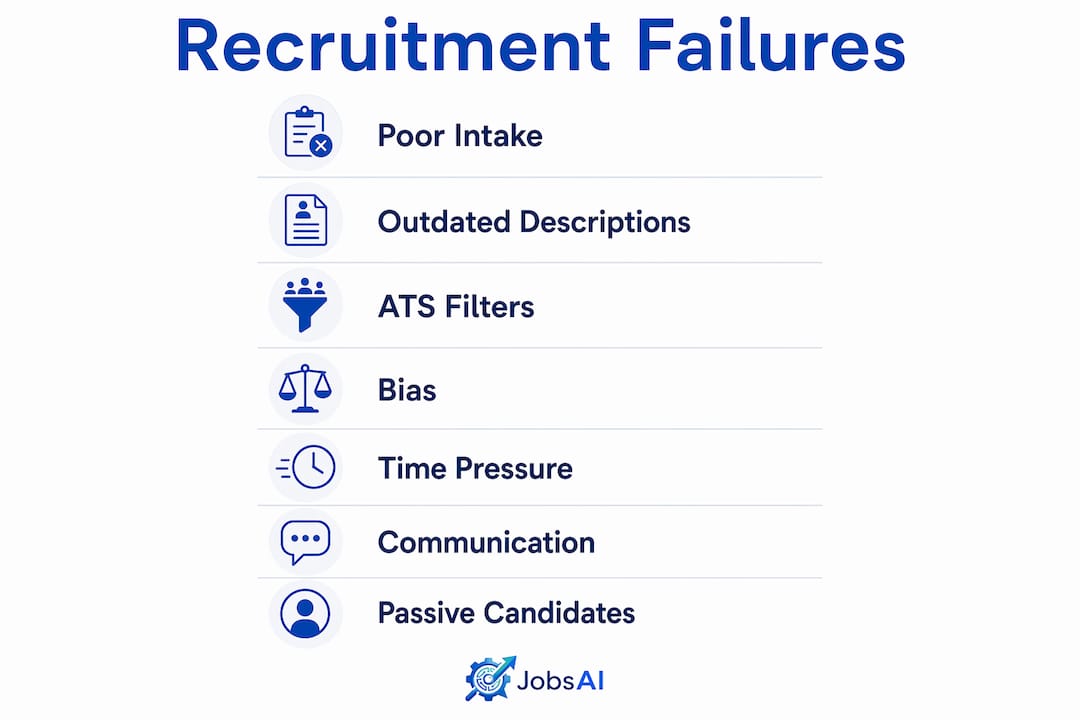
Bias compounds the filtering problem. AI tools perpetuate hiring the same profile types, looping recruiters back to candidates from familiar schools and career paths. Confirmation bias reinforces this: an impressive brand name on a resume earns the benefit of the doubt, while a non-traditional background gets extra scrutiny. Candidates from minority or non-elite backgrounds receive fewer callbacks despite equal qualifications.
Time pressure shifts the evaluation standard. Under a heavy workload, recruiters stop asking “can this person do the job?” and start asking “can I quickly see that they can?” Resumes that require decoding get abandoned. Recruiters prioritize clear, relevant proof of experience to reduce perceived hiring risk, which means strong candidates with non-linear careers often lose to weaker candidates with cleaner-looking profiles.
Communication breakdowns lose candidates late in the process. Poor feedback loops, cancelled interviews, and internal hiring politics prevent qualified candidates from advancing even after strong interviews. A role frozen mid-process or quietly filled internally rarely gets communicated to external candidates, leaving them without closure and the organization without a completed hire.
Passive candidates rarely get reached. Most sourcing strategies target active applicants, which is a fraction of the qualified talent market. Recruiters who rely on inbound applications alone miss the candidates who are not actively looking but would move for the right opportunity.
How Jobsai Enterprise helps you stop losing qualified candidates
Jobsai Enterprise is built to address the specific failure points described above, not just to process applications faster.
- Automated resume parsing and ranking aligned to clearly defined role criteria, so candidates are evaluated against what the job actually requires, not a recycled keyword list.
- Reduced manual workload means recruiters spend less time triaging and more time on the candidates who genuinely fit. The platform surfaces relevant profiles faster, which directly counters the time-pressure problem.
- Organized hiring workflows keep every candidate visible across the pipeline. Nothing ages out silently because a hiring manager did not check their inbox.
- Improved candidate follow-up is built into the platform, reducing the communication gaps that cause qualified applicants to withdraw or accept other offers.
- AI screening that goes beyond keyword matching recognizes varied experience formats, which helps reduce the bias toward candidates from conventional career paths.
Jobsai Enterprise also integrates insights from recruitment professionals to refine how screening and shortlisting work over time. The AI candidate scoring system ranks applicants on criteria that matter for the role, not just on resume formatting or title alignment.
Pro Tip: Before activating any AI screening tool, define your success criteria in writing. The output of any ranking system is only as good as the criteria you feed it. Jobsai Enterprise’s intake workflow prompts you to do this before sourcing begins.
Best practices for capturing every qualified candidate
Fixing the process requires deliberate changes at each stage, not just better tools.
- Start with a structured job intake session. Define what success looks like in the first 90 days before writing the job description or opening the sourcing pipeline. This single step eliminates most downstream misalignment.
- Rewrite job descriptions against actual role needs. Strip out requirements that are not genuinely necessary. A confusing or inflated job description filters out strong candidates and attracts weak ones.
- Balance AI with human review. Use AI to rank and organize, but build in a human checkpoint before any candidate is eliminated. Recruiters should periodically audit AI screening outputs for patterns that suggest bias toward familiar profiles.
- Train interviewers to evaluate ability, not fit signals. Enthusiasm and articulate communication are not proxies for job performance. Structured interview questions tied to measurable outcomes reduce this bias.
- Establish a clear communication rhythm with hiring managers. Set deadlines for resume review, feedback, and decisions. Time-to-hire is usually lost in the gaps between steps, not in the steps themselves.
- Build and maintain a talent pool for passive candidates. Proactive sourcing through targeted outreach and talent pool management reaches qualified candidates who never see your job posting. Effective candidate follow-up practices keep these relationships warm.
- Audit your process regularly. Review placement rates, hiring manager feedback, and candidate dropout points on a quarterly basis. Patterns in where candidates fall out often reveal the specific bottleneck causing missed hires. For teams looking to cut placement time, a structured approach to reducing recruiter placement time is worth reviewing.
Pro Tip: If your sourcing is consistently returning the same candidate profile, that is a signal your criteria or your channels are too narrow, not that the talent pool is limited.
Jobsai Enterprise gives hiring teams a clearer view of qualified talent
Hiring teams that rely on manual processes and basic ATS filtering are working against themselves in a high-volume market. Jobsai Enterprise is built for recruiting agencies and corporate HR teams that need to move faster without sacrificing candidate quality.
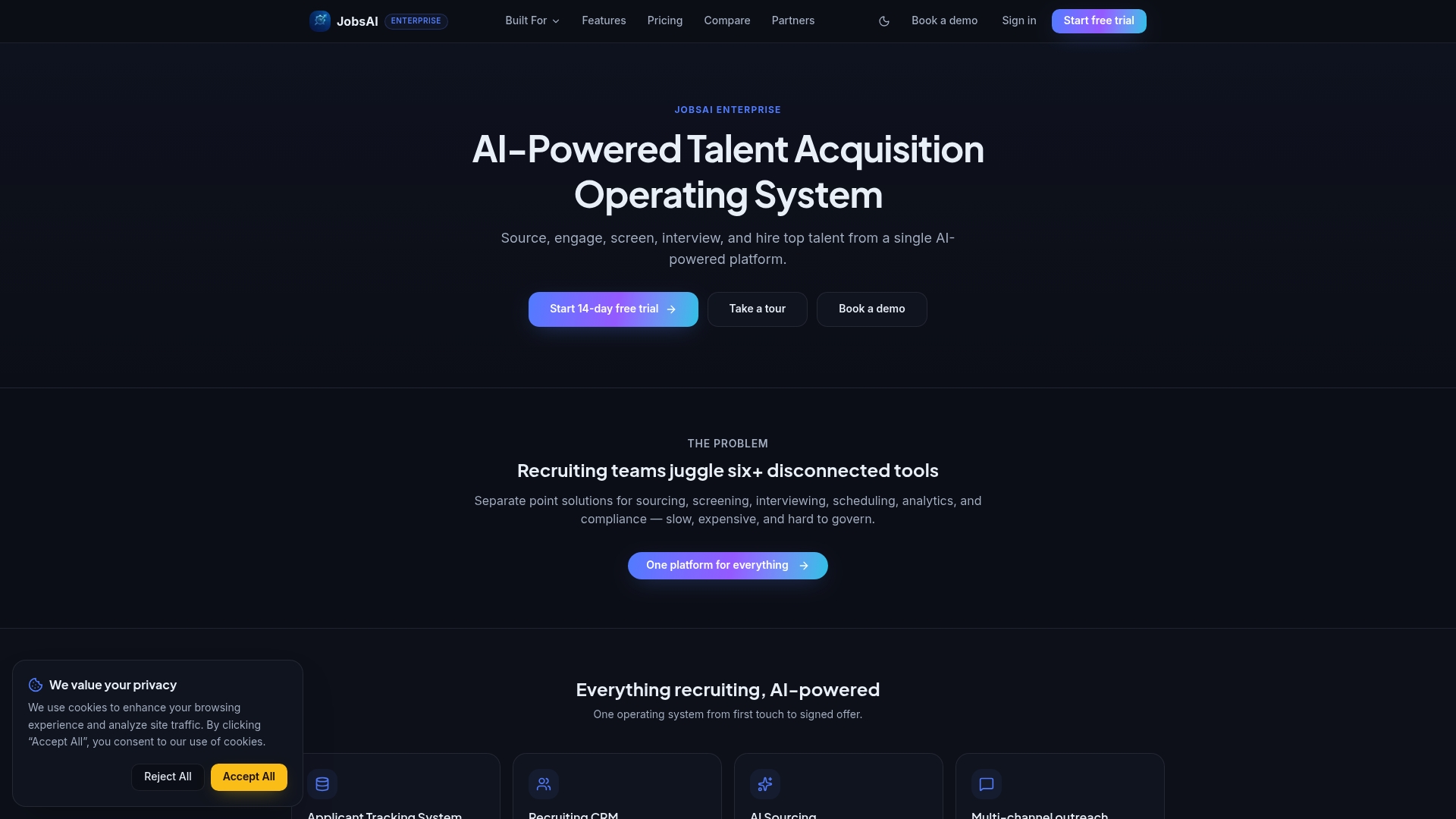
The platform handles AI-powered screening and ranking, workflow organization, and candidate communication in one place, so qualified applicants do not get lost between tools or team members. Real-time data keeps every stakeholder aligned, and automation handles the repetitive work that leads to recruiter fatigue and missed follow-ups. For teams ready to see how it fits their process, take the tour to explore the full feature set.
Key Takeaways
Recruiters most consistently miss qualified candidates when sourcing begins before the role is clearly defined and when AI filters go unchecked by human judgment.
| Point | Details |
|---|---|
| Job intake comes first | Define success criteria before sourcing; skipping this step misaligns the entire search. |
| ATS filters bury real talent | Over 98% of Fortune 500 firms use ATS ranking, and most recruiters never scroll past the first page of results. |
| Bias favors familiar profiles | AI tools perpetuate hiring the same profile types, bypassing candidates with unconventional but capable backgrounds. |
| Communication gaps lose late-stage candidates | Poor feedback loops and internal delays cause qualified applicants to withdraw before a decision is made. |
| Jobsai Enterprise addresses all four failure points | The platform combines AI screening, workflow organization, and candidate follow-up to reduce missed hires across the pipeline. |
FAQ
Why do recruiters overlook qualified candidates so often?
The most common reasons are poor job intake, ATS keyword filtering, unconscious bias toward familiar profiles, and communication breakdowns between recruiters and hiring managers. These factors compound across the hiring cycle, making it easy for strong candidates to fall through without anyone noticing.
How does AI screening cause recruiters to miss qualified candidates?
AI tools trained on historical hiring data tend to favor candidates from conventional career paths and penalize non-standard resume formats. A candidate with identical skills but different terminology can rank too low to be reviewed, even when they are fully qualified for the role.
What is the single most damaging recruiting mistake?
Starting a candidate search without a thorough job intake session. Without clear success criteria defined upfront, every subsequent step, from sourcing to screening to interviewing, is built on a flawed foundation.
How can Jobsai Enterprise help reduce missed qualified candidates?
Jobsai Enterprise automates resume parsing and ranking against defined role criteria, organizes hiring workflows to keep candidates visible, and improves follow-up communication, directly addressing the process failures that cause qualified applicants to be overlooked.
How do you reach qualified candidates who are not actively applying?
Build and maintain a talent pool through proactive outreach, and set up a consistent follow-up cadence to keep passive candidates engaged. Structured sourcing beyond job boards, combined with clear candidate communication, significantly expands the qualified talent you can access.
Recommended
See it in your workflow
JobsAI Enterprise runs sourcing, AI screening, and the whole interview pipeline in one place. Book a walkthrough tailored to your team.
Book a demo