
Article
The Role of Compliance in Recruiting: HR Guide

The Role of Compliance in Recruiting: HR Guide
TL;DR:
- Recruitment compliance involves adhering to laws, regulations, and internal policies throughout the hiring process to mitigate legal risks.
- Building structured, auditable workflows and training ensures consistent practices and helps protect employer brand and candidate trust.
Recruitment compliance is defined as adherence to all relevant employment laws, anti-discrimination regulations, data privacy requirements, and internal policies throughout the hiring lifecycle. The role of compliance in recruiting extends far beyond avoiding lawsuits. It shapes every touchpoint a candidate has with your organization, from the job posting to the offer letter. The U.S. Equal Employment Opportunity Commission receives over 80,000 job discrimination complaints annually. That volume means your hiring records are your first line of defense. Regulatory bodies like the EEOC, the Office of Federal Contract Compliance Programs (OFCCP), and state agencies set the boundaries within which every recruiter must operate.
What are the essential legal requirements recruiters must follow?
Legal compliance in recruitment starts with federal anti-discrimination law. Title VII of the Civil Rights Act, the Americans with Disabilities Act (ADA), and the Age Discrimination in Employment Act (ADEA) collectively prohibit bias based on race, sex, disability, age, and other protected characteristics. These laws apply from the moment you write a job description, not just when you extend an offer.
Background checks add another layer of obligation. The Fair Credit Reporting Act (FCRA) requires a specific sequence: written disclosure, candidate authorization, and a pre-adverse action notice before any negative decision is finalized. FCRA mandates a minimum five-business-day wait after sending that pre-adverse notice before you can reject a candidate. Skipping or shortening that window is one of the most common triggers for class-action litigation against employers.
Employment eligibility verification is non-negotiable. Every new hire requires a completed Form I-9, and recruiters must verify documents without discriminating based on citizenship status or national origin. Errors here carry civil and criminal penalties.
State and local laws add significant complexity. Pay transparency requirements now mandate salary range disclosures in job postings across states including Colorado, California, New York, and Washington. Ban-the-box laws restrict when you can ask about criminal history. Several jurisdictions now regulate the use of AI hiring tools, requiring bias audits before deployment.
Data privacy rounds out the picture. The California Consumer Privacy Act (CCPA) and the EU’s General Data Protection Regulation (GDPR) govern how you collect, store, and delete candidate information. Recruiters must obtain explicit consent before processing personal data and must honor deletion requests, even when EEOC record retention rules require keeping certain files for up to two years.
- Obtain written authorization before running any background check
- Send pre-adverse action notices and wait the required period before rejecting candidates
- Include salary ranges in job postings where state law requires it
- Collect only the candidate data you need and document your legal basis for keeping it
- Verify Form I-9 documents consistently, using the same process for every new hire
Pro Tip: Build a compliance checklist into your applicant tracking system (ATS) so each step, from disclosure to adverse action, is logged automatically. Manual tracking creates gaps that are hard to defend in an audit.
How does compliance improve recruiting operations and reduce risk?
Consistent hiring processes reduce both bias and litigation exposure. When every candidate goes through the same structured interview, scored on the same criteria, you remove the subjectivity that creates legal vulnerability. Unstructured interviews and undocumented hiring decisions represent one of the biggest compliance risks in recruiting. The fix is straightforward: standardized scorecards, pre-set interview questions, and written rationale for every hiring decision.

Documentation is your organization’s memory. If a rejected candidate files a discrimination complaint six months after the fact, your hiring notes, interview scores, and offer records are what determine the outcome. Federal contractors face particularly strict requirements. OFCCP requires detailed applicant flow logs and placement goal records, with audit response deadlines often within 30 days. Organizations that lack this documentation scramble under pressure and frequently settle claims they could have defended.
The consequences of non-compliance go beyond legal fees. Fines, consent decrees, and public settlements damage employer brand in ways that take years to repair. Candidates talk. A poorly handled adverse action or a data breach involving applicant records can surface on employer review sites within days.
Compliance done well actually improves the candidate experience. Transparent communication about background check timelines, clear data consent processes, and consistent follow-up all signal that your organization treats people fairly.
Treating compliance as a quality standard rather than a legal checkbox changes how your entire recruiting team operates. When fairness is built into the process, you attract candidates who value transparency, and you retain hiring managers who trust the system.
- Standardize every interview with pre-written questions and a shared scoring rubric
- Document the rationale for every hire and every rejection before closing the requisition
- Retain hiring records for the legally required period, typically one to two years for most employers
- Audit your job postings quarterly for language that could signal bias or violate pay transparency laws
- Train every recruiter and hiring manager on adverse action procedures before they conduct their first interview
What are best practices for maintaining compliance in recruiting?
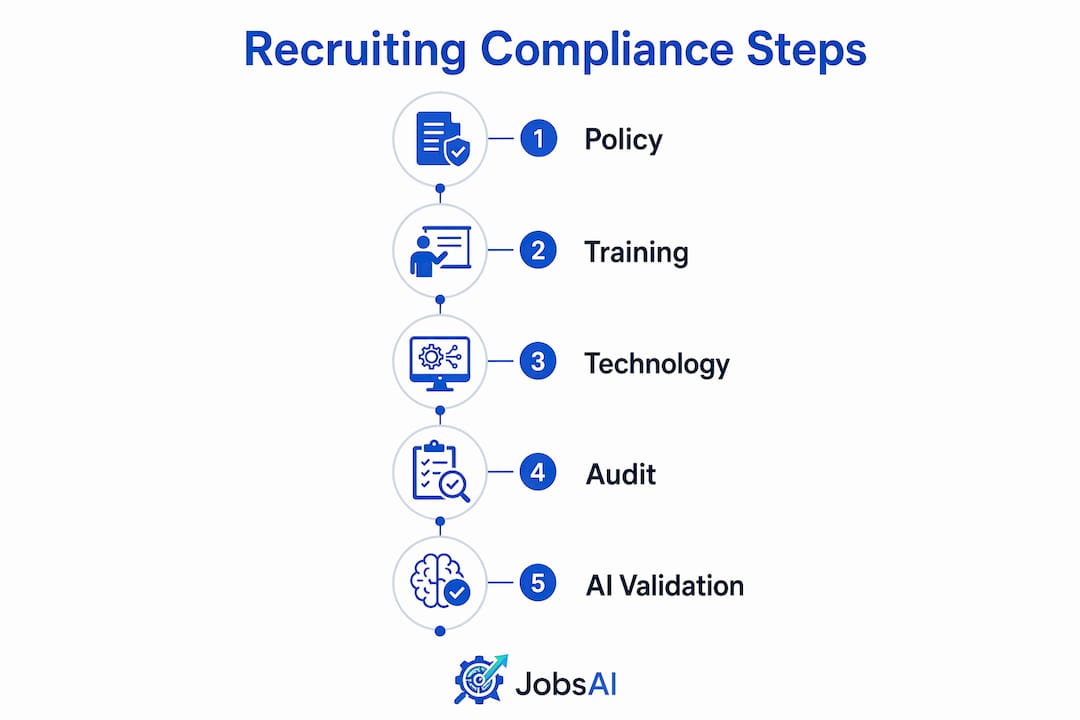
Building a compliant recruiting operation requires policy, training, and the right technology working together. Policy without training produces inconsistency. Training without technology produces manual errors. All three must align.
Develop and enforce written recruitment policies
Every organization needs a written recruitment compliance policy that covers anti-discrimination standards, background check procedures, data handling, and record retention. That policy must be reviewed annually and updated when laws change. Assign ownership to a specific HR role so accountability is clear.
Train recruiters and hiring managers regularly
Compliance training cannot be a one-time onboarding event. Laws change, new jurisdictions add requirements, and hiring managers turn over. Quarterly refreshers on FCRA procedures, structured interviewing, and data privacy keep your team current. Track completion so you can demonstrate due diligence if a complaint arises.
Use technology that supports compliance by design
Your ATS should enforce process steps, not just record them. Workflow automation that requires a completed scorecard before moving a candidate to the next stage prevents the shortcuts that create liability. Jobsai Enterprise builds structured workflows into its platform, so recruiters cannot skip required steps or advance candidates without documented decisions. For teams managing applicant data at scale, centralized data management with role-based access controls also reduces the risk of unauthorized data exposure.
Use AI responsibly and validate for adverse impact
AI screening tools speed up candidate review, but they carry compliance risk if not validated. The EEOC’s 2023 guidelines require validation of AI selection tools when they produce adverse impact against protected groups. Before deploying any automated screening, audit the tool’s outputs across demographic groups and document the results. Jobsai Enterprise’s AI screening features are designed with this obligation in mind, giving teams visibility into how candidates are ranked and why.
Apply specialized standards in healthcare staffing
Healthcare staffing carries additional obligations. Nearly 60% of sentinel events in medical settings are linked to communication or credentialing failures. That statistic makes credentialing a patient safety issue, not just an HR one. Healthcare staffing agencies must also sign Business Associate Agreements and protect PHI under HIPAA with administrative, physical, and technical safeguards. Automated expiry alerts and compliance dashboards help agencies monitor credentials continuously rather than catching lapses after placement.
| Compliance Area | Key Requirement | Recommended Tool or Practice |
|---|---|---|
| Background checks | FCRA pre-adverse action, 5-business-day wait | ATS with built-in adverse action workflow |
| Data privacy | CCPA/GDPR consent and deletion rights | Centralized data platform with access controls |
| AI screening | EEOC adverse impact validation | Audited AI tools with demographic reporting |
| Healthcare credentialing | Primary source verification, HIPAA BAAs | Automated credential monitoring dashboards |
| Record retention | EEOC requires 1–2 years for most records | Structured document storage with retention rules |
Pro Tip: Run a compliance audit of your last 90 days of hiring activity before implementing new technology. Auditing backward reveals the gaps your new system needs to close, not just the ones you already know about.
What are common misconceptions about recruiting compliance to avoid?
Several compliance errors are widespread precisely because they feel like minor shortcuts in the moment.
- Compliance starts at the offer stage. Recruiters often treat compliance as a post-offer checklist. Legal obligations begin at the job posting. Biased language in a job ad, an unlawful screening question on an application, or a missing salary range can all trigger complaints before a single interview occurs.
- FCRA is just a disclosure form. Many recruiters obtain the required disclosure but then skip the pre-adverse action wait period. FCRA litigation frequently targets this specific gap. The five-business-day minimum is not a suggestion.
- Data privacy only applies after hiring. Candidate data collected during sourcing, screening, and interviewing is subject to CCPA and GDPR from the moment of collection. Recruiters must have a documented legal basis for processing that data and a process for honoring deletion requests. Balancing deletion requests against EEOC retention mandates requires a written policy, not ad hoc decisions.
- AI tools are neutral by default. Automated screening tools inherit the biases present in their training data. Without validation, they can produce adverse impact against protected groups without any human ever making a biased decision. Treating AI as inherently fair is a compliance risk.
- Credentialing is a one-time check. In healthcare staffing, licenses expire, sanctions get issued, and exclusion lists get updated. Treating credentialing as a hire-time event rather than an ongoing obligation puts patients and agencies at risk.
Pro Tip: Map your full recruiting funnel from sourcing to onboarding and identify every point where candidate data is collected or a decision is made. Each of those points is a potential compliance exposure.
Key Takeaways
Recruitment compliance is a continuous operational discipline that protects organizations legally, builds candidate trust, and produces more consistent hiring outcomes across every stage of the process.
| Point | Details |
|---|---|
| Compliance starts at the job posting | Legal obligations under Title VII, ADA, and pay transparency laws apply before any candidate applies. |
| FCRA sequencing is non-negotiable | The five-business-day pre-adverse action wait is a legal requirement, not a best practice. |
| Documentation is your defense | Structured scorecards and retained hiring records protect against discrimination claims and OFCCP audits. |
| AI tools require validation | EEOC guidelines require adverse impact testing for any automated selection tool before deployment. |
| Healthcare staffing demands ongoing credentialing | Credential monitoring must be continuous, not a one-time verification at the point of hire. |
Compliance as a competitive advantage, not just a constraint
I’ve spent enough time working alongside recruiting teams to know that compliance is almost always framed as the thing that slows hiring down. That framing is wrong, and it costs organizations more than they realize.
The teams I’ve seen operate most effectively treat compliance as a design constraint, the same way an engineer treats load-bearing requirements. You build the process around it from the start, and the result is a hiring operation that is faster, more defensible, and more consistent than one where compliance is bolted on at the end.
The most underrated benefit of structured compliance is what it does for candidate trust. When candidates receive clear disclosures, timely communication about background check timelines, and honest feedback, they form a positive impression of your organization even when they don’t get the job. That impression affects your employer brand in ways that no job board ad can fix.
The AI dimension is where I think most organizations are currently behind. The EEOC’s adverse impact validation requirement for AI tools is not widely understood at the recruiter level. Teams are deploying automated screening without auditing outputs, and they will face consequences as enforcement catches up. Investing in AI hiring bias awareness now is far cheaper than defending a class-action claim later.
Compliance also scales. A team of five recruiters can manage compliance through manual checklists. A team of fifty cannot. The organizations that build compliance into their technology and workflows early are the ones that can grow without their legal exposure growing proportionally.
— Hippolyte A.
How Jobsai Enterprise supports compliant talent acquisition
Compliance failures in recruiting often trace back to process gaps, not bad intentions. Jobsai Enterprise is built for talent acquisition teams that need structured, auditable hiring workflows without adding administrative overhead.
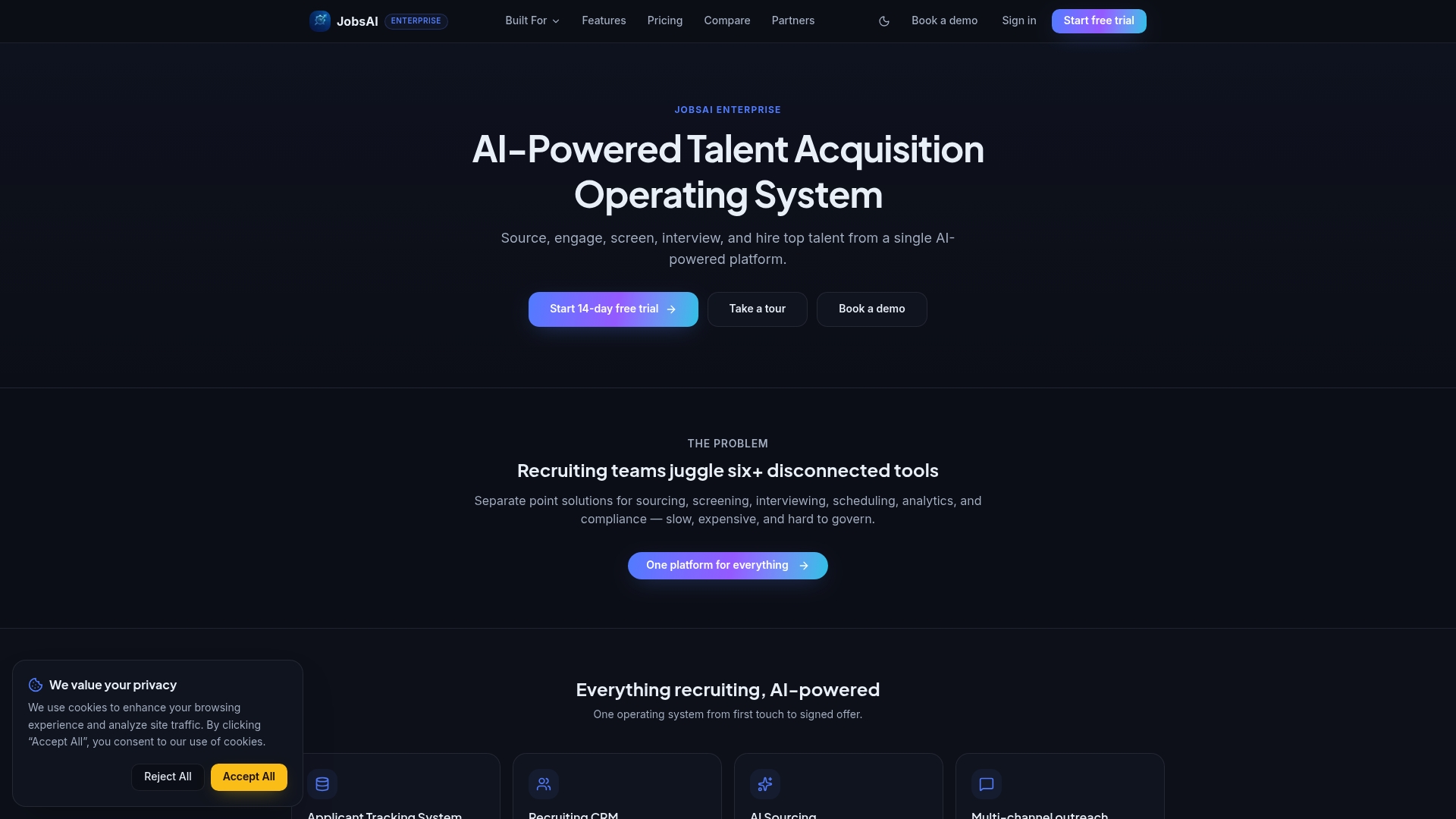
The platform enforces process steps at each stage, so recruiters document decisions before advancing candidates. Consent management, role-based data access, and structured candidate tracking reduce the manual work that creates compliance gaps. Jobsai Enterprise’s workflow automation keeps every requisition on a documented path from posting to offer, giving HR teams the audit trail they need when questions arise. For teams ready to see it in action, the platform tour walks through how these features work together in a live recruiting environment.
FAQ
What is recruitment compliance?
Recruitment compliance is the practice of following all applicable employment laws, anti-discrimination regulations, data privacy requirements, and internal policies throughout the hiring process. It applies from job posting through offer acceptance and record retention.
What laws govern compliance in hiring?
The primary federal laws include Title VII, the ADA, the ADEA, and the FCRA. State laws add requirements around pay transparency, ban-the-box, and AI tool auditing, which vary significantly by jurisdiction.
How does the FCRA affect background checks in recruiting?
The FCRA requires written disclosure and candidate authorization before running a background check. If the result may lead to rejection, recruiters must send a pre-adverse action notice and wait at least five business days before making a final decision.
What is the role of compliance in healthcare staffing?
Healthcare staffing compliance includes HIPAA data protection, Business Associate Agreements, and continuous credential monitoring. Nearly 60% of sentinel events in medical settings are linked to credentialing failures, making ongoing verification a patient safety requirement.
How do AI hiring tools create compliance risk?
AI screening tools can produce adverse impact against protected groups if not validated before deployment. EEOC guidelines require employers to test and document the demographic outcomes of any automated selection procedure used in hiring.
Recommended
See it in your workflow
JobsAI Enterprise runs sourcing, AI screening, and the whole interview pipeline in one place. Book a walkthrough tailored to your team.
Book a demo