
Article
How Onboarding Compliance Differs Across Roles and Regions

How Onboarding Compliance Differs Across Roles and Regions
TL;DR:
- Onboarding compliance involves meeting specific legal and regulatory requirements for new workers, which vary by jurisdiction and worker type. It requires distinct documentation, training, and records for employees and contractors to avoid legal risks and misclassification. Systems that configure process variants by location and role improve audit readiness and help organizations stay compliant across multiple regions.
Onboarding compliance is defined as the process of meeting all legal and regulatory requirements when integrating new workers into an organization. How onboarding compliance differs is not a minor administrative detail. It is a material risk factor. The rules change based on where your worker is located, whether they are an employee or a contractor, what role they hold, and which phase of onboarding they are in. Frameworks like Form I-9, GDPR employee privacy notices, and EU NIS2 cybersecurity training each impose distinct obligations. Getting any one of them wrong exposes your organization to audits, fines, and legal liability.
How onboarding compliance differs between employees and contractors
Employee onboarding compliance and contractor onboarding compliance are governed by entirely different legal frameworks. Treating them as variations of the same process is one of the most common and costly mistakes HR teams make.

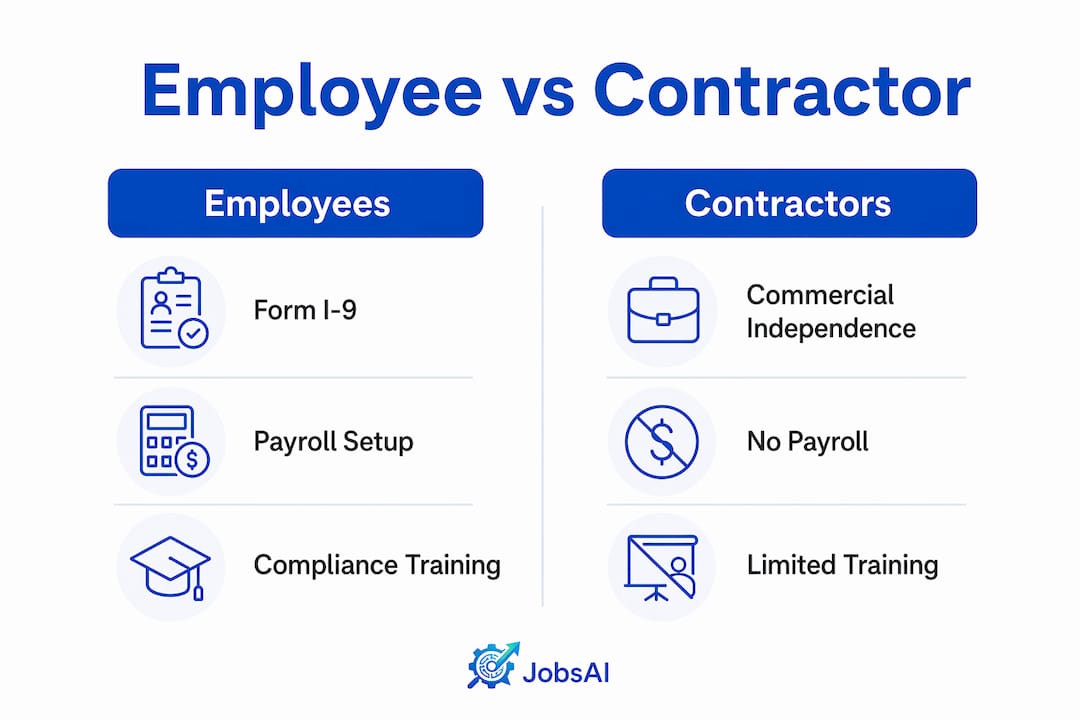
For employees, Form I-9 Section 1 must be completed by the employee on or before their first day. The employer must complete Section 2 within three business days. Tax withholding forms, benefits enrollment paperwork, and state-specific documentation follow immediately. The entire process is built around the assumption of an ongoing employment relationship with supervision, benefits, and payroll obligations.
Contractor onboarding works differently by design. Regulators assess real working relationships through onboarding practices, not just written contracts. If you require a contractor to attend mandatory orientation sessions, follow internal supervision protocols, or use company-issued equipment under close direction, you are creating evidence of an employment relationship. That evidence can trigger misclassification liability regardless of what the contract says.
The documentation differences reflect this legal separation:
- Employees: Form I-9, W-4, state tax withholding forms, benefits enrollment, employee handbook acknowledgment, and direct deposit setup
- Contractors: Independent contractor agreement, W-9 (for U.S. tax reporting), scope of work documentation, invoicing terms, and insurance certificates
- Key distinction: Employees are onboarded into a role with defined supervision. Contractors are onboarded into a project with defined deliverables and outcomes.
Pro Tip: Never include contractors in employee-facing compliance training sessions without first reviewing whether that inclusion creates a supervision or control dynamic. Shared training environments can be used as evidence of employment status in misclassification disputes.
The operational difference matters just as much as the paperwork. Employee onboarding compliance covers payroll registration, benefits eligibility, and workplace rights disclosures. Contractor onboarding compliance focuses on preserving commercial independence. Both require documentation, but the purpose and legal weight of each document are fundamentally different.
How do onboarding compliance requirements vary by jurisdiction?
Geographic location is the single biggest driver of onboarding process variations. A company hiring in California, New York, Texas, and Florida faces four different state-level compliance requirements on top of federal obligations.
U.S. states differ in new hire paperwork in ways that directly affect payroll setup. California requires the DE-4 state withholding form. New York requires the IT-2104. Texas and Florida have no state income tax, so no state withholding form is required at all. Employers with workers in multiple states must maintain the correct form for each work location, not the company’s headquarters location.
The variation is even more pronounced when you cross international borders. The table below shows how key compliance requirements differ across three major jurisdictions:
| Compliance area | United States | European Union | United Kingdom |
|---|---|---|---|
| Work authorization | Form I-9 (Day 1 / Day 3) | Varies by member state | Right to Work check (before start) |
| Tax withholding form | W-4 (federal) + state form | Local tax registration | Starter checklist (HMRC) |
| Data privacy notice | Not federally mandated | GDPR Article 13 notice required at onboarding | UK GDPR notice required at onboarding |
| Cybersecurity training | Sector-specific (HIPAA, FINRA) | NIS2 mandatory for management roles | NCSC guidance, sector-specific rules |
Global HR onboarding requires jurisdiction-specific configuration rather than a single global template. A one-size-fits-all checklist creates compliance gaps the moment you hire outside your home jurisdiction. The practical solution is configurable process variants that adjust forms and steps by region. SAP SuccessFactors, for example, uses a Process Variant Manager specifically to handle jurisdictional onboarding differences without maintaining disconnected checklists for each country.
Audit trail requirements also vary by jurisdiction. Some regions require signed acknowledgment of specific documents. Others require timestamped digital records. Building a documented, retrievable audit trail from day one is the safest approach regardless of local minimums.
Orientation vs. onboarding vs. compliance onboarding: what is the difference?
These three terms are often used interchangeably. They describe distinct processes with different timelines, purposes, and compliance implications.
Orientation is a short introduction to the organization, typically lasting one to three days. It covers logistics: office access, system credentials, team introductions, and basic policy overviews. Orientation is not a compliance program. It is a starting point.
Employee onboarding programs are multi-phased and span 90–365 days, involving ongoing compliance training and documentation throughout. That timeline matters because compliance obligations do not end after the first week. Many organizations make the mistake of treating orientation completion as onboarding completion. That gap leaves compliance documentation incomplete and audit readiness at risk.
Compliance-focused onboarding has a specific structure:
- Pre-start documentation: Offer letter, background check consent, Form I-9 Section 1, and privacy notices delivered before or on Day 1.
- First-week compliance: I-9 Section 2 verification, tax forms, benefits enrollment, and mandatory policy acknowledgments.
- First-month training: Role-specific compliance modules, data handling training, and anti-harassment programs with documented completion.
- 30–90 day checkpoints: Confirmation that all required training is complete, access permissions are aligned with role, and records are retrievable.
- Ongoing compliance: Annual recertification, updated policy acknowledgments, and role-change triggered training reviews.
Pro Tip: Use compliance gating to control system access. Restrict access to sensitive platforms or data until the employee has completed and acknowledged the required training for their role. This creates a natural audit trail and reduces exposure.
Compliance documentation must cover the entire onboarding timeline to achieve audit readiness. A single orientation sign-in sheet does not satisfy regulators who want to see what was trained, when it was trained, and who acknowledged it.
How do data privacy and cybersecurity rules shape onboarding compliance?
Data privacy and cybersecurity regulations create role-based and jurisdiction-based compliance training differences that go well beyond standard HR paperwork.
Under GDPR, HR must deliver an employee privacy notice at the point of onboarding or contract issue. The notice must explain what personal data is collected, why it is processed, how long it is retained, and what rights the employee holds. Delaying this notice, even by a few days, creates a documented gap in GDPR Article 13 compliance. The acknowledgment must be retrievable. A verbal explanation does not satisfy the requirement.
The EU NIS2 Directive adds another layer for organizations in scope. The compliance training differences between management and general staff are significant:
| Role category | NIS2 training requirement | System access condition |
|---|---|---|
| Senior management | Mandatory cybersecurity training | Access conditioned on documented completion |
| IT and security staff | Mandatory role-specific security training | Access conditioned on documented completion |
| General staff | Encouraged but not mandated | Access not formally conditioned |
| Contractors with system access | Treated as equivalent to staff | Access conditioned on security acknowledgment |
Access to systems is conditioned on documented completion of required security training for management and IT roles under NIS2. This is compliance gating in practice. The organization cannot simply grant system credentials and schedule training for later. The training must precede access for covered roles.
Audit readiness demands detailed training records that specify covered content, dates, and employee acknowledgment. A generic “completed” status in an LMS is not sufficient. Regulators expect to see exactly which modules were covered, when, and by whom. Organizations that rely on vague completion records face significant exposure during audits, even if the training itself was adequate.
Key Takeaways
Onboarding compliance varies by jurisdiction, worker type, role, and phase, and each dimension requires distinct documentation, training, and audit records to manage risk effectively.
| Point | Details |
|---|---|
| Employee vs. contractor compliance | Contractor onboarding must preserve commercial independence; employee-style processes create misclassification risk. |
| Jurisdiction drives documentation | U.S. states, EU member states, and the UK each require different forms, notices, and acknowledgment timing. |
| Orientation is not onboarding | Compliance documentation must span 90–365 days, not just the first week or orientation event. |
| Role-based training requirements | NIS2 mandates cybersecurity training for management before system access; general staff requirements differ. |
| Audit records must be specific | Retrievable records must detail exact modules, dates, and acknowledgments, not just a completion status. |
What I have learned about managing onboarding compliance variations
After working with HR and compliance teams across multiple jurisdictions, the pattern I see most often is this: organizations build one onboarding checklist and then try to stretch it across every worker type and location. It never works cleanly. The checklist either becomes so long it overwhelms new hires, or it misses critical jurisdiction-specific steps entirely.
The organizations that handle this well treat onboarding compliance as a configuration problem, not a documentation problem. They build process variants by worker type and region, then assign the right variant at the point of hire. That approach is far more defensible in an audit than a single master checklist with handwritten notes about which steps apply where.
The other mistake I see regularly is conflating audit readiness with behavior change. Compliance training must foster real behavior change through scenario-based learning, not just checkbox completion. A signed acknowledgment proves the employee received information. It does not prove they understood it or will apply it. The organizations that invest in scenario-based training see fewer compliance incidents, which is ultimately what regulators care about.
The future of onboarding compliance management is clearly moving toward configurable, traceable systems that generate audit-ready records automatically. HR teams that still rely on spreadsheets and email confirmations are one audit away from a painful lesson. The investment in structured, documented processes pays for itself the first time a regulator asks for proof.
— Hippolyte A.
How Jobsai Enterprise supports compliant onboarding workflows
Managing onboarding compliance across multiple jurisdictions and worker types requires more than a checklist. It requires a system that tracks documentation, enforces process steps, and keeps records retrievable.
Jobsai Enterprise is built for hiring teams and recruiting agencies that need structured, auditable workflows from the moment a candidate is hired. The platform organizes candidate and new hire documentation in one place, supports distinct workflows for employees and contractors, and reduces the manual work that creates compliance gaps. HR teams managing multi-jurisdictional hiring can configure process steps by location and role type without maintaining separate systems. Visit the Jobsai Enterprise pricing page to see which plan fits your team’s compliance and hiring workflow needs, or take the tour to see the platform in action.
FAQ
What is employee onboarding compliance?
Employee onboarding compliance is the process of completing all legally required documentation, training, and acknowledgments when integrating a new employee. Requirements vary by jurisdiction and include forms like Form I-9, tax withholding documents, and privacy notices.
How does contractor onboarding differ from employee onboarding?
Contractor onboarding must preserve commercial independence and avoid supervision or control dynamics that signal an employment relationship. Regulators assess actual working practices, not just written contracts, when determining worker classification.
Which U.S. states require different tax withholding forms at onboarding?
California requires the DE-4 and New York requires the IT-2104, while Texas and Florida have no state income tax forms. Employers must use the form for the state where the employee works, not where the company is headquartered.
When must a GDPR employee privacy notice be delivered?
The GDPR Article 13 privacy notice must be delivered at the point of onboarding or contract issue. Delaying delivery creates a documented compliance gap, and acknowledgment must be retrievable for audit purposes.
What is compliance gating in onboarding?
Compliance gating restricts access to systems or data until an employee has completed and acknowledged required role-specific training. Under NIS2, management and IT staff must complete cybersecurity training before receiving system access.
Recommended
See it in your workflow
JobsAI Enterprise runs sourcing, AI screening, and the whole interview pipeline in one place. Book a walkthrough tailored to your team.
Book a demo