
Article
How AI Hiring Bias Works: A Guide for Recruiters

How AI Hiring Bias Works: A Guide for Recruiters
TL;DR:
- AI hiring bias results from algorithms learning and amplifying historical human prejudices based on flawed data. Recognizing and addressing bias require structured monitoring, multi-metric fairness analysis, and human oversight throughout the hiring process.
AI hiring bias is defined as the process by which recruiting algorithms replicate and amplify existing human prejudices by learning from historical data that reflects past unfair decisions. Understanding how AI hiring bias works is not optional for recruiters and hiring managers. It is a compliance and fairness obligation. A Stanford-led 2026 study found that 26% of Black applicants and 15% of Asian applicants were exposed to AI hiring discrimination that triggered scrutiny under the Equal Employment Opportunity Commission’s four-fifths rule. That finding means your AI screening tool may already be producing outcomes that violate federal employment standards, even if no one on your team intended it.
How AI hiring bias works: learning from flawed data
AI hiring systems learn bias the same way they learn everything else: from the data you feed them. When that data reflects decades of human decisions shaped by racial, gender, or socioeconomic bias, the model treats those patterns as correct signals. The algorithm does not know the difference between a legitimate qualification and a proxy for demographic background.

The most dangerous bias does not come from explicit demographic fields. It comes from indirect proxy features like zip codes, university names, hobbies, or even behavioral gameplay data used in pre-employment assessments. These features correlate with race, class, and gender without naming them directly. A model trained on historical hires from a company that historically favored Ivy League graduates will penalize candidates from state schools, not because the algorithm is programmed to discriminate, but because it learned that pattern as a success signal.
Feature selection compounds this problem. When engineers build a hiring model, they choose which data points to include. Each choice carries assumptions. A feature like “years of uninterrupted employment” disadvantages candidates who took caregiving breaks. A feature like “extracurricular leadership” favors candidates from well-funded schools. The bias is embedded before the model ever runs a single prediction.
Pro Tip: Audit every feature in your AI hiring model and ask one question: does this variable correlate with a protected class? If the answer is yes or maybe, flag it for review before training.
The Stanford Digital Economy Lab also identified what researchers call the averaging effect. When hiring recommendations are averaged across many job openings, localized discrimination at the position level disappears into the aggregate numbers. A demographic group might be over-selected for administrative roles and under-selected for technical roles. The overall numbers look balanced. The discrimination is real and invisible.
What does the data say about AI bias in recruitment?
The empirical record on AI bias in recruitment is clear and concerning. The 2026 Stanford study is the most cited recent example, but the pattern it describes is not new.
“Candidates applying to several companies using the same biased algorithms risk systemic rejection, showcasing the cumulative impact of algorithmic monoculture in hiring.”
That systemic rejection is measurable. 10% of job seekers who applied to four or more companies using the same underlying AI were rejected by all of them. That figure illustrates what researchers call algorithmic monoculture: when many employers use similar AI models, a candidate rejected by one is effectively rejected by all. The market closes around them.
Intersectional bias compounds the problem further. A Black woman applying for a senior engineering role faces a different algorithmic outcome than a white woman applying for the same role, or a Black man applying for a different role. Standard fairness metrics often miss this because they measure one demographic dimension at a time. Multi-task adversarial learning frameworks that use nine intersectional metrics across group, individual, and causal fairness dimensions increased bias detection accuracy by 12–18 percentage points compared to single-metric approaches. That improvement is significant. It means standard audits miss a substantial share of real discrimination.
| Demographic group | Discrimination exposure rate | Regulatory threshold triggered |
|---|---|---|
| Black applicants | 26% | EEOC four-fifths rule |
| Asian applicants | 15% | EEOC four-fifths rule |
| Multi-company applicants | 10% rejected by all | Algorithmic monoculture effect |
The table above reflects findings from the 2026 Stanford study. Each percentage represents real candidates filtered out by systems their employers believed were neutral.
Advanced techniques for detecting and mitigating AI bias
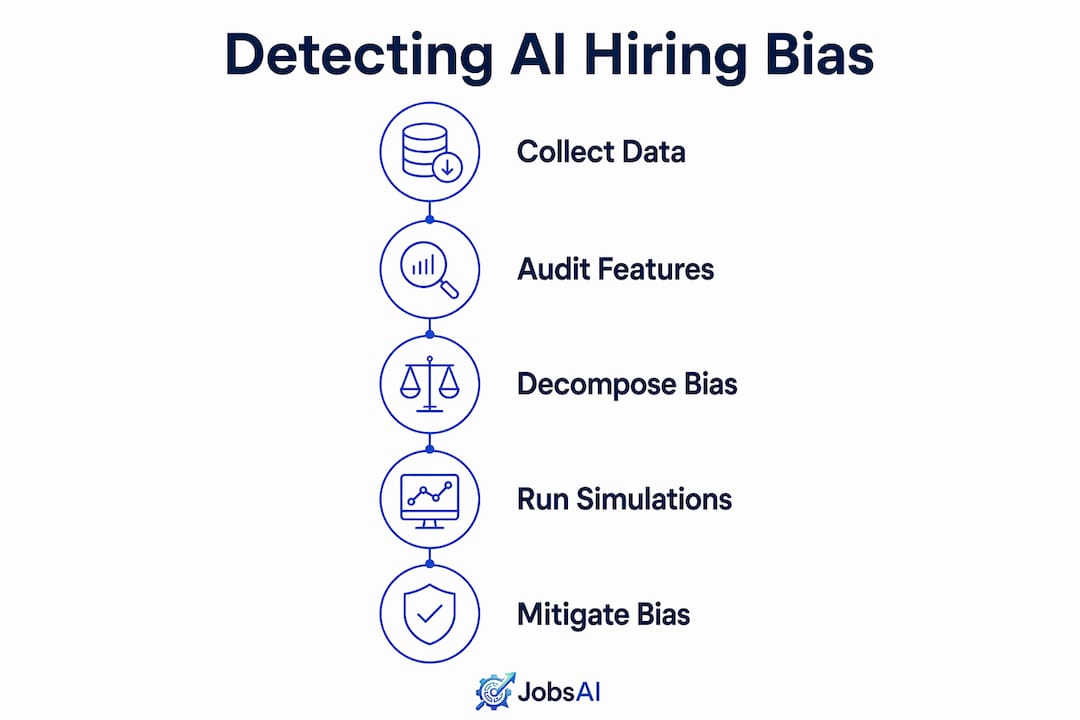
Detection comes before mitigation. Recruiters and hiring managers cannot fix what they cannot see, and most AI hiring tools do not surface bias by default.
Bias decomposition is one of the most effective detection methods available. A bias decomposition module mathematically separates the biased components in candidate feature data before the model trains on it. It identifies which features carry correlations with sensitive attributes and removes or adjusts those correlations. The result is a cleaner training dataset that produces fairer predictions without requiring the model to be rebuilt from scratch.
Longitudinal simulation frameworks take a different approach. Instead of fixing the data before training, they test the model’s outputs over time across demographic groups and job categories. These frameworks track whether fairness metrics hold up as the candidate pool changes. Research shows that multi-layered mitigation frameworks improved demographic parity by 32.4%, equal opportunity by 28.7%, and equalized odds by 25.9%, while maintaining predictive accuracy with only a 0.024 delta. That is a meaningful gain in fairness at almost no cost to performance.
Adversarial learning architectures add another layer. These systems train a secondary model to detect demographic patterns in the primary model’s outputs. When the secondary model can predict a candidate’s demographic group from the primary model’s scores, that is evidence of bias. Attention mechanisms within these architectures allow fine-grained bias localization, meaning researchers can identify exactly which features and which job categories are driving discriminatory outcomes.
Pro Tip: Do not rely on a single fairness metric. Use Pareto frontier analysis to map trade-offs between group fairness, individual fairness, and causal fairness. Each metric catches different types of discrimination.
The trade-offs between fairness types matter. Group fairness asks whether demographic groups receive equal outcomes on average. Individual fairness asks whether similar candidates receive similar scores regardless of group membership. Causal fairness asks whether the model’s decisions would change if a candidate’s demographic background were different. No single metric captures all three. Effective bias mitigation requires all three lenses working together.
How recruiters can recognize and prevent AI hiring bias
Recognizing bias in your AI tools requires structured monitoring, not one-time audits. Here is a practical framework for hiring managers and recruiters to apply.
-
Monitor recommendation rates by demographic group and by job category separately. Do not rely on aggregate pass rates. The averaging effect hides position-level discrimination in overall numbers. Break your data down by role, department, and seniority level.
-
Track rejection patterns across multiple application cycles. If a demographic group shows consistently lower pass rates across multiple roles over multiple months, that is a signal worth investigating. One data point is noise. A pattern is evidence.
-
Require your AI vendor to document which features the model uses. Ask specifically whether any features correlate with race, gender, age, or national origin. If the vendor cannot answer that question, that is itself a red flag.
-
Add structured interviews as a check on AI screening. Structured interviews use the same questions for every candidate and score answers against defined criteria. They reduce the influence of subjective impressions and provide a human layer of review that can catch cases where the AI screen was wrong.
-
Use multi-layered mitigation, not single fixes. Removing one biased feature is not enough. Bias re-enters through correlated features. A full mitigation approach addresses data quality, feature selection, model training, and output monitoring simultaneously.
Jobsai Enterprise supports this kind of layered approach by giving hiring teams visibility into how candidates are ranked and why. The platform’s hiring guide covers how to build structured workflows that keep human judgment in the loop without slowing down the screening process. Transparency at the ranking stage is where most AI tools fall short, and it is where the risk of undetected bias is highest.
Key Takeaways
AI hiring bias is a systemic, data-driven problem that requires structured detection, multi-metric fairness analysis, and human oversight to address effectively.
| Point | Details |
|---|---|
| Bias originates in training data | AI models learn from historical decisions that reflect past human prejudices, not neutral facts. |
| Proxy features carry hidden risk | Variables like zip codes and school names correlate with demographics and produce indirect discrimination. |
| Aggregate metrics hide position-level bias | The averaging effect masks discrimination at the job level; always analyze fairness by role, not overall. |
| Multi-layered mitigation outperforms single fixes | Frameworks combining data diagnostics, adversarial learning, and longitudinal testing achieve the strongest fairness gains. |
| Human oversight remains non-negotiable | Structured interviews and manual review catch cases where AI screening produces unfair outcomes. |
What I’ve learned about AI bias that most articles get wrong
Most articles on AI hiring bias focus on the obvious cases: a model trained entirely on male resumes that penalizes women, or a system that explicitly uses race as a variable. Those cases are real, but they are largely solved problems. The harder challenge is the subtle, second-order bias that emerges from seemingly neutral features.
I have spent years watching hiring teams adopt AI tools with genuine good intentions and then express genuine surprise when bias audits surface problems. The surprise is understandable. The features that cause the most damage look completely reasonable in isolation. “Time in current role” sounds like a stability indicator. “Participation in professional associations” sounds like a commitment signal. Neither sounds like a demographic proxy. Both can function as one.
The other thing most articles miss is the monoculture risk. When the entire market converges on similar AI models, a candidate who fails one system’s screen effectively fails all of them. That is a structural problem, not a vendor problem. It requires industry-level thinking about model diversity and fairness standards, not just individual audits.
My honest recommendation: treat your AI hiring tool the way you treat any other compliance system. Audit it regularly, document your methodology, and never assume that a tool that worked fairly last year is still working fairly today. Candidate pools change. Labor markets shift. A model that was calibrated on 2022 hiring data is operating in a different world in 2026. The bias profile changes with the data, and your monitoring has to keep pace.
— Hippolyte A.
Jobsai Enterprise and bias-aware hiring for recruiting teams
Recruiters who want to act on what this article covers need tools that make bias visible, not tools that hide it behind a score.
Jobsai Enterprise is built for hiring teams that need speed and fairness at the same time. The platform screens and ranks candidates automatically while keeping the reasoning transparent enough for recruiters to review and override. That combination matters because AI speed without human oversight is where bias compounds fastest. Hiring managers can see how Jobsai Enterprise works for their specific team structure, including how the platform supports structured workflows that reduce manual review time without removing human judgment from the process. For teams ready to compare plans, pricing details are available without a sales call.
FAQ
What is AI hiring bias?
AI hiring bias is the replication of human demographic prejudices through algorithmic models trained on historical hiring data. The model learns to favor or penalize candidates based on patterns that correlate with race, gender, or other protected characteristics.
How does the four-fifths rule apply to AI hiring?
The EEOC’s four-fifths rule requires that the selection rate for any protected group be at least 80% of the rate for the highest-selected group. The 2026 Stanford study found that AI tools were producing outcomes that violated this threshold for Black and Asian applicants.
Can removing demographic fields from a hiring model eliminate bias?
Removing explicit demographic fields does not eliminate bias. Proxy features like zip codes, university names, and behavioral data still correlate with demographics and produce discriminatory outcomes through indirect pathways.
How effective are current bias mitigation techniques?
Multi-layered mitigation frameworks have improved demographic parity by 32.4% and equal opportunity by 28.7% while maintaining predictive accuracy with only a 0.024 delta. These results show that fairness and performance are not mutually exclusive.
What is algorithmic monoculture and why does it matter?
Algorithmic monoculture occurs when many employers use similar AI hiring models, causing candidates rejected by one system to be rejected by all. Research shows that 10% of applicants who applied to four companies using the same AI were rejected by every one of them.
Recommended
See it in your workflow
JobsAI Enterprise runs sourcing, AI screening, and the whole interview pipeline in one place. Book a walkthrough tailored to your team.
Book a demo