
Article
The Role of AI in Recruiting: A Hiring Manager's Guide

The Role of AI in Recruiting: A Hiring Manager’s Guide
TL;DR:
- AI-assisted hiring uses machine learning and generative AI to automate recruitment tasks from screening to follow-up. It improves efficiency and objectivity but requires careful oversight to address bias and legal compliance. Responsible implementation involves role-specific validation, ongoing audits, and maintaining human final decision authority.
AI-assisted hiring is defined as the use of machine learning, natural language processing, and generative AI to automate and augment recruitment tasks from résumé screening to candidate communication. The role of AI in recruiting has expanded well beyond simple keyword matching. Today it covers candidate pre-selection, interview scheduling, skills scoring, and follow-up automation. These capabilities improve efficiency and objectivity while introducing new challenges around algorithmic bias, legal compliance, and the need for human oversight. For hiring managers and HR professionals, understanding both sides of that equation is what separates a well-run AI-powered hiring process from one that creates legal and reputational risk.
What is the role of AI in recruiting workflows?
AI handles the parts of recruiting that consume the most time and the least judgment. A systematic review of AI in recruitment covering publications from 2020 to 2025 identifies machine learning, NLP, and generative chatbots as the core techniques now embedded in hiring workflows. That breadth matters because it means AI is not a single tool but a set of capabilities that can be applied at every stage of the funnel.
The most common applications hiring teams deploy today include:
- Résumé classification and ranking: AI reads applications against a job descriptor and scores each candidate. This removes the need to manually sort hundreds of submissions before a recruiter ever opens a file.
- Candidate pre-selection: Machine learning models flag the strongest applicants based on skills, experience patterns, and role-specific criteria. Jobsai Enterprise, for example, scores resumes against job requirements automatically before a recruiter reviews a single profile.
- Interview question generation: Generative AI drafts structured interview questions tied to specific competencies, saving preparation time and improving consistency across interviewers.
- Candidate scoring: AI highlights key skills in applications and scores candidates against job descriptors, giving recruiters a ranked shortlist rather than a raw pile of applications.
- Chatbot engagement and scheduling: Automated chatbots handle initial candidate questions, collect screening information, and book interview slots without recruiter involvement.
- Communication automation: AI drafts follow-up messages, rejection notices, and status updates, which directly supports the role of AI in candidate follow-up and reduces the communication gaps that damage candidate experience.
Pro Tip: Use AI-generated interview questions as a starting point, not a final script. Review them against the specific job context and adjust for role nuances before the interview.
The practical result is a faster, more consistent top-of-funnel process. Hiring teams that use AI screening report significant reductions in the time spent on initial review, which frees recruiters to focus on the candidates who actually matter.

How does AI change what recruiters actually do?
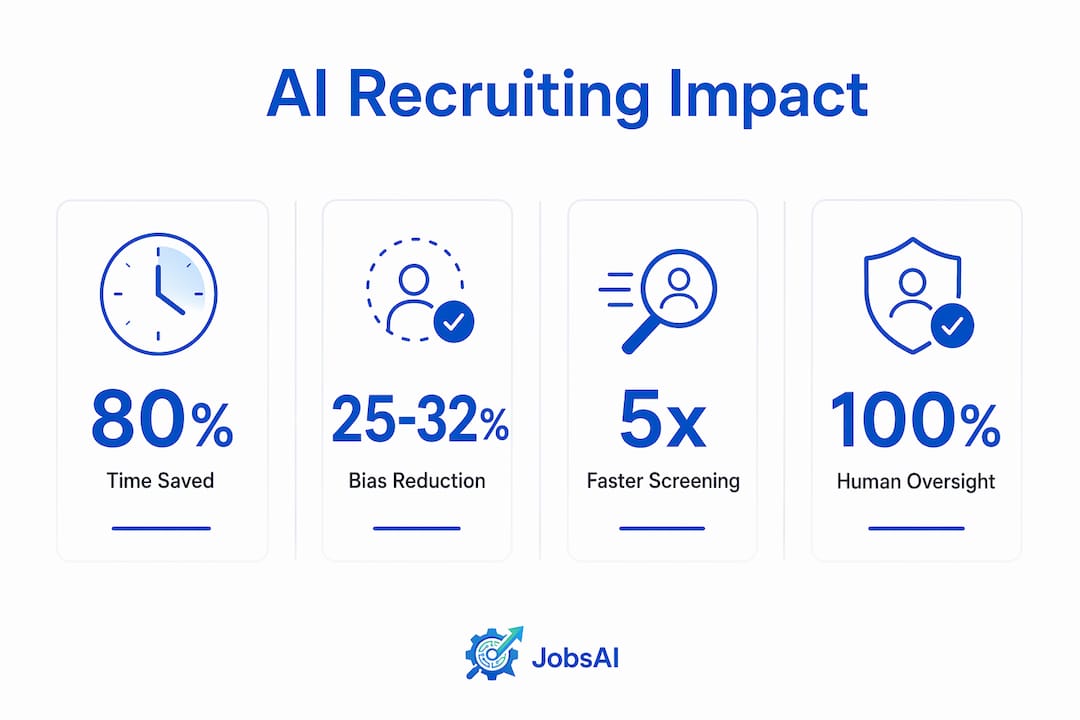
AI reduces recruiter process-heavy work by approximately 80%, according to a Forbes Tech Council analysis. That is not a minor efficiency gain. It represents a fundamental shift in how recruiting teams spend their time.
The recruiter’s role is moving from process driver to orchestrator. Where recruiters once spent the majority of their day filtering applications and sending scheduling emails, AI now handles those tasks. Recruiters instead focus on:
- Evaluating culture fit and team dynamics, which AI cannot assess reliably
- Building relationships with high-priority candidates
- Making final hiring recommendations with full context
- Interpreting AI-generated insights and challenging outputs that seem off
- Advising hiring managers on market conditions and candidate expectations
This shift is well documented. Korn Ferry’s analysis describes AI as augmenting human judgment rather than replacing it, with recruiters becoming strategic partners rather than administrative processors.
The practical workflow change looks like this: instead of reviewing 200 applications manually, a recruiter opens a ranked shortlist of 20, reviews AI-generated notes on each candidate, and spends their time on calls and assessments. Live dashboards surface pipeline health, bottlenecks, and candidate drop-off rates in real time. Recruiters act on data rather than hunt for it.
The risk in this shift is over-reliance. When AI handles the filtering, recruiters can lose visibility into who was screened out and why. Maintaining that visibility requires deliberate documentation and periodic audits of AI outputs, not just trust in the algorithm.
How do you address bias and legal compliance in AI hiring?
Algorithmic bias is the most serious risk in AI-assisted hiring. AI systems trained on historical hiring data reproduce and amplify existing inequalities. A model trained on past hires from a homogeneous workforce will systematically disadvantage candidates who do not match that historical pattern, regardless of their actual qualifications.
Research published in PLOS ONE in 2026 found that multi-layer bias mitigation frameworks can improve demographic parity, equal opportunity, and equalized odds by 25–32% with minimal loss in predictive accuracy. That finding is significant because it disproves the common assumption that fairness and accuracy trade off against each other.
The legal requirements are equally clear. The U.S. Department of Justice and the ADA require that AI hiring tools do not unfairly screen out qualified individuals with disabilities and that reasonable accommodations are built into the process. This is not optional compliance. Employers must validate that their AI tools measure job-relevant abilities and support accommodation workflows.
A responsible bias management approach follows four steps:
- Data diagnostics: Audit training data for demographic imbalances before deploying any AI screening tool.
- Fairness evaluation: Test the model against multiple fairness metrics, not just overall accuracy. Demographic parity alone is insufficient.
- Interpretability: Use tools like SHAP (SHapley Additive exPlanations) to identify which features drive AI decisions and whether those features are job-relevant.
- Intersectional analysis: Advanced intersectional bias detection improves accuracy by 12–18 percentage points over traditional single-attribute methods. Bias often concentrates at the intersection of race, gender, and disability status, not in any single dimension.
“Fairness in AI hiring includes not just demographic parity but also disability-related accessibility and accommodation considerations. Employers must ensure AI assessment tools measure relevant job abilities and support accommodation workflows to comply with disability discrimination laws.” — ADA.gov, 2026
The legal and ethical work is ongoing, not a one-time setup task. AI models drift as job markets and candidate pools change. Regular audits are not best practice. They are a legal requirement.
What are the best practices for integrating AI responsibly?
Responsible AI integration starts with a clear boundary: use AI for triage and recommendation, not for final hiring decisions. Harvard Business Review’s 2026 analysis is direct on this point. A human recruiter must own the final call, and that decision must be documented.
The practical steps for HR teams building an AI-assisted hiring process include:
- Validate tools for your specific context. An AI screening tool validated for software engineering roles may not be appropriate for healthcare recruiting or trades recruitment. Job-relatedness must be tested for each role category, not assumed.
- Document every recruiter decision. When a recruiter overrides an AI recommendation, that decision and its rationale should be recorded. This creates accountability and provides data for future model improvements.
- Plan accommodation workflows explicitly. ADA compliance requires that candidates can request accommodations during AI-assisted assessments. Build that request pathway into the process before you go live.
- Train recruiters for the orchestrator role. The skills needed to evaluate AI outputs, spot anomalies, and challenge model recommendations are different from traditional recruiting skills. Invest in that training.
- Adopt gradually. Start AI screening with one role category, measure outcomes, and expand only after validating results. Generative AI makes traditional hiring signals less reliable, so structured, validated assessments become more important as AI adoption increases.
Pro Tip: Build a simple decision log in your ATS or a shared document. Record the AI recommendation, the recruiter’s decision, and the reason for any override. After 90 days, review the log for patterns. You will learn more about your AI tool’s blind spots from that log than from any vendor report.
The goal is not to automate hiring. The goal is to give recruiters better information faster so they can make better decisions. That distinction shapes every integration choice.
Key Takeaways
AI-assisted hiring works best when it automates triage and surfaces ranked candidates, while human recruiters retain final decision authority and maintain documented accountability throughout the process.
| Point | Details |
|---|---|
| AI automates triage, not decisions | Use AI to rank and filter candidates, but keep final hiring calls with a human recruiter. |
| Recruiter role shifts to orchestrator | AI handles 80% of process work, freeing recruiters for relationship-building and judgment calls. |
| Bias requires active management | Multi-layer frameworks improve fairness metrics by 25–32% without sacrificing predictive accuracy. |
| ADA compliance is mandatory | AI tools must support accommodation requests and measure only job-relevant abilities. |
| Validation must be role-specific | An AI tool validated for one job category cannot be assumed to work fairly across all roles. |
Where I think most teams get this wrong
I have watched hiring teams adopt AI screening with genuine enthusiasm, then quietly walk it back six months later because the results felt off. The problem is almost never the technology. It is the assumption that deploying AI is the same as governing it.
The teams that get real value from AI-assisted hiring treat it like a new hire on probation. They check its work. They document when it gets things wrong. They adjust the criteria it uses. The teams that struggle hand it the keys and move on.
The other pattern I see consistently is underinvestment in recruiter training. When AI handles the filtering, recruiters need a different skill set. They need to read a ranked shortlist critically, ask why a strong candidate ranked low, and know when to override the model. That is not intuitive. It requires deliberate practice and clear internal guidance on when human judgment should override AI output.
The future of recruiting is not AI replacing recruiters. It is recruiters who understand AI outperforming those who do not. The US staffing benchmarks for 2026 already show a widening gap between teams using structured AI workflows and those still running manual processes. That gap will only grow.
The honest advice is this: start smaller than you think you need to, document everything, and treat your first AI deployment as a learning exercise rather than a finished solution.
— Hippolyte A.
How Jobsai Enterprise supports AI-powered hiring
Hiring teams that want to put these principles into practice need a platform built for the full workflow, not just one piece of it.
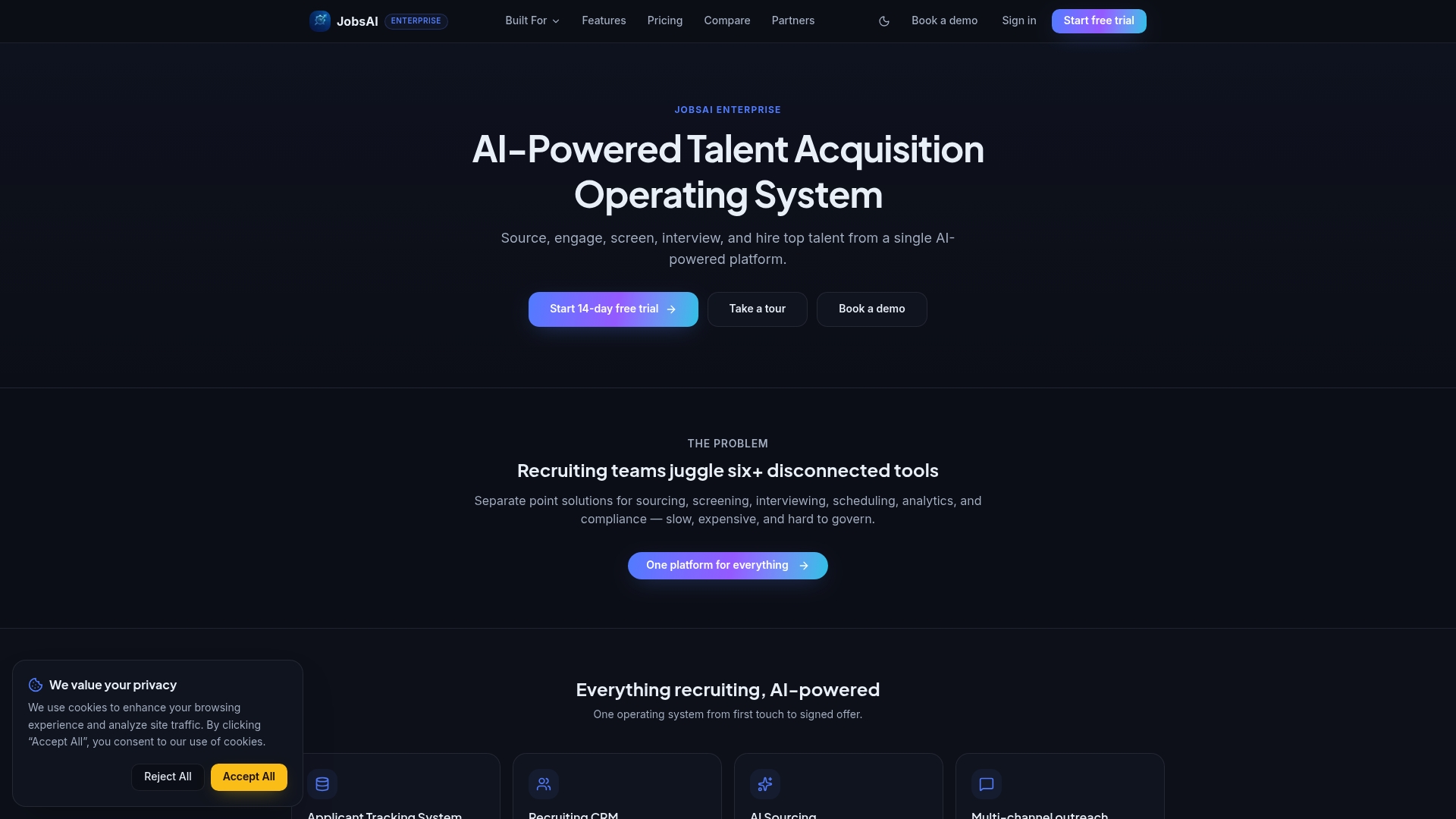
Jobsai Enterprise is an AI-powered talent acquisition operating system that screens and ranks applicants automatically, matches résumés against job requirements, and organizes candidate communication in one place. It reduces manual review time so recruiters can focus on the decisions that require human judgment. The platform supports compliance workflows and gives hiring teams the visibility they need to audit AI outputs and document recruiter decisions. For agencies and in-house teams managing high-volume hiring, take a tour of the platform to see how the workflow fits your process.
FAQ
What is AI-assisted hiring?
AI-assisted hiring is the use of machine learning, NLP, and generative AI to automate résumé screening, candidate scoring, interview scheduling, and follow-up communication. It augments recruiter judgment rather than replacing it.
Why do hiring teams use AI screening?
AI screening reduces the time recruiters spend on manual application review by approximately 80%, allowing them to focus on higher-value activities like candidate evaluation and hiring manager consultation.
How does AI help with unbiased screening?
Multi-layer bias mitigation frameworks can improve demographic parity and equal opportunity metrics by 25–32% compared to unmanaged AI systems. However, bias management requires ongoing audits, not a one-time setup.
Does AI in recruiting have legal requirements?
Yes. U.S. DOJ and ADA guidance requires that AI hiring tools do not unfairly screen out qualified individuals with disabilities, that tools measure job-relevant abilities, and that accommodation workflows are built into the process.
Can AI be used for healthcare or trades recruiting?
AI can support recruiting in healthcare, trades, and customer service roles, but each job category requires its own validation. A tool validated for one role type cannot be assumed to perform fairly or accurately across different job contexts.
Recommended
See it in your workflow
JobsAI Enterprise runs sourcing, AI screening, and the whole interview pipeline in one place. Book a walkthrough tailored to your team.
Book a demo