
Article
How to Score Resumes Against Job Requirements

How to Score Resumes Against Job Requirements
Scoring resumes against job requirements is the process of translating job criteria into measurable, scoreable components that let recruiters rank candidates objectively. Without a structured method, hiring teams default to gut feel, which introduces inconsistency and slows decisions. The industry term for this practice is structured resume screening, and it combines rubric design, job requirement analysis, and increasingly, AI-powered tools like Jobscan and Jenova.ai. Done well, it cuts screening time, surfaces stronger candidates, and gives every applicant a fair evaluation based on the same criteria.
What are the essential components of an effective resume scoring rubric?
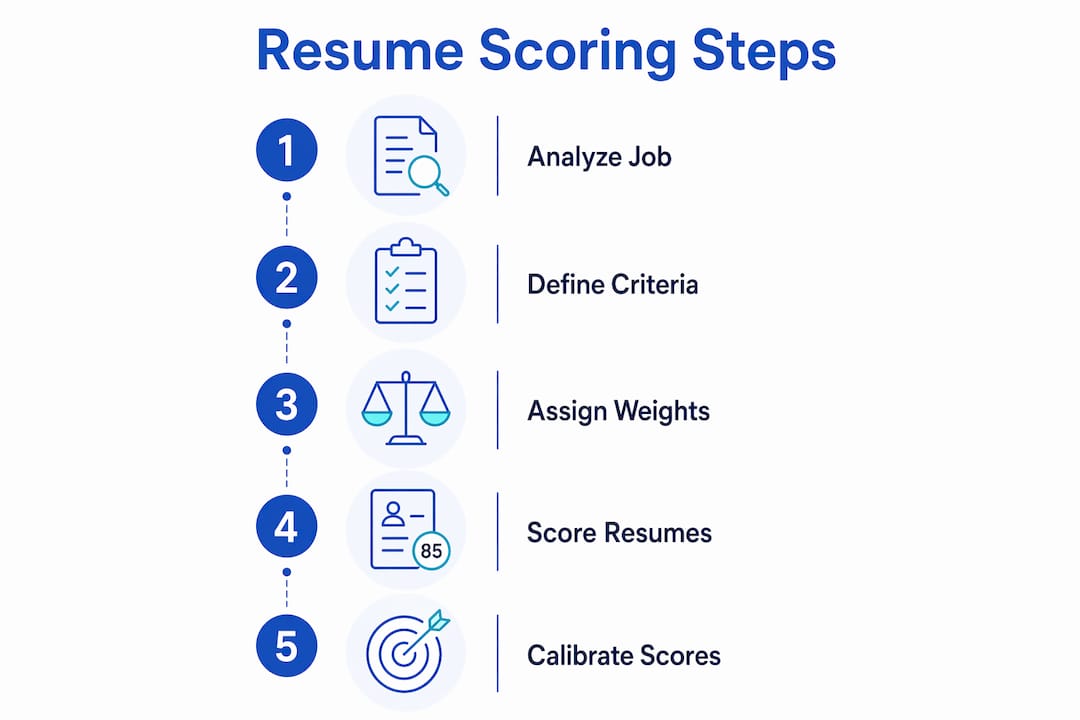
A resume scoring rubric converts a job description into 5–7 weighted criteria tied directly to the role’s core duties. Each criterion gets a defined weight and a scoring scale, typically 0–3, where each level describes a specific, observable resume fact. This structure removes ambiguity and makes it possible for two different recruiters to score the same resume and reach the same result.
The first step is job requirement analysis. Pull the job description and identify the skills, experience, and qualifications that actually predict success in the role. Separate must-haves from nice-to-haves. A must-have for a data analyst role might be proficiency in SQL. A nice-to-have might be experience with Tableau. Setting written criteria before reviewing any resumes minimizes bias and keeps the process consistent.

Weighting reflects priority. Must-have criteria should carry more weight than nice-to-haves. A common approach assigns 20–30% of the total score to the top criterion and distributes the remainder across supporting criteria. The table below shows a sample rubric structure for a marketing manager role.
| Criterion | Weight | Score 0 | Score 1 | Score 2 | Score 3 |
|---|---|---|---|---|---|
| Years of relevant experience | 25% | None listed | 1–2 years | 3–4 years | 5+ years |
| Campaign management skills | 25% | Not mentioned | Mentioned only | One example | Multiple results |
| Data analysis proficiency | 20% | Not mentioned | Tool listed | Used in role | Quantified outcomes |
| Team leadership | 15% | Not mentioned | Mentioned | Led small team | Led cross-functional team |
| Industry knowledge | 15% | Not mentioned | Adjacent industry | Same industry | Deep domain expertise |
Effective rubrics avoid irrelevant proxies such as candidate names, university brand, or employment gaps without context. Score only observable, job-related facts. “Culture fit” is not a criterion. If you cannot point to a specific line on a resume to justify a score, the criterion does not belong in the rubric.
Pro Tip: Test your rubric on five to ten past hires before using it live. If the scores do not align with who you actually hired and why, recalibrate the weights before screening new applicants.
How can technology and AI improve scoring resumes against job requirements?
AI resume screeners parse job descriptions into persistent evaluation criteria and apply them across every resume in a pipeline. The practical result is speed. Rubric-based AI screening can process 100 resumes in about 30 minutes at a cost of $62–$123, compared to $320–$640 for manual review. That cost difference compounds quickly at volume.
The key distinction between AI tools and basic applicant tracking systems is semantic understanding. Tools like Jobscan, SkillSyncer, and Jenova.ai compare resumes to job descriptions using meaning, not just keyword matching. A resume that says “built predictive models” will match a requirement for “machine learning experience” even without the exact phrase. This matters because candidates write resumes differently, and keyword-only matching penalizes qualified applicants who use different terminology.
AI tools also surface signals that a manual reviewer might miss. AI resume screeners detect red flags such as employment gaps, inconsistencies between job titles and described responsibilities, and overqualification signals. These flags do not disqualify a candidate automatically. They give the recruiter a specific reason to ask a follow-up question.
The table below compares three approaches to resume evaluation.
| Approach | Speed | Consistency | Bias risk | Best for |
|---|---|---|---|---|
| Manual review | Slow | Low | High | Small pipelines under 20 resumes |
| Rubric-based manual | Moderate | High | Medium | Teams without AI tools |
| AI-assisted scoring | Fast | High | Low to medium | High-volume pipelines |
The main limitation of AI scoring is data quality. Poor resume parsing impairs all downstream scoring and ranking accuracy inside ATS systems. If a resume is formatted with complex tables or graphics, the parser may misread dates, titles, or skills. The score becomes unreliable not because the criteria are wrong, but because the input data is corrupted.
Pro Tip: Ask candidates to submit resumes in plain .docx or PDF formats without tables or graphics. Clean formatting dramatically improves parsing accuracy and score reliability.
What are the best practices for interpreting and using resume scores?
Resume scores are a prioritization signal, not a final verdict. A score tells you where to focus your attention first. It does not tell you whether to hire someone. Scores paired with structured output that includes strengths, concerns, and a recommended next step give recruiters far more to work with than a number alone.
A practical three-band system works well for most pipelines:
- Advance (top band): Candidates who meet or exceed the threshold on must-have criteria. Move directly to a phone screen or structured interview.
- Review (middle band): Candidates who meet most must-haves but show gaps on one or two criteria. A brief screening call can clarify whether the gap is real or a resume presentation issue.
- Pass (bottom band): Candidates who miss multiple must-have criteria. Archive with a standard response.
Research shows that an 88% or higher role fit score correlates with better candidate visibility and interview routing inside ATS systems. Use that benchmark as a starting point for your advance threshold, then adjust based on your actual hiring outcomes over time.
Use the strengths and concerns extracted from scores to build your interview questions. If a candidate scores a 2 out of 3 on data analysis because they listed tools but did not show quantified outcomes, ask them directly: “Walk me through a time when your analysis changed a business decision.” The score tells you where to probe. The interview tells you what is actually there.
Pro Tip: Review your score thresholds every quarter. If candidates in the review band consistently outperform those in the advance band during interviews, your rubric weights need adjustment.
What are common pitfalls in resume scoring against job requirements?
Even well-designed scoring systems break down when applied carelessly. These are the most common failure points and how to address each one.
- Incomplete rubrics: Criteria that cover only two or three dimensions miss important qualifications. A rubric for a software engineer role that scores only years of experience and degree level will miss candidates with strong open-source portfolios and no formal degree.
- Inconsistent application: Two recruiters using the same rubric but interpreting scoring levels differently produce incomparable results. Run a calibration session before screening begins. Score the same five resumes independently, then compare and discuss discrepancies.
- Misleading scores from poor parsing: Without clean data parsing, match scores may be misleading regardless of how accurate the criteria are. A resume with a two-column layout may have its skills section read out of order, causing the parser to miss listed qualifications entirely.
- Keyword density over demonstrated skills: Scoring systems that reward keyword frequency rather than evidence of skill will favor candidates who stuff their resumes with terms. Weight criteria toward demonstrated outcomes, not mentions.
- Proxy bias: Criteria like “prestigious university” or “no employment gaps” are proxies that introduce bias without predicting job performance. Remove them. Replace them with criteria tied to actual job duties.
- Over-reliance on the score: A score of 85% does not mean the candidate is ready to hire. It means they look good on paper against your criteria. Combine scores with a structured interview and reference checks before making a final call.
Blind screening addresses several of these issues at once. Remove names, graduation years, and other identifying information before scoring. This keeps evaluators focused on job-related facts and reduces the chance that irrelevant details influence the score.
Key takeaways
Structured resume scoring combines a well-designed rubric with AI-assisted tools to evaluate candidates consistently, reduce screening time, and surface the strongest matches for any role.
| Point | Details |
|---|---|
| Build a weighted rubric first | Extract 5–7 job criteria, assign weights, and define observable scoring levels before reviewing any resumes. |
| Use AI for speed and consistency | AI tools like Jobscan and Jenova.ai screen large volumes faster and with more consistency than manual review. |
| Treat scores as signals, not decisions | Use score bands to prioritize candidates, then use strengths and concerns to guide interview questions. |
| Fix parsing before scoring | Require clean resume formats to avoid misleading scores caused by poor ATS parsing. |
| Calibrate regularly | Review rubric weights quarterly and adjust based on which scored candidates actually succeed in the role. |
The case for a hybrid approach
The most reliable resume screening systems I have seen combine human-designed rubrics with AI execution. Neither works as well alone. A rubric without AI is slow at volume. AI without a rubric produces scores that are hard to explain or defend to a hiring manager.
The part most teams underestimate is calibration. Building the rubric takes an afternoon. Keeping it accurate takes ongoing attention. Every quarter, you should pull your recent hires, run their original resumes through your current rubric, and check whether the scores match your actual hiring decisions. If they do not, the rubric is drifting from reality.
Parsing quality is the other underappreciated variable. I have watched teams invest in AI scoring tools and then wonder why the results feel off. The answer is almost always the same: the resumes are formatted in ways the parser cannot handle cleanly. Fixing that upstream problem, before scoring begins, produces better results than any amount of criteria tuning.
The teams that get the most out of structured scoring are the ones who treat it as a living system. They test, measure, and adjust. They use scores to start conversations in interviews, not to end them before the interview happens. That mindset is what separates a screening process that finds great candidates from one that just moves paper faster.
— EveryBrainAI
Jobsai Enterprise puts resume scoring to work
Jobsai Enterprise is an AI-powered talent acquisition platform built for recruiting teams that need to screen and rank candidates at volume without sacrificing quality. It matches resumes against job requirements automatically, surfaces fit scores with candidate strengths and concerns, and organizes your pipeline so nothing falls through the gaps.
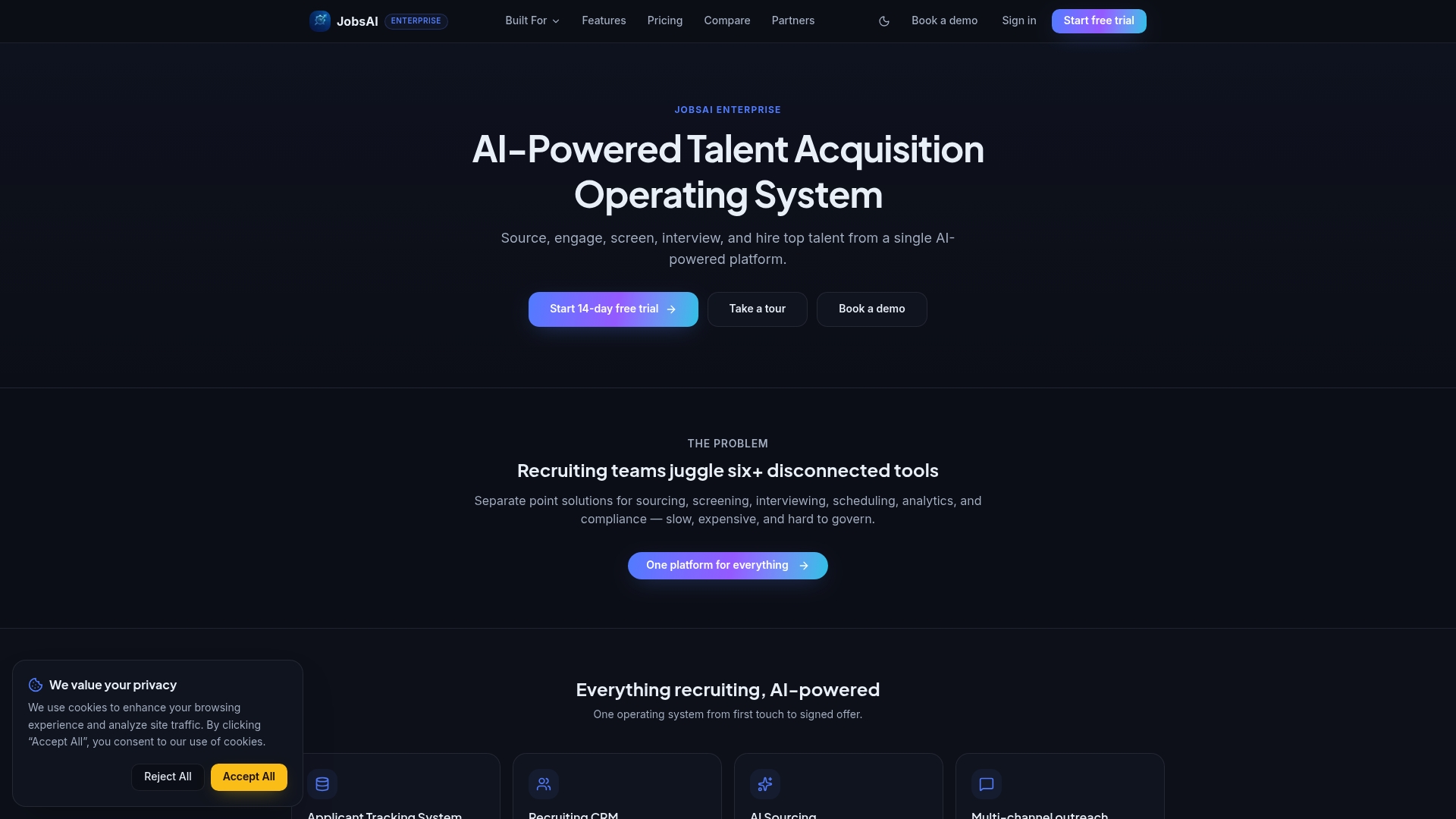
Hiring teams using Jobsai reduce manual review time significantly while improving the consistency of their screening decisions. You can see the full feature set on the platform overview or review Jobsai pricing to find the plan that fits your team’s volume. If you want to see how it handles resume scoring in practice, the product tour walks through the full workflow.
FAQ
What does it mean to score resumes against job requirements?
Scoring resumes against job requirements means evaluating each candidate’s qualifications by comparing their resume to a defined set of job criteria, then assigning a numeric score based on how well they match. The result is a ranked list of candidates prioritized by fit.
How many criteria should a resume scoring rubric include?
A rubric should include 5–7 criteria drawn directly from the job description. Fewer criteria miss important qualifications; more criteria create scoring complexity that slows the process without improving accuracy.
What score threshold should I use to advance candidates?
A role fit score of 88% or higher correlates with stronger ATS outcomes and better interview routing. Use that as a starting benchmark and adjust based on your hiring results over time.
Can AI tools replace manual resume review entirely?
AI tools handle volume and consistency well, but they work best as a first-pass filter. Structured output with strengths and concerns still requires a recruiter to interpret the results and make the final call on which candidates to advance.
Why do resume scores sometimes feel inaccurate?
Inaccurate scores are most often caused by poor resume parsing inside the ATS. When a resume is formatted with tables, graphics, or unusual layouts, the parser misreads data and the score reflects corrupted input rather than the candidate’s actual qualifications.
Recommended
See it in your workflow
JobsAI Enterprise runs sourcing, AI screening, and the whole interview pipeline in one place. Book a walkthrough tailored to your team.
Book a demo