
Article
12% More Offers in Six Weeks with AI Voice Interviews for Recruiters

12% More Offers in Six Weeks with AI Voice Interviews for Recruiters
AI voice interviews use conversational AI to conduct structured, recorded candidate screens at scale, replacing the first human phone screen. A 70,000-interview field study found candidates screened this way were 12% more likely to get offers and roughly 18% more likely to start and stay in the role. Some recruiting platforms build this capability directly into their AI voice and avatar interviews, giving recruiting teams a tested way to standardize early-stage screening without adding headcount.
TL;DR:
- Using AI voice interviews can increase candidate offer rates by approximately 12 percent and improve retention and start rates by around 18 percent.
- The technology asks all planned questions consistently, ensuring comprehensive topic coverage without fatigue or bias inherent in human interviewers.
- Pilot programs should focus on high-volume, entry-level roles, running parallel tests for 2 to 6 weeks to compare AI and human screening outcomes.
- Successful deployment relies on well-designed scripts and rubrics, native ATS integration, transparent scoring, and maintaining human oversight for final decisions.
- Vendors must enable exportable transcripts and scoring data, provide adjustable scripts, and support bias testing and candidate consent for a compliant rollout.
Table of Contents
- What Does an AI Voice Interview Actually Do for Recruiters?
- Do AI Voice Interviews Actually Improve Hiring Outcomes?
- How to Pilot AI Voice Interviews Without Betting the Whole Requisition
- What Should You Ask a Vendor Before You Sign?
- What Compliance Guardrails Does a Rollout Need?
- What Do Successful Deployments Actually Look Like?
- Why the “AI Will Replace Recruiters” Framing Misses the Point
- How JobsAI Enterprise Fits Your Pilot Plan
- Start Your AI Voice Interview Pilot
- Sources
- FAQ
What Does an AI Voice Interview Actually Do for Recruiters?
An AI voice interview replaces the first human phone screen with an automated conversation the candidate completes on their own time. The candidate talks through a structured set of questions with a voice or avatar interviewer, and the system handles the rest: recording, transcribing, scoring against a rubric, and flagging highlights for the recruiter to review.
That last part matters more than most teams expect. Recruiters aren’t listening to raw audio; they’re reading a scorecard and skimming a transcript with key moments marked. Most platforms bundle a similar feature set:
- Structured interview scripts tied to job requirements, not generic templates
- Follow-up probing on vague or incomplete answers
- Scoring rubrics that produce a comparable rating across every candidate
- Automatic transcription with searchable text
- Multilingual support for distributed candidate pools
- Recorded audio or video for later review and audit
The workflow shift is the real win. Recruiters stop chasing calendar slots for first-round screens and instead review completed interviews in batches, often the next morning. A tool like A detailed AI phone screening guide walks through how that batch-review model fits into a standard applicant tracking system flow.
Do AI Voice Interviews Actually Improve Hiring Outcomes?
The evidence here is unusually concrete for an HR technology claim. The Chicago Booth field experiment, run across more than 70,000 real job interviews, found candidates interviewed by AI voice agents were 12% more likely to receive an offer.
The core finding: Across 70,000+ interviews, AI-screened candidates saw a 12% lift in offer rates and an 18% lift in job-start and one-month retention rates compared to human-only screening.
Those numbers hold up because of a specific mechanism, not because the AI is a better judge of character. Researchers behind a related natural field experiment on automated interviews found AI agents covered 45% of recommended interview topics, compared to 38% for human interviewers. The AI didn’t ask better questions. It asked all of the planned questions, every time, without skipping topics under time pressure or interviewer fatigue.
For a pilot, that means tracking the right operational signals from week one:
- Time-to-shortlist (days from application to a ranked candidate list)
- Interviews completed per day, per recruiter-hour
- Recruiter-hours saved versus the prior screening process
- Candidate no-show and completion rates
- Candidate satisfaction or NPS on the interview experience itself
How to Pilot AI Voice Interviews Without Betting the Whole Requisition
Running a contained pilot beats a full rollout every time, and it takes roughly six weeks from setup to a go/no-go decision.
- Pick a high-volume, entry-level role. These roles have the biggest scheduling bottleneck and the fastest sample size, which is why industry writeups on AI voice interviews consistently recommend starting there rather than with specialized or executive hires.
- Build the script and rubric before you build anything else. Every question should map to a specific job requirement, and every rubric line should produce a score a hiring manager could defend in an audit.
- Wire up the integration layer. Connect the tool to your ATS, calendar, and candidate messaging so interviews trigger automatically after application and results land where recruiters already work.
- Run AI and human screens in parallel for 2 to 6 weeks. Split volume randomly where possible, and hold both groups to the same KPIs you defined above.
- Review the transcripts, not just the scores. Pull a sample of recordings weekly, adjust script wording that’s producing weak or off-topic answers, and re-test before scaling volume.
Pro Tip: Run the parallel test on the same requisition, same week, same hiring manager. Comparing AI results from March against human results from January will always confound your data with seasonal applicant quality.
What Should You Ask a Vendor Before You Sign?
Most vendor demos are built to hide the same three weaknesses: opaque scoring, no exportable data, and scripts you can’t edit. A practical buyer’s checklist for AI recruitment vendors recommends pressing on these areas specifically:
- Ask to see real scoring rubric examples, not marketing screenshots, and confirm you can customize them per role.
- Require exportable transcripts and score data in a format your ATS can ingest.
- Confirm ATS and SSO integration is native, not a manual CSV upload every week.
- Ask directly about bias testing, audit trails, and whether third parties have reviewed the model’s scoring behavior.
- Verify the candidate consent flow and what happens when someone needs a human alternative, such as an accessibility accommodation.
If a vendor can’t produce a sample transcript or rubric on request, or their platform has no version history for edited scripts, treat that as a disqualifying red flag rather than a minor gap.
What Compliance Guardrails Does a Rollout Need?
Keep a human in the loop for every final hiring decision, and preserve recordings and audit logs long enough to defend a decision if it’s ever challenged. Notify candidates that they’re interacting with an AI system, capture explicit consent, and set a clear data retention and deletion policy for recordings and transcripts.
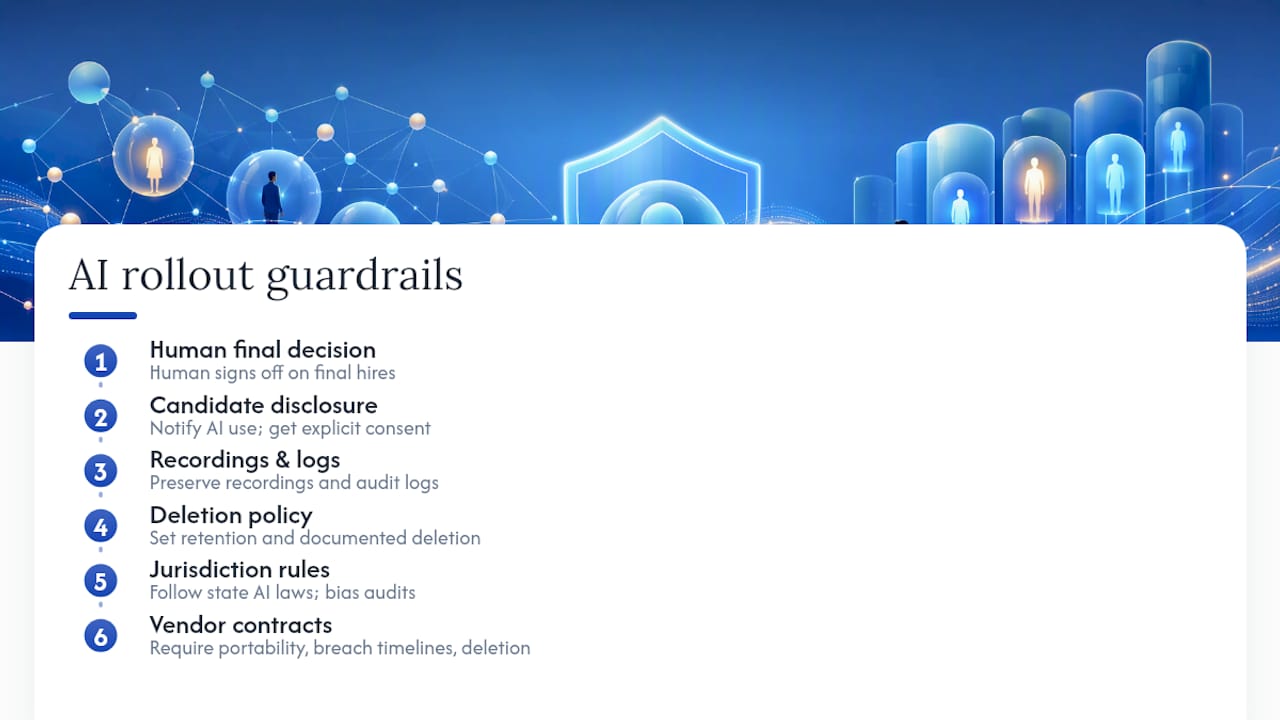
State-level AI hiring laws vary, and some jurisdictions require disclosure or bias-audit evidence before automated assessment tools can be used in hiring decisions. Build vendor contracts that require data portability, breach notification timelines, and a documented deletion procedure. A guide on how AI hiring bias works is worth reviewing before your pilot’s first candidate is interviewed, not after.
What Do Successful Deployments Actually Look Like?
The pattern across documented rollouts is consistent: teams that succeed start narrow, measure hard, and expand only after the data supports it. Staffing firms handling seasonal retail or warehouse hiring have used AI voice screens to compress a multi-day scheduling bottleneck into same-day results, since candidates complete interviews the moment they apply instead of waiting for a recruiter callback.
Corporate HR teams running high-volume entry-level hiring report a similar shape of win. The 70,000-interview field study itself is the clearest evidence base here: it wasn’t a single company’s case study but a controlled experiment across many real hiring processes, which is part of why the 12% offer-rate lift and 18% retention lift carry more weight than a typical vendor testimonial.
Partner research on AI adoption more broadly backs the pattern. Agency-focused productivity research has found measurable ROI when firms apply AI to repetitive, high-volume operational tasks rather than judgment-heavy final decisions, which lines up with where AI voice interviews fit best: first-round screening, not final hiring calls.
The common thread across every deployment that held up under scrutiny: recruiters kept ownership of the rubric, the shortlist decision, and the offer, while the AI handled the repetitive, time-consuming first conversation.
Why the “AI Will Replace Recruiters” Framing Misses the Point
The loudest argument against AI voice interviews treats them as a threat to recruiter judgment. That argument gets the mechanism backwards. The Chicago Booth data didn’t show AI making better judgment calls than experienced recruiters. It showed AI asking the same planned questions consistently, every single time, while human interviewers skipped topics under time pressure or let strong rapport with one candidate quietly lower their guard on another.
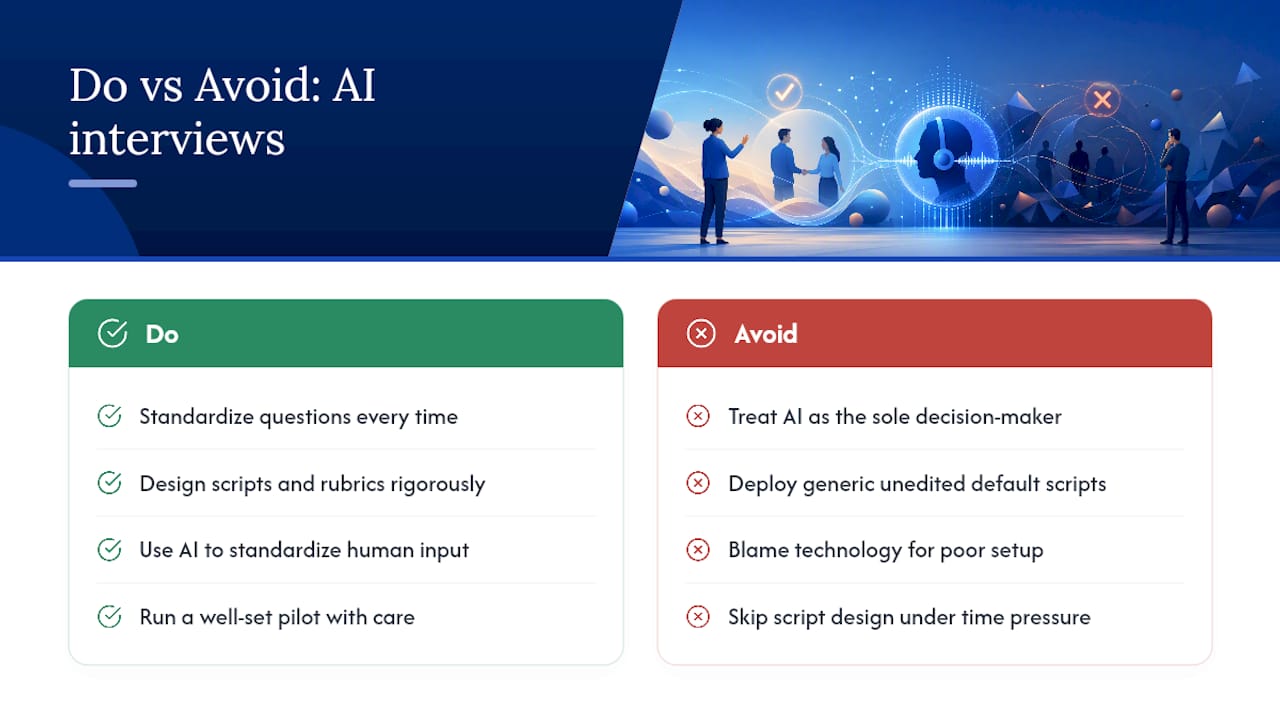
That’s a scheduling and consistency problem, not an intelligence problem. Recruiters who resist AI voice interviews because they distrust “a machine deciding who gets hired” are arguing against a use case that barely exists in practice. The systems worth adopting don’t decide anything. They standardize the input a human decision-maker works from, and that’s a meaningfully different claim than the one skeptics are usually arguing against.
The bigger risk isn’t over-trusting the AI. It’s under-designing the script and rubric, then blaming the technology when a poorly built pilot produces poor results. Teams that treat script design with the same rigor they’d apply to a structured human interview guide see the gains the research documents. Teams that deploy a generic, unedited default script usually don’t, and they walk away concluding the technology doesn’t work when the real problem was setup.
— Hippolyte A.
How JobsAI Enterprise Fits Your Pilot Plan
Every step in the pilot above maps to a specific piece of the platform. JobsAI Enterprise’s AI voice and avatar interviews handle the structured scripting and scoring rubric work, while built-in scheduling and AI screening cover the ATS integration and candidate communication steps without a separate tool for each. Most teams running a first pilot start with one high-volume requisition, the same shape recommended above, and use the platform’s exportable transcripts and scorecards to keep the parallel test auditable from day one.
Start Your AI Voice Interview Pilot
The fastest path there is testing the workflow directly rather than sitting through another round of vendor slide decks.
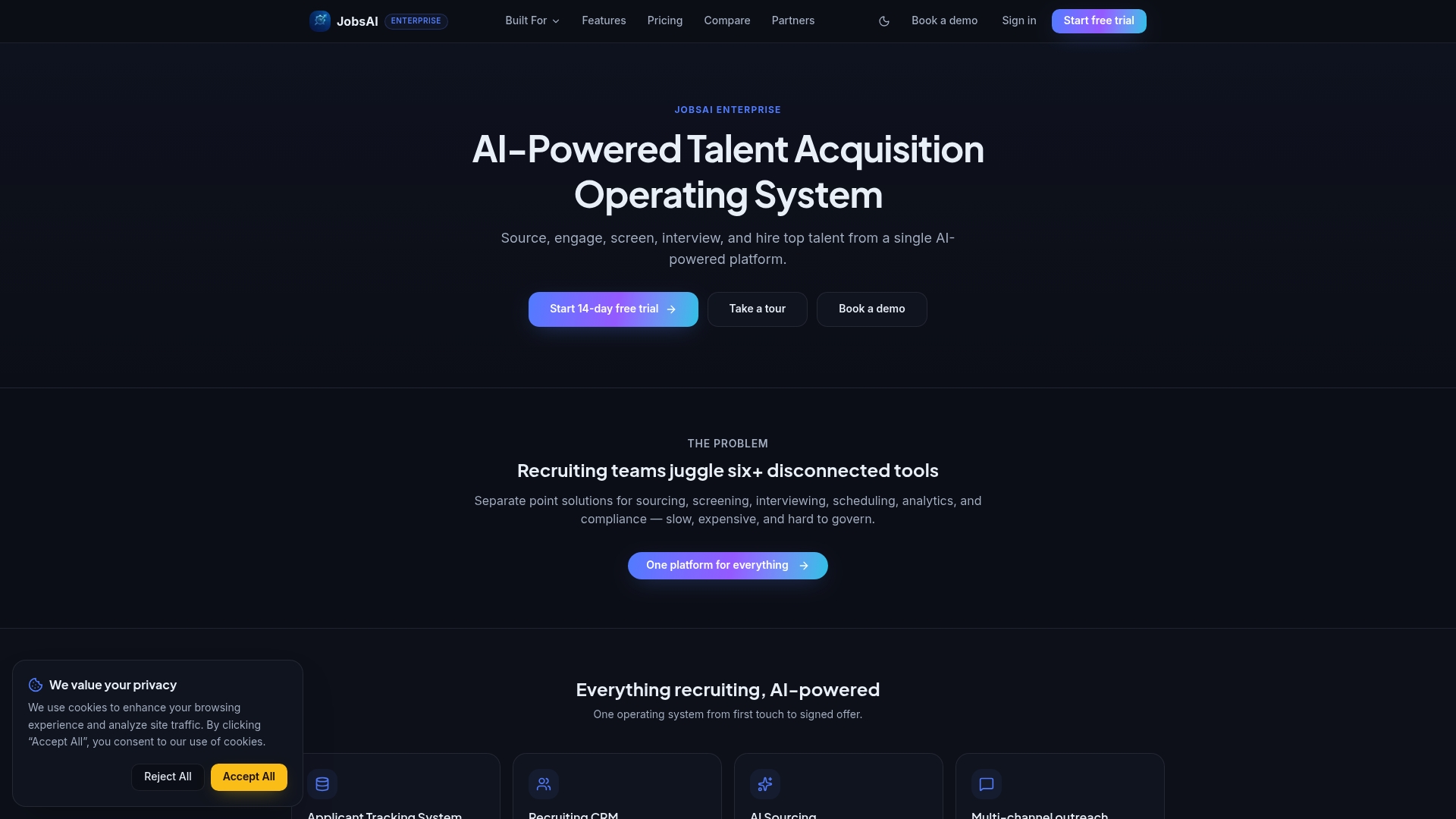
Some AI-powered recruiting platforms give recruiting teams a direct way to run that pilot without stitching together separate tools for scripting, scheduling, and scoring. Instead of buying a standalone voice AI tool and bolting it onto an existing ATS, these platforms offer interview automation, candidate messaging, and screening in one workspace, addressing the common integration challenges of self-run pilots. If you’re screening high volume for staffing clients or corporate roles, the AI screening guide walks through setup, and the product tour shows the interview and scorecard flow end to end. Start by requesting a demo on the main platform page and bring one real requisition to test against.
Sources
- AI on the job — Chicago Booth (field experiment write-up)
- Voice AI in Firms: A Natural Field Experiment on Automated Job Interviews | alphaXiv
- AI Recruitment Vendor Evaluation: Buyer’s Checklist 2026
FAQ
What Is an AI Voice Interview?
It’s an automated, recorded interview where a candidate answers structured, job-specific questions from a voice or avatar interviewer instead of a human recruiter, with transcripts and scores generated for later review.
Do AI Voice Interviews Really Improve Hiring Results?
A field study of over 70,000 interviews found a 12% higher offer rate and roughly 18% higher job-start and one-month retention rates for AI-screened candidates compared to human-only screening.
How Long Should a Pilot Run Before Scaling?
Most teams run a parallel AI-versus-human test for 2 to 6 weeks on one high-volume role, tracking time-to-shortlist, completion rates, and recruiter-hours saved before deciding whether to expand.
What Should I Ask Vendors During a Demo?
Request sample scoring rubrics, exportable transcripts and score data, native ATS and SSO integration, and evidence of bias auditing before signing a contract.
Does JobsAI Enterprise Offer AI Voice Interviews?
Yes. JobsAI Enterprise includes AI voice and avatar interviews alongside AI screening, scheduling, and workflow automation in a single recruiting platform.
Recommended
See it in your workflow
JobsAI Enterprise runs sourcing, AI screening, and the whole interview pipeline in one place. Book a walkthrough tailored to your team.
Book a demo