
Article
Prove Autonomous Recruiting Agent ROI in 4–8 Weeks for Talent Teams

Prove Autonomous Recruiting Agent ROI in 4–8 Weeks for Talent Teams
An autonomous recruiting agent is software that runs multi-step sourcing, screening, outreach, and scheduling workflows with minimal human intervention to deliver interview-ready candidates. The main payoff is speed: recruiters spend less time on admin and candidates hear back faster. It’s most useful for high-volume roles and passive sourcing, where manual work usually piles up fastest.
TL;DR:
- Autonomous recruiting agents excel at high-volume sourcing and screening, automating tasks like candidate ranking and deduplication to save significant recruiter time.
- They follow a structured workflow starting with role briefs, then sourcing, scoring, multi-channel outreach, and scheduling, all with minimal human triggers.
- Explainable scoring and full audit trails are critical to avoid bias, ensure transparency, and maintain compliance during AI-driven recruiting processes.
- Integration with existing applicant tracking, calendar, and messaging systems is essential to prevent manual reconciliation and maximize efficiency.
- Pilot programs should focus on one role family for four to eight weeks, measuring response rates and time-to-fill before wider implementation.
Table of Contents
- What Is an Autonomous Recruiting Agent, Exactly?
- How Does an AI Recruiter Work Step by Step?
- What Can an Autonomous Recruiting Agent Actually Do?
- Why Are Talent Teams Adopting Autonomous Agents Now?
- What Are the Risks of Using AI Recruiting Agents?
- How Do You Evaluate and Choose a Recruiting Agent?
- How Does JobsAI Enterprise Handle Agentic Recruiting?
- Where Should Autonomous Agents Sit in a Recruiter’s Workflow?
- Ready to Pilot an Autonomous Recruiting Agent?
- Sources
- FAQ
What Is an Autonomous Recruiting Agent, Exactly?
An autonomous recruiting agent isn’t a single feature. It’s a system that chains together several recruiting tasks and executes them in sequence, making its own decisions about what to do next based on rules, scoring models, and candidate responses.
That distinction matters more than it sounds. A macro or a workflow automation runs one action when triggered. Send a reminder email when a candidate hasn’t replied in three days, for example. An autonomous agent, by contrast, evaluates a situation, picks from multiple possible actions, and moves a candidate forward without someone clicking “next” at every step. If a candidate doesn’t respond to an initial outreach message, a sourcing agent might automatically switch channels, adjust the message, or flag the profile for human review after a set number of attempts.
Recruiting agents generally fall into a few working categories:
- Sourcing agents search job boards, professional networks, and internal databases to find and rank candidates against a role’s requirements.
- Screening agents apply structured scoring to resumes and applications, filtering or ranking candidates before a recruiter ever opens a file.
- Outreach agents manage multi-channel messaging campaigns, follow-up cadences, and response tracking.
- Scheduling agents coordinate interview logistics across recruiters, hiring managers, and candidates.
- Verification agents confirm identity, employment history, or credentials before a candidate advances.
Some platforms bundle all five into a single “agentic” layer that sits on top of an applicant tracking system. Others sell them as separate modules. Either way, the defining trait is the same: less manual triggering, more autonomous execution against a goal.
How Does an AI Recruiter Work Step by Step?
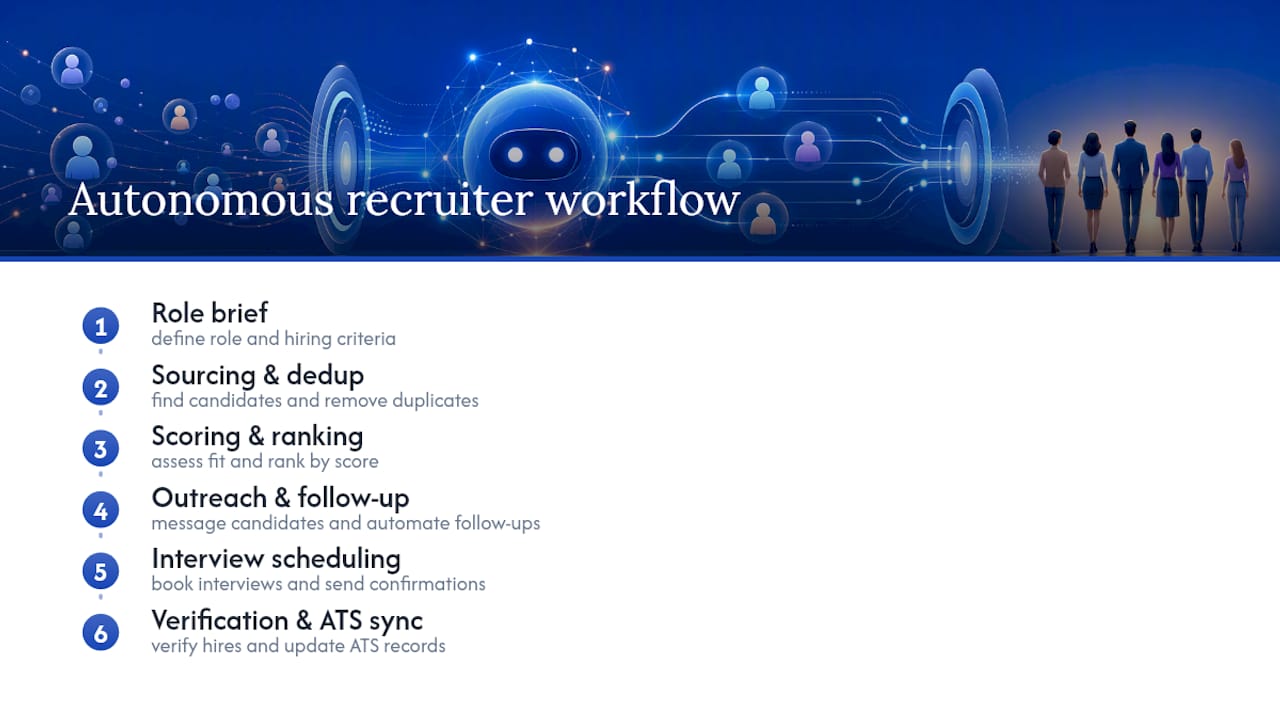
Most autonomous recruiting agents follow a similar pattern, regardless of vendor. Understanding that pattern is the fastest way to evaluate whether one fits your hiring process.
Step 1: The role brief
Everything starts with a brief. A recruiter or hiring manager feeds the agent the job description, must-have qualifications, deal breakers, and often a few example resumes of people who succeeded in similar roles. Some platforms let you weight criteria (years of experience versus specific certifications, for instance) so the agent knows what actually matters for that job.
Step 2: Sourcing and deduplication
The agent searches connected databases, job boards, and sometimes its own internal candidate pool for matches. It deduplicates against your existing applicant tracking system so you’re not re-sourcing people already in your pipeline. This is where a lot of manual recruiter time historically went, and it’s the step most agents automate first.
Step 3: Scoring and ranking
Candidates get scored against the brief using a rubric or matching algorithm. Better systems produce an explainable output. Something like a Match Card that shows why a candidate ranked where they did, rather than a black-box number. That explainability matters both for recruiter trust and for defending hiring decisions later.
Step 4: Outreach and follow-up
The agent initiates contact, often across email, SMS, or WhatsApp, and manages follow-up sequences based on whether a candidate opens, replies, or ignores the message. Staged cadences (a first touch, a follow-up at 48 hours, a final nudge at a week) replace what used to be a recruiter’s manual tracking spreadsheet.
Step 5: Interview scheduling
Once a candidate confirms interest, the agent coordinates calendars between the candidate, the recruiter, and any hiring panel members, handling reschedules and reminders without back-and-forth email chains.
Step 6: Verification and ATS sync
Depending on the role, an agent may trigger identity or credential verification before the candidate reaches a human interviewer. Every step gets logged and synced back to the applicant tracking system, so the recruiter’s system of record stays current without manual data entry.
Human review typically happens at two points: approving the initial scoring rubric before launch, and reviewing the shortlist before final interviews. The best deployments keep a human in the loop at decision points, not just at the end. Integration surface area matters here too. An agent that can’t talk to your ATS, calendar, and messaging tools natively will create more manual reconciliation than it saves.
What Can an Autonomous Recruiting Agent Actually Do?
The workflow above describes the sequence. The capabilities below describe what happens at each stage in practice, and where teams tend to see the clearest gains.
Sourcing at scale means an agent can search thousands of profiles across multiple platforms in the time a recruiter spends reviewing a single stack of resumes. The real value shows up in deduplication. A good sourcing agent cross-references new candidates against your existing database so recruiters aren’t rediscovering people already in the pipeline. JobsAI Enterprise’s AI sourcing approach, for example, focuses on this kind of automated discovery layered on top of existing candidate records rather than treating every search as a blank slate.
Structured screening replaces the keyword-scan approach with rubric-based assessments tied to the actual job requirements. Instead of a resume getting flagged for missing a specific phrase, a screening agent evaluates experience, skills, and context against weighted criteria, and produces a score a recruiter can inspect and challenge. This structured method is a meaningful shift from earlier applicant tracking systems that simply matched keywords.
Multi-channel outreach means the agent doesn’t rely on a single email that might sit unread for days. Staged follow-ups across email, text, and messaging apps like WhatsApp raise response rates simply because they meet candidates where they actually check messages.
Scheduling and panel coordination solve a problem every recruiter knows: getting four calendars to align. An agent that can autonomously propose times, handle conflicts, and send reminders eliminates a surprising share of interview no-shows tied to scheduling confusion rather than candidate disinterest.
Identity and verification options vary by vendor, but the more mature platforms offer configurable checks. Confirming a candidate is who they claim to be before a final interview, verifying credentials for regulated roles, or flagging inconsistencies for human review.
Analytics for pipeline health round out the picture. Dashboards showing time-to-first-contact, response rates by channel, and shortlist quality by role let talent teams spot bottlenecks before they become missed hiring deadlines.
Why Are Talent Teams Adopting Autonomous Agents Now?
The business case usually comes down to redistributed effort rather than headcount reduction. Recruiters spend less time on searching, deduping, and chasing replies, and more time on the parts of the job that actually require judgment: interviewing, negotiating, and advising hiring managers.
Gartner predicts that 40% of enterprise applications will include task-specific AI agents by 2026, up from less than 5% in 2025. That’s not a recruiting-specific figure, but it tracks with what talent acquisition leaders are describing: agentic features moving from novelty to default in the tools they already use.
For staffing agencies working high volume requisitions, the throughput gain is often the clearest sell. One analysis of AI adoption in agencies points to a 3.2x return on investment tied to productivity gains, a figure worth treating as directional rather than a guarantee for every deployment, since results depend heavily on role mix and data quality.
Consistency is the underrated benefit. A tired recruiter reviewing resume number 200 of the day makes different judgment calls than they did on resume number 10. An agent applies the same rubric every time, which reduces the kind of administrative drift that creates inconsistent candidate experiences across a hiring cycle.
The KPIs worth watching during adoption are fairly consistent across teams: time-to-first-contact, candidate response rate, and shortlist quality (measured by hiring manager acceptance of agent-recommended candidates). SHRM’s recruiting benchmarking research offers useful baselines for time-to-fill and response metrics that make good comparison points when you’re deciding whether a pilot actually moved the needle.
What Are the Risks of Using AI Recruiting Agents?
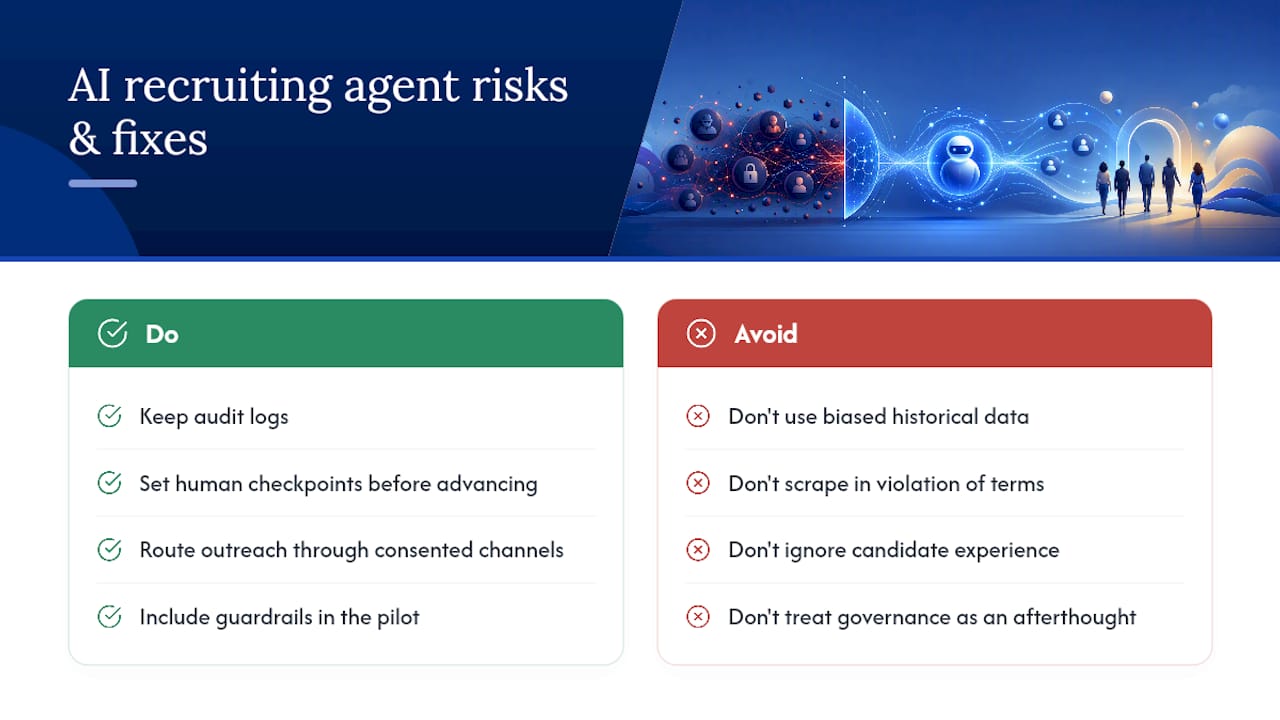
Autonomous agents inherit whatever biases exist in the data and rubrics they’re trained on. If historical hiring data favored certain schools, employment gaps, or demographic patterns, a scoring model trained on that data can quietly reproduce the same skew at a much larger scale than a single biased recruiter ever could. This is the single biggest reason explainable scoring matters. If you can’t see why a candidate was ranked the way they were, you can’t catch the bias before it does damage. JobsAI Enterprise’s guide on how AI hiring bias works breaks down where these patterns tend to originate and how structured rubrics help control for them.
Privacy and platform terms create a second layer of risk. Sourcing agents that scrape data from professional networks or job boards can run into terms-of-service violations or regional data protection issues, particularly when candidate data crosses borders. Vendors should be able to explain exactly where their candidate data comes from and how it’s stored.
Candidate experience is the risk teams underestimate most. A candidate who gets three automated messages, a scheduling link, and no human contact until day 30 of a process feels processed, not recruited. Staged outreach needs a human checkpoint before it starts to feel impersonal.
The mitigations aren’t complicated, but they require discipline: keep audit logs of every automated decision, set explicit human checkpoints before candidates advance past screening, and route outreach only through channels candidates have actually consented to. Gartner has warned that a significant share of agentic AI projects risk cancellation without this kind of governance built in from the start, which is a strong argument for treating guardrails as part of the pilot, not an afterthought.
How Do You Evaluate and Choose a Recruiting Agent?
Picking an autonomous recruiting agent is less about comparing feature lists and more about testing whether a vendor’s system actually integrates with how your team already works. Here’s a practical order of operations.
- Confirm data sources and integrations first. Ask exactly which job boards, networks, and databases the sourcing agent pulls from, and whether it syncs natively with your applicant tracking system and calendar tools. A gap here creates manual reconciliation work that erases the time savings.
- Demand explainable scoring. Any vendor should be able to show you a Match Card or equivalent output that explains why a candidate scored the way they did, not just the final number.
- Check security and identity verification options. Ask how candidate data is stored, who can access it, and what verification methods (identity, credentials, employment history) are configurable per role.
- Test customization against a real job requisition. Feed the system an actual open role from your pipeline, not a demo script, and see how the rubric and outreach cadence adapt.
- Request false-positive and false-negative examples. A vendor confident in their scoring model should be able to show you cases where the system got it wrong and how those were caught.
- Review audit logging depth. You need a full trail of every automated action for compliance and dispute resolution.
Once you’ve cleared that checklist, run a pilot scoped to one role family for four to eight weeks. Track time-to-first-contact, candidate response rate, and hiring manager acceptance rate of shortlisted candidates against your baseline. Industry guidance consistently recommends piloting one function (screening or outreach for a single role family) before expanding scope, rather than switching your entire pipeline over at once.
Pro Tip: Run your pilot against a role you’re currently struggling to fill, not your easiest requisition. A pilot on an easy role tells you the agent works when everything’s already going well. You need to know how it performs under real pressure.
Red flags worth walking away from: a vendor that can’t explain their scoring methodology in plain language, no visible audit trail, no clear data retention policy, or a sales team that can’t answer specific questions about ATS integration without looping in engineering.
How Does JobsAI Enterprise Handle Agentic Recruiting?
A platform that combines AI-powered candidate screening, workflow automation, and native ATS and CRM integration inside one workspace can address the integration gap that derails a lot of agent pilots. When sourcing, screening, and outreach live in the same system as your applicant tracking data, you skip the manual syncing that eats into the time savings an agent is supposed to deliver.
The screening layer applies rubric-based scoring against job requirements, producing ranked candidates with visible reasoning rather than an opaque match percentage. That’s the explainability piece procurement teams should be asking every vendor about, detailed further in the JobsAI Enterprise AI screening guide.
For teams planning a pilot, the practical sequence looks like this: connect your existing ATS and calendar first, define a scoring rubric for one role family, run outreach through a single consented channel, and review the shortlist with a human before any interview gets scheduled. That mirrors the piloting discipline McKinsey’s research on AI adoption points to: process redesign and clean data matter more than the sophistication of the model itself.
Identity verification and compliance controls sit alongside the screening and outreach modules, giving talent teams a way to configure checks per role without bolting on a separate third-party tool. The goal isn’t to remove recruiters from the loop.
Where Should Autonomous Agents Sit in a Recruiter’s Workflow?
Delegate the repetitive middle of the funnel: sourcing, initial scoring, and outreach cadences. Keep humans in charge of final shortlist decisions, candidate relationship moments that matter (offer conversations, salary negotiation), and any judgment call involving nuance an algorithm can’t weigh.
The biggest adoption mistake is treating the rollout as a technology switch instead of a change management project. Hiring managers need to see explainable scores before they’ll trust a shortlist. Most teams see measurable time savings on sourcing and screening within the first pilot cycle, well before outreach and scheduling gains show up.
— Hippolyte A.
Ready to Pilot an Autonomous Recruiting Agent?
If you’ve been comparing standalone sourcing tools, generic email sequencers, and a separate scheduling app, you already know the real cost isn’t any one tool. It’s stitching them together and re-entering the same candidate data three times. Some platforms run sourcing, screening, outreach, and scheduling inside one workspace connected to existing ATS and CRM systems, enabling a candidate’s data and score to travel with them instead of getting rebuilt at every stage.
The platform covers what agencies and corporate HR teams actually pilot first: AI-powered screening with explainable scoring, workflow automation across the funnel, and integrations that keep your applicant tracking system as the single source of truth. You can see how it fits your team’s structure on the built for talent teams page, or check plan details on the pricing page before scoping a pilot. If you’d rather see it in motion first, take the product tour and start with one role family this quarter.
FAQ
What does an autonomous recruiting agent actually do?
It runs multi-step recruiting tasks, sourcing, screening, outreach, and scheduling, making its own decisions about next actions based on candidate responses and scoring rules, rather than waiting for a recruiter to trigger each step.
Can recruiting teams really save time and money with AI agents?
Yes, most measurable gains show up in reduced admin time on sourcing and screening, plus faster time-to-first-contact, though the size of the gain depends heavily on data quality and how well the agent integrates with your existing applicant tracking system.
What should I look for in an ATS when adopting an autonomous agent?
Look for native integration capability, explainable scoring output, audit logging, and configurable identity verification. Whether a system markets itself as a top-tier applicant tracking system matters less than whether it connects cleanly to the agent you’re piloting.
How much does an autonomous recruiting agent cost?
Pricing varies significantly by vendor, team size, and feature scope, since most platforms, including JobsAI Enterprise, price agentic features as tiered or add-on modules. Check the pricing page for current plan structures rather than relying on a single quoted number.
How does an AI recruiter work compared to a human recruiter?
An AI recruiter agent handles volume tasks like sourcing, initial scoring, and outreach cadences at a scale a human can’t match, while human recruiters retain judgment calls on final shortlists, candidate relationships, and negotiation, where nuance still outperforms automation.
Recommended
See it in your workflow
JobsAI Enterprise runs sourcing, AI screening, and the whole interview pipeline in one place. Book a walkthrough tailored to your team.
Book a demo