
Article
Recruiters: Prove Two Way SMS Recruiting in Two Weeks, TCPA Compliant

Recruiters: Prove Two Way SMS Recruiting in Two Weeks, TCPA Compliant
Two-way texting recruiting turns a broadcast channel into an actual conversation, and that shift changes candidate response speed more than almost any other outreach fix available today. Recruiters who move outreach, screening, and scheduling into a shared, auditable SMS thread see faster replies and shorter time-to-fill, but only when the setup includes ATS integration, documented consent, and A2P/10DLC registration. Skip the technical and legal groundwork and you trade one problem for a bigger one.
TL;DR:
- Using registered A2P 10DLC numbers ensures messages are not filtered as spam and allows scalable, compliant outreach.
- Response rates to SMS recruiting can reach around 98%, with candidates replying within about three minutes, especially for hourly roles.
- Automating reply handling and direct ATS integration prevents missed messages and keeps conversation records transparent and audit-ready.
- Follow strict consent procedures, including opt-in checkboxes and immediate opt-out confirmation, to avoid legal and compliance risks.
- Piloting SMS recruiting on high-volume, low-complexity roles for a few weeks provides measurable data on response speed, engagement, and process efficiency.
Table of Contents
- What Is Two Way Texting Recruiting, and Why Does It Matter?
- How Does Two Way Texting Work Technically?
- Which Recruiting Workflows Work Best Over SMS?
- Compliance, Consent, and Recordkeeping: What Recruiters Must Get Right
- How Do You Launch Two-Way Texting Recruiting? A Step-by-Step Checklist
- What Metrics Actually Prove Two Way Texting Is Working?
- Where Texting Rollouts Actually Go Wrong
- How Jobsai Enterprise Supports Every Step of the Texting Checklist
- Primary Regulations and Industry Resources
- Sources
- FAQ
What Is Two Way Texting Recruiting, and Why Does It Matter?
Two-way texting recruiting is an interactive, tracked SMS conversation between a recruiter and a candidate, used for outreach, screening, scheduling, and follow-up, as opposed to a one-way blast that a candidate can never actually answer. Every reply lands back in a shared system instead of disappearing into a personal phone, which is the entire point.
Candidates, especially in hourly and frontline hiring, live on their phones and answer texts faster than emails or missed calls. Platform-reported benchmarks cited by GoHire put SMS open rates around 98% with average response times near three minutes, numbers that no phone-tag process or inbox full of unread emails can match. Those figures come from vendor reporting, so treat them as a directional signal rather than a guarantee, but the underlying behavior pattern (people read texts almost immediately) holds up across most staffing workflows.
What separates true two-way texting from a mass SMS blast:
- Replies route to a shared inbox, not one recruiter’s personal phone.
- Every message and reply logs to the candidate’s record automatically.
- Candidates can ask questions, reschedule, or drop out mid-thread, and the system tracks it.
- Templates and automation handle routine questions, freeing recruiters for judgment calls.
How Does Two Way Texting Work Technically?
Sending numbers matter more than most recruiters realize. A 10DLC (10-digit long code) number, registered under the A2P (application-to-person) framework, is the standard choice for recruiting teams that need conversational, two-way volume without the throughput caps or setup delay of toll-free numbers, or the high cost of short codes reserved for mass marketing. Skipping A2P registration risks carrier filtering and blocked messages once volume climbs.
- Register for A2P 10DLC. Carriers require this before you can send recruiting texts at meaningful scale, and unregistered traffic gets throttled or flagged as spam.
- Route messages through a shared sending number and inbox, never a recruiter’s personal cell. Personal-phone texting strips out the audit trail your legal team will need later.
- Sync the number to your ATS/CRM so every inbound and outbound message attaches to the candidate’s profile automatically, alongside calendar availability for in-thread scheduling.
- Layer in AI or chatbot intake for after-hours replies, FAQ handling, and basic pre-screening, so a candidate texting at 9 p.m. still gets an immediate response instead of a next-morning callback.
Webhook and automation flows tie these pieces together, triggering a calendar invite the moment a candidate confirms a time, or flagging a recruiter when a reply contains a scheduling conflict.
Which Recruiting Workflows Work Best Over SMS?
Some workflows translate to texting almost perfectly; others still need a phone call. The ones that work best share a common trait: they are short, transactional, and don’t require nuance.
- Outreach and re-engagement sequences with personalized tokens (first name, role, location) that pause automatically the moment a candidate replies, avoiding the awkward double-text that makes a recruiter look careless.
- Text-to-apply flows, where a candidate texts a keyword or scans a QR code and the chatbot handles intake instantly. This works especially well for frontline and hourly roles because it removes desktop friction entirely, according to Fountain’s guide to SMS recruiting.
- In-thread interview scheduling, where the candidate picks a time slot without leaving the SMS conversation or opening a separate scheduling link.
- Reminder and rescue messages sent the morning of an interview or shift, cutting no-shows and giving recruiters a same-day chance to fill a gap.
Pro Tip: Keep your outreach templates under 320 characters (two SMS segments) and always end with a question. A message that asks something specific gets a reply; a message that just informs gets ignored.
Compliance, Consent, and Recordkeeping: What Recruiters Must Get Right
The Telephone Consumer Protection Act governs recruiter-initiated texting, and it treats automated or bulk SMS to a candidate’s cell phone as a regulated communication requiring documented consent, not a casual courtesy. The FCC’s TCPA rules spell out what counts as express written consent and how opt-outs must be honored, and ignoring that framework exposes a staffing agency to real litigation risk, not just an angry candidate.
Practical consent capture is simpler than it sounds:
- Add a checkbox at the application or intake form: “I agree to receive text messages about my application.”
- Confirm consent inside the first automated text before any screening questions begin.
- Store the consent timestamp and method on the candidate’s record, not in a spreadsheet someone forgets to update.
- Honor “STOP” replies immediately and monitor complaint rates to protect deliverability.
One organizational fact stands out here: texting from a recruiter’s personal phone bypasses every audit trail your compliance team relies on. As NYU Law’s Compliance Enforcement blog puts it, personal-device texting creates a compliance black hole with no central transcript to defend the agency in a dispute. SHRM’s guidance on candidate texting echoes the same point: transparent opt-outs and centralized records aren’t optional extras, they’re the baseline.
How Do You Launch Two-Way Texting Recruiting? A Step-by-Step Checklist
Rolling out texting works best as a staged pilot, not a company-wide switch flipped overnight.
- Choose your sending number type (10DLC for most conversational volume) and complete A2P registration before sending a single production message.
- Draft consent and privacy language for your application forms and initial opt-in text, reviewed against TCPA requirements.
- Connect the platform to your ATS/CRM so every thread logs automatically and nothing lives in a recruiter’s personal messages app.
- Build short, compliant templates for outreach, screening, and scheduling, with pause-on-reply rules built in so automated sequences stop the instant a candidate responds. That rule alone prevents the double-send confusion that 100Hires flags as one of the most common texting mistakes.
- Assign ownership and set reply SLAs. Someone needs to own the shared inbox during business hours, and escalation rules should route sensitive questions (pay disputes, accommodation requests) to a human immediately.
- Pilot on one role or campaign first. Track response rate and time-to-interview for two to four weeks before expanding to the rest of your requisitions.
Pro Tip: Run your pilot on your highest-volume, lowest-complexity role, think warehouse associate or customer service rep, not an executive search. High volume gives you data fast, and low complexity keeps the automated flows doing most of the work.
What Metrics Actually Prove Two Way Texting Is Working?
Response rate and median reply time tell you whether candidates are actually engaging, and both should improve within the first pilot cycle if your templates and timing are right.
- Response rate and speed: how many candidates reply, and how fast.
- Conversion metrics: completed pre-screens, interview-scheduling conversion, and time-to-offer, the numbers that connect texting activity to actual hires.
- Compliance signals: opt-out rate and complaint volume, both of which should stay low if your consent language and opt-in flow are clean.
- Deliverability and throughput: message failure rates and volume caps tied to your sending number type, since an under-registered number will start dropping messages under load.
Agencies piloting on a single high-volume role before scaling tend to catch throughput and template problems early, per GoHire’s benchmarking data, rather than discovering them after rollout across every requisition.
Where Texting Rollouts Actually Go Wrong
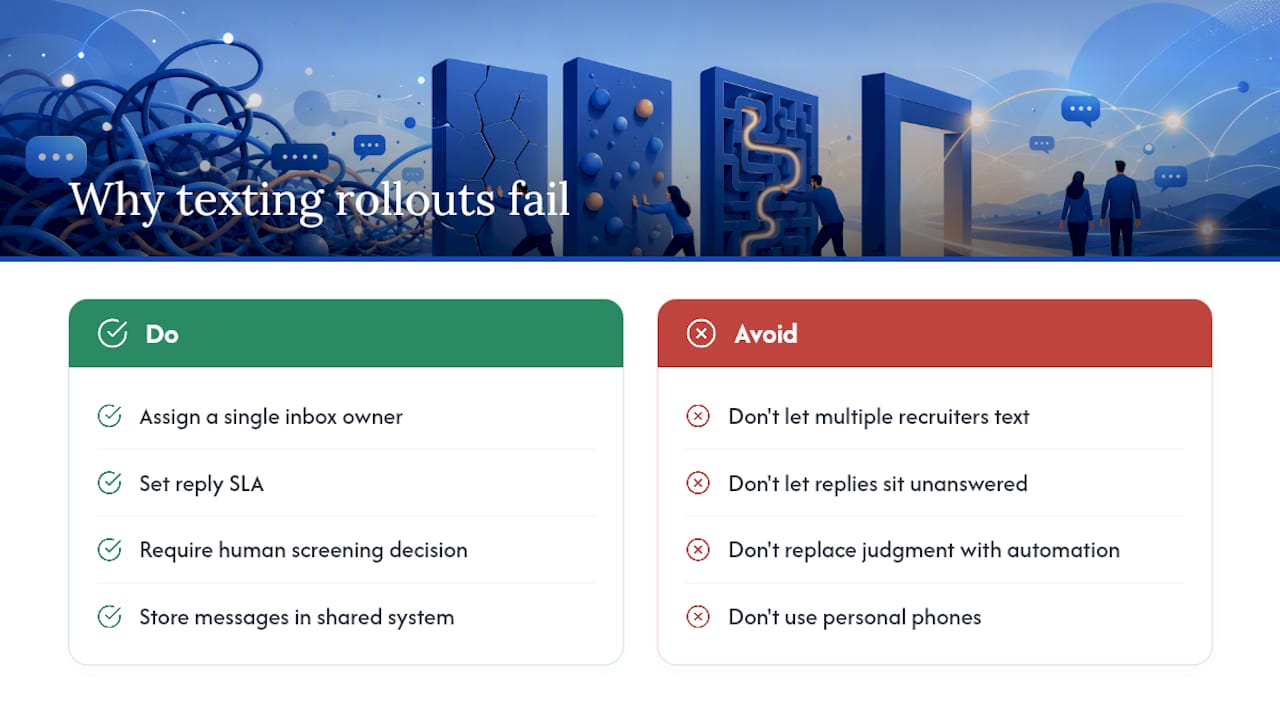
Most texting failures aren’t legal disasters. They’re organizational ones. Two recruiters both text the same candidate because nobody owns the shared inbox, or a reply sits unanswered for two days because no one set an SLA. Clear ownership prevents both.
The bigger mistake is letting texting replace judgment. Automation should speed up intake and routine scheduling, but the actual screening decision, whether this candidate moves forward, still belongs to a person reading the full thread. Keep personal phones out of the workflow entirely; every message needs to live where compliance and hiring managers can both see it.
— Hippolyte A.
How Jobsai Enterprise Supports Every Step of the Texting Checklist
The platform cuts the manual coordination out of two-way texting by connecting AI screening, shared inbox logging, and workflow automation inside one recruiting operating system, so you’re not stitching together a texting tool and your ATS by hand.
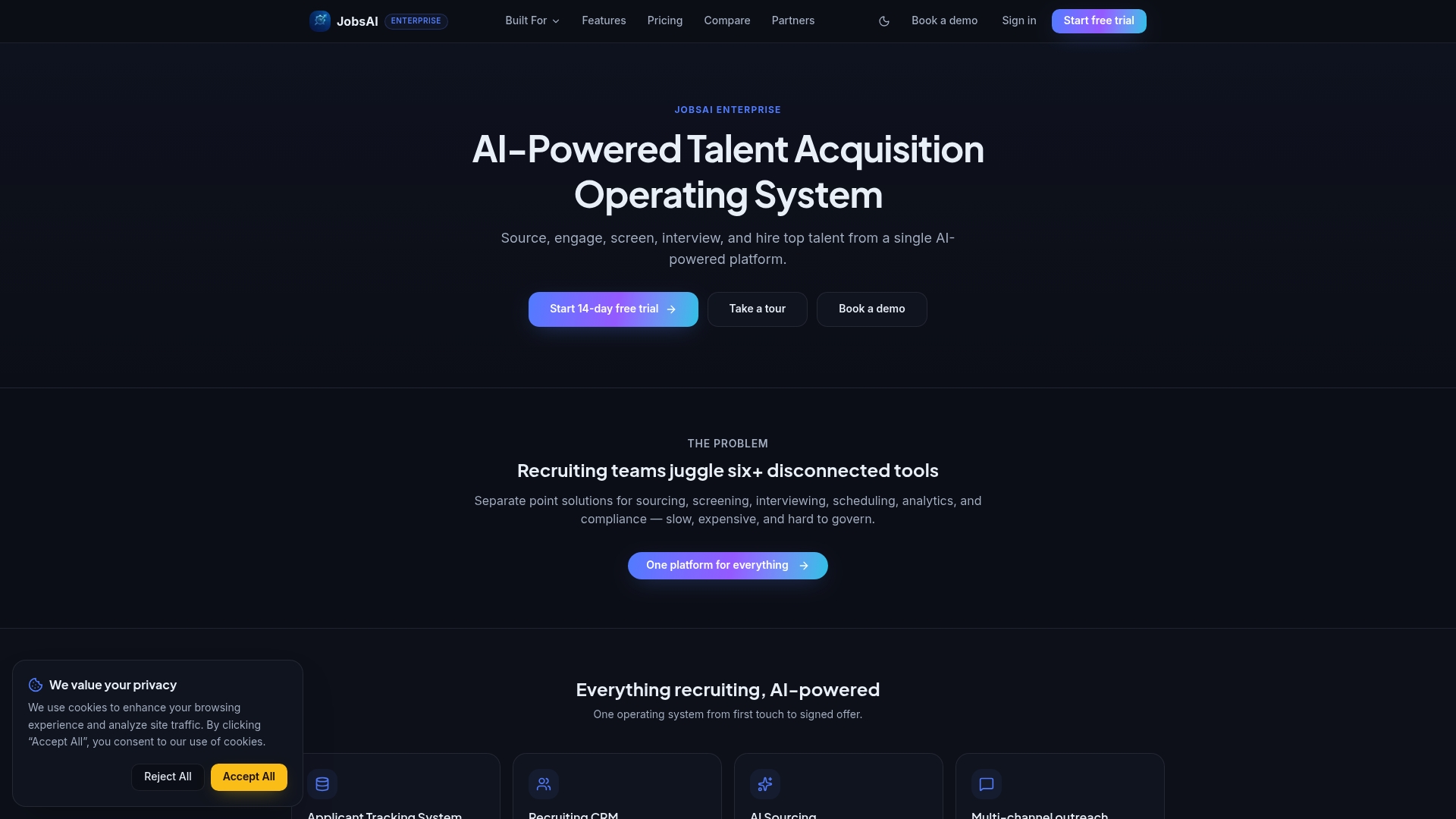
Every reply threads back to the candidate’s record automatically, which solves the audit-trail problem outlined above without a separate compliance project. The AI screening feature handles intake and pre-screening around the clock, while workflow automation manages pause-on-reply sequences and escalation routing so no candidate falls through the cracks between recruiters.
Start the way the pilot section recommends: pick one high-volume role, load a campaign with a handful of tested templates, and measure response rate for two weeks before expanding. If you’re ready to see how the pieces fit together, take the product tour or check pricing to scope a pilot for your team.
Primary Regulations and Industry Resources
- SHRM guidance on texting candidates
- TextUs guide to SMS recruiting integration
Sources
- TCPA rules (PDF) — FCC
- Business texts on personal phones: the growing compliance and enforcement risk — NYU Law (Compliance Enforcement blog)
FAQ
Is P2P Texting Legal for Recruiters?
Yes, person-to-person and A2P texting are legal for recruiting when you have documented consent and follow TCPA rules on opt-in language, opt-out handling, and message frequency.
Will Recruiters Actually Reach Out via Text?
Increasingly, yes. Staffing agencies and corporate hiring teams are shifting first-touch outreach and scheduling to SMS because candidates respond faster to texts than to calls or emails, particularly for hourly and frontline roles.
What Should You Look for in a Texting App for Recruiting?
Prioritize a platform with A2P/10DLC support, ATS/CRM integration, a shared team inbox, automatic transcript logging, and built-in opt-out handling. Jobsai Enterprise bundles those capabilities with AI screening so texting connects directly to your existing candidate pipeline.
What Are Red Flags for Recruiters Using Text Outreach?
Watch for texting from unregistered personal numbers, no documented consent trail, missing opt-out confirmation, and messages that skip straight to sensitive personal or financial questions before establishing legitimacy. Any of those should make a candidate pause before replying further.
Recommended
See it in your workflow
JobsAI Enterprise runs sourcing, AI screening, and the whole interview pipeline in one place. Book a walkthrough tailored to your team.
Book a demo