
Article
Why Hiring Teams Lose Candidates: A 2026 Guide

Why Hiring Teams Lose Candidates: A 2026 Guide
TL;DR:
- Poor communication is the main reason candidates withdraw from hiring, accounting for 87.5% of dropouts. Slow processes, mismatched expectations, and poor interview experiences also contribute, leading to lost talent and higher costs. Focusing on clear, timely communication and fast decision-making can significantly reduce candidate attrition.
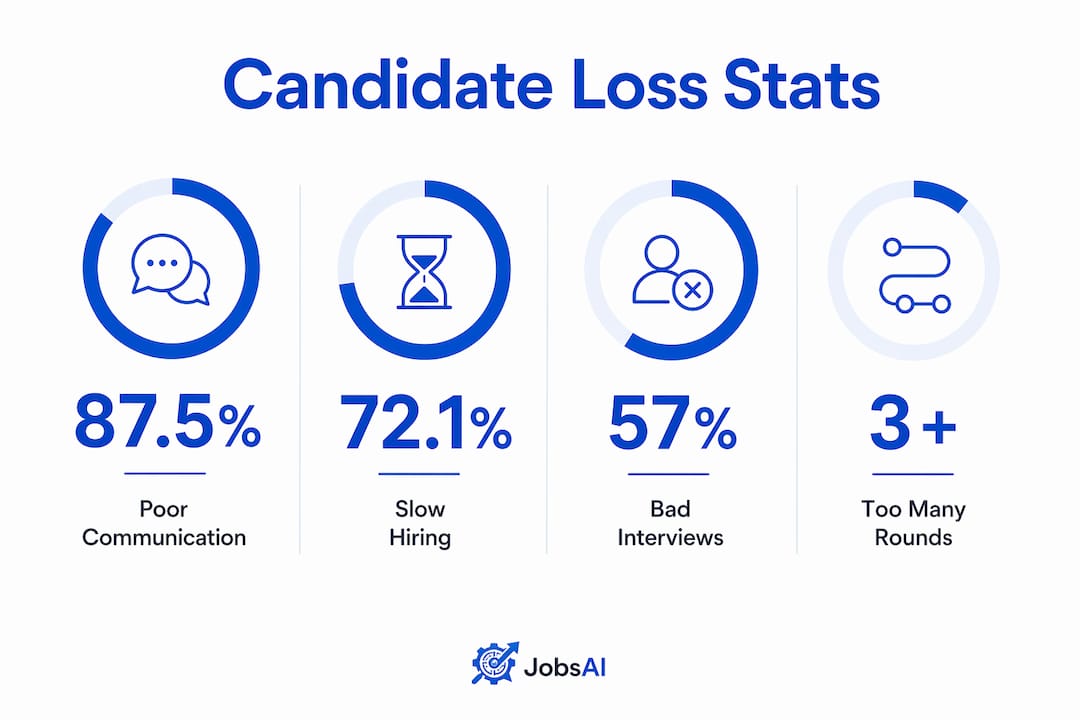
Candidate loss is defined as the withdrawal of qualified applicants from a hiring process before an offer is accepted. Understanding why hiring teams lose candidates is the first step toward fixing it. Poor communication tops the list, cited by 87.5% of candidates as their primary reason for dropping out. That figure alone tells you this is not a pipeline problem. It is a process problem. Slow timelines, misaligned job expectations, and negative interview experiences compound the damage. Each failure point costs you real talent, and in a tight labor market, those losses add up fast.
Why hiring teams lose candidates: the core breakdown
The industry term for this problem is candidate attrition, and it happens at every stage of the funnel. Most hiring teams focus on sourcing more candidates to compensate. The smarter fix is reducing the drop-off rate among candidates already in the process.
Slow hiring timelines frustrate 72.1% of candidates, and the average time-to-fill has increased by 37% in recent years. That combination is lethal. Candidates do not wait. They accept other offers, and your role stays open longer, which costs more in both time and money. The four main factors driving candidate attrition are communication failures, process delays, expectation mismatches, and poor interview experiences. Each one is preventable.
What are the top communication failures causing candidate loss?
Communication failure is the single largest driver of candidate withdrawal. 36% of candidates have declined offers specifically because of poor experiences during the hiring process, and 32% drop off at the interview stage alone.
The most common communication breakdowns hiring teams create include:
- No status updates after application submission. Candidates assume rejection and move on.
- Vague next steps after interviews. “We’ll be in touch” is not a timeline. It creates anxiety.
- Zero feedback after rejection. Candidates remember how they were treated, and so does their network.
- Delayed responses to candidate questions. A two-day wait on a simple salary question signals disorganization.
- Inconsistent messaging between recruiter and hiring manager. Contradictory information destroys trust immediately.
The psychological impact of poor communication is underestimated. Candidates interpret silence as disrespect. They also use the hiring experience as a direct preview of what working at your company will feel like. A candidate experience standard built around consistent, timely communication changes that perception fast.
Pro Tip: Set a 48-hour maximum response window for every candidate touchpoint. Automate status updates at each stage transition so no candidate goes more than two business days without hearing from your team.
How do slow hiring processes contribute to losing candidates?
Speed in hiring is about decisiveness, not just pace. Candidates avoid processes marked by delays and indecision because those delays signal organizational dysfunction, not thoroughness.
The most damaging slow-process patterns follow a predictable sequence:
- Application to first contact takes more than a week. Top candidates are typically off the market within 10 days of starting a search.
- More than three interview rounds. Candidates view multiple interviews beyond three as bureaucratic and time-wasting.
- Internal alignment delays between rounds. When hiring managers take two weeks to debrief, candidates interpret that as a lack of priority.
- No clear decision timeline communicated upfront. Candidates cannot plan their own job search without knowing your schedule.
- Offer approval bottlenecks. A strong verbal offer that takes 10 days to formalize in writing loses candidates to faster-moving employers.
Slow, opaque hiring signals bureaucracy and a lack of leadership commitment. Highly qualified passive candidates, who are often the most valuable hires, are especially sensitive to this. They are not desperate. They have options, and they will choose the employer who respects their time.
Reducing time-to-hire gaps requires clear ownership at every stage. Assign one person accountable for moving each candidate forward. Set internal deadlines, not just candidate-facing ones.

Pro Tip: Map your current hiring process end-to-end and identify every handoff point. Each handoff is a potential delay. Eliminate or automate the ones that do not require human judgment.
Why do misaligned job expectations prompt candidates to withdraw?
Misaligned expectations are a trust problem, not a sourcing problem. 72% of candidates have withdrawn from a process after discovering the actual role differed significantly from what was advertised.
The most common expectation gaps that trigger late-stage withdrawals include:
- Salary range shifts. A role advertised at $90,000–$110,000 that comes in at $75,000 at offer stage is a bait-and-switch. Candidates do not forget it.
- Scope changes. A “senior individual contributor” role that turns out to include managing a team of eight is a fundamentally different job.
- Culture misrepresentation. Describing a rigid, hierarchical environment as “collaborative and fast-moving” destroys credibility the moment a candidate meets the team.
- Remote work policy contradictions. Advertising flexibility and then requiring five days in-office at the offer stage ends the conversation immediately.
The bait-and-switch effect from mismatched role descriptions destroys trust in a way that is nearly impossible to repair. Candidates who withdraw for this reason rarely reconsider, and they share their experience. Accurate job descriptions and consistent messaging across every touchpoint, from the job post to the final offer letter, are the fix. Audit your job descriptions against what hiring managers actually want before posting.
What aspects of the interview experience lead candidates to decline offers?
The interview is the moment candidates decide whether they want to work for you. 57% of candidates withdraw after a poor interview experience. That is more than half your pipeline, lost at the stage where you have already invested the most time.
Stat to know: Poor interviewer attitude, unpreparedness, or irrelevant questions lead to a 56% exit rate among candidates who otherwise intended to accept an offer.
The behaviors that drive candidates away during interviews are specific and consistent:
- Interviewers who have not read the resume. Asking a candidate to “walk me through your background” when it is all on the page signals that their time is not valued.
- Inappropriate or legally questionable questions. Questions about family status, age, or nationality are not just off-putting. They are a legal liability.
- Disorganized panel interviews. When interviewers repeat the same questions or contradict each other, candidates perceive internal dysfunction.
- No opportunity for the candidate to ask questions. Top-tier candidates treat the interview as a two-way evaluation. Cutting off their questions signals a one-sided culture.
Top candidates evaluate recruiter and interviewer behavior as a direct indicator of company culture. A disorganized interview does not just lose one candidate. It generates negative word-of-mouth that affects future applicants. Structured interviewer training and a standardized question set solve most of these problems. The hiring manager workspace approach, where interviewers coordinate on questions and feedback before and after each session, reduces these failures significantly.
Key Takeaways
Candidate attrition is preventable when hiring teams address communication, speed, accuracy, and interview quality as connected systems rather than isolated problems.
| Point | Details |
|---|---|
| Communication is the top driver | 87.5% of candidates cite poor communication as their reason for withdrawing from a hiring process. |
| Speed signals decisiveness | Processes with more than three interview rounds or multi-week delays lose candidates to faster employers. |
| Expectation accuracy builds trust | 72% of candidates withdraw when the actual role differs from what was advertised. |
| Interview quality predicts offer acceptance | 57% of candidates decline after a poor interview experience, making interviewer preparation non-negotiable. |
| Process design reflects company culture | Candidates use hiring efficiency as a direct proxy for how the organization operates day-to-day. |
What I have learned about candidate loss after years in recruiting
The uncomfortable truth about candidate attrition is that most hiring teams know exactly where they are losing people. They just do not act on it because fixing the process requires internal coordination that feels harder than sourcing more candidates.
I have seen teams spend significant budget on job board advertising while ignoring a two-week gap between the final interview and the offer letter. That gap is where the best candidates disappear. They do not ghost you out of rudeness. They accept the offer from the employer who moved faster and communicated clearly.
The candidate-centric hiring mindset is not about being soft on standards. It is about recognizing that qualified candidates have choices. Every unnecessary delay, every vague email, and every disorganized interview round is a signal that your organization does not value their time. The best candidates read those signals accurately.
My practical advice: treat your hiring process the way you treat a client-facing process. Set response time standards. Assign clear ownership. Audit your job descriptions against reality before posting. Train your interviewers on structure and legal compliance. These are not complex changes. They are discipline and coordination, applied consistently.
The teams that retain the most candidates are not the ones with the most sophisticated technology. They are the ones with the clearest internal accountability and the most consistent candidate communication. Technology helps, but the foundation is process clarity.
— Hippolyte A.
How Jobsai Enterprise helps reduce candidate drop-off
Hiring teams that address candidate attrition systematically need more than good intentions. They need a process that holds together across every stage, from first contact to offer.
Jobsai Enterprise is an AI-powered talent acquisition operating system built for recruiting teams and hiring managers who need to move faster without losing quality. It automates candidate status updates, ranks applicants against job requirements, and keeps every team member aligned on next steps. The workflow automation features eliminate the manual handoffs that cause most hiring delays. The recruiting CRM keeps candidate communication consistent and on schedule. If your team is losing candidates to process gaps, Jobsai Enterprise is built to close them.
FAQ
What is the leading cause of candidate withdrawal?
Poor communication is the leading cause, cited by 87.5% of candidates in surveys. Delayed updates, unclear next steps, and no post-rejection feedback are the most common failures.
How many interview rounds before candidates drop out?
Candidates view more than three interview rounds as excessive. Processes beyond three rounds are perceived as bureaucratic, and top candidates typically withdraw or accept competing offers before completing them.
Why do candidates decline offers after reaching the final stage?
Late-stage withdrawals most often result from misaligned expectations, where the actual role, salary, or culture differs from what was advertised. 72% of candidates have withdrawn for this reason.
How does interview quality affect offer acceptance rates?
A poor interview experience causes 57% of candidates to withdraw. Interviewer unpreparedness and disorganized panel formats are the primary triggers.
What is the fastest way to reduce candidate drop-off?
Set a maximum 48-hour response window at every stage and assign clear ownership for moving candidates forward. Consistent candidate follow-up practices alone reduce attrition significantly without requiring process redesign.
Recommended
- Where teams lose time-to-hire — and how to win it back | JobsAI Enterprise
- Candidate Follow-Up Best Practices for Recruiters | JobsAI Enterprise
- Mid-Market Hiring Challenges: What HR Teams Face in 2026 | JobsAI Enterprise
- US Staffing Industry Benchmarks 2026: Hiring Manager’s Guide | JobsAI Enterprise
See it in your workflow
JobsAI Enterprise runs sourcing, AI screening, and the whole interview pipeline in one place. Book a walkthrough tailored to your team.
Book a demo