
Article
Mid-Market Hiring Challenges: What HR Teams Face in 2026

Mid-Market Hiring Challenges: What HR Teams Face in 2026
TL;DR:
- Mid-market companies face persistent hiring difficulties due to skills gaps, AI-generated application noise, and high employee attrition. These factors increase screening workload and perpetually keep roles open, making process improvements and workforce development essential. Investing in AI screening tools, internal skills training, and clear career paths helps mid-market firms overcome operational and talent shortages.
The mid-market hiring challenge is defined as the persistent difficulty mid-sized companies face in finding, screening, and retaining qualified talent while operating under resource constraints that large enterprises do not share. This is not simply a volume problem. Skills gaps, AI-generated application noise, and weak career path perception combine to create a compounding recruitment obstacle that most mid-market HR teams are underprepared for. 84% of mid-market executives expect staffing open roles to be at least somewhat challenging in the next 12 months. That figure signals a structural problem, not a temporary hiring slowdown.
What is the mid-market hiring challenge, exactly?
The mid-market hiring challenge, also called mid-market talent acquisition difficulty in HR literature, describes the gap between the volume of applicants a mid-sized company receives and the actual number of qualified, job-ready candidates within that pool. Mid-market firms typically employ between 100 and 2,000 people. They compete for talent against both large enterprises with strong employer brands and smaller firms that offer flexibility and equity upside.
The core problem is skills supply. 58% of business leaders report that finding skilled talent is harder now than a year ago. Only 6% feel confident they have the talent needed for priority projects. That gap is not closing on its own.
Three factors drive this challenge most directly:
- Skills gaps: Demand for technical and specialized roles outpaces the available candidate supply in most U.S. metro markets.
- AI application noise: AI tools allow candidates to apply to dozens of roles in minutes, flooding inboxes with low-fit applications.
- Retention pressure: Mid-market firms lose employees at higher rates than large companies, which forces continuous rehiring for the same roles.
Each factor amplifies the others. A team spending more time screening low-quality applications has less time to build the retention programs that would reduce turnover in the first place.
What are the main hiring challenges mid-market companies face?
Mid-market recruitment obstacles cluster around three operational realities: a shrinking qualified candidate pool, a growing screening workload, and a retention gap that keeps roles perpetually open.

Skills shortages are widening, not narrowing
The qualified candidate pool for technical, operational, and specialized roles is not keeping pace with demand. Robert Half research shows skills gaps are widening across industries, with hiring managers reporting more pronounced shortages in 2026 than in prior years. Mid-market firms feel this more acutely because they cannot offer the compensation packages or brand recognition that draw top candidates to Fortune 500 employers.
Geographic competition compounds the problem. RSM’s Middle Market Business Index identifies skills supply and geographic competition as the primary drivers of hiring difficulty, not the number of job openings. A mid-sized manufacturer in a secondary market competes with remote-first tech companies for the same engineering talent.
AI-generated applications are increasing screening friction
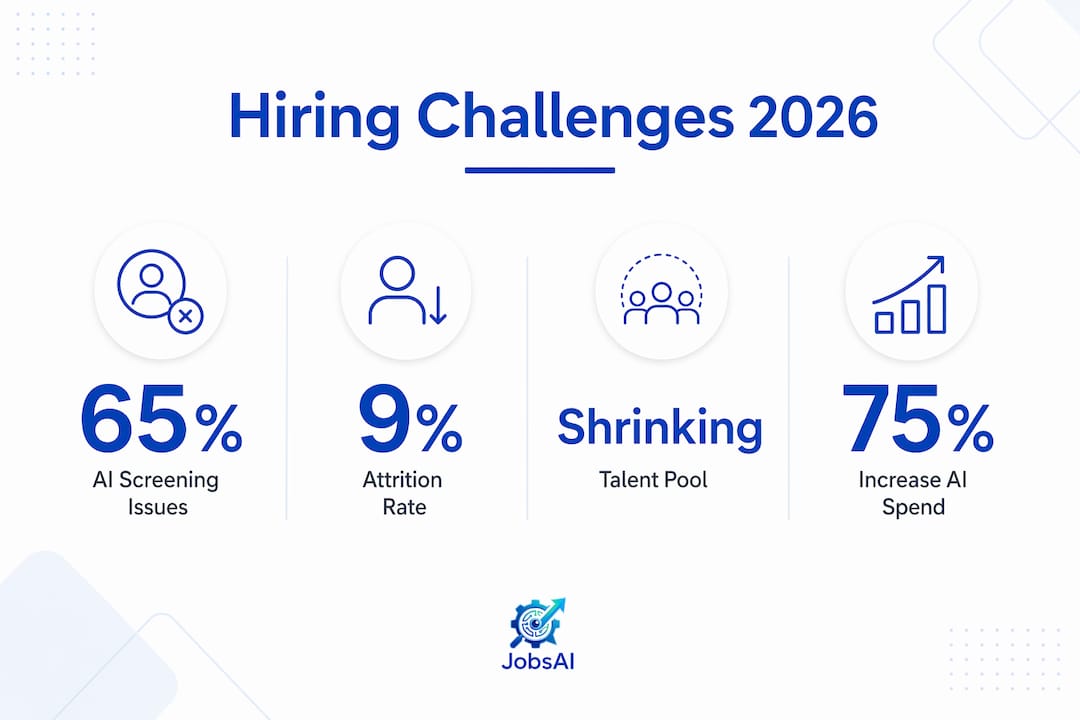
65% of business leaders report challenges specifically tied to AI-generated applications. Candidates now use AI writing tools to tailor resumes and cover letters at scale, making it harder to distinguish genuine fit from well-formatted noise. This means a recruiter reviewing 200 applications may find the same number of qualified candidates as when reviewing 80, but the work to get there has more than doubled.
Attrition keeps the pipeline permanently open
Mid-market companies experience 9% annual employee attrition compared to 7% at large-cap firms. That two-point difference sounds small. Across a 500-person organization, it means roughly 10 additional departures per year, each requiring a full recruiting cycle. The cost and time compound quickly.
How do sourcing and screening challenges show up operationally?
The operational reality for mid-market hiring teams is a bottleneck that sits between receiving applications and making confident hiring decisions. Time-to-hire is usually lost in the gaps between steps, not in any single stage.
Increased candidate volume from AI does not speed hiring. The throughput issue affects hiring manager feedback speed and skills validation capacity, not just candidate reach. A recruiter managing three open roles simultaneously cannot give each applicant the review time needed to confirm job fit. The result is a slower decision cycle despite a full pipeline.
| Challenge | Earlier stage impact | Current stage impact |
|---|---|---|
| AI-generated applications | Low: fewer applications overall | High: volume surge, low signal-to-noise ratio |
| Skills validation | Low: candidates self-reported skills | High: manual confirmation required for each candidate |
| Hiring manager bandwidth | Low: fewer roles, smaller teams | High: multiple open roles, limited review time |
| Candidate quality | Moderate: some mismatches expected | High: AI polish masks actual skills and experience |
The table above shows how each challenge has shifted in severity. What was once a manageable mismatch problem is now a structural screening workload problem.
Pro Tip: Set a skills confirmation step early in your screening process, before the hiring manager review stage. A short skills assessment or structured phone screen filters out AI-polished applications faster than resume review alone.
Hiring teams that rely on resume review as the primary filter are working against themselves. The screening and validation bottleneck is the single biggest operational drag on mid-market recruiting speed. Fixing it requires process changes, not just more headcount.
What strategies are mid-market companies using to overcome hiring challenges?
Mid-sized companies are responding to recruitment difficulties with a combination of technology investment, internal development, and workforce redesign. The most effective approaches address both the supply side and the retention side of the problem simultaneously.
The U.S. Chamber of Commerce reports that top planned investments among mid-market firms include:
- New skills training (62%): Building internal capability rather than waiting for the external market to supply it.
- AI investments (61%): Using AI tools to screen, rank, and assess candidates faster and more consistently.
- AI preparation (59%): Training existing staff to work alongside AI tools in hiring and operations.
Nearly three-quarters of mid-market firms expect to increase AI spending over the next two years. That signals a broad recognition that manual hiring processes cannot scale to meet current demand.
Outsourcing and co-sourcing for hard-to-fill roles
Mid-market companies are increasingly using outsourced or co-sourced recruiting for IT and customer service roles where internal capacity is thin. This approach reduces time-to-fill for specialized positions without requiring a full internal recruiting team expansion. The tradeoff is cost and cultural fit risk, both of which require careful vendor selection.
Building an internal labor market
Upskilling and internal labor-market building are growing components of mid-market hiring strategy. Rather than treating every open role as an external search, forward-looking HR teams are mapping current employees to future roles and investing in the training to close the gap. This reduces external recruiting costs and improves retention by giving employees a visible career path.
Pro Tip: Before posting an open role externally, run a 10-minute internal skills audit against your current employee database. You may already have someone 80% qualified who can be trained into the role faster than an external hire can be onboarded.
How do retention and internal mobility affect the hiring challenge?
Retention and recruiting are not separate problems. Every employee who leaves creates a recruiting need. Mid-market firms that treat retention as an HR function separate from talent acquisition are solving half the problem.
BCG research shows that employees at mid-market firms score career opportunities at 3.5 out of 5, compared to 4.1 out of 5 at large-cap firms. That gap directly affects both retention and recruiting. Candidates evaluate career growth potential during the interview process. If your team cannot articulate a clear path forward, you lose candidates to competitors who can.
Four practical steps to address retention-driven recruiting pressure:
- Map career paths before posting roles. Define what the next two roles look like for anyone you hire into a position. Share that map during interviews.
- Communicate internal mobility options during onboarding. BCG’s research confirms that career pathway transparency early in the employee lifecycle reduces attrition at mid-market firms.
- Track attrition by role and tenure. Identify which roles turn over most frequently and at what point. That data tells you where your retention messaging is failing.
- Connect recruiting messaging to development programs. If you have a skills training program, mention it in job postings. Candidates who value growth will self-select in.
The 9% versus 7% attrition gap between mid-market and large-cap firms is not inevitable. It reflects a structural difference in how career opportunity is communicated and delivered. Closing that gap is a recruiting advantage, not just an HR metric.
Key Takeaways
Mid-market hiring challenges are structural, not cyclical. Addressing them requires simultaneous investment in screening efficiency, skills development, and career path clarity.
| Point | Details |
|---|---|
| Skills gaps are the root cause | Only 6% of organizations have the talent needed for priority projects, making external supply unreliable. |
| AI applications increase screening work | 65% of leaders report AI-generated applications add friction, requiring more rigorous skills validation. |
| Attrition compounds recruiting costs | Mid-market firms lose employees at 9% annually versus 7% at large caps, keeping roles perpetually open. |
| Investment priorities are clear | 62% of mid-market firms plan skills training and 61% plan AI investment to address hiring shortfalls. |
| Retention starts during recruiting | Career opportunity scores of 3.5/5 at mid-market firms versus 4.1/5 at large caps show a gap recruiters can close with better messaging. |
What I have learned about mid-market hiring after years in the field
The conversation about mid-market hiring challenges tends to focus on tools and tactics. That misses the deeper issue. The real problem is that most mid-market HR teams are running a 2019 recruiting process against a 2026 talent market.
I have seen teams invest in applicant tracking systems and AI screening tools without changing how they define job fit. The result is faster processing of the wrong candidates. Technology does not fix a broken definition of what you are actually hiring for. That work has to happen first.
The retention piece is where I see the most consistent underinvestment. Mid-market companies spend heavily on sourcing and almost nothing on making the career path legible to new hires. A candidate who joins without a clear picture of where they can go will leave within 18 months. You will then spend more recruiting them again. The math on proactive career development is straightforward. The execution is where most teams fall short.
My honest recommendation: before your next hiring cycle, spend two hours mapping the internal mobility options for your five most frequently open roles. Then build that map into your recruiting pitch. You will not eliminate attrition, but you will reduce the portion of it that comes from unmet expectations. That is the most cost-effective recruiting improvement most mid-market teams can make right now.
— Hippolyte A.
How Jobsai Enterprise helps mid-market hiring teams move faster
Mid-market hiring teams need a way to handle higher application volumes without adding headcount to the recruiting function. That is the core problem Jobsai Enterprise is built to solve.
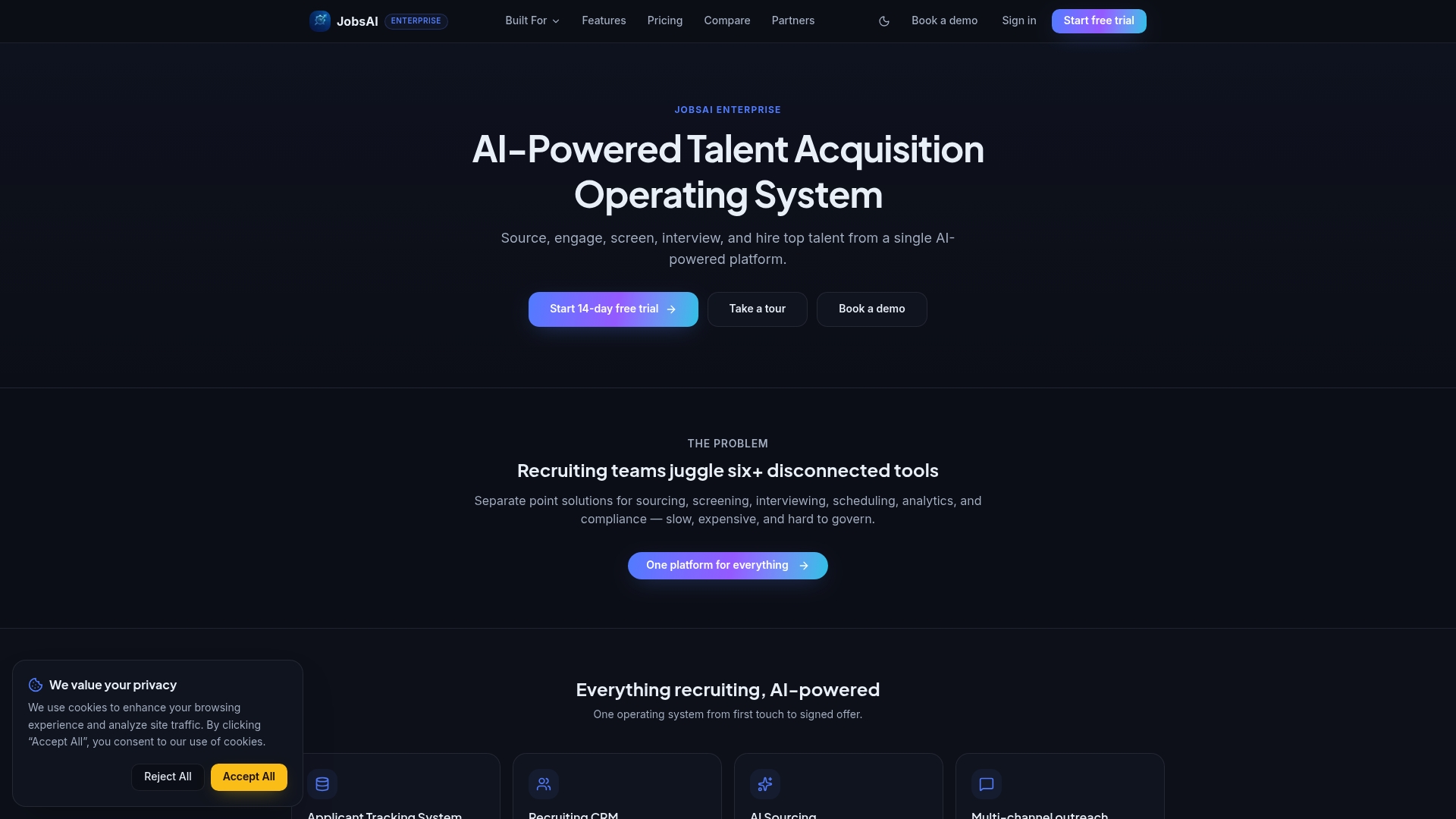
Jobsai Enterprise is an AI-powered talent acquisition platform that screens, ranks, and organizes candidates automatically. It matches resumes against job requirements, scores candidates on skills fit, and reduces the manual review time that creates bottlenecks in mid-market recruiting workflows. Hiring managers get a shorter, better-ranked candidate list. Recruiters spend less time on low-fit applications and more time on the candidates who actually match. If you are managing volume and quality at the same time, the mid-market hiring solution Jobsai Enterprise offers is worth a close look.
FAQ
What is a mid-market hiring challenge?
The mid-market hiring challenge is the difficulty mid-sized companies face in finding, screening, and retaining qualified talent while competing against larger employers with stronger brands and bigger budgets. Skills gaps, AI-generated application noise, and higher attrition rates are the primary drivers.
Why is finding skilled talent harder for mid-market companies?
Mid-market firms compete for the same specialized talent as large enterprises but cannot match compensation packages or brand recognition. Robert Half research shows 58% of business leaders report finding skilled talent is harder than a year ago, with skills gaps widening across most industries.
How does AI affect mid-market recruiting?
AI tools allow candidates to apply to many roles quickly, increasing application volume without increasing candidate quality. 65% of business leaders report that AI-generated applications add screening friction, requiring more time for skills validation and resume verification.
What is the attrition rate at mid-market companies?
Mid-market companies experience 9% annual employee attrition compared to 7% at large-cap firms, according to BCG research. That gap keeps recruiting pipelines permanently active and increases the total cost of talent acquisition.
What are the most effective strategies for mid-market talent acquisition?
The most effective strategies combine AI-assisted screening, internal skills training, and career path transparency. U.S. Chamber of Commerce data shows 62% of mid-market firms plan new skills training investments and 61% plan AI investments to address ongoing hiring shortfalls.
Recommended
See it in your workflow
JobsAI Enterprise runs sourcing, AI screening, and the whole interview pipeline in one place. Book a walkthrough tailored to your team.
Book a demo