
Article
How Staffing Firms Scale Hiring: a 2026 Growth Guide

How Staffing Firms Scale Hiring: a 2026 Growth Guide
TL;DR:
- Staffing firms scale hiring by automating prospecting, outsourcing sourcing tasks, and developing structured outreach strategies. Prioritizing gross margin over revenue and separating business development from delivery functions support sustainable growth. Using verified data, clear playbooks, and targeted account lists enables effective expansion and improved conversion.
Scaling hiring in a staffing firm means expanding placement capacity without proportionally increasing overhead. The firms that grow past $5M in revenue share three structural advantages: a data-driven business development (BD) infrastructure, repeatable recruitment workflows, and a clear separation between founder activity and daily operations. The American Staffing Association identifies gross margin discipline and leadership clarity as the foundations of sustainable staffing growth. Understanding how staffing firms scale hiring requires looking at all three levers together, not in isolation.
How staffing firms scale hiring with data-driven infrastructure
Data infrastructure is the fastest-returning investment a staffing firm can make in its BD operation. Most agencies waste recruiter and BD rep time on manual list building, contact verification, and CRM cleanup. That time compounds into lost revenue every week.

Automating list building and contact verification reclaims 8–15 hours per BD rep per week. That is the equivalent of adding a half-rep to your team without any additional labor cost. For a firm with three BD reps, that recovered time equals roughly 1.5 additional full-time contributors in productive outreach hours.
Verified hiring company databases with hiring intent signals reduce the time to build a qualified prospect list from 6–12 weeks down to 2 days. That compression matters because speed to outreach directly affects conversion. When a company posts a new role or signals expansion, the first staffing firm to reach them wins the conversation.
The quality of your list also shapes your conversion rate. Vertical-matched outbound campaigns convert at 3–5 times the rate of generalist campaigns. A BD rep calling manufacturing companies with a manufacturing-specific pitch will outperform a rep calling a mixed list every time.
| Infrastructure Component | Manual Approach | Automated Approach |
|---|---|---|
| List building time | 6–12 weeks | 2 days |
| BD rep hours recovered | 0 | 8–15 hours per week |
| Outbound conversion rate | Baseline | 3–5x higher (vertical-matched) |
| CRM data quality | Inconsistent | Verified and current |
Pro Tip: Connect your verified hiring database directly to your CRM so BD reps start each day with a pre-loaded call list. Remove the friction of list prep and they spend more time on conversations that close.
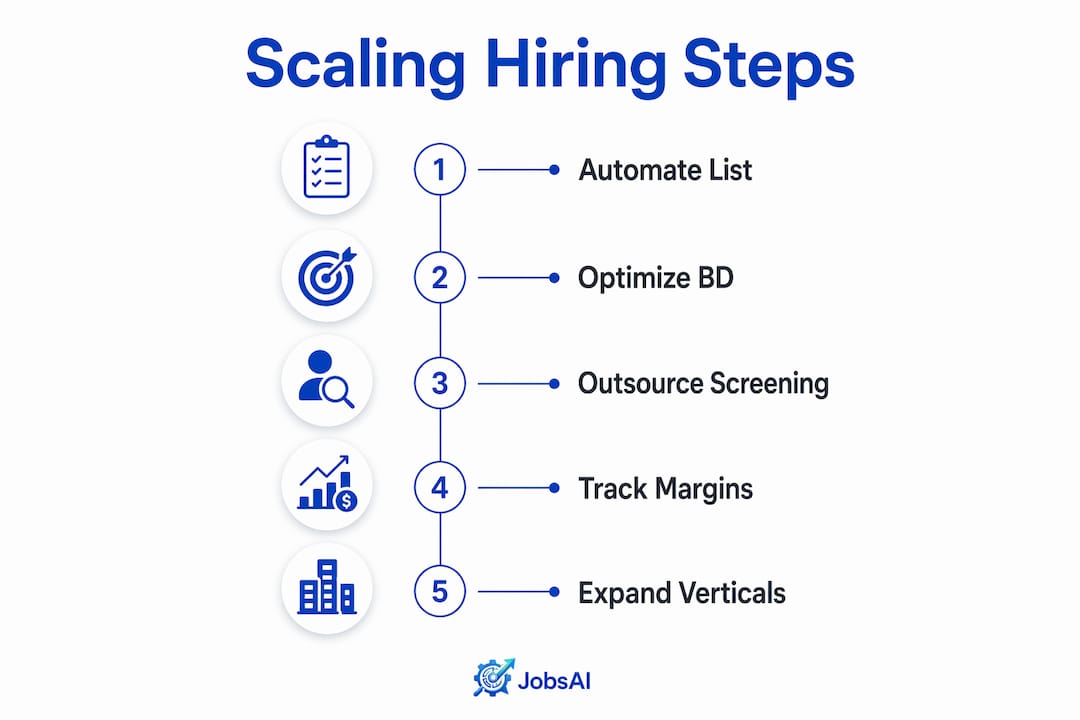
How can staffing firms optimize business development for scalable hiring?
Business development is where most staffing agencies leave the most growth on the table. The fix is not hiring more reps. The fix is giving the reps you have a structured system to work.
The foundation of that system is the Ideal Client Profile (ICP). An ICP defines the exact type of company your firm serves best: industry vertical, company size, geography, hiring frequency, and average bill rate. Without it, BD reps chase any open door and close very few of them.
Once you have an ICP, you build named account lists around it. Named account lists of 1,000–2,000 companies per BD rep, filtered by vertical and geography, drive the most efficient outreach and conversion. That specificity gives reps a finite, workable universe instead of an overwhelming sea of prospects.
From there, the playbook matters as much as the list. A repeatable BD playbook documents the outreach sequence, qualification gates, objection responses, and handoff criteria. It removes guesswork from the process and makes training new reps faster.
- Define your ICP. Identify the 3–5 firmographic traits that describe your best current clients. Use those traits to filter your prospect database.
- Build named account lists. Assign each BD rep a list of 1,000–2,000 target companies. Refresh the list quarterly based on hiring signals.
- Document the playbook. Write down every step from first touch to signed contract. Include email templates, call scripts, and qualification criteria.
- Set qualification gates. Define what a qualified opportunity looks like before a rep spends time on a discovery call. This protects recruiter capacity.
- Track signal-based triggers. Monitor job postings, LinkedIn hiring announcements, and funding news to time outreach when companies are actively hiring.
Owner extraction is the structural unlock that most founders resist. Founders who remain the primary BD rep become a ceiling on growth. Hiring BD reps from B2B sales backgrounds with cadence discipline, and coaching them through a documented playbook, is how firms break past that ceiling. Expect 90–180 days to ramp a new BD rep to 60% of founder conversion rate. That timeline is predictable when the playbook exists.
Pro Tip: When hiring BD reps, prioritize candidates with B2B sales experience over recruiting backgrounds. Cadence discipline and pipeline management skills transfer faster than industry knowledge.
What operational models support scalable recruitment delivery?
Growing your client base creates a delivery problem if your recruitment operations cannot keep pace. Scaling recruitment processes on the delivery side requires a different set of decisions than scaling BD.
The core challenge is that internal recruiter capacity does not flex easily. When hiring volumes spike, internal teams get stretched, submission quality drops, and time-to-fill increases. Clients notice.
Outsourcing recruitment support addresses this directly. Offshore recruitment teams handle sourcing, screening, coordination, and reporting, which reduces the workload on internal recruiters and lets them focus on high-value tasks like candidate relationship management and client communication. This model also gives firms the ability to scale up or down based on seasonal demand without the fixed cost of full-time hires.
Key operational benefits of outsourced recruitment support include:
- Faster submission speed. Offshore teams working in different time zones can source and screen candidates overnight, so internal recruiters start each day with a shortlist ready.
- Reduced recruiter burnout. Removing administrative sourcing tasks from internal recruiters keeps them focused on placements, not paperwork.
- Seasonal flexibility. Firms serving industries with cyclical hiring, such as logistics or retail, can scale support teams up during peak periods without permanent headcount additions.
- Consistent workflow execution. Documented processes handed to an outsourced team produce more consistent outputs than ad hoc internal processes under pressure.
- Lower cost per submission. Offshore labor rates for sourcing and screening are typically lower than domestic rates, improving margin on each placement.
Structured workflows are what make outsourcing work. Without documented intake processes, job order templates, and screening criteria, an outsourced team cannot deliver consistent quality. The investment in documentation pays off whether you outsource or not, because it also improves internal recruiter consistency.
Screening bottlenecks are one of the most common delivery failures in growing staffing firms. When screening slows hiring efficiency, client satisfaction drops and fill rates decline. Technology that automates initial screening and candidate ranking removes that bottleneck without adding headcount.
How do staffing firms measure and sustain growth while scaling hiring effectively?
Growth measurement is where many staffing firms make a costly mistake. Revenue is the wrong primary metric. Gross margin is the right one.
A firm billing $10M with 18% gross margin is less healthy than a firm billing $6M with 28% gross margin. Chasing revenue by accepting low-margin clients or high-volume, low-bill-rate contracts erodes the financial foundation needed to invest in people and technology. The American Staffing Association’s guidance on growth is clear: prioritize margin discipline over top-line expansion.
Sustainable growth also requires an honest leadership assessment before you scale. Firms that grow without the right internal leadership in place end up with operational chaos that damages client relationships and recruiter retention. Ask whether your current team can execute at 2x volume before you commit to 2x growth.
Key indicators of sustainable scaling:
- Gross margin per placement is trending up or holding steady as volume increases.
- Recruiter productivity metrics are tracked weekly, not monthly. Top-performing staffing firms track metrics and automate where possible to stay ahead of performance gaps.
- Client retention rate is above 80%. Losing clients while acquiring new ones is expensive and signals a delivery problem, not a BD problem.
- Employee engagement is measured at least twice per year. Recruiter turnover is one of the highest hidden costs in staffing.
Organic scaling preserves culture and execution quality. Acquisitions can accelerate growth strategically, but they introduce integration risk that can destabilize the core business if leadership is not ready.
Deepening a vertical before expanding into new ones is almost always the better path. Becoming the go-to firm for, say, light industrial placements in the Midwest gives you pricing power, referral volume, and recruiter expertise that generalist expansion cannot replicate. Effective talent pool management within a defined vertical compounds over time as your candidate database grows more relevant with every placement.
Key Takeaways
Staffing firms scale hiring by combining data-driven BD infrastructure, repeatable operational workflows, and gross margin discipline into a single growth system.
| Point | Details |
|---|---|
| Automate list building | Reclaim 8–15 hours per BD rep weekly by replacing manual prospecting with verified databases. |
| Build named account lists | Assign each BD rep 1,000–2,000 ICP-matched companies to focus outreach and improve conversion. |
| Extract the founder from BD | Hire B2B-trained BD reps with a documented playbook to break past founder-led growth ceilings. |
| Outsource delivery support | Use offshore recruitment teams for sourcing and screening to handle volume spikes without fixed headcount. |
| Measure gross margin, not revenue | Track margin per placement and client retention as the true indicators of healthy, sustainable growth. |
What I’ve learned about scaling staffing firms the hard way
The most common mistake I see in staffing firms trying to grow is confusing activity with infrastructure. A founder works 60 hours a week, closes most of the business personally, and assumes the firm is scaling because revenue is up. It is not scaling. It is growing dependent on one person.
The playbook concept sounds obvious until you try to write one. Most founders cannot document their BD process because it lives entirely in their head. That is the bottleneck. The first real step toward scale is sitting down and writing out every step from prospecting to signed contract, even if it takes two weeks. That document is worth more than any new hire you make before it exists.
I have also seen firms invest heavily in technology before fixing their data. An expensive applicant tracking system sitting on top of a messy, unverified contact database does not produce better results. It produces faster garbage. Clean, verified, intent-enriched data is the foundation. Technology amplifies what is already there.
The firms that scale well share one trait: they treat BD and delivery as separate functions with separate metrics, separate teams, and separate accountability. When one person is doing both, neither gets done at the level the firm needs to grow. Separating those functions is uncomfortable for founders who built the business by doing everything. It is also non-negotiable for growth past a certain point.
Candidate follow-up is another area where growing firms lose ground quietly. As volume increases, follow-up consistency drops, candidate experience suffers, and your talent pipeline degrades. Structured follow-up processes, supported by technology, are what keep your pipeline healthy at scale.
— Hippolyte A.
Jobsai Enterprise helps staffing firms hire at scale
Staffing firms that are ready to grow need more than a bigger team. They need a system that keeps candidate management organized, screening consistent, and workflows running without manual intervention at every step.
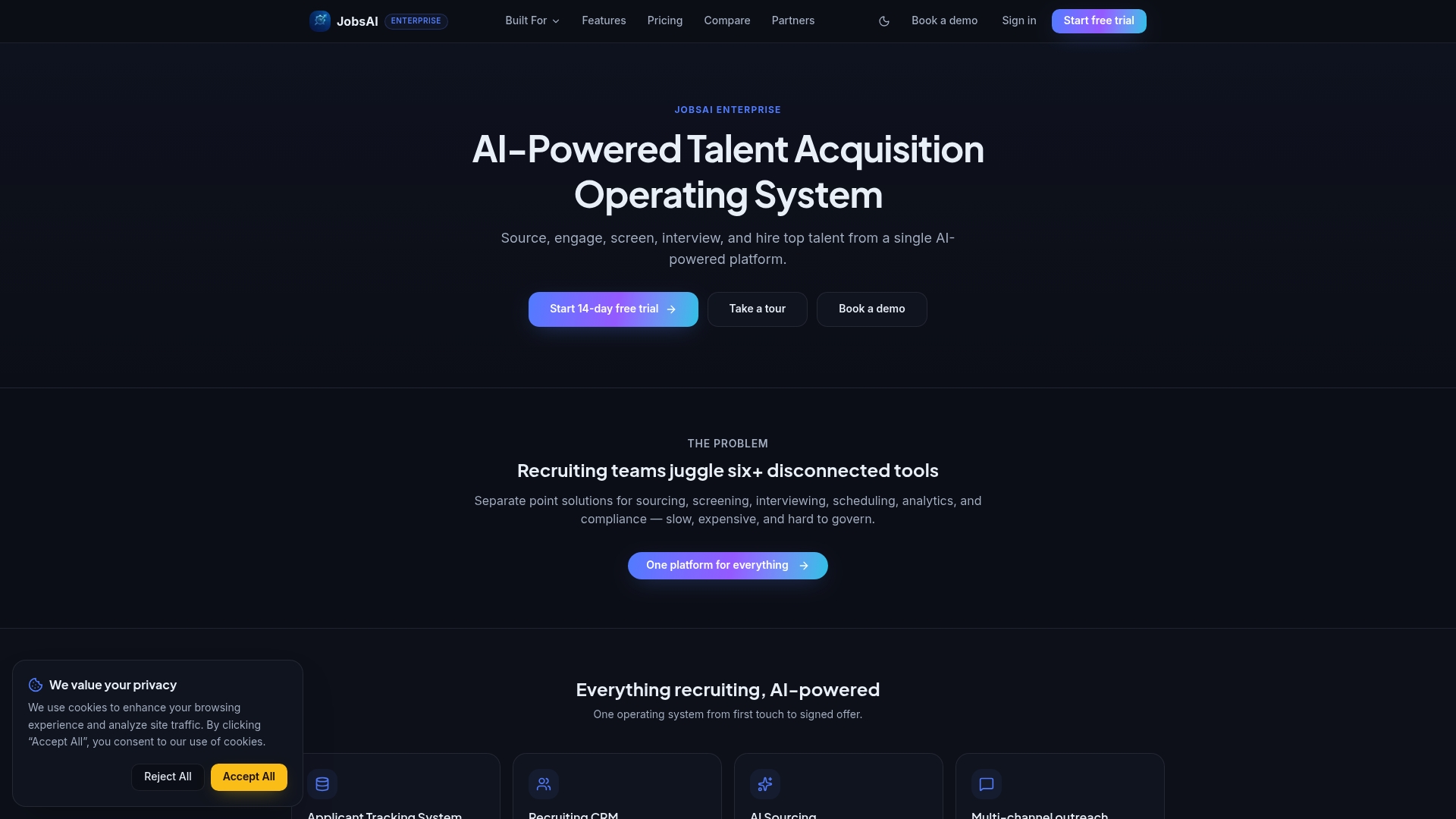
Jobsai Enterprise is an AI-powered talent acquisition operating system built for recruiting teams managing high volumes. It screens and ranks applicants automatically, matches resumes against job requirements, and organizes your hiring workflows in one place. BD teams and recruiters stay aligned without chasing each other for updates. If you want to see how it fits your operation, the Jobsai Enterprise built-for page shows exactly which staffing firm use cases the platform supports. You can also take a platform tour to see the workflows in action before committing.
FAQ
How do staffing firms scale hiring without adding headcount?
Staffing firms scale hiring by automating list building, outsourcing sourcing and screening tasks, and implementing repeatable BD playbooks. These approaches reclaim recruiter time and increase output per person rather than requiring proportional headcount growth.
What is the most important metric for a scaling staffing firm?
Gross margin per placement is a more reliable growth indicator than total revenue. Firms that prioritize margin discipline build the financial foundation needed to invest in people, technology, and client retention.
How long does it take to ramp a new BD rep in a staffing firm?
Expect 90–180 days for a BD rep hired from a B2B sales background to reach 60% of a founder’s conversion rate. A documented playbook and structured coaching shorten that ramp significantly.
Why do staffing firms outsource recruitment support?
Outsourcing recruitment support lets firms handle sourcing, screening, and administrative coordination through offshore teams, freeing internal recruiters for high-value placement and client relationship work.
What is an Ideal Client Profile in staffing?
An Ideal Client Profile (ICP) defines the specific firmographic traits of companies a staffing firm serves best, including industry, size, geography, and hiring frequency. BD reps use it to build focused named account lists and improve outbound conversion rates.
Recommended
See it in your workflow
JobsAI Enterprise runs sourcing, AI screening, and the whole interview pipeline in one place. Book a walkthrough tailored to your team.
Book a demo