
Article
Talent Pool Management: A Practical Guide for Recruiters

Talent Pool Management: A Practical Guide for Recruiters
TL;DR:
- Talent pool management involves building and maintaining a proactive database of qualified candidates to enable faster and more effective hiring. It reduces time-to-hire and costs while improving candidate fit and organizational agility. Implementing strong segmentation, communication, technology tools, and internal pools maximizes recruitment success.
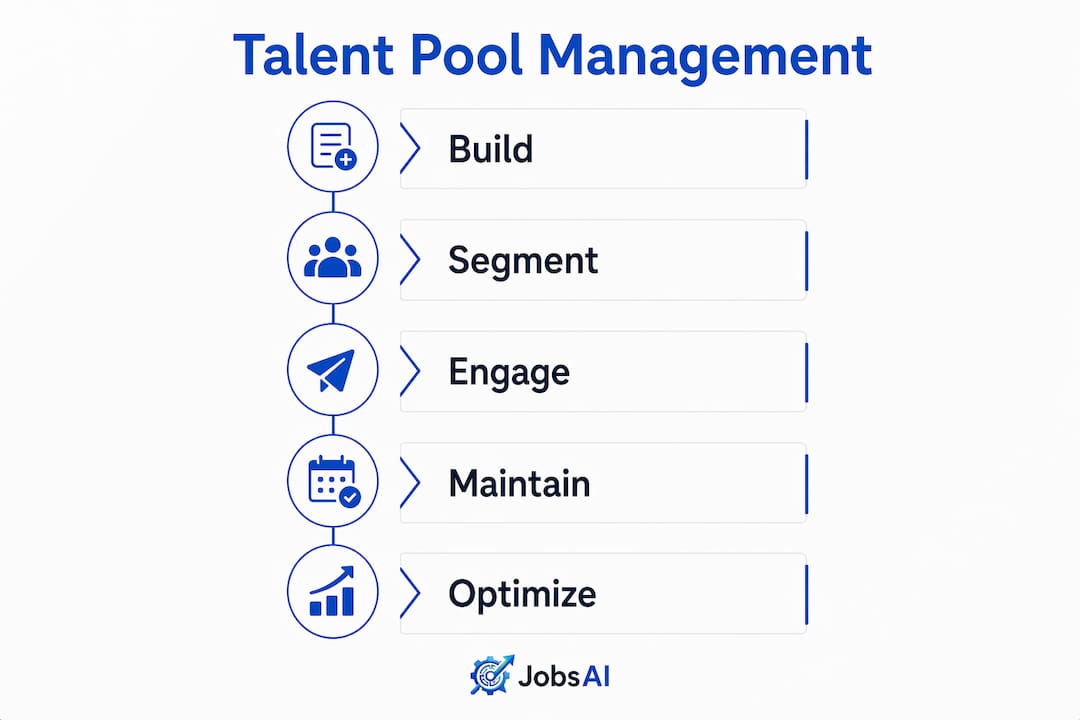
Talent pool management is defined as the ongoing practice of building, organizing, and nurturing a structured database of qualified candidates to support faster, higher-quality hiring. The industry term you will see in HR literature is “talent pool management,” and it sits alongside the related concept of talent pipeline management, though the two are distinct. Talent pools are broader than pipelines. Pipelines track candidates moving toward a specific role. Pools are a standing resource of potential hires not yet tied to any open position. For recruiters and hiring managers, understanding what is talent pool management means understanding how to stop reacting to open roles and start building a ready bench of candidates before you need them.
What is talent pool management and why does it matter?
Talent pool management is the practice of continuously sourcing, segmenting, engaging, and updating a database of candidates so your team can fill roles faster and with better fits. The core idea is proactive recruitment. Instead of posting a job and waiting, you maintain relationships with qualified people before a vacancy exists.
The cost of not doing this is real. An unfilled position open for 42 days costs an average of $4,129, and agency fees add another 20%–25% of annual salary on top of that. For revenue-generating roles like sales, the cost climbs even higher because every empty seat directly reduces output. A well-managed talent pool cuts that exposure by giving your team qualified candidates to contact on day one of a vacancy.
The importance of talent pools also shows up in recruiting agility. Teams with active pools can move from vacancy to offer in days rather than weeks. That speed is a competitive advantage when top candidates are fielding multiple offers at once.
How does talent pool management improve hiring outcomes?
Effective pool management produces measurable gains across cost, speed, and candidate quality. Here is where those gains show up most clearly:
- Reduced time-to-hire. Candidates in your pool are already screened and engaged. You skip the cold sourcing phase entirely.
- Lower cost-per-hire. Fewer agency fees and job board spends when you already know who to call.
- Better candidate fit. Segmented pools let you match candidates to roles by skill, experience level, and location rather than sorting through unqualified applicants.
- Recruiting agility. When business needs shift quickly, a live pool means you can respond without scrambling.
- Stronger employer brand. Candidates who receive consistent, respectful communication remember your organization positively, even if they were not hired the first time.
Proactive talent pool management is a defining trait of high-growth recruiting teams. The difference between a reactive and a proactive team is not budget. It is whether the pool is treated as a living resource or a static spreadsheet.
Pro Tip: Track the source of every candidate who enters your pool. After six months, you will know which channels produce the most hires and can shift budget accordingly.
What are the essential components of managing a talent pool?
Building a pool is straightforward. Keeping it productive requires discipline across four areas.
1. Database organization and segmentation
Segment candidates by skill set, experience level, geographic location, and stated interest. A recruiter filling a senior software engineering role in Austin should be able to filter to that exact group in under a minute. Generic databases where everyone is lumped together produce noise, not speed.

2. Consistent candidate communication
Regular, segmented communication keeps candidates warm and your organization top of mind. A quarterly email with relevant industry news, a note about a new role, or an invitation to a webinar costs almost nothing and prevents candidate dropout.
3. Technology infrastructure
ATS and CRM systems are the backbone of any well-run pool. The table below shows how each tool contributes.
| Tool | Primary function | Key benefit |
|---|---|---|
| Applicant Tracking System (ATS) | Stores and tracks applicant data | Centralizes candidate records across roles |
| Candidate Relationship Manager (CRM) | Manages ongoing candidate communication | Automates follow-up and nurture sequences |
| AI screening tools | Ranks and matches candidates to roles | Reduces manual review time significantly |
| Predictive assessments | Evaluates aptitude and skills fit | Improves match quality before interviews |
4. Regular database upkeep
Candidate data goes stale fast. People change jobs, relocate, and update their skills. A pool that has not been refreshed in 12 months is not a resource. It is a liability. Schedule quarterly audits to remove outdated records and re-engage candidates who have gone quiet.
Pro Tip: Send a simple “still interested?” email to candidates who have been in your pool for more than six months. A one-click response keeps the record current and signals genuine respect for their time.
How can skills-based hiring expand and optimize talent pools?
Skills-based hiring is the practice of evaluating candidates on demonstrated aptitude and specific competencies rather than on degree requirements or job title history. It is not a new idea, but its adoption has accelerated sharply. Skills-based hiring can expand a talent pool by up to 20 times compared to credential-focused methods, and 75% of organizations have adopted it in some form. That scale shift changes everything about how you build and screen a pool.
Why credentials limit your pool
A job posting that requires a four-year degree in computer science filters out self-taught developers, bootcamp graduates, and career changers who may outperform degreed candidates on actual tasks. When you drop that requirement and screen for the skill instead, the eligible candidate population grows dramatically. That growth is not just about volume. It also improves diversity, because credential requirements often reflect socioeconomic access rather than actual ability.
How to apply skills-based screening to your pool
Recruiters using resume scoring against job requirements can evaluate candidates on specific competencies rather than keyword matching. This approach works especially well when building pools for technical roles, where demonstrated output matters far more than where someone studied. Pair skills assessments with structured intake forms when candidates enter your pool, and you will have richer data for matching when a role opens.
What strategies engage passive and internal candidates in talent pools?
Passive candidates make up roughly 70% of the global workforce. They are not actively job searching, but they are open to the right opportunity. Reaching them requires relationship building over time, not a cold pitch the moment a vacancy opens.
Effective engagement channels for passive candidates include:
- LinkedIn outreach with personalized messages tied to their specific background
- Email newsletters featuring relevant industry content, not just job listings
- Virtual events and webinars that provide genuine value and create a reason to stay connected
- Alumni networks for candidates who were strong fits but not selected in a previous round
- Employee referral programs that tap your existing team’s professional networks
Candidate follow-up best practices matter here as much as initial outreach. A candidate who receives one message and then silence will not remember your organization fondly. Consistent, relevant touchpoints build the trust that converts a passive contact into an active applicant when the time is right.
Internal candidates deserve equal attention. Two in three workers say they would leave a company without clear advancement opportunities. Internal talent pools address this directly by giving HR teams visibility into who is ready for a new challenge before that person starts looking externally. Internal hires also reduce onboarding time and voluntary turnover costs because the candidate already understands the organization’s culture and processes.
Pro Tip: Create a separate segment in your pool specifically for internal candidates who have expressed interest in lateral moves or promotions. Review this segment before posting any role externally.
What tools and technologies support efficient talent pool management?
Modern talent pool management depends on technology to handle volume and maintain consistency. No recruiting team can manually track hundreds of candidates across multiple stages without systems in place.
The core technology stack for pool management includes an ATS for record keeping, a CRM for communication automation, AI-powered screening tools for ranking and matching, and workforce analytics for tracking pool health over time. ATS and CRM systems centralize candidate data and automate communication, which shortens time-to-hire and improves match quality. Automation handles the repetitive tasks, like sending follow-up emails or flagging candidates whose skills match a new opening, so recruiters can focus on conversations that require human judgment.
AI-powered platforms take this further by predicting which candidates are most likely to accept an offer, flagging pool members whose profiles align with a new role before the job is even posted, and surfacing internal candidates for succession planning. Jobsai Enterprise, for example, screens and ranks applicants automatically, matches resumes against job requirements, and organizes hiring workflows in one platform. That kind of integration connects pool management directly to live hiring decisions rather than keeping the two processes separate.
The teams that get the most from their technology are the ones that treat their pool as a live system. They set up automated re-engagement sequences, track engagement scores for each candidate, and use analytics to measure which segments are producing hires. That data discipline is what separates a productive pool from a forgotten database.
Key Takeaways
Talent pool management is the most direct way to reduce time-to-hire, lower recruiting costs, and improve candidate quality by maintaining an engaged, segmented database of qualified people before roles open.
| Point | Details |
|---|---|
| Define the pool clearly | Talent pools are broader than pipelines and include candidates not tied to a specific open role. |
| Segment from the start | Organize candidates by skill, location, and experience so you can filter fast when a vacancy opens. |
| Engage passive candidates | Roughly 70% of the workforce is passive; consistent, relevant outreach converts them over time. |
| Prioritize internal talent | Two in three workers may leave without advancement options, making internal pools a retention tool. |
| Use technology deliberately | ATS, CRM, and AI screening tools reduce manual work and improve match quality across the pool. |
The mindset shift that actually makes talent pools work
Hippolyte A., Senior Editorial Contributor
The biggest mistake I see recruiting teams make with talent pools is treating them like an archive. They collect resumes, tag candidates in their ATS, and then do nothing until a role opens. At that point, the pool is six months stale and half the candidates have moved on. The pool becomes a false comfort rather than a real resource.
The teams I have seen get genuine results from pool management share one trait: they treat the pool like a community, not a list. That means scheduled touchpoints, not just reactive outreach. It means tracking engagement scores and removing candidates who have gone cold rather than inflating the pool size with dead records. It means building across industries with intention, not just collecting whoever applied last quarter.
The internal pool piece is underrated. Most organizations invest heavily in external sourcing and almost nothing in mapping their own workforce’s untapped skills. The data on retention is clear. When people see a path forward internally, they stay. When they do not, they leave and you pay to replace them. Connecting your internal pool to succession planning is not a nice-to-have. It is a cost control measure.
My honest advice: start smaller than you think you need to. A well-maintained pool of 200 genuinely engaged candidates beats a neglected database of 2,000 every time.
— Hippolyte A.
How Jobsai Enterprise helps recruiting teams manage talent pools
Jobsai Enterprise is built for recruiting teams that need to move fast without sacrificing candidate quality. The platform screens and ranks applicants automatically, matches resumes against job requirements, and keeps hiring workflows organized in one place.
For teams building or rebuilding their talent pool process, Jobsai Enterprise reduces the manual work that causes pools to go stale. Automated follow-up, AI-powered candidate matching, and centralized candidate records mean your pool stays current and your team stays focused on the conversations that matter. See how it fits your workflow on the Jobsai Enterprise platform or review pricing and plan options to find the right fit for your team size and hiring volume.
FAQ
What is talent pool management?
Talent pool management is the practice of building, organizing, and maintaining a database of qualified candidates to support faster, proactive hiring. It includes sourcing, segmenting, engaging, and regularly updating candidate records before roles open.
How is a talent pool different from a talent pipeline?
A talent pool is a broad database of potential candidates not tied to specific roles. A talent pipeline tracks candidates actively progressing toward a particular position. Pools are a proactive resource; pipelines indicate active qualification and progression.
How do you keep a talent pool from going stale?
Schedule quarterly database audits to remove outdated records and re-engage inactive candidates. Automated CRM sequences and regular, segmented communication keep candidates warm between active hiring cycles.
Why does skills-based hiring matter for talent pools?
Skills-based hiring can expand a talent pool by up to 20 times compared to credential-focused methods. Evaluating candidates on demonstrated competencies rather than degrees or job titles increases both pool size and diversity.
How do internal talent pools reduce turnover?
Two in three workers say they would leave a company without clear advancement opportunities. Internal talent pools give HR teams visibility into employees ready for new roles, reducing the need for external hires and cutting voluntary turnover costs.
Recommended
See it in your workflow
JobsAI Enterprise runs sourcing, AI screening, and the whole interview pipeline in one place. Book a walkthrough tailored to your team.
Book a demo