
Article
Recruiting KPIs Worth Tracking for Hiring Teams

Recruiting KPIs Worth Tracking for Hiring Teams
TL;DR:
- Recruiting KPIs link talent acquisition to business results and help teams hire faster and cheaper. Key metrics include time to hire, cost per hire, and quality of hire, with a focus on outcome-based indicators. Focusing on 5 to 7 core KPIs improves decision-making and aligns hiring with strategic goals.
Recruiting KPIs worth tracking are quantifiable measures that link talent acquisition activities directly to business outcomes, giving recruiting teams the data they need to hire faster, smarter, and at lower cost. The global median time to hire is 38 days and the average cost per hire sits at approximately $4,129. Those two numbers alone tell you whether your process is competitive or bleeding budget. The challenge is not finding metrics to track. The challenge is choosing the right ones. SHRM and LinkedIn both recommend focusing on outcome-based indicators rather than activity counts, and high-performing teams track 5–7 core KPIs to stay focused and avoid data overload.

1. What are the core recruiting KPIs worth tracking for hiring efficiency?
Time to hire and time to fill are the two foundational efficiency metrics in any recruiting operation. Time to fill measures the days from when a job opens to when an offer is accepted. Time to hire measures the days from when a candidate enters your pipeline to when they accept. The distinction matters because time to fill reflects process design, while time to hire reflects recruiter speed and candidate experience.
The 38-day global median for time to hire gives you a clear benchmark. If your team consistently runs above 50 days, the bottleneck is almost certainly in one or two specific stages, not the entire process.
Cost per hire captures all recruiting expenses divided by the number of hires in a given period. That includes job board fees, agency costs, recruiter salaries, and onboarding overhead. The $4,129 average is a useful anchor, but your number will vary by role level and sourcing mix.
Pro Tip: Break time to hire down by pipeline stage. If candidates stall between the phone screen and the hiring manager interview, that is your bottleneck. Fix the handoff, not the whole process.
2. Which KPIs best measure quality of hire and long-term success?
Quality of hire is the most valuable metric in recruiting, and 31% of recruiters rank it highest among all key recruiting metrics. That ranking reflects a real shift in how talent acquisition is measured. Speed and cost matter, but a fast, cheap hire who leaves in six months costs far more than a slower, pricier one who performs and stays.
Measuring quality of hire requires combining at least two data points. Common approaches include:
- Post-hire performance scores collected at 30, 60, and 90 days from hiring managers
- First-year retention rate, which tracks how many new hires remain after 12 months
- Hiring manager satisfaction scores, gathered through structured surveys after each placement
- Ramp time to productivity, measuring how quickly a new hire reaches full output
First-year attrition is the clearest signal that quality of hire is off. When new hires leave within 12 months, you absorb the full cost of recruiting again plus lost productivity during the gap. Organizations without formal performance review systems can start simply by asking hiring managers one question at the 90-day mark: “Would you hire this person again?”
Pro Tip: Tie quality of hire scores to specific sourcing channels. If employee referrals consistently outperform job boards on retention and performance, that data justifies shifting your sourcing budget.
3. How candidate experience and sourcing channel KPIs improve outcomes
Candidate experience is a measurable KPI, not just a soft concept. The candidate Net Promoter Score, or cNPS, asks candidates how likely they are to recommend your hiring process to others. It follows the same 0–10 scale used in customer experience programs and gives you a single, trackable number for process quality.
Poor communication is the leading driver of candidate dropout. 64% of candidates who withdraw from a process cite poor communication as the reason. That is a fixable problem, and cNPS data tells you exactly when in the process candidates start disengaging.
Source of hire is equally important for budget decisions. It identifies which channels, job boards, referrals, social media, or direct sourcing, produce the best candidates at the lowest cost. Tracking source of hire by quality and cost, not just volume, changes how you allocate your recruiting budget.
| Sourcing channel | What to measure | Why it matters |
|---|---|---|
| Employee referrals | Retention rate at 12 months | Referrals typically outperform on quality and retention |
| Job boards | Cost per qualified applicant | Volume is high but quality varies significantly |
| Direct sourcing | Time to hire and offer acceptance rate | Measures recruiter efficiency and candidate fit |
| Social media | Application-to-interview conversion rate | Indicates how well your employer brand attracts qualified candidates |
Tracking candidate engagement data alongside sourcing channel performance gives you a complete picture of where your pipeline is strong and where it leaks.
4. What emerging KPIs are transforming recruiting with AI and internal mobility?
Internal mobility rate measures the percentage of open roles filled by existing employees. The recommended target sits between 15% and 30%, and organizations that hit that range consistently report stronger retention and lower recruiting costs. Promoting from within is faster and cheaper than external hiring, and it signals to your workforce that growth is available.
AI productivity KPIs are now essential for any team using recruiting technology. The core ones to track include:
- Sourcing time saved: hours per week recovered by automating resume screening and outreach
- Automation rate: the percentage of screening steps handled without manual recruiter input
- Match accuracy: how often AI-ranked candidates are advanced or hired versus rejected
- Candidate response rate: whether automated communication improves or hurts engagement
AI tools can reduce manual recruiting effort by 40–50%. That reduction is only meaningful if you measure it. Without AI productivity KPIs, you cannot prove the return on your technology investment or identify where automation is underperforming.
Understanding what to automate in recruiting and what to keep human is the foundation for setting AI KPIs that actually reflect business value. Match accuracy, in particular, is a leading indicator of whether your AI screening tool is calibrated correctly for your roles.
Pro Tip: Track AI match accuracy by role type. A model that works well for high-volume hourly roles may perform poorly for senior technical positions. Segment your data before drawing conclusions.
5. How to build a KPI framework that drives decisions, not just reports
A KPI framework only works if each metric has a clear owner and a defined threshold for action. KPI dashboards need defined owners and on/off track indicators to trigger timely decisions. Without that structure, metrics become reports that people read and forget.
The decision-first approach to KPI design asks one question before adding any metric: “What decision will this number help us make?” If you cannot answer that question, the metric does not belong in your core set. This discipline is what separates high-performing recruiting teams from teams buried in spreadsheets.
Organizing your applicant data efficiently is a prerequisite for any KPI framework. If your data lives in disconnected systems, your metrics will be inconsistent and unreliable. Centralized data is not optional. It is the infrastructure your KPIs depend on.
Review your KPI set quarterly. Business priorities shift, and your metrics should shift with them. A metric that was critical during a high-volume hiring push may be irrelevant during a hiring freeze. Keeping your framework current is as important as building it correctly in the first place.
Key takeaways
The most effective recruiting KPI frameworks combine efficiency, quality, cost, and candidate experience into a focused set of 5–7 metrics tied directly to business decisions.
| Point | Details |
|---|---|
| Anchor to benchmarks | Use the 38-day time to hire and $4,129 cost per hire as baseline comparisons for your team. |
| Prioritize quality of hire | Track post-hire performance, retention, and hiring manager satisfaction to measure true hiring success. |
| Measure candidate experience | Use cNPS and communication dropout rates to identify where your process loses strong candidates. |
| Track source of hire by quality | Allocate recruiting budget to channels that produce the best hires, not just the most applicants. |
| Add AI productivity KPIs | Measure sourcing time saved and match accuracy to prove and improve your AI tool’s return on investment. |
The case for fewer, sharper metrics
Recruiting teams often fall into the same trap: they add metrics every quarter and never remove any. Within a year, the dashboard has 20 numbers on it, and nobody knows which ones actually matter. I have seen this pattern repeatedly, and the result is always the same. Teams spend more time explaining their data than acting on it.
The research is clear on this. Focusing on 5–7 well-chosen KPIs improves decision making and hiring outcomes. That is not a suggestion to track less. It is a directive to track what counts.
My recommendation for 2026 is to anchor your core set around quality of hire and AI productivity metrics. Quality of hire connects recruiting directly to business performance. AI productivity metrics justify your technology investment and identify where automation is actually working. Everything else should be secondary or situational.
The teams I respect most in talent acquisition treat their KPI set like a product. They ship a version, test it, get feedback, and iterate. They do not cling to metrics because they have always tracked them. They ask whether each number is still driving a decision. If it is not, they cut it.
— Hippolyte A.
Jobsai Enterprise brings your recruiting KPIs into one place
Recruiting teams that track the right KPIs still need a platform that makes those metrics visible and usable. Jobsai Enterprise is built for exactly that. Its AI-powered talent acquisition tools screen and rank candidates automatically, track sourcing performance across channels, and give hiring managers clear visibility into pipeline health.
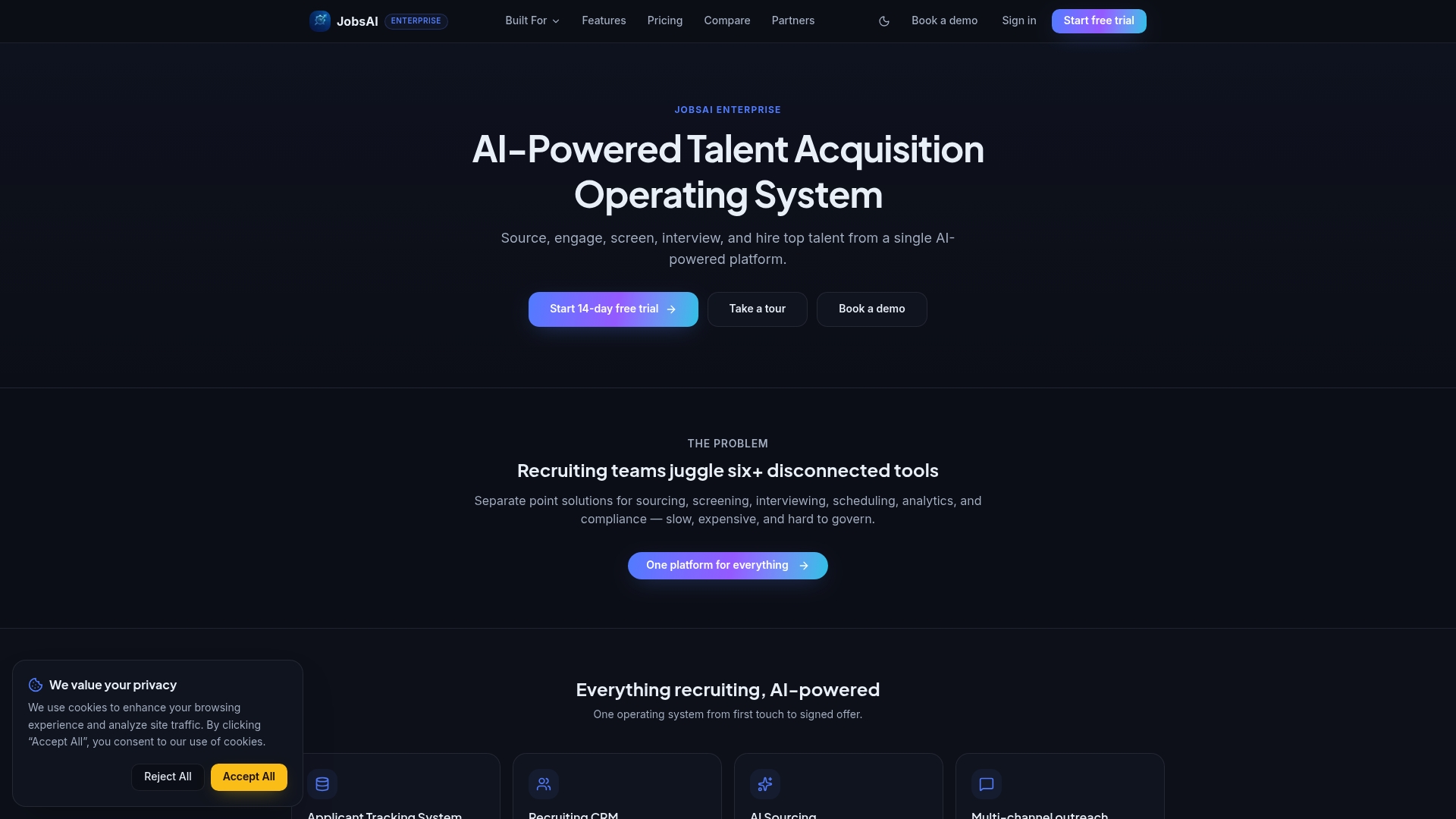
Jobsai Enterprise reduces manual screening effort so your team spends time on decisions, not data entry. Customizable reports connect recruitment activity to business outcomes, making budget conversations straightforward. Whether you are building your first KPI dashboard or refining an existing one, the Jobsai Enterprise platform gives you the structure to act on your data. See what the full feature set looks like on the Jobsai Enterprise pricing page and find the plan that fits your team’s hiring volume.
FAQ
What recruiting KPIs should every team track?
Every recruiting team should track time to hire, cost per hire, quality of hire, source of hire, and candidate experience score. These five metrics cover efficiency, cost, quality, and process health in one focused set.
How is quality of hire measured?
Quality of hire is measured by combining post-hire performance scores, first-year retention rates, and hiring manager satisfaction surveys. Collecting data at the 30, 60, and 90-day marks gives the most reliable picture.
What is a good time to hire benchmark?
The global median time to hire is 38 days. Teams consistently above 50 days should audit their pipeline stage by stage to find where candidates are stalling.
How many recruiting KPIs should a team track?
High-performing teams track 5–7 core KPIs to maintain focus and avoid data overload. Tracking more than that typically reduces the quality of decisions rather than improving them.
What AI KPIs matter most for recruiting teams?
Sourcing time saved, automation rate, and match accuracy are the three most important AI productivity KPIs. They measure whether your AI tools are delivering real efficiency gains and whether the candidate ranking is aligned with actual hiring outcomes.
Recommended
See it in your workflow
JobsAI Enterprise runs sourcing, AI screening, and the whole interview pipeline in one place. Book a walkthrough tailored to your team.
Book a demo