
Article
Project-Based Hiring Model: A Practical Playbook

Project-Based Hiring Model: A Practical Playbook
Project-based hiring means bringing in talent to deliver a defined outcome within a set timeframe, not to fill an ongoing role. The engagement ends when the deliverable is accepted. If you have a system implementation to complete, an M&A integration to run, or a regulatory audit to close, this model fits. If you need someone to own a function indefinitely, it does not.
Common use cases where project hiring works well:
- IT or DevOps migrations: a defined system cutover with clear acceptance criteria, usually running several months
- ERP or platform rollouts: phased implementation with milestone sign-offs, typically taking multiple months
- M&A integration work: cross-functional coordination with a defined end date, often requiring extended engagement
- Marketing product launches: campaign delivery with measurable output, usually completed within a few months
- Fractional CFO for fundraising: financial modeling and investor preparation with a limited engagement period
Two practical advantages stand out. You can onboard faster because the scope is already defined, and you get access to niche skills without adding permanent headcount.
Table of Contents
- What is the project-based hiring model, and how does it differ from permanent hiring?
- Why project-based hiring is growing and what it means for your team
- Core characteristics that define a project-based engagement
- What does project-based work actually look like? Real examples
- Step-by-step playbook: how to implement project-based hiring
- U.S. legal and compliance considerations you cannot skip
- Typical timelines and how to budget for a project hire
- How to measure project-hire performance and decide on conversion
- How modern hiring tech speeds up project-based recruitment
- Best practices for converting a project hire to a permanent employee
- Key Takeaways
- Why project-based hiring deserves more intentional design
- Jobsai Enterprise cuts the manual work out of project hiring
- Useful sources
- FAQ
What is the project-based hiring model, and how does it differ from permanent hiring?
Project-based hiring is outcome-driven by design. The worker is hired to deliver specific milestones, not to perform an ongoing job function. When the deliverable is accepted, the engagement closes. That is the structural difference from a permanent role, where the employee owns a function with no fixed end date.
The distinction matters for how you write the brief, structure the contract, and measure success. A project hire needs acceptance criteria. A permanent hire needs a job description. Both require onboarding, but the offboarding expectations are completely different.
| Dimension | Project-based hiring | Permanent hiring |
|---|---|---|
| Time commitment | Fixed scope, defined end date | Ongoing, no set end |
| Ownership | Deliverable-specific | Function-wide |
| Benefits | Typically not included | Full benefits package |
| Evaluation method | Milestone acceptance, deliverable quality | Performance reviews, role growth |
| Onboarding focus | Fast ramp to project context | Full cultural and functional integration |
Why project-based hiring is growing and what it means for your team
Three forces are pushing this model forward. Skills scarcity makes it hard to find permanent hires with highly specialized expertise. Budget pressure makes long-term headcount commitments harder to justify for short initiatives. And the independent workforce has grown large enough that organizations can reliably source experienced contractors for defined work.
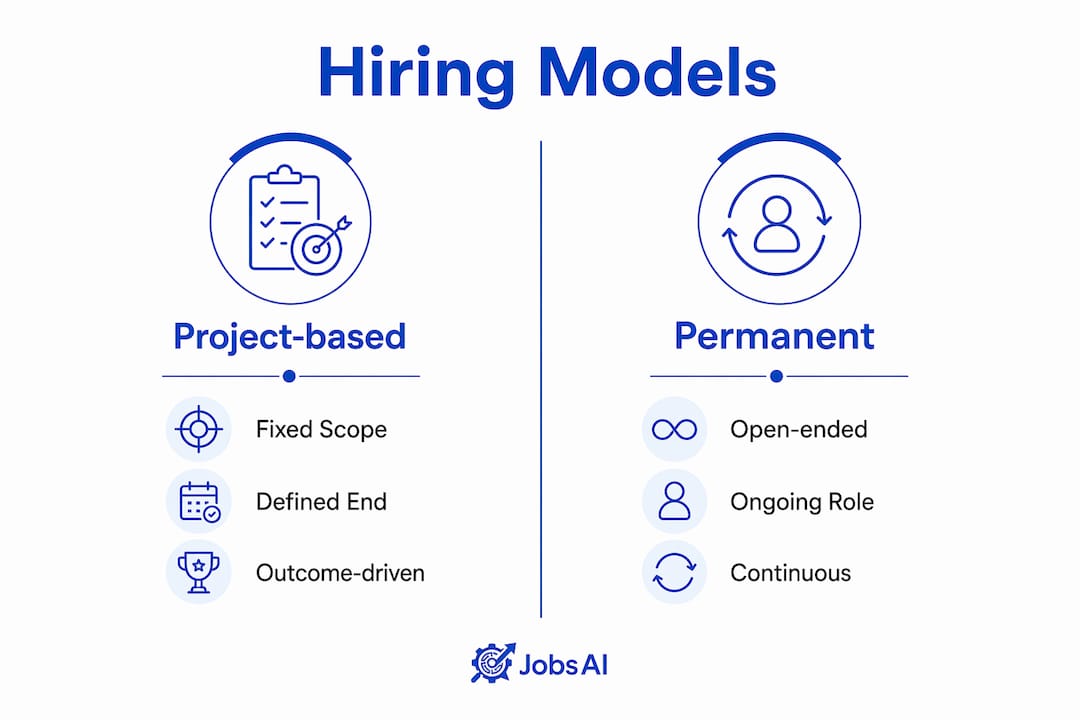
From an operational standpoint, the financial flexibility is real. Project-based hiring avoids long-term commitments like benefits and permanent severance, which matters when a project’s long-term value is still being proven. You pay for the outcome, not the seat.
The speed benefit is equally concrete. Because the scope is defined before sourcing begins, you can shortlist faster, onboard with a focused kickoff, and get to productive work in days rather than weeks. Capital-intensive and technical industries, including engineering, construction, and renewables, have relied on project-based recruitment for years precisely because their work is naturally milestone-driven.
Core characteristics that define a project-based engagement
Before committing to this model, confirm the work actually fits it. A project hire placed into an ambiguous, open-ended role will drift, and so will the engagement.
Defining attributes to check before you post:
- Fixed scope: the work has a clear start, a defined body of deliverables, and an agreed end point
- Measurable deliverables: acceptance criteria exist so both parties know when the work is done
- Milestone-based structure: the project can be broken into phases with sign-off points
- Defined ownership: one person or small team is accountable for the output
- Knowledge-transfer requirement: the organization will need to operate without the contractor after close
Team composition follows from scope. A single expert works for a focused technical sprint. A small specialist team fits a multi-workstream rollout. Fractional leadership (an interim CFO or CTO) works when the scope is senior but time-bound.
Pro Tip: Include a knowledge-handover milestone in the contract, not just at the end. Build it into the final phase as a deliverable with its own acceptance criteria. Contractors who know handover is measured deliver better documentation throughout.

What does project-based work actually look like? Real examples
Project-based work spans both execution-level and senior roles. The model fits whenever the scope is outcome-driven, regardless of seniority.
IT/DevOps migration: A cloud migration with defined infrastructure targets. The contractor delivers a working environment, hands over runbooks, and exits. Success is binary: the systems run or they do not.

ERP rollout: A phased implementation across business units. Milestones include configuration, UAT sign-off, go-live, and hypercare. Common in manufacturing and professional services.
M&A integration: Cross-functional coordination across HR, finance, and operations. The deliverable is a functioning combined entity. Interim subject-matter experts are standard here because the work is complex and time-limited.
Fractional CFO for a fundraising round: Financial modeling, investor materials, and due diligence support. The engagement closes when the round closes or the process ends.
Marketing product launch: Campaign strategy, creative delivery, and launch execution. Common in agencies and consumer brands.
When to avoid this model: if the work requires continuous product ownership, ongoing customer relationships, or iterative development without a clear endpoint, a permanent hire or a long-term contract is the better fit.
Step-by-step playbook: how to implement project-based hiring
-
Define the outcome first. Write a short project brief: what will be delivered, what “done” looks like, and how you will measure success. This brief replaces the job description and drives every step that follows.
-
Choose your sourcing route. Independent contractors work for focused, well-scoped work. Specialist agencies add screening and compliance support. A project RPO makes sense for high-volume or recurring project hiring. Match the sourcing route to the risk level and urgency of the engagement.
-
Structure the contract carefully. Include: scope of work, milestone schedule, deliverable acceptance criteria, payment tied to milestones, IP assignment, NDA, knowledge-transfer clause, and a termination-for-convenience provision. Do not use a generic service agreement.
-
Onboard fast and focused. Run a kickoff meeting on day one: project context, tools access, internal owner introduction, and communication cadence. A project hire does not need a two-week orientation. They need context and access.
-
Manage delivery by milestones. Review progress at each milestone gate. Accept or reject deliverables against the criteria in the contract. Do not let milestones slip without a formal scope-change discussion.
Sample project brief outline:
- Project name and sponsor
- Objective (one sentence)
- Deliverables (bulleted, specific)
- Acceptance criteria per deliverable
- Timeline and milestone dates
- Budget and payment schedule
- Internal owner and escalation path
Pro Tip: For specialist roles, use a short paid work-sample task that mirrors the actual project work rather than relying on resume review alone. Work-sample assessments are a more reliable signal of delivery capability, and they set expectations for both sides before the contract starts.
U.S. legal and compliance considerations you cannot skip
The primary legal risk in project-based hiring is worker misclassification. If a contractor functions like an employee, the IRS and the Department of Labor may treat them as one, regardless of what the contract says. The consequences include back taxes, penalties, and potential benefits liability.
Watch for these misclassification signals:
- You control how the work is done, not just what is delivered
- The contractor works exclusively for your organization during the engagement
- You provide all tools, equipment, and workspace
- The engagement has no defined end and keeps renewing informally
Practical controls to reduce risk:
- Write a scope-of-work contract, not an employment agreement
- Pay on milestone acceptance, not a regular payroll cycle
- Allow the contractor to use their own tools and methods
- Include an independence clause stating the contractor is not an employee
- For high-risk or long-duration engagements, use a PEO or established contractor supplier to shift legal and payroll risk
Recommended contract clauses: IP assignment, deliverable acceptance criteria, milestone sign-off, confidentiality and NDA, termination for convenience, and expense reimbursement policy.
Misclassifying a project worker can trigger significant U.S. labor and tax penalties. Consult employment counsel before structuring any engagement where the classification is unclear. For gig and contract workers, the compliance requirements differ by state, so local legal review is worth the cost.
This article is general information, not legal or tax advice. Confirm current classification rules with a qualified employment attorney or your primary regulatory source for your specific situation.
Typical timelines and how to budget for a project hire
Timeline ranges vary by project type. Short technical sprints run a few weeks. System rollouts typically last several months. M&A integration work often requires extended time. Fractional leadership engagements generally last a few months, depending on the trigger event.
What affects speed: how clearly the scope is defined before sourcing, how quickly you can clear legal and procurement, and whether the contractor needs significant ramp time to understand your environment.
Budget line items to plan for:
- Contractor rate: daily or weekly rate, or a fixed-price milestone structure
- Recruiting or agency fee: typically a percentage of total contract value for specialist sourcing
- Onboarding costs: tools access, system provisioning, security clearances if required
- Knowledge-transfer time: budget for documentation and handover sessions as a separate deliverable
- Conversion premium: if you plan to convert, factor in any agreed conversion fee upfront
Fixed-price milestone contracts work best when the scope is well-defined and stable. Time-and-materials contracts are better when the scope may evolve, but they require tighter milestone governance to avoid cost drift. For contractor scheduling and time tracking on field or hourly project roles, tools like Heyhive can simplify attendance and hours visibility across distributed teams.
How to measure project-hire performance and decide on conversion
Track these operational KPIs throughout the engagement:
- Deliverable acceptance rate: what percentage of submitted deliverables pass on first review
- On-time delivery: milestone completion against the agreed schedule
- Stakeholder satisfaction: a short structured survey at each milestone gate
- Documentation completeness: does the handover package meet the knowledge-transfer criteria in the contract
Business-level KPIs to assess after close: time-to-value (how quickly the project delivered measurable impact), budget variance, and post-project performance of the function the contractor built or improved.
Conversion decision checklist. Consider converting a project hire to permanent when:
- The long-term need for the role has become clear during the engagement
- Cultural fit has been observed over a sustained period of collaboration
- Knowledge transfer is complete and the candidate wants to stay
- Budget and headcount approval are in place
Organizations often convert effective project hires to permanent roles precisely because the engagement acts as a low-risk audition. You have seen the work, not just the resume.
How modern hiring tech speeds up project-based recruitment
The practical workflow for assembling a project team moves through four stages: post brief, shortlist, validate, onboard. Time is usually lost in the gaps between those stages, not within them.
A modern hiring platform compresses those gaps. The workflow looks like this:
- Post a structured project brief to relevant candidate pools
- AI-assisted screening ranks applicants against the defined deliverables and skills criteria
- Work-sample validation replaces or supplements the resume review step
- Automated interview scheduling eliminates back-and-forth coordination
- Milestone-based onboarding gives the new hire a structured first week tied to project context
Tooling checklist for project hiring:
- Candidate pools and talent database: reuse vetted contractors across projects
- AI screening and ranking: match applicants to the project brief automatically
- Interview scheduling: reduce coordination time between screening and offer
- Hiring manager workspace: track milestones, approvals, and candidate status in one place
A project-to-hire residency approach adds a supervised work-based validation layer: candidates contribute to live project work while being evaluated, which reduces conversion risk significantly. Combining AI shortlisting with proof-of-work screening cuts manual review time and accelerates the path from brief to productive contractor. Jobsai Enterprise’s AI screening and candidate pools features are built for exactly this workflow.
Best practices for converting a project hire to a permanent employee
Conversion works best when it is planned from the start, not improvised at the end of an engagement.
-
Include a conversion clause in the original contract. Specify the notice period required to convert, any conversion fee owed to a staffing agency, and how compensation will be determined at conversion.
-
Run a structured performance review at the final milestone. Use the KPIs tracked during the project as the basis. This is not a new evaluation; it is a summary of what you already observed.
-
Confirm knowledge transfer is complete before making the offer. A contractor who has not finished documentation has an incentive to delay. Close that loop first.
-
Negotiate salary and band placement based on the role, not the contract rate. The contractor rate and the permanent salary are different structures. Treat them separately.
-
Set a benefits enrollment timeline. Give the new permanent employee a clear start date for benefits, and communicate it in writing at the time of the offer.
Post-project checklist before extending an offer: knowledge handover complete, performance review documented, long-term role defined, budget approved, and offer letter reviewed by HR or counsel.
Key Takeaways
Project-based hiring delivers the most value when the scope is defined before sourcing begins and success criteria are written into the contract from day one.
| Point | Details |
|---|---|
| Define before you source | Write a project brief with acceptance criteria before posting; scope clarity drives every downstream decision. |
| Use proof-of-work screening | Work-sample assessments are more reliable than resume review for specialist project roles. |
| Build in knowledge transfer | Include a documented handover milestone with its own acceptance criteria, not just an end-of-project note. |
| Manage U.S. classification risk | Use milestone-based payments, independence clauses, and a PEO for high-risk engagements; consult employment counsel. |
| Plan conversion from day one | Include a conversion clause in the original contract so the path to permanent is clear if the engagement succeeds. |
| Jobsai Enterprise | Jobsai Enterprise’s AI screening, candidate pools, and hiring manager workspace support the full project hiring workflow from brief to onboarding. |
Why project-based hiring deserves more intentional design
Most hiring teams treat project engagements as a faster version of permanent hiring. They post a job description, run a standard interview loop, and hand the contractor a laptop. That approach works until it does not, and it usually fails at the same two points: unclear scope at the start and no knowledge-transfer plan at the end.
The model works when you treat it as a distinct hiring motion with its own brief, its own contract structure, and its own success metrics. The organizations that get the most out of project-based hiring are the ones that have a repeatable playbook for it, not the ones that improvise each time.
One practical observation worth emphasizing: cultural fit concerns are real but often overstated for project hires. A contractor who has a clear scope, a single internal owner, and a defined communication cadence will integrate faster than most permanent hires. The friction usually comes from ambiguity, not from the model itself.
The conversion path is also underused. Treating a project engagement as a low-risk audition for a permanent role is one of the most practical talent strategies available. You get to see how someone actually works before you commit. That is a significant advantage over a traditional interview process, and it is worth building into your hiring strategy deliberately.
Jobsai Enterprise cuts the manual work out of project hiring
Assembling a project team fast means less time on manual screening and more time on the work that actually moves the project forward. Jobsai Enterprise is built for exactly that: an AI-powered talent acquisition platform that screens and ranks applicants automatically, matches resumes against your project brief, and organizes the entire hiring workflow in one place.
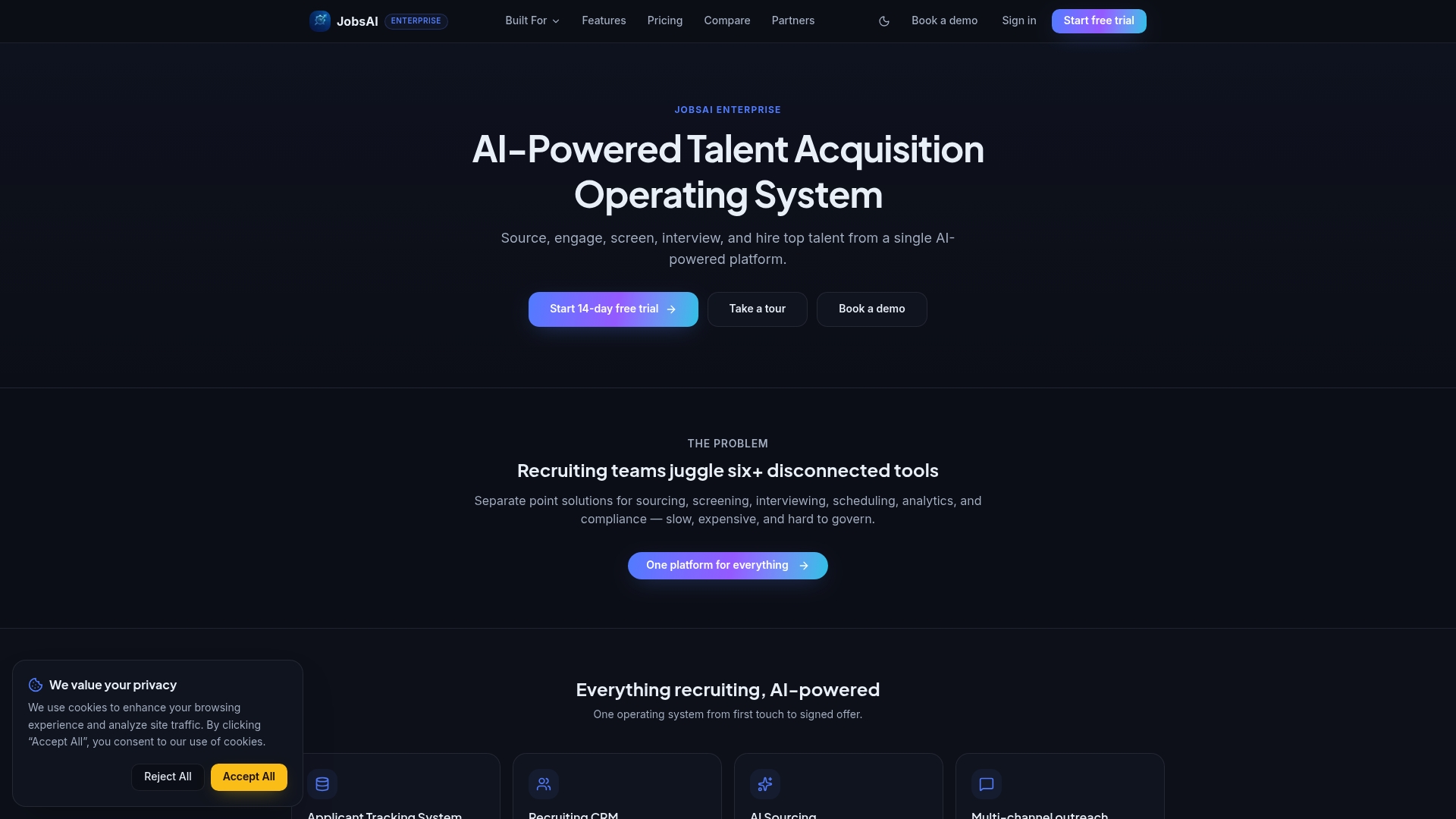
For project-based hiring specifically, three capabilities matter most. AI screening and ranking surface the strongest candidates against your defined deliverables without manual resume review. Candidate pools let you build and reuse a vetted roster of contractors across projects, so you are not starting from scratch each time. The hiring manager workspace keeps milestones, approvals, and candidate status visible in one place throughout the engagement.
If you are running project hires regularly, the time savings compound quickly. See how it fits your workflow at Jobsai Enterprise pricing or take a product tour to see the platform in action.
Useful sources
Authoritative references used in this article, organized by use case:
- U.S. worker classification and labor law: U.S. Bureau of Labor Statistics for workforce tenure data; IRS and DOL primary guidance for classification rules (consult directly for current standards)
- Strategic workforce planning: MIT Sloan Management Review — Workforce Ecosystems for the strategic case for flexible workforce models
- Project-based hiring definition and examples: Movement Search & Delivery for a practical comparison of hiring models
- Financial flexibility and compliance: TalentCrowd for U.S.-focused benefits and risk considerations
- Industry fit and technical sectors: NES Advantage for engineering and technical project hiring context
- Independent workforce and cost savings: MBO Partners for independent talent and project staffing data
- Conversion and long-term fit: Altis Recruitment for project-to-permanent conversion guidance
- Proof-of-work validation: TalentSplit for residency and work-based screening approaches; JRG Partners for work-sample assessment context
- Jobsai Enterprise platform: AI screening guide, candidate pools guide, and hiring manager workspace for platform-specific workflows
FAQ
What is the project-based hiring model in simple terms?
Project-based hiring means bringing in a worker to deliver a specific outcome within a defined timeframe, with the engagement ending when the deliverable is accepted, rather than hiring someone to fill an ongoing role.
What is an example of project-based work?
Common examples include ERP system rollouts, M&A integration coordination, marketing product launches, and interim fractional CFO engagements for fundraising rounds.
What is the difference between project-based hiring and contract hiring?
Contract hiring often means filling a role on a temporary basis with no fixed deliverable. Project-based hiring is specifically outcome-driven: the scope, milestones, and acceptance criteria are defined upfront, and the engagement closes when the work is done.
What are the biggest legal risks in project-based hiring in the U.S.?
Worker misclassification is the primary risk. If you control how the work is done, the contractor works exclusively for you, or the engagement keeps renewing without a defined end, the IRS or DOL may treat the worker as an employee. Milestone-based payments, independence clauses, and PEO arrangements reduce that exposure.
When should you convert a project hire to a permanent employee?
Convert when the long-term need for the role has become clear, cultural fit has been observed during the engagement, knowledge transfer is complete, and budget approval is in place. Including a conversion clause in the original contract makes the process cleaner for both parties.
Recommended
See it in your workflow
JobsAI Enterprise runs sourcing, AI screening, and the whole interview pipeline in one place. Book a walkthrough tailored to your team.
Book a demo