
Article
How to Set Up Hiring Pipeline Stages That Work

How to Set Up Hiring Pipeline Stages That Work
Hiring pipeline stages are the defined checkpoints that move a candidate from first contact to final offer. When you set up hiring pipeline stages correctly, every recruiter on your team knows exactly where each candidate stands, what decision comes next, and who owns it. Without that structure, time-to-hire stretches, candidates drop off, and hiring managers lose confidence in the process.
The foundation is straightforward:
- Identify the key decisions your process must make at each step (baseline qualifications, role fit, compensation alignment, final selection)
- Name each stage to reflect that decision, not just a task label
- Assign one owner per stage for scheduling, feedback, and candidate communication
- Define exit criteria so candidates move forward only when specific conditions are met
- Segment pipelines by department, location, or role type when hiring needs differ significantly across teams
- Choose a platform that lets you add, rename, reorder, and delete stages without rebuilding from scratch
- Collect structured data at every stage so you can measure conversion rates, time-in-stage, and drop-off points later
A structured hiring workflow defines stages, decision criteria, owners, and service-level expectations before any candidate enters the pipeline. That upfront design is what separates a process that scales from one that breaks under volume.
How to customize and manage your recruiting pipeline stages
Customization is where most teams either gain real efficiency or create confusion. The goal is a pipeline that reflects how your organization actually makes hiring decisions, not a generic template copied from a help article.
Step-by-step: building and adjusting your stages
- Start before the job posting. Clarify the business need, must-have qualifications, compensation range, and what success looks like in the first 6–12 months. This shapes which stages you actually need.
- Map stages in order. A typical sequence runs: Application Review, Phone Screen, First Interview, Second Interview, Reference Check, Offer Approval, Hired. Add or remove steps based on role complexity.
- Rename stages to reflect their purpose. “Technical Screen” is clearer than “Interview 1” for an engineering role. Rename directly in your recruiting platform so the label matches the decision being made.
- Reorder stages when the sequence doesn’t match reality. If your team runs assessments before phone screens for high-volume roles, move the stage. Most modern platforms support drag-and-drop reordering.
- Delete stages that add no decision value. If a stage exists only because it always has, remove it. Every redundant touchpoint extends time-to-hire without improving the quality of the hire.
- Segment pipelines by team or role type. A sales pipeline may need a “Demo Presentation” stage that engineering never uses. Most enterprise platforms let you create separate pipeline templates per department or job category.
Managing stages day-to-day
- Assign one accountable owner per stage (recruiter, hiring manager, or coordinator)
- Set response-time expectations: resume reviews within a few business days, interview scheduling promptly, and interviewer feedback in a timely manner.
- Use automated reminders to surface overdue actions before candidates withdraw
- Require completed scorecards as a prerequisite for moving a candidate forward
- Keep candidates informed at each transition; transparent communication reduces drop-off and keeps top candidates engaged
Pro Tip: Before finalizing your pipeline, ask this about each stage: “What binary decision does this stage answer?” If you can’t answer that clearly, the stage needs to be redefined or removed.

What are the common default hiring pipeline stages?
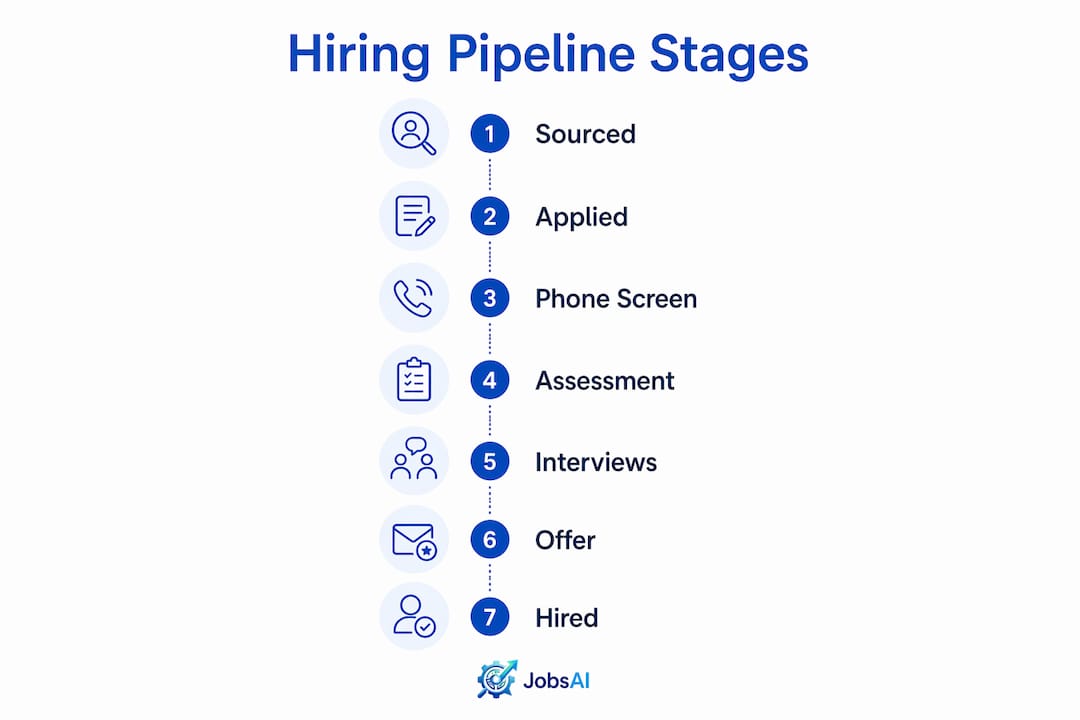
Most recruiting platforms ship with a standard set of stages. These defaults give you a working framework, but they require customization to match your actual process.
| Stage | Primary Purpose | Key Evaluation Focus |
|---|---|---|
| Sourced | Candidate identified, not yet applied | Source quality, initial profile fit |
| Applied | Application received | Completeness, basic qualifications |
| Phone Screen | First live contact | Baseline requirements, compensation alignment, communication |
| Assessment | Skills or role-specific testing | Technical ability, role-relevant competencies |
| Interview 1 | Structured role-specific conversation | Experience, problem-solving, cultural alignment |
| Interview 2 | Deeper or cross-functional evaluation | Leadership, decision-making, team fit |
| Offer | Compensation and terms extended | Offer competitiveness, candidate readiness |
| Hired | Offer accepted, onboarding begins | Compliance steps, first-day preparation |
Common default stages include sourced, applied, phone screen, assessment, multiple interview rounds, offer, and hired. These cover the full candidate journey, but the mistake is treating them as fixed. A phone screen for a senior executive role looks nothing like one for a high-volume customer service position.
Each stage should answer a distinct question and have a defined exit condition. A screening stage confirms whether a candidate meets non-negotiable requirements. It should not become a vague second interview. When two stages overlap in purpose, candidates and interviewers both feel it, and the process slows down.
Best practices for building effective pipeline stages
The teams that hire well treat pipeline stages as a decision architecture, not just a tracking system. Here’s what separates a pipeline that produces good hires from one that just moves names around.

Design stages around decisions, not labels
Every stage should answer a binary question: yes or no, move forward or exit. “Has the candidate demonstrated the technical competency required for this role?” is a stage. “Interview 2” is just a label. When stages are defined by the decision they support, evaluation criteria become obvious and interviewers know exactly what evidence to gather.
Enforce structured feedback at every exit point
Successful hiring teams collect specific rejection reasons at each stage, not just a thumbs-down. This creates an audit trail, reduces bias, and makes future process analysis possible. Require feedback before the debrief so the loudest voice in the room doesn’t reshape everyone else’s assessment.
Replace gut-feel with scorecards
Standardized competency frameworks tied to each stage reduce subjectivity and speed up transitions. A good scorecard doesn’t need a complicated rating model. It needs clear criteria: what does strong evidence look like for this competency, what is acceptable, and what is weak. Consistent hiring criteria also protect against legal exposure in the U.S., where EEOC-compliant evaluation practices matter at every stage.
Automate the repetitive work
87 % of companies use AI tools in recruiting, with 65 % seeing improved hiring outcomes. Automation handles the tasks that create bottlenecks: resume screening, interview scheduling, status updates, and feedback reminders. That frees recruiters to focus on the decisions that actually require human judgment. Jobsai Enterprise’s workflow automation handles candidate movement and communications so nothing falls through the gaps between stages.
Track the metrics that reveal where your pipeline breaks
The metrics worth watching per stage: time-in-stage, stage conversion rate, candidate withdrawal rate, and interviewer feedback completion. If qualified candidates are dropping out after final interviews, faster sourcing won’t fix it. Investigate decision latency and offer competitiveness at that specific stage, then measure again after you change it.
Pro Tip: Most hiring delays aren’t caused by slow sourcing. They’re caused by screening bottlenecks and delayed feedback between stages. Audit your time-in-stage data before assuming the top of the funnel is the problem.
Most job seekers abandon applications that take too long to complete, making concise, well-paced pipeline stages critical to retaining candidates through the process. Speed and thoroughness aren’t opposites. A well-designed pipeline delivers both by eliminating stages that don’t contribute to the hiring decision.
Jobsai Enterprise makes pipeline management faster
Jobsai Enterprise is built for hiring teams that need to move quickly without sacrificing consistency. The platform handles AI-powered candidate screening, automatic ranking against job requirements, and structured pipeline management in one place. Recruiters spend less time on manual review and more time on the decisions that matter.
Whether you’re running a single pipeline or managing dozens of roles across departments, Jobsai Enterprise gives your team full visibility into where every candidate stands and what needs to happen next. See how it fits your team at Jobsai Enterprise.
Key Takeaways
A well-designed hiring pipeline defines each stage by the decision it answers, assigns clear ownership, and collects structured data at every step.
| Point | Details |
|---|---|
| Start before posting | Clarify business need, qualifications, and success metrics before mapping any pipeline stages. |
| Define exit criteria | Each stage needs a binary decision condition so candidates move forward only when ready. |
| Assign stage ownership | One accountable owner per stage prevents delays in feedback, scheduling, and communication. |
| Automate repetitive tasks | AI tools in recruiting correlate with improved hiring outcomes, freeing teams for high-judgment work. |
| Track time-in-stage | Stage conversion rates and withdrawal data reveal where your pipeline actually breaks down. |
FAQ
What are the standard stages of a hiring pipeline?
Most pipelines include Sourced, Applied, Phone Screen, Assessment, Interview 1, Interview 2, Offer, and Hired. These defaults provide a framework, but each stage should be customized to reflect the specific decisions your team needs to make.
What are the main stages of the recruitment process?
The core recruitment stages run from role approval and job posting through sourcing, screening, interviews, selection, offer, and onboarding handoff. What matters is that each stage has a defined purpose, an owner, and clear criteria for moving candidates forward.
What is the 70/30 rule in hiring?
The 70/30 rule is not a universally standardized framework in structured hiring methodology. Definitions vary across organizations; its application to pipeline stage design depends on internal team criteria.
How do you prevent bottlenecks in a hiring pipeline?
Set response-time expectations at every stage (resume reviews within 2 business days, interview scheduling within a week, feedback within 1 day), assign clear ownership, and use automated reminders to surface overdue actions before candidates withdraw. Tracking time-in-stage data shows exactly where delays concentrate.
How many interview rounds should a hiring pipeline include?
The right number depends on role complexity, but each round must assess a distinct capability. If two interview stages cover the same ground, remove one. Redundant rounds extend time-to-hire without improving decision quality.
Recommended
See it in your workflow
JobsAI Enterprise runs sourcing, AI screening, and the whole interview pipeline in one place. Book a walkthrough tailored to your team.
Book a demo