
Article
How to Evaluate Sales Candidates at Scale

How to Evaluate Sales Candidates at Scale
TL;DR:
- Effective sales candidate evaluation at scale relies on validated assessments, calibrated scorecards, and early deployment. Skipping assessments or failing to calibrate interview rubrics reduces predictive power and can lead to poor hiring decisions. AI tools streamline the process by automating screening, scoring, and candidate comparison to improve fairness and efficiency.
Evaluating sales candidates at scale is defined as applying validated, performance-based assessments consistently across large candidate pools to produce fair, comparable hiring decisions. Without a structured approach, traditional assessments fail to predict sales performance 96% of the time. That failure rate means only one in four hires becomes a top performer. The solution is a data-driven framework built on Sales DNA tests, calibrated scorecards, and structured interviews deployed early in the funnel, not just at the final stage.
What are the essential components to evaluate sales candidates at scale?
A scalable sales evaluation framework rests on four building blocks: role-based scorecards, validated assessments, structured interviews, and consistent data capture. Each component must work together. Remove one, and the entire system loses predictive power.

Role-family scorecards
Building role families with clusters of shared competencies lets you reuse tailored scorecards across similar positions. The optimal range is 7–10 core competencies per role family. Fewer than seven produces a shallow picture; more than ten overloads interviewers and dilutes focus.
For a sales team, role families might include inside sales reps, enterprise account executives, and sales development representatives. Each family shares competencies like prospecting discipline, objection handling, and pipeline management. The scorecard for each family then weights those competencies differently based on the role’s actual demands.
Validated, predictive assessments
Generic personality tests do not predict sales performance reliably. Validated Sales DNA tests achieve 72% predictive validity, compared to near-zero for unstructured interviews alone. That gap is significant. A 72% predictive rate means your hiring decisions are grounded in real performance data, not gut instinct.
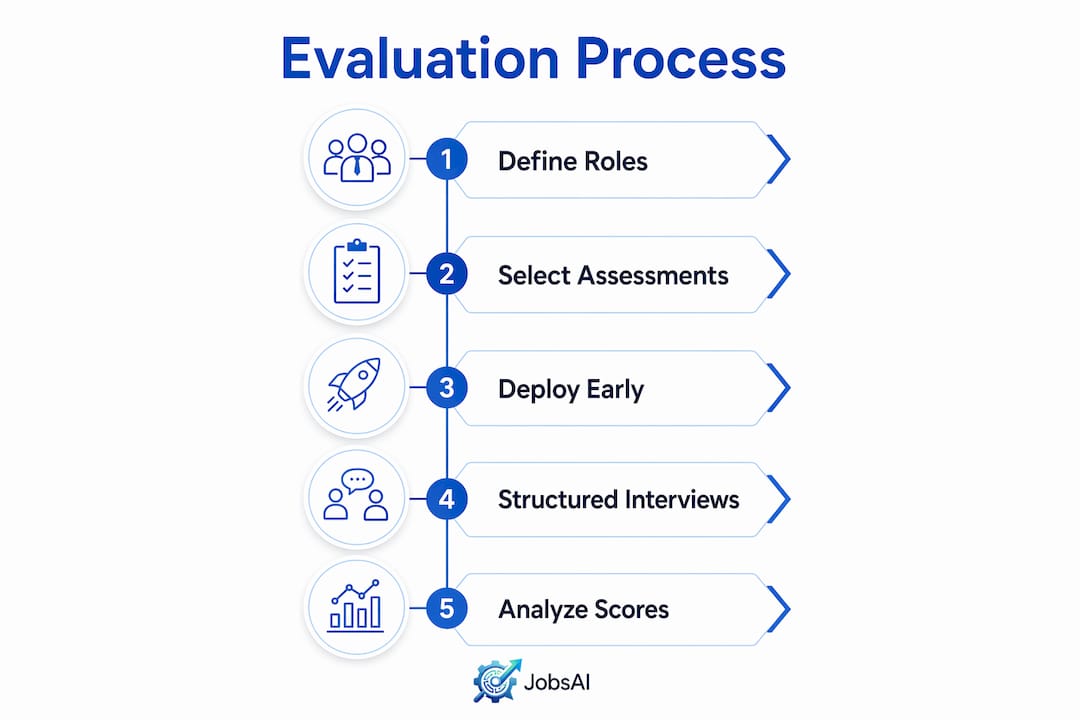
Effective assessments take 15–30 minutes to complete, balancing depth with candidate experience. Assessments longer than 30 minutes increase dropout rates without adding meaningful predictive value.
Structured interviews with calibrated rubrics
Scorecards alone are not enough. Calibrated rubrics paired with scorecards keep every interviewer applying the same standard. Without calibration, two interviewers can score the same candidate 40 points apart and both believe they are being objective. Bi-weekly calibration sessions, where interviewers score shared candidate recordings together, close that gap.
Pro Tip: Run a calibration session before each new hiring cycle, not just when you notice inconsistency. Drift happens gradually, and you rarely see it until the damage is done.
Technology for consistent data capture
Spreadsheets break down fast when you are reviewing hundreds of candidates. Interview evaluation software with structured templates captures scores in a standardized format, making candidate comparison direct and auditable. AI candidate scoring tools go further by flagging score outliers and generating summary profiles that hiring managers can review in minutes rather than hours.
How can AI tools help you assess sales applicants efficiently?
AI does not replace human judgment in sales hiring. It removes the manual work that slows judgment down. Here is how a well-built AI-assisted process works in practice:
-
Pre-screen with AI-driven aptitude assessments. Deploy a short, validated sales aptitude test to every applicant at the top of the funnel. AI scores responses instantly and ranks candidates by predicted fit. This step alone cuts manual resume review time significantly.
-
Use structured interview templates. Interview evaluation software presents the same questions to every candidate and captures responses in a consistent format. AI interview evaluators score communication, aptitude, and knowledge consistently across many candidates, reducing panel fatigue.
-
Generate standardized scoring dashboards. Automated dashboards show each candidate’s scores across all competencies in one view. Hiring managers see a clear, comparable profile for every applicant without digging through notes.
-
Integrate with your applicant tracking system. Scores and profiles feed directly into your ATS, keeping the entire hiring workflow in one place. This prevents data from living in separate spreadsheets or email threads.
-
Monitor candidate dropout rates. Short, validated assessments keep dropout low. If your completion rate drops below acceptable levels, the assessment is too long or poorly timed in the funnel.
Pro Tip: Place the aptitude assessment immediately after the application, before any human review. Candidates who complete it signal genuine interest, and you capture predictive data on every applicant, not just the ones who make it past a resume screen.
AI screening tools built for high-volume hiring handle this sequencing automatically, so the process runs consistently whether you are reviewing 50 candidates or 500.
What step-by-step process should HR teams follow to scale candidate evaluation?
A repeatable process is what separates a one-time hiring push from a system that works every quarter. Follow these six steps to build one.
Step 1: Define role competencies and cluster roles into families. Start by listing the behaviors that actually predict success in each sales role. Talk to your top performers. Review call recordings. Identify the patterns. Then group similar roles into families so you can reuse scorecards without rebuilding from scratch each time.
Step 2: Select or build validated assessment tools. Match your assessment to the competencies you identified. A general cognitive test will not tell you whether a candidate can handle objections under pressure. A Sales DNA test will. Confirm the assessment has published validity data before deploying it at volume.
Step 3: Deploy assessments early and to every candidate. Deploying assessments early at the top of the funnel prevents the most common scaling mistake: rationing. When you only assess finalists, you lose predictive data on the majority of your pipeline. Every candidate should complete the assessment before the first human interview.
Step 4: Conduct structured interviews with calibrated rubrics. Train every interviewer on the rubric before the hiring cycle opens. Run a calibration session using sample responses. Set a clear scoring scale, such as 1–5 per competency, with written anchors describing what each score looks like in practice.
Step 5: Analyze scores with a focus on divergence. Debriefs focused on score divergence uncover hidden biases and overlooked observations. If two interviewers score a candidate 3 and 5 on the same competency, that gap is the most important data point in the room. Consensus without analyzing divergence yields little useful insight.
Step 6: Pivot based on data. Track your hiring funnel metrics: assessment completion rates, score distributions, offer acceptance rates, and 90-day performance of new hires. Use that data to adjust your assessments, rubrics, and interview questions each quarter. A scalable hiring process improves continuously because it generates its own feedback loop.
The key behaviors to reinforce across all six steps:
- Score before discussing. Never share scores with other interviewers before everyone has submitted independently.
- Document reasoning, not just scores. A score of 3 with no notes is useless in a debrief.
- Revisit your role families at least once per year as the business evolves.
What mistakes should you avoid when evaluating sales candidates at scale?
Scaling a broken process just produces bad hires faster. These are the five mistakes that most consistently undermine high-volume sales evaluation.
Rationing assessments to finalists only. This is the most damaging error. Rationing assessments to finalists results in missed predictive insights across the majority of your pipeline. You end up making final decisions with less data than you had at the start.
Using generic scorecards without calibrated rubrics. A scorecard with no rubric is just a list of words. “Communication skills: 1–5” means something different to every interviewer. Without written anchors, inconsistent interviewer standards make reliable data-driven hiring impossible.
Ignoring score divergence in debriefs. Most teams default to averaging scores and moving on. That approach buries the most useful signal in your data. The divergence between interviewers is where bias, blind spots, and genuine disagreement live.
Letting assessment fatigue drive dropout. A 45-minute assessment at the application stage will lose a large share of qualified candidates before you ever see them. Keep assessments at 15–30 minutes and place them at a logical point in the process.
Misaligning assessments to the actual role. An enterprise account executive role requires different competencies than an inside sales rep role. Using the same assessment for both produces scores that do not predict performance in either.
“The biggest risk in high-volume sales hiring is not that you will miss a great candidate. It is that you will hire the wrong one at scale, repeatedly, because your process never told you the difference.”
Pro Tip: Audit your last 20 hires. Compare their assessment scores to their 90-day performance ratings. If the correlation is weak, your assessment is not predicting what you think it is.
Key Takeaways
Effective, large-scale sales candidate evaluation requires validated assessments, calibrated scorecards, and early funnel deployment working together, not as isolated steps.
| Point | Details |
|---|---|
| Deploy assessments early | Assess every candidate at the top of the funnel to capture predictive data across the full pipeline. |
| Use validated Sales DNA tests | Validated assessments achieve 72% predictive validity; generic tests offer near-zero predictive power. |
| Calibrate rubrics regularly | Bi-weekly calibration sessions keep interviewers aligned and prevent scoring drift across panels. |
| Focus debriefs on divergence | Score gaps between interviewers reveal bias and overlooked observations more than consensus does. |
| Build role families | Clustering roles into families with 7–10 shared competencies makes scorecards reusable and consistent. |
What I have learned about scaling sales evaluation fairly
By Hippolyte A.
The conventional wisdom says the interview is where you find great salespeople. After years working in sales talent acquisition, I disagree. The interview is where you confirm what a good assessment already told you.
The teams that hire well at volume are not the ones with the most creative interview questions. They are the ones who deployed a validated assessment to every single applicant, calibrated their rubrics before the cycle opened, and then used the interview to probe the specific gaps the assessment flagged. That sequence matters. Reversing it, or skipping the assessment entirely for early-stage candidates, is where most high-volume hiring programs quietly fail.
The other thing I have seen consistently: score divergence is a gift, not a problem. When two experienced interviewers disagree sharply on a candidate, that disagreement contains real information. One of them saw something the other missed. The debrief is where you find out which one, and why. Teams that skip past divergence to reach consensus faster are leaving their best hiring intelligence on the table.
AI tools have made the early funnel work much more manageable. Automating what belongs automated and keeping human judgment where it adds the most value is the right model. The goal is not to remove humans from sales hiring. The goal is to make sure humans are spending their time on the decisions that actually require them.
— Hippolyte A.
Jobsai Enterprise for high-volume sales hiring
Hiring teams that need to assess sales applicants efficiently across large pipelines face a real operational problem: the manual work compounds fast. Jobsai Enterprise is built to handle that volume without sacrificing the structure that makes evaluation reliable.
Jobsai Enterprise deploys AI screening at the top of the funnel so every candidate gets assessed, not just the ones who make it past a resume review. Structured interview templates, calibrated scoring, and automated candidate comparison are all built into one platform. Hiring managers get a clear view of the full pipeline without digging through spreadsheets. If you are ready to see how it works for your team, explore the platform or review Jobsai Enterprise pricing to find the right fit.
FAQ
What does it mean to evaluate sales candidates at scale?
Evaluating sales candidates at scale means applying structured, validated assessments consistently to large candidate pools so every applicant receives the same quality of evaluation. The goal is comparable, fair data across the full pipeline, not just for finalists.
How accurate are Sales DNA tests compared to traditional interviews?
Validated Sales DNA tests achieve 72% predictive validity, while traditional unstructured interviews fail to predict performance 96% of the time. That gap makes validated assessments the most reliable tool available for sales hiring decisions.
How long should a sales candidate assessment take?
Effective sales assessments take 15–30 minutes to complete. Assessments shorter than 15 minutes lack sufficient depth; those longer than 30 minutes increase candidate dropout without adding meaningful predictive value.
Why does interviewer calibration matter in high-volume hiring?
Without calibrated rubrics, different interviewers apply inconsistent standards, making it impossible to compare candidates reliably. Bi-weekly calibration sessions, where interviewers score shared candidate examples together, prevent scoring drift and reduce bias.
What is the biggest mistake in scaling sales candidate evaluation?
The most common mistake is rationing assessments to finalists only. Deploying assessments only at the end of the funnel means you make final decisions with less predictive data than you had at the start of the process.
Recommended
See it in your workflow
JobsAI Enterprise runs sourcing, AI screening, and the whole interview pipeline in one place. Book a walkthrough tailored to your team.
Book a demo