
Article
What Is Skills Based Hiring? A 2026 HR Guide

What Is Skills Based Hiring? A 2026 HR Guide
TL;DR:
- Skills-based hiring evaluates candidates based on demonstrated abilities instead of credentials or titles. It uses structured assessments and interview rubrics to improve hiring accuracy and fairness. Implementing it as a comprehensive system leads to better workforce agility, diversity, and long-term success.
Skills-based hiring is the practice of evaluating candidates on their demonstrated abilities and competencies rather than on credentials like degrees or prior job titles. The industry term for this approach is competency-based recruitment, and it has moved from a niche experiment to a mainstream hiring standard. SHRM and AIHR both track its adoption as a core workforce strategy. As of early 2026, 81% of organizations use competency-based job descriptions, and 87% apply skills-based evaluation in interviews. For hiring managers and HR professionals, understanding what skills-based hiring is and how to apply it correctly is now a practical requirement, not a theoretical interest.
What is skills based hiring and why does it matter?
Skills-based hiring is defined as a structured recruitment process where candidate evaluation centers on measurable skills and proficiency levels tied directly to job performance. It replaces proxy measures, such as a four-year degree or a specific job title, with evidence of actual ability. A candidate who built a data pipeline through self-study carries the same weight as one who studied computer science at a university, provided both can demonstrate the skill at the required level.

The shift matters because traditional credentials are weak predictors of on-the-job success. A degree signals that someone completed a program. It does not confirm they can do the work your role requires today. Skills-based recruitment closes that gap by measuring what candidates can actually do, not what they were once taught.
This approach also connects directly to workforce adaptability. Organizations that hire for current and adjacent skills build teams that can pivot faster when business needs change. That is a concrete competitive advantage, not a soft HR goal.
How does skills-based hiring work in practice?
The process follows a clear sequence. Each step replaces a traditional, credential-driven equivalent with a skills-focused one.
- Rewrite job descriptions around skills. Replace degree requirements and years-of-experience thresholds with specific competencies and proficiency levels. A job description for a marketing analyst should list “ability to build attribution models in Google Analytics 4” rather than “bachelor’s degree in marketing.”
- Screen with validated assessments. Skills assessments in screening are used by 65% of organizations as of early 2026. These include cognitive ability tests, role-specific technical tasks, and work samples that reflect real job conditions.
- Structure your interviews with rubrics. Structured interview rubrics remove interviewer subjectivity by scoring each candidate against the same behavioral and competency indicators. 58% of organizations now use them.
- Combine multiple assessment types. Cognitive tests, practical skills tasks, and behavioral assessments each measure different dimensions of performance. Using all three gives you a fuller picture than any single signal.
- Score against measurable outputs. Define what “proficient” looks like for each skill before you start reviewing candidates. This keeps evaluation consistent across your hiring team.
Pro Tip: Removing degree requirements from a job posting is not skills-based hiring. It is one policy change. Without redesigning your screening process, interview rubrics, and evaluation criteria, you will default back to gut-feel decisions within weeks.
The most common mistake hiring teams make is treating degree removal as the finish line. Effective adoption requires redesigning the entire hiring loop, including intake guidelines, rubrics, interview frameworks, and reference checks.
What does the evidence say about skills-based hiring?
The data on skills-based recruitment is clear and consistent. Skills assessments show a 0.51 correlation coefficient with job performance. That is a strong predictive signal by any measurement standard in organizational psychology.
The number gets stronger when you combine assessment types. Validated batteries that stack cognitive, role-specific, and behavioral measures reach correlations of 0.65–0.70 with job performance. That means a well-designed assessment process predicts success with meaningful accuracy before a candidate starts their first day.
Traditional interviews, by contrast, are unreliable predictors of job performance. Unstructured conversations favor candidates who interview well, not candidates who perform well. Skills assessments provide objective, performance-grounded data that removes that distortion.
The operational benefits are also real. Skills assessments save over 4 hours per role and reduce profile reviews by 62%. That time savings compounds across a full hiring cycle, especially for high-volume roles.
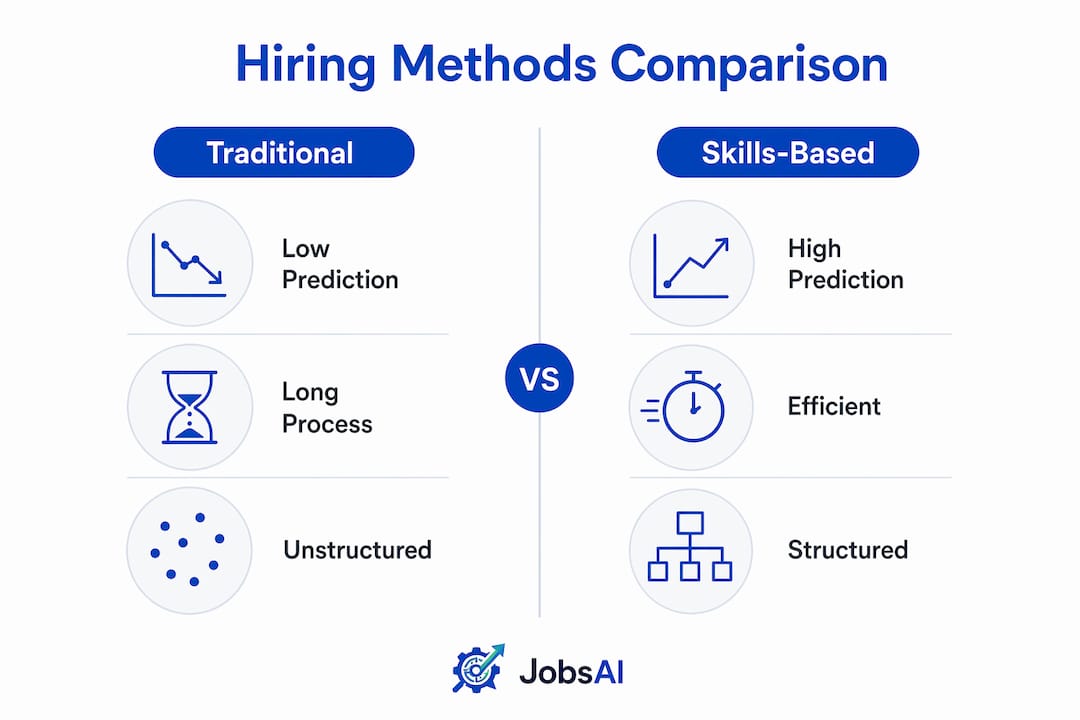
| Metric | Traditional Hiring | Skills-Based Hiring |
|---|---|---|
| Performance prediction | Low (unstructured interviews) | 0.51–0.70 correlation coefficient |
| Time spent on profile review | High | Reduced by 62% |
| Time saved per role | Baseline | Over 4 hours |
| Diversity outcomes | Credential-filtered | Skills-filtered, broader access |
| Retention and quality of hire | Variable | Improved through better fit |
Pro Tip: Always use validated assessments, not generic quiz-style tests. Validated tools have documented reliability and legal defensibility. Generic tests may introduce bias and will not hold up under scrutiny.
Skills-based hiring also creates fairer access for candidates from non-traditional backgrounds. When you evaluate skills rather than credentials, you reduce barriers tied to socioeconomic status, geography, and institutional prestige. That directly strengthens workforce diversity without requiring a separate initiative.
Common misconceptions about skills-based hiring
Several persistent misunderstandings slow adoption and cause well-intentioned programs to fail.
- It does not mean eliminating all degree requirements. Some roles genuinely require licensed credentials, such as medicine, law, or engineering. Skills-based hiring means evaluating whether a credential is a real job requirement or a convenient filter.
- It is not a quick policy fix. Redesigning recruitment processes takes months, not days. Organizations that announce a skills-first policy without rebuilding their process infrastructure see no measurable improvement.
- It does not ignore experience. Relevant work history is itself a form of demonstrated skill. The difference is that experience gets evaluated for what it proves about ability, not used as a proxy for assumed competence.
- It requires sustained executive support. Without structured processes and leadership commitment, skills-based hiring reverts to subjective, bias-prone evaluation. This is the most common failure mode in organizations that try and abandon the approach.
- Tactical hiring and strategic workforce planning are different things. Using skills assessments in your next hire is tactical. Building a skills-first talent pipeline that informs internal mobility, succession planning, and workforce forecasting is strategic. Both matter, but they require different investments and timelines.
The gap between tactical and strategic is where most organizations stall. They run a few skills assessments, see modest improvement, and declare the project complete. Sustainable gains come from treating skills-based recruitment as an operating model, not a one-time experiment.
How to implement skills-based hiring effectively
Transitioning from traditional hiring to a skills-first model follows a practical sequence. Each step builds on the last.
Redesign job descriptions first
Start by auditing every open role. Remove credentials that do not directly predict performance. Replace them with specific skills, proficiency levels, and measurable outputs. This is the foundation everything else depends on.
Build assessment into the funnel early
Place skills screening before resume review, not after. AI-powered candidate screening can rank applicants by skill match before a recruiter reads a single profile. This removes credential bias from the first filter and surfaces qualified candidates who would otherwise be screened out.
Train your hiring team on structured evaluation
Recruiters and hiring managers need calibration sessions before they evaluate candidates. They need to understand the rubric, agree on what “meets standard” looks like for each skill, and practice scoring consistently. Without this step, different interviewers apply different standards, and your data becomes unreliable.
| Component | Traditional Hiring | Skills-Based Hiring |
|---|---|---|
| Job description | Degree and years of experience | Specific skills and proficiency levels |
| Screening method | Resume review | Validated skills assessments |
| Interview format | Unstructured conversation | Structured rubric with behavioral anchors |
| Evaluation criteria | Gut feel and credential match | Scored competency evidence |
| Hiring decision | Holistic impression | Aggregated assessment data |
Connect hiring to internal mobility
Skills-based hiring does not stop at the offer letter. The same competency data you collect during hiring feeds workforce planning, internal mobility decisions, and succession pipelines. Organizations that use skills data this way get compounding returns on their investment.
Pro Tip: Governance matters as much as design. Assign someone to own assessment validation on a recurring basis. Assessments drift over time as roles evolve. A test that was valid 18 months ago may no longer reflect what the job actually requires.
Key Takeaways
Skills-based hiring delivers measurable improvements in hiring quality, speed, and fairness when implemented as a full operating model, not a single policy change.
| Point | Details |
|---|---|
| Core definition | Skills-based hiring evaluates demonstrated abilities, not degrees or job titles. |
| Assessment accuracy | Combined assessment batteries reach 0.65–0.70 correlation with job performance. |
| Operational gains | Skills assessments save over 4 hours per role and cut profile reviews by 62%. |
| Common failure mode | Removing degree requirements without redesigning the full hiring loop produces no lasting improvement. |
| Strategic extension | Skills data from hiring should feed internal mobility and workforce planning for long-term gains. |
Skills-based hiring in 2026: what I’ve actually seen work
I have watched organizations announce skills-first hiring programs with genuine enthusiasm, then quietly abandon them six months later. The pattern is almost always the same. They remove degree requirements, add one assessment tool, and expect the results to follow automatically. They do not.
What actually works is treating skills-based hiring as an organizational design project. The assessment is the easy part. The hard part is getting hiring managers to trust a rubric score over their instincts, getting executives to fund the process redesign, and getting recruiters to change workflows they have used for years. That is a change management problem, not a technology problem.
The diversity gains are real, and they are one of the strongest arguments for doing this right. When you stop filtering on credentials, you surface candidates from community colleges, bootcamps, and self-taught backgrounds who can genuinely do the work. I have seen teams improve measurably after making that shift, not because they lowered standards, but because they stopped using the wrong ones.
The organizations that sustain skills-based hiring share one trait: they treat it as ongoing governance, not a one-time rollout. They validate assessments regularly, retrain interviewers annually, and track quality-of-hire data to confirm the model is still working. That discipline is what separates a program that lasts from one that fades.
— Hippolyte A.
How Jobsai Enterprise supports skills-based hiring teams
Hiring teams that want to run a skills-based process need more than good intentions. They need infrastructure that makes structured evaluation the default, not the exception.
Jobsai Enterprise is an AI-powered talent acquisition platform built for exactly this workflow. It handles AI-driven candidate screening that ranks applicants by skill match before manual review begins, cutting the time your team spends on unqualified profiles. The platform supports competency-based job description building, structured interview workflows, and a centralized candidate database that keeps your hiring process consistent across every role. Corporate HR teams can see how Jobsai Enterprise fits their specific hiring model on the corporate HR solutions page. If you are building a skills-first hiring process and need the tooling to back it up, that is the right place to start.
FAQ
What is skills based hiring in simple terms?
Skills-based hiring is a recruitment method that evaluates candidates on what they can actually do rather than on their degrees or job titles. It uses assessments, structured interviews, and competency rubrics to measure ability directly.
What are skills based interviews?
Skills-based interviews use structured rubrics and behavioral questions tied to specific competencies required for the role. Each candidate is scored against the same criteria, which removes interviewer subjectivity and improves prediction of job performance.
How does skills-based hiring improve retention?
Skills-based hiring improves retention by creating better job fit from the start. When candidates are selected based on demonstrated ability rather than credentials, they are more likely to perform well and stay longer in the role.
Does skills-based hiring mean removing all degree requirements?
No. Skills-based hiring means evaluating whether a degree is a genuine job requirement or a convenient filter. Some roles require licensed credentials. For most roles, the focus shifts to specific skills and proficiency levels instead.
How do skills assessments compare to traditional interviews?
Traditional unstructured interviews are weak predictors of job performance. Validated skills assessments show a 0.51 correlation with performance, and combined assessment batteries reach 0.65–0.70, making them significantly more reliable hiring signals.
Recommended
- Candidate Shortlisting Best Practices for Hiring Teams | JobsAI Enterprise
- Mid-Market Hiring Challenges: What HR Teams Face in 2026 | JobsAI Enterprise
- Candidate Experience Standard: A Complete Guide for HR Teams | JobsAI Enterprise
- Talent Pool Management: A Practical Guide for Recruiters | JobsAI Enterprise
See it in your workflow
JobsAI Enterprise runs sourcing, AI screening, and the whole interview pipeline in one place. Book a walkthrough tailored to your team.
Book a demo