
Article
Cross-Border Talent Acquisition Guide for Hiring Teams

Cross-Border Talent Acquisition Guide for Hiring Teams
TL;DR:
- Cross-border talent acquisition involves sourcing and hiring candidates internationally while managing legal and operational complexities. The most common models are direct local entity hiring, employer of record, independent contractors, and relocation, each fitting different company needs. Successful global hiring requires strategic planning, legal compliance, system readiness, and a systematic approach to onboarding and scaling.
Cross-border talent acquisition is the strategic process of sourcing, hiring, and integrating candidates from other countries while managing compliance, payroll, and operational complexity. Recruiters who treat it as a simple extension of domestic hiring consistently run into legal exposure, classification errors, and onboarding failures. This cross-border talent acquisition guide covers the four main hiring models, the five compliance risk domains every recruiter must know, and the operational steps that turn a one-off international hire into a repeatable system. The goal is to give hiring managers a clear framework, not a checklist of generic advice.
What are the main models for cross-border hiring?
Cross-border hiring is not a single method. It is a category of employment structures, each with different legal, financial, and operational implications. Choosing the wrong model is one of the most common and costly mistakes hiring teams make.
The four primary models are:
- Direct local entity hiring. Your company registers a legal entity in the target country and employs workers directly. This gives you full control over employment terms, but setup takes months and requires ongoing local compliance management. Best for companies committing to a market long term.
- Employer of Record (EOR). A third-party company employs the worker on your behalf in their country. You direct the work; the EOR handles payroll, taxes, and local labor law. This is the fastest path to legal employment in a new country without entity setup.
- Independent contractor engagement. You contract directly with a self-employed individual. Fast and low-overhead, but misclassification risk is high. Many countries reclassify contractors as employees based on work patterns, not contract labels.
- Relocation. You sponsor the candidate’s move to your country of operation. This gives you direct employment control but adds immigration timelines, relocation costs, and candidate drop-off risk.
How to choose the right model
The right model depends on four factors: how quickly you need the hire, how long you plan to operate in that country, how much tax exposure you can accept, and how much day-to-day control you need over the worker. A startup testing a new market fits the EOR model well. A company building a regional headquarters fits direct entity hiring. Contractor engagement works for project-based, clearly scoped work where the role is genuinely independent.
Pro Tip: Evaluate EOR providers by their in-country legal infrastructure, not just their pricing. A provider with actual local entities carries far less risk than one that subcontracts compliance.
What legal and compliance risks must recruiters manage?
Global hiring failures most often come from compliance gaps, not from a shortage of qualified candidates. Getting the legal foundation right before extending an offer is not optional. It is the difference between a successful hire and a regulatory problem that takes months to resolve.
Experts classify cross-border hiring risks into five core domains:
- Worker classification. Whether someone is an employee or a contractor is determined by local law, not by what your contract says. Misclassifying an employee as a contractor leads to back-tax liability, penalties, and forced reclassification.
- Payroll and tax compliance. Each country has its own payroll cycle, withholding rules, and tax filing requirements. Running payroll incorrectly, even unintentionally, creates liability for both the company and the worker.
- Social benefit obligations. Many countries mandate contributions to pension funds, health insurance, and unemployment schemes. These obligations apply regardless of whether your company has a local entity.
- Employment rights. Local labor protections apply based on where the employee physically works, not where your company is incorporated. Termination rules, notice periods, and severance requirements vary widely.
- Permanent establishment risk. A single employee’s activities in a country can create a taxable presence for your company. This is one of the most underestimated risks in cross-border hiring.
Legal experts emphasize simultaneous evaluation of immigration, tax, and employment requirements. Handling them in sequence creates gaps. For example, confirming a candidate’s right to work is a threshold step. Hiring without legal work authorization puts the entire employment relationship at risk.
The best practice is a coordinated approach involving legal counsel, payroll specialists, and HR from the start of each international hiring process. You can find a deeper breakdown of compliance in recruiting in Jobsai Enterprise’s HR guide.
Pro Tip: Before posting a role in a new country, run a 30-minute legal review covering classification, tax nexus, and mandatory benefits. It costs far less than correcting a misclassification after the fact.
How do you prepare your team for cross-border hiring?
Successful organizations build a connected system integrating workforce planning, payroll, and legal compliance before extending the first international offer. Preparation is not a phase that happens before hiring. It is an ongoing operational capability.
Organizational readiness
Start by confirming that decision-makers agree on the target market, the budget, and the hiring timeline. International hiring stalls most often because internal alignment breaks down after a candidate is already in process. You also need clarity on reporting structures, since a remote hire in another country needs a clear manager and a clear escalation path from day one.
System and process readiness
Your systems need to handle contracts in local languages, payroll in local currencies, and onboarding documentation that meets local legal requirements. Data privacy laws such as the GDPR in Europe add another layer. Storing candidate data incorrectly across borders creates its own compliance exposure.
Technology plays a direct role here. A centralized platform that tracks candidate pipelines, manages communications, and integrates with payroll reduces the manual coordination that causes errors. Jobsai Enterprise is built to handle exactly this kind of workflow, giving hiring teams one place to screen, rank, and manage candidates across multiple geographies. Teams that use talent pool management practices alongside centralized systems move faster and make fewer classification errors.
Automation matters most in the gaps between steps. Sending offer letters, collecting documents, and triggering onboarding tasks manually across time zones adds days to every hire. Automated workflows close those gaps without adding headcount.
What are the practical steps to execute a cross-border hiring strategy?
Execution is where most international hiring strategies break down. The plan looks solid on paper, but the process falls apart between role definition and the first day of work. A step-by-step approach prevents that.
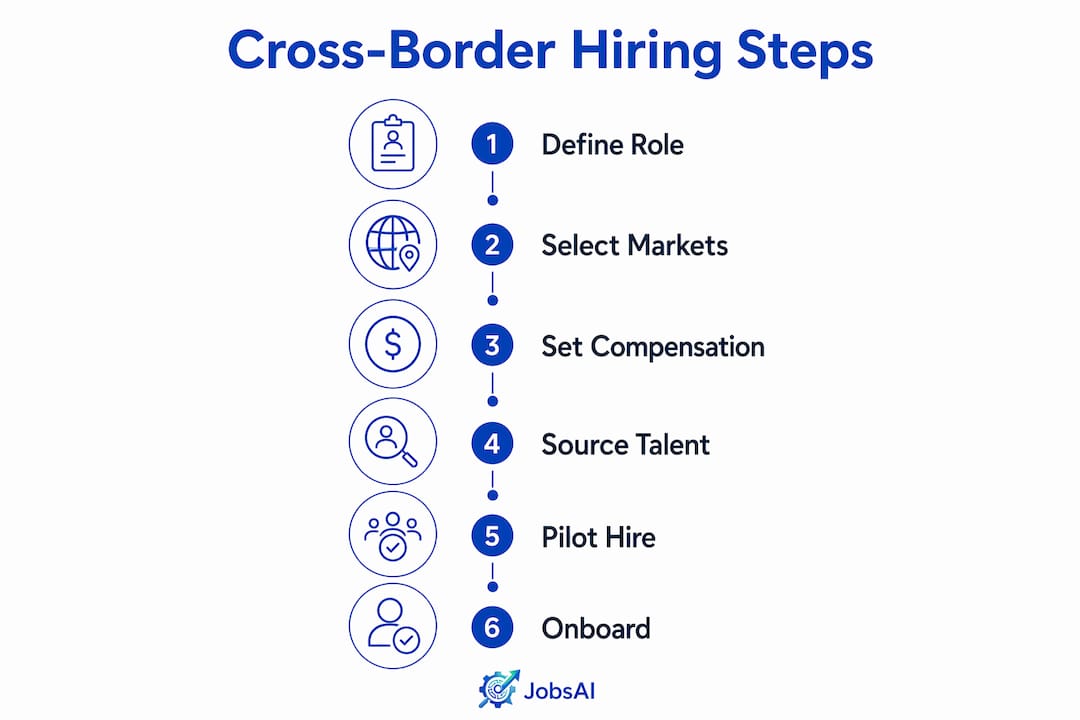
Step 1: Define the role with legal precision
Write the job description to reflect the actual work, not the label you want to apply. Prioritizing the real shape of the role over the employment label is the single most effective way to avoid misclassification. If the role requires daily direction, set hours, and company equipment, it is an employment relationship in most jurisdictions.

Step 2: Select and prioritize target markets
Not every country is equally accessible. Evaluate markets by talent availability, legal complexity, time zone compatibility, and cost. Start with one or two countries rather than expanding broadly at once.
Step 3: Set compensation with local benchmarks
Compensation must reflect local market rates, not a conversion of your domestic salary bands. Underpaying relative to local norms increases attrition. Overpaying creates internal equity problems. Use local salary data from HR analytics providers or regional compensation surveys.
Step 4: Source through the right channels
Cross-border recruitment gives companies access to specialized talent unavailable locally. That advantage only materializes if you source through the right channels. Local job boards, regional LinkedIn networks, and country-specific professional associations reach candidates that global platforms miss.
Step 5: Pilot before scaling
Starting with a controlled pilot in one or two countries lets you gather real operational data before committing to a broader rollout. Track approval times, onboarding friction points, and manager challenges. That data tells you what to fix before you scale.
Step 6: Build a repeatable onboarding process
Remote and international hires need structured onboarding more than office-based hires do. Build a checklist that covers legal document collection, system access, introductions, and 30-day check-ins. Standardize it so every international hire gets the same quality of start.
| Step | Key action | Primary risk if skipped |
|---|---|---|
| Role definition | Write for actual work, not label | Misclassification |
| Market selection | Prioritize by legal complexity | Regulatory exposure |
| Compensation setting | Use local benchmarks | Attrition or equity issues |
| Sourcing | Use local and regional channels | Thin candidate pipeline |
| Pilot hiring | Test in 1–2 countries first | Unscalable process |
| Onboarding | Standardize across all markets | Early attrition |
Key Takeaways
Effective cross-border hiring requires selecting the right employment model, managing five distinct compliance risk domains, and building systems that make international hiring repeatable rather than reactive.
| Point | Details |
|---|---|
| Choose the right hiring model | Match EOR, direct entity, contractor, or relocation to your scale, speed, and control needs. |
| Compliance covers five domains | Worker classification, payroll, benefits, employment rights, and permanent establishment all require active management. |
| Prepare systems before hiring | Payroll, contracts, onboarding, and data privacy systems must be ready before the first international offer. |
| Pilot before scaling | Test in one or two markets first to collect operational data and fix process gaps. |
| Automation reduces errors | Centralized platforms and automated workflows cut manual coordination and speed up international hiring. |
What I’ve learned from watching cross-border hiring go wrong
Most cross-border hiring failures I’ve observed share one pattern: the company treated the first international hire as a one-off project rather than the start of a system. They solved each problem as it appeared, improvised on compliance, and built nothing reusable. The second hire was just as hard as the first.
The companies that get this right treat international hiring as a capability they are building, not a problem they are solving once. They invest in legal relationships before they need them. They document every step of their first pilot hire, including what went wrong. They build onboarding templates that work across markets with minor adjustments. That discipline pays off when hiring volume increases.
The compliance landscape is also evolving faster than most recruiters realize. Countries that were straightforward to hire in two years ago now have stricter classification rules, mandatory benefit schemes, or new data residency requirements. Staying current requires ongoing investment in legal partnerships and internal knowledge, not a one-time review.
The most underrated skill in global recruiting is knowing when to slow down. Rushing an offer into a new market without legal review feels efficient in the moment. The back-tax liability or forced reclassification that follows is never worth it. The teams that build the most effective international hiring operations are the ones that treat compliance as a competitive advantage, not a constraint.
— Hippolyte A.
How Jobsai Enterprise supports global hiring teams
Recruiting across borders generates more candidate data, more workflow steps, and more room for error than domestic hiring. Jobsai Enterprise is built to handle that complexity.
Jobsai Enterprise gives hiring teams AI-powered screening and ranking across large international candidate pools, so you spend time on the candidates who actually fit the role. The platform centralizes candidate pipelines, automates follow-up, and keeps hiring workflows organized across multiple markets and time zones. For teams managing cross-border hiring workflows, that means fewer dropped candidates and faster decisions. You can also explore platform capabilities and pricing to find the right fit for your team’s size and hiring volume.
FAQ
What is cross-border talent acquisition?
Cross-border talent acquisition is the process of sourcing, evaluating, and hiring candidates located in other countries while managing local employment law, payroll, and compliance requirements. It differs from domestic hiring in legal complexity and operational scope.
What are the biggest cross-border hiring challenges?
The five core risk domains are worker misclassification, payroll and tax compliance, social benefit obligations, employment rights, and permanent establishment exposure. Compliance gaps, not talent shortages, are the leading cause of international hiring failures.
What is an Employer of Record and when should I use one?
An Employer of Record is a third-party company that legally employs a worker in their country on your behalf. Use an EOR when you need to hire quickly in a new country without setting up a local legal entity.
How do I reduce misclassification risk when hiring internationally?
Write job descriptions that reflect the actual work, not the label you want to apply. If the role involves daily direction, fixed hours, and company-provided tools, most jurisdictions will treat it as employment regardless of contract language.
Should I hire in multiple countries at once or start with one?
Start with one or two countries. A controlled pilot lets you collect real data on approval times, onboarding friction, and manager challenges before you commit to a broader rollout.
Recommended
See it in your workflow
JobsAI Enterprise runs sourcing, AI screening, and the whole interview pipeline in one place. Book a walkthrough tailored to your team.
Book a demo