
Article
What Is Bulk Resume Review? A Recruiter's Guide

What Is Bulk Resume Review? A Recruiter’s Guide
TL;DR:
- Bulk resume review automates parsing and ranking large candidate pools to help recruiters focus on the best matches. It works through stages of ingestion, parsing, semantic matching, scoring, and human validation, providing transparency and auditability. For high-volume hiring, choosing accurate, fair, and integrable tools ensures consistent results and regulatory compliance.
Bulk resume review is an automated process that parses, scores, and ranks large applicant pools against a job brief to produce a prioritized shortlist, so your team spends human attention on the candidates who actually fit. The outcome is faster sift-to-shortlist, consistent baseline scoring across every applicant, an auditable record of how matches were made, and the capacity to handle volumes that would overwhelm manual review. For campus hiring coordinators processing hundreds of new-grad applications, staffing agencies building client slates, or recruiting teams filling high-volume customer support and sales development roles, bulk resume screening is the difference between a manageable pipeline and a backlog. Jobsai Enterprise is one platform that delivers this capability end-to-end.
Table of Contents
- How does bulk resume review actually work?
- What are the real benefits, and when does bulk review pay off?
- What should you look for when evaluating a bulk screening tool?
- How do you implement bulk resume review without breaking your workflow?
- What are the real risks, and how do you manage them?
- What data security and privacy controls should you require?
- Which type of tool fits your hiring scale?
- Key Takeaways
- The part most teams get wrong about bulk resume review
- Jobsai Enterprise handles bulk resume review from upload to shortlist
- Useful sources
- FAQ
How does bulk resume review actually work?
The basic pipeline runs in five stages: ingest, parse, match, score, and shortlist, with human review closing the loop. Here is what each step involves.
-
Job brief creation. Before any resume touches the system, you define the role requirements: required skills, experience range, education, and any must-have qualifications. The quality of this brief directly determines scoring accuracy downstream.
-
Resume ingestion. Applicants submit files, or you upload a batch directly. Most platforms accept PDF, DOCX, and TXT files. Scanned resume PDFs with embedded images require OCR processing, which introduces a small accuracy risk. If your applicant pool includes image-heavy or nonstandard formats, confirm OCR support with your vendor before committing.
-
Parsing and normalization. The system extracts raw text and maps it to structured fields: job titles, employers, dates, skills, education, certifications. This normalization step is where format inconsistencies get resolved into comparable data points.
-
Semantic matching and scoring. Rather than simple keyword matching, well-built systems compare the normalized resume fields to the job brief using semantic similarity, so “customer success manager” and “client relationship specialist” register as related rather than unrelated. AI resume screening parses resumes into structured data, compares them to required skills and experience, and ranks applicants by fit, which greatly speeds initial triage.
-
Thresholding and shortlisting. You set a score threshold or a top-N cutoff. Candidates above the line move to the shortlist; those below are archived with their scores preserved for audit purposes.
-
Explainability output. A good system returns evidence alongside each score: matched keywords, skill alignment notes, experience gaps, and the specific criteria that drove the ranking. Bulk screening should prioritize transparency and auditability so recruiters can validate why a candidate scored where they did, not just accept a number.
-
Human review and audit trail. Recruiters validate the shortlist, override scores where judgment warrants it, and log those decisions. Every action is timestamped and stored.
Pro Tip: Set your score threshold conservatively on the first run. A slightly wider shortlist reviewed by a human is far safer than a tight cutoff that silently drops qualified candidates.
What are the real benefits, and when does bulk review pay off?
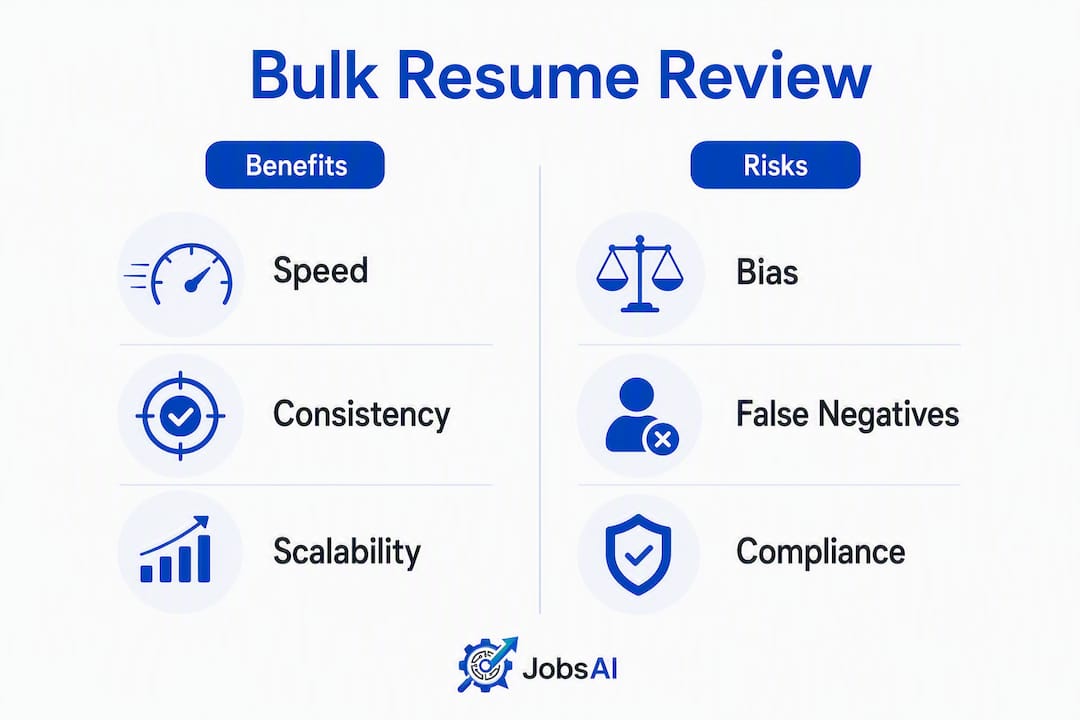
The primary benefit is scale plus consistency. A recruiter reviewing resumes manually applies slightly different criteria at 9 AM versus 4 PM, after 20 resumes versus after 200. Automated bulk resume analysis applies the same rubric to every applicant, every time.
Beyond consistency, the practical gains break down this way:
- Throughput — Bulk resume screening can process hundreds or thousands of resumes in a single workflow, making it especially useful for campus drives, seasonal hiring, and high-volume roles. Enterprise-grade systems generate rankings and summaries in seconds for small batches and scale linearly with volume.
The use cases where bulk resume screening delivers the most value:
Where bulk review is not the right tool: senior leadership searches, highly specialized technical roles, and any position where nuanced judgment about career narrative or cultural context outweighs keyword and skills matching. For those, a candidate shortlisting approach that keeps humans more centrally involved from the start tends to produce better results.
What should you look for when evaluating a bulk screening tool?
The most important evaluation axis is accuracy plus fairness plus integratability. A fast tool that scores poorly, introduces bias, or cannot connect to your ATS creates more work than it saves.
Feature checklist:
- Parsing accuracy across PDF, DOCX, TXT, and scanned formats
- Semantic matching, not just keyword matching
- Job description alignment controls (ability to weight criteria)
- Customizable scoring rules and threshold settings
- ATS integration or API access
- Throughput limits per batch and per day
- Audit logs with timestamps and override tracking
- Security certifications (SOC 2, ISO 27001)
- Data retention and deletion policies
- Bias controls and anonymized scoring options
Questions to ask on a demo:
- Can you run a sample job against a real applicant batch and show me the ranked output?
- What evidence does the system return for each match, and how granular is it?
- How do I customize the weight of different criteria for different role types?
- What is your calibration process when my team disagrees with the rankings?
- What are your data retention defaults, and how do I request deletion?
- What reporting exports are available, and in what formats?
Red flags to watch:
- Opaque scores with no explanation of what drove them
- No audit trail or decision log
- No bias controls or fairness monitoring
- Poor handling of nonstandard file formats
- No integration path with your existing ATS
- Throughput claims that cannot be demonstrated in a live test
On feature priority: parsing accuracy, explainability, and ATS integration are must-haves. A machine learning retraining console or multi-language parsing support are useful additions for larger teams but not blockers for an initial deployment. Some tools offer tiered upload limits, with free tiers supporting up to 10 CVs and paid tiers supporting up to 250 per analysis. Know your average batch size before you evaluate plans.
How do you implement bulk resume review without breaking your workflow?

Start with a small, measurable pilot tied to a single role category. One role type, one two-week run, and a clear success metric is enough to surface the most common failure modes before you scale.
Pilot checklist:
- Define success metrics upfront: throughput, precision among your top-ranked candidates, reviewer agreement rate, and time saved per hire
- Prepare a representative job brief with weighted criteria, not a copy-paste from an old posting
- Gather a sample applicant batch of at least 50 resumes, including some edge cases (career changers, nontraditional formats)
- Create an evaluation rubric your team agrees on before seeing the ranked output
- Map your integration points: does the output feed directly into your ATS, or does it require a manual export step?
- Confirm data handling: where are resumes stored during processing, and for how long?
Sample pilot timeline:
- Week 1: Prepare job brief, configure scoring rules, upload sample batch, run initial ranking
- Week 2: Recruiter team reviews top-N output, logs agreements and overrides, notes parsing failures
- Week 3: Calibrate thresholds based on reviewer feedback, rerun with adjusted weights
- Week 4: Measure precision@N, compare time spent to baseline, document findings for scale decision
Enterprise-grade bulk resume processing typically yields near-instant rankings for small batches and scales linearly, so processing time is rarely the bottleneck. The bottleneck is usually calibration: getting your team aligned on what a good match looks like before the system scores for it.
For downstream automation, connecting bulk screening outputs to your workflow automation layer means shortlisted candidates can trigger interview scheduling, outreach sequences, or hiring manager notifications without manual handoffs.

What are the real risks, and how do you manage them?
Bulk resume screening done carelessly introduces errors, bias, and compliance exposure. Done well, those risks are manageable.
Common failure modes:
- Poor parsing from nonstandard or heavily formatted resumes (tables, graphics, two-column layouts)
- Keyword-stuffed resumes that game scoring without reflecting actual qualifications
- Over-reliance on resume length or formatting as a proxy for quality
- Blind spots for career gaps, nontraditional career paths, or candidates who describe skills in non-standard terms
Bias mitigation steps:
- Enable anonymized scoring where the tool supports it (name, address, and graduation year removed before scoring)
- Calibrate feature weights with a diverse review panel, not just the hiring manager
- Monitor score distributions across demographic groups if your data supports it
- Run human-in-the-loop review for any candidate in the top bucket who was flagged by the system as a borderline case
- Audit your job brief for exclusionary language before it becomes the scoring rubric
U.S. compliance considerations: The EEOC requires that selection criteria be job-related and consistently applied. Bulk screening tools that produce documented, consistent scoring against defined criteria support that standard, but only if you preserve the audit trail and can demonstrate that the same criteria applied to every applicant. Document your job brief, your threshold settings, and any overrides. If your tool cannot produce that record, it is not ready for production use.
Pro Tip: If your team has limited technical resources, set conservative thresholds (wider shortlist), require a second human review on the top bucket for the first three hiring cycles, and log every override decision. That discipline catches systematic errors before they become patterns.
What data security and privacy controls should you require?
The non-negotiable baseline is secure storage, a defined retention policy, and the ability to delete candidate data on request. Before you onboard any vendor, confirm the following:
- Encryption in transit and at rest for all resume files and extracted data
- SOC 2 Type II or ISO 27001 certification, or a clear timeline to achieve it
- Access controls and audit logs showing who accessed candidate data and when
- Data retention defaults and the process for shortening them or triggering deletion
- Subprocessors disclosure: which third-party services touch your candidate data
- Data processing addendum (DPA) available in the vendor contract
- Breach notification timelines (U.S. state breach notification laws vary; confirm the vendor’s process covers your operating states)
- Audit rights so you can verify compliance claims independently
Some bulk analyzers include GDPR and compliance claims and fairness filters, but these features vary significantly. Always request the DPA and retention policy in writing before signing, not after.
On candidate privacy: collect only the data the role requires, retain it only as long as your hiring process needs it, and provide candidates with a clear notice of how their information is used. For roles where you are processing data from California residents, confirm your vendor’s CCPA compliance posture as well.
Which type of tool fits your hiring scale?
The main categories are ATS-native screening, standalone batch analyzers, enterprise AI platforms, and agency-focused batch tools. Each fits a different scale and workflow.
| Category | Typical scale | Integration ease | Explainability | Best fit |
|---|---|---|---|---|
| ATS-native screening | Small to mid-volume | High (built in) | Basic | Teams already on a major ATS wanting simple filtering |
| Standalone batch analyzers | Small to mid-volume | Low to medium | Moderate | Teams needing quick batch analysis without full ATS commitment |
| Enterprise AI platforms | High volume | High (API/native) | Strong | Agencies and corporate HR teams with complex, multi-role pipelines |
| Agency-focused batch tools | Mid to high volume | Medium | Moderate to strong | Staffing firms building client slates across multiple roles |
Quick scenario guidance:
- Campus hiring: An enterprise AI platform or agency-focused tool handles the volume and produces the explainable output hiring managers need to defend decisions.
- Agency slates: Agency-focused batch tools with client portal features save the most time; enterprise platforms work well when the agency manages multiple clients simultaneously.
- Executive search: None of the above. Manual review with structured scorecards is more appropriate for senior or highly specialized roles.
- High-volume hourly roles: ATS-native screening or a standalone analyzer is often sufficient, provided parsing accuracy is confirmed for the file formats your applicants submit.
Key Takeaways
Bulk resume review delivers the most value when it is treated as a measurable workflow, not a black box: pilot it, measure precision among your top-ranked candidates, and keep humans in the loop for final decisions.
| Point | Details |
|---|---|
| Pilot before scaling | Run one role type for two weeks to surface parsing failures and calibrate thresholds before full deployment. |
| Measure what matters | Track precision among top-ranked candidates, reviewer agreement rate, and time saved per hire, not just processing speed. |
| Require explainability | Every ranked candidate should come with evidence: matched skills, experience alignment, and the criteria that drove the score. |
| Protect candidate data | Confirm encryption, retention policy, DPA, and deletion rights before signing any vendor contract. |
| Jobsai Enterprise | Jobsai Enterprise provides end-to-end AI-powered bulk screening with parsing, scoring, audit logs, and ATS integrations in a single platform. |
The part most teams get wrong about bulk resume review
Most teams evaluate bulk screening tools on speed. That is the wrong axis. Speed is table stakes. What actually determines whether a bulk review system improves your hiring is whether your team trusts the output enough to act on it.
That trust comes from two things: explainability and calibration. If recruiters cannot see why a candidate ranked where they did, they will either ignore the ranking or rubber-stamp it, and both outcomes waste the investment. The teams that get the most out of bulk screening are the ones that spend the first two weeks not just running the tool, but sitting together and comparing their own judgments to the system’s output. Where they agree, the tool is working. Where they disagree, the job brief or the scoring weights need adjustment.
The other thing worth saying plainly: bulk resume screening is not a replacement for recruiting judgment. It is a way to protect that judgment from being exhausted on the wrong work. The boundary between what to automate and what to keep human in recruiting is real, and bulk screening sits clearly on the automation side of the initial triage decision, not the final hiring decision.
Jobsai Enterprise handles bulk resume review from upload to shortlist
Jobsai Enterprise gives recruiting agencies and corporate HR teams a faster path from a large applicant pool to a defensible, ranked shortlist. The platform handles parsing across standard file formats, applies semantic matching against your job brief, returns explainability notes for every ranked candidate, and logs all scoring and override decisions in a full audit trail.
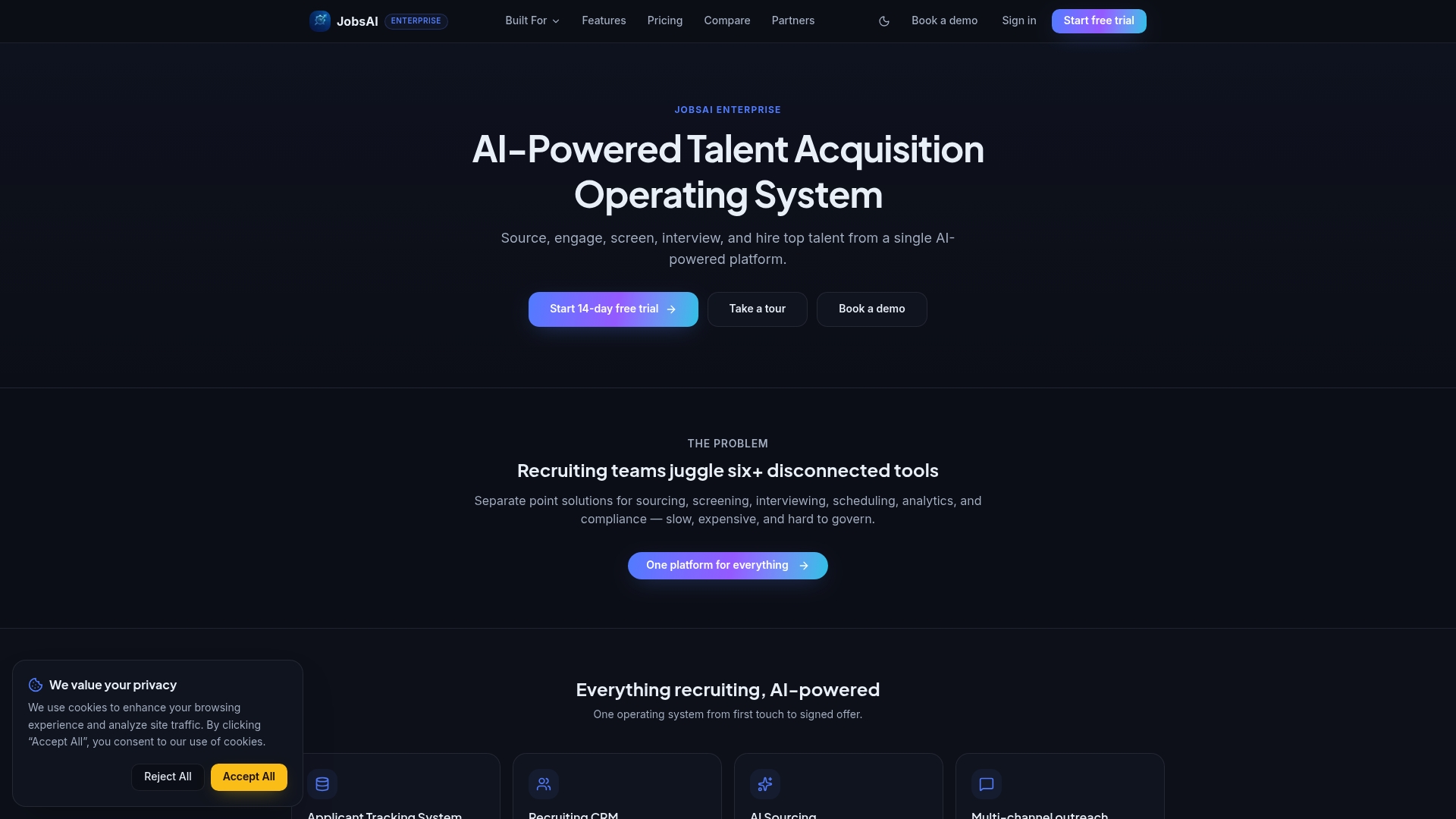
Features map directly to the evaluation criteria that matter: customizable scoring rules, ATS and API integrations, access controls, and data retention settings your compliance team can verify. For staffing firms managing multiple client roles simultaneously, the platform’s built-for-staffing capabilities handle batch processing across concurrent pipelines without requiring separate tool stacks.
If you are ready to see how the workflow runs in practice, the AI screening guide walks through the full process. To evaluate plans and pricing for your team size, visit the Jobsai Enterprise pricing page or take the product tour to see the ranked shortlist output firsthand.
Useful sources
The following sources informed this article and are worth reviewing for deeper reading on bulk resume screening, vendor evaluation, and implementation best practices.
- AI Resume Screening: Screen Resumes in Bulk with AI ATS — practical overview of how AI parsing and ranking works in a bulk screening context, with vendor-claimed throughput benchmarks.
- SHRM: AI in HR — 2025 Talent Trends — authoritative industry research on AI adoption in talent acquisition from the Society for Human Resource Management.
- Jobsai Enterprise AI Screening Guide — product-level documentation on how Jobsai Enterprise implements bulk screening, scoring, and audit logging.
- Resume Screening Checklist for Recruiters: 2026 Guide | Jobsai Enterprise — practical checklist for recruiters building or auditing a screening process.
For candidates preparing resumes that parse cleanly through automated systems, the resume builder at isetplus.com provides format guidance aligned with standard ATS and bulk screening expectations.
FAQ
What is bulk resume screening in simple terms?
Bulk resume screening is an automated process that reads, scores, and ranks a large group of resumes against a job’s requirements, so recruiters receive a prioritized shortlist instead of a raw pile of applications.
Is it worth paying for a resume review or screening tool?
For teams handling more than a few dozen applicants per role, a paid bulk screening tool typically pays for itself in recruiter hours saved. Vendors often claim up to a 70% reduction in review time, though you should validate that figure in a pilot against your own applicant mix.
Can employers tell if a resume was written by AI?
Some bulk screening tools flag AI-generated content patterns, but detection is inconsistent. More practically, AI-written resumes that are keyword-heavy but thin on specifics tend to score well initially and then fail at the human review stage, which is one reason keeping humans in the loop on the top bucket matters.
What is a good ATS or screening score, and how should you interpret it?
Score thresholds depend entirely on how the tool is calibrated and how competitive the role is. Rather than treating any single score as a pass/fail line, use the score distribution across your full applicant batch to set a relative cutoff, and review the explainability notes for candidates near the threshold before making shortlist decisions.
What are the biggest red flags to watch for in bulk resume review tools?
Opaque scoring with no explainability, no audit trail, no bias controls, and poor handling of nonstandard file formats are the four most common red flags. A tool that cannot show you why a candidate ranked where they did is not ready for production use in a compliant U.S. hiring process.
Recommended
See it in your workflow
JobsAI Enterprise runs sourcing, AI screening, and the whole interview pipeline in one place. Book a walkthrough tailored to your team.
Book a demo