
Article
Recruitment Process Outsourcing (RPO) Explained for HR Teams

Recruitment Process Outsourcing (RPO) Explained for HR Teams
Recruitment Process Outsourcing (RPO) is a form of business process outsourcing where an employer transfers ownership of some or all recruitment activities to an external provider that assumes responsibility for process design, staffing, technology, and results. The quick decision rule: RPO fits organizations with ongoing, predictable hiring volume, a need to reduce agency spend, or limited internal TA capacity. If you’re a staffing firm, corporate HR team, or recruiting agency weighing your options, here’s what you need to know before committing.
RPO is the right fit when:
- You hire a relatively high number of roles per year with consistent demand
- Your cost-per-hire is high due to heavy agency reliance
- You need to scale across multiple geographies or business units
- You want a structured, accountable process with defined SLAs
- You’re rebuilding employer brand or standardizing a fragmented TA function
Key Takeaways
RPO delivers measurable value at scale, but software-first is the smarter starting point for most U.S. hiring teams with the capacity to build internal TA capability.
| Point | Details |
|---|---|
| RPO definition | An external provider takes ownership of some or all recruitment activities, including process design and results. |
| Volume threshold | Organizations with sufficiently high hiring volume tend to see the clearest cost benefits from RPO over agency-heavy models. |
| Cost reduction potential | RPO can reduce recruitment spend by roughly 20–40% versus agency-heavy models over 12 months. |
| Governance is the risk | Undefined SLAs and data ownership clauses are the most common RPO failure modes; nail these before signing. |
| Jobsai Enterprise alternative | Teams wanting in-house control can use Jobsai Enterprise to automate screening, ranking, and workflow coordination without an outsourcing contract. |
Table of Contents
- What tasks and models does an RPO engagement actually cover?
- How does RPO work in practice, step by step?
- How does RPO compare to agencies, in-house TA, and recruitment software?
- When does RPO make sense for your organization?
- What are the real risks and red flags in RPO?
- How to evaluate and select an RPO provider
- How recruitment technology relates to RPO, and when software wins
- The case for keeping RPO in perspective
- Jobsai Enterprise handles the work RPO providers charge fees to manage
- Sources
- FAQ
What tasks and models does an RPO engagement actually cover?
RPO providers act as an extension of your TA function, supplying recruiters, technology, methodology, and reporting while taking ownership of sourcing, screening, interview coordination, offer management, and early onboarding support. The scope varies by engagement model.
Core tasks RPO providers typically own:
- Workforce planning support and job intake
- Candidate sourcing across job boards, social channels, and talent pools
- Resume screening and initial assessments
- Interview scheduling and coordination
- Offer management and negotiation support
- Onboarding coordination and new-hire reporting
- Ongoing analytics and pipeline reporting
Engagement models:
| Model | Scope | Duration | Best fit | Pricing shape |
|---|---|---|---|---|
| End-to-end RPO | Full hiring lifecycle | 12+ months | Enterprises with ongoing volume | Monthly management fee |
| Project RPO | Defined hiring initiative | 3–6 months | Rapid scaling, new market entry | Per-hire or project fee |
| Selective/managed tasks | Specific functions (e.g., sourcing only) | Ongoing or fixed | Teams with partial gaps | Fee per function |
| Recruiter-on-demand | Embedded recruiter(s) | Flexible | Surge coverage, backfill | Day rate or monthly |
End-to-end RPO centralizes the full hiring lifecycle under one delivery engine and typically generates ROI through technology consolidation, reduced agency dependency, and process standardization.
How does RPO work in practice, step by step?
Time-to-hire is usually lost in the gaps between steps, not within them. A well-run RPO engagement closes those gaps with defined handoffs and clear ownership at each stage.
Typical process flow:
- Scoping and intake: Provider and employer align on role requirements, hiring manager expectations, and SLA targets.
- Sourcing: Provider activates sourcing channels, talent pools, and direct outreach campaigns.
- Screening and assessment: Provider conducts initial screens, skills assessments, and shortlisting against defined criteria.
- Interview coordination: Provider schedules and manages interview logistics; hiring managers conduct final interviews.
- Offer and negotiation: Provider supports offer preparation; employer retains final approval authority.
- Onboarding coordination: Provider manages pre-boarding paperwork and handoff to HR operations.
- Reporting: Provider delivers pipeline velocity, time-to-fill, source-of-hire, and quality-of-hire data on agreed cadences.
Who owns what: The provider executes the process. The employer retains final hiring decisions, employer-brand strategy, and workforce planning. A mature engagement defines this boundary in writing before day one.
Technologies RPO teams typically use: ATS platforms, candidate CRM systems, assessment tools, and video interviewing software. Integration with your existing systems is a contract requirement, not a nice-to-have.
Statistic: Analyst case studies report cost-per-hire reductions around 20% and time-to-hire improvements near 40% in some end-to-end RPO engagements.
How does RPO compare to agencies, in-house TA, and recruitment software?
Each model solves a different problem. The right choice depends on ownership preference, hiring volume, and budget structure.
Key differences:
- Transactional staffing agencies: Fill individual roles on a contingency basis. Fast for one-off needs, expensive at volume, and the agency owns no process accountability beyond placement.
- Internal TA centers: Full control and employer-brand ownership, but require headcount investment, technology, and management overhead. Best when hiring volume is stable and predictable.
- RPO providers: Take process ownership and accountability for outcomes. Cost-effective at scale, but require governance discipline and a longer commitment.
- AI recruitment platforms: Automate sourcing, screening, and workflow coordination. Lower cost, faster deployment, and full data ownership. Best when teams want to keep recruiting in-house with automation.
Decision signals:
- Prefer RPO when volume is high, internal TA capacity is thin, and you need a provider to own outcomes.
- Prefer a staffing agency for niche, executive, or one-off roles where speed matters more than cost.
- Prefer software when you want control, transparency, and the ability to build internal capability without a long-term outsourcing contract.
When does RPO make sense for your organization?
Industry data suggests RPO can reduce recruitment spend by roughly 20–40% versus agency-heavy models over 12 months for organizations with ongoing hiring needs. That math only works at sufficient volume.
Common use cases:
- High-volume hiring across multiple locations or business units
- Rapid headcount scaling after funding rounds or market expansion
- Seasonal hiring surges (retail, logistics, healthcare)
- Technical hiring programs requiring specialized sourcing expertise
- Employer-brand rebuilds where candidate experience needs standardization
- Centralized hiring for distributed or decentralized organizations
Pricing models to expect:
- Management fee: Fixed monthly fee covering a defined scope of roles and services.
- Cost-per-hire: Variable fee tied to filled positions; aligns provider incentives with output.
- Blended pricing: Combination of base fee plus per-hire component for variable-volume programs.
- Setup and transition costs: One-time fees for onboarding, technology integration, and process design. Budget for these separately.
Timeline expectations: Most end-to-end RPO engagements typically take several weeks to a few months to reach full operational capacity. Project RPO can mobilize relatively quickly for defined initiatives, often within a few weeks.
What are the real risks and red flags in RPO?
RPO’s biggest failure mode isn’t a bad provider. It’s a poorly scoped contract that leaves governance undefined.
Key risks:
- Loss of process visibility if reporting cadences and dashboards aren’t contractually specified
- Cultural mismatch between provider recruiters and your employer brand
- Vendor lock-in when proprietary ATS or candidate data stays with the provider at contract end
- Integration gaps if the provider’s technology stack doesn’t connect cleanly with your HRIS or ATS
- Weak SLA definitions that make performance accountability impossible to enforce
Red flags to screen for during vendor selection:
- Opaque or delayed reporting with no real-time dashboard access
- Refusal to embed delivery staff on-site or within your systems
- Thin references for roles or industries similar to yours
- Unclear data ownership and IP clauses in the contract
- Pricing that doesn’t separate setup costs from ongoing fees
Pro Tip: Ask every shortlisted provider to show you the exact governance document they use on a current engagement, not a template. A provider that can’t produce a live example hasn’t operationalized governance, regardless of what the sales deck says.
How to evaluate and select an RPO provider
Treat vendor selection like a structured hiring process. Define criteria before you talk to providers, not after.
Metrics to require in your SLA:
- Time-to-fill and time-to-hire (defined from requisition open to offer accepted)
- Quality-of-hire (hiring manager satisfaction score at 30/60/90 days)
- Retention at 6 and 12 months
- Candidate NPS or satisfaction score
- Source-of-hire breakdown by channel
- Pipeline velocity (candidates per stage per week)
Track these against your recruiter productivity benchmarks to establish a baseline before the engagement starts.
Selection checklist:
- Governance model: who owns what, in writing
- Technology stack and integration plan with your existing systems
- Team composition: dedicated vs. shared recruiters
- Data ownership clause: your data leaves with you at contract end
- Transition plan: how the provider exits cleanly if needed
- Pricing transparency: no bundled fees that obscure per-hire costs
Sample questions to ask providers:
- What does your governance document look like on a current engagement?
- How do you handle a role that stays open past the agreed time-to-fill SLA?
- Who owns the candidate data and ATS records at contract end?
- How do your recruiters represent our employer brand to candidates?
- What’s your process for escalating hiring-manager feedback into sourcing adjustments?
How recruitment technology relates to RPO, and when software wins
Automation compresses sourcing and screening, while human-led RPO still adds value where negotiation, employer brand, and complex stakeholder management are critical. The line between the two is shifting fast.
What technology handles well:
- Bulk resume screening and AI-powered candidate ranking
- Automated outreach via email, SMS, and messaging platforms
- Interview scheduling and calendar coordination
- Pipeline reporting and analytics dashboards
- Talent pool management and candidate re-engagement
What still benefits from human RPO delivery:
- Complex offer negotiations and counter-offer management
- Employer-brand storytelling in candidate conversations
- Workforce planning and headcount forecasting
- Executive and highly specialized role searches
When software replaces parts of RPO: Teams that want to keep recruiting in-house, maintain full data ownership, and build internal TA capability often find that an AI recruitment platform covers the high-volume, process-heavy work without a long-term outsourcing contract. Jobsai Enterprise’s AI screening and workflow automation handle the tasks RPO providers charge management fees to perform, at a fraction of the cost and with full visibility into every step.
For staffing firms specifically, the ability to manage bulk resume review and talent pool pipelines inside a single platform reduces the operational overhead that typically drives outsourcing decisions in the first place.
The case for keeping RPO in perspective
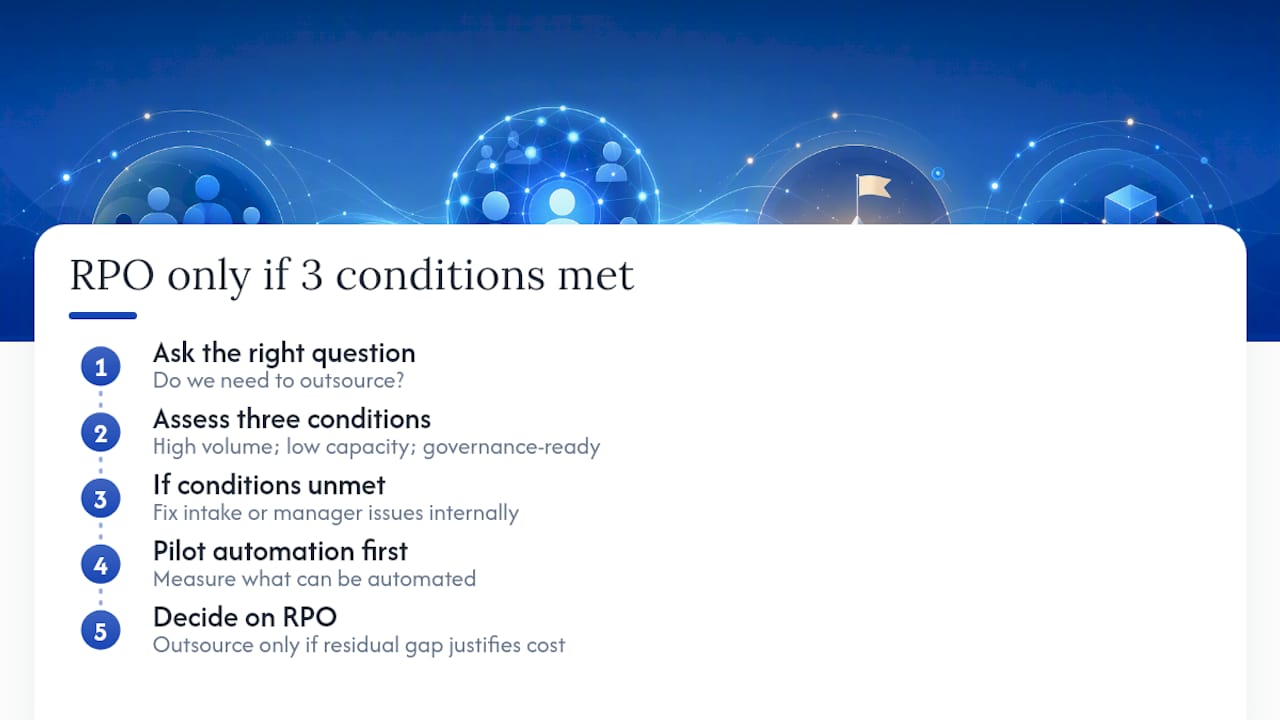
Most RPO conversations start with the wrong question. Teams ask “which provider should we choose?” before they’ve answered “do we actually need to outsource this?”
The honest answer is that RPO earns its cost when volume is high, internal capacity is genuinely constrained, and the organization is ready to invest in governance. When those conditions aren’t met, outsourcing often transfers the problem rather than solving it. A provider can’t fix a broken intake process or a hiring manager who changes requirements mid-search. Those are internal problems that require internal solutions first.
The other thing conventional advice underweights: technology has closed the gap significantly. The tasks that once required an RPO provider’s scale, such as sourcing at volume, screening hundreds of applicants, and coordinating interview logistics, are now automatable at the team level. The remaining RPO value is concentrated in governance, employer brand, and complex negotiations. That’s a narrower value proposition than the industry typically presents.
For most mid-market U.S. organizations, the practical path is to pilot software first, measure what you can automate, and then decide whether the residual gap justifies an outsourcing contract. That sequence is cheaper, faster, and leaves you with better data for any future RPO conversation.
Jobsai Enterprise handles the work RPO providers charge fees to manage
If your team wants the output of RPO without the contract commitment, Jobsai Enterprise is built for exactly that. It’s an AI-powered talent acquisition platform that screens and ranks candidates automatically, automates outreach across email, SMS, and WhatsApp, coordinates interviews, and delivers pipeline analytics in a single workspace.
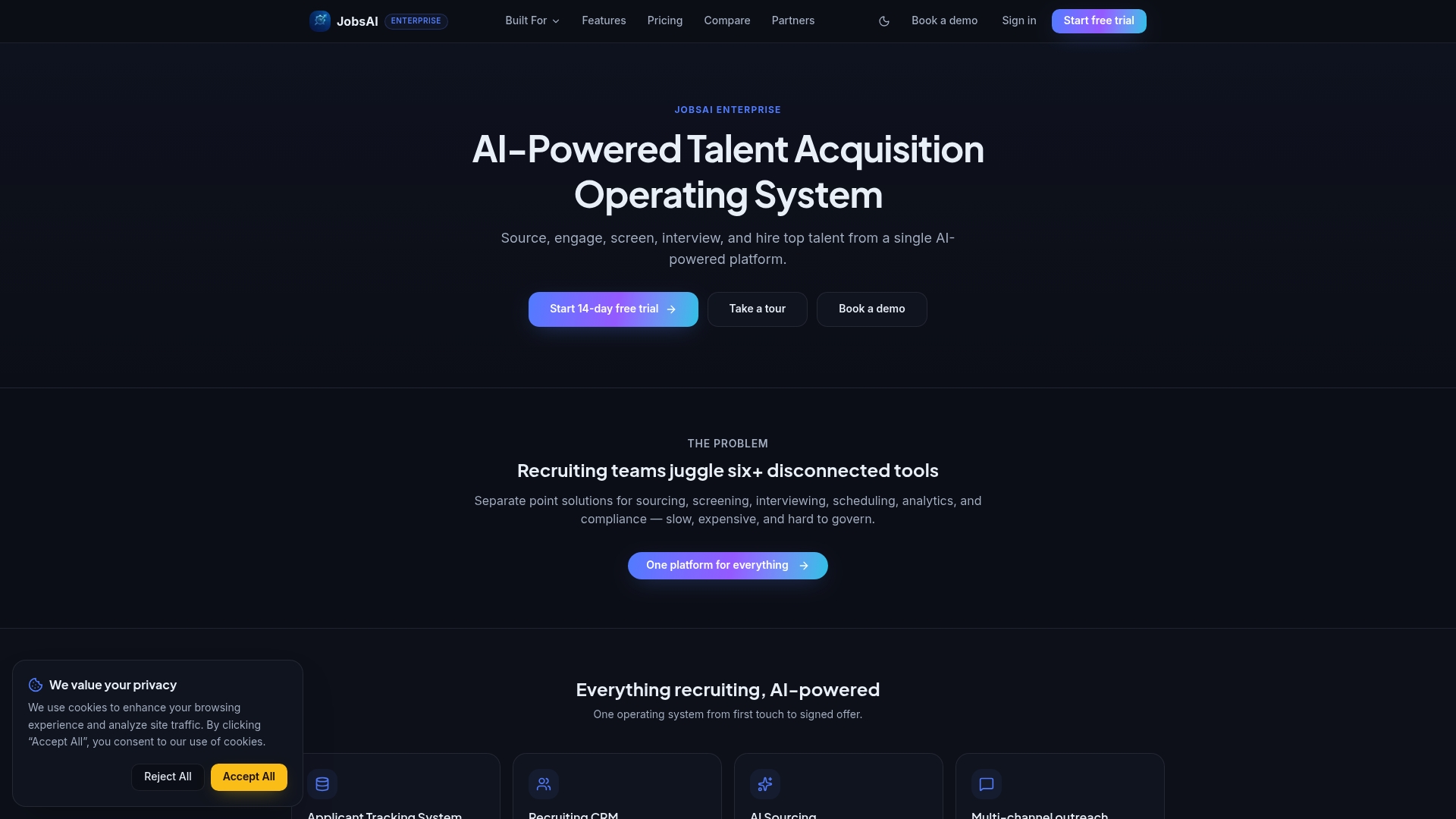
The concrete difference: you keep full ownership of your candidate data, your hiring workflows, and your employer brand, with no transition risk and no vendor lock-in. Corporate HR teams, staffing firms, and recruiting agencies use Jobsai Enterprise to handle high-volume screening and workflow coordination in-house, at a cost structure that doesn’t scale with headcount the way RPO fees do. See the full platform capabilities or review pricing to compare against your current cost-per-hire.
Sources
- Recruitment Process Outsourcing Association (RPOA) - Home
When doing due diligence on any RPO provider, request at least two client case studies from organizations with similar hiring volume and role types, and ask for 12-month retention data on placed candidates.
FAQ
What does RPO stand for in recruiting?
RPO stands for Recruitment Process Outsourcing. It describes an arrangement where an employer transfers ownership of some or all recruitment activities to an external provider responsible for process design and results.
How is RPO different from a staffing agency?
A staffing agency fills individual roles on a transactional, contingency basis with no process accountability. An RPO provider takes ownership of the end-to-end recruitment process, operates as an extension of your TA function, and is accountable to defined SLAs and performance metrics.
What are the main types of RPO?
The four main engagement models are end-to-end RPO, project RPO, selective or managed-task RPO, and recruiter-on-demand. Each differs in scope, duration, and pricing structure.
When should a company choose software over RPO?
Software is the better starting point when your team wants to retain full control of candidate data and hiring workflows, build internal TA capability, or reduce costs without a long-term outsourcing contract. Jobsai Enterprise covers the high-volume screening and workflow tasks that typically drive RPO decisions.
What metrics should you require in an RPO contract SLA?
At minimum, require time-to-fill, time-to-hire, quality-of-hire at 30/60/90 days, candidate retention at 6 and 12 months, candidate NPS, and source-of-hire reporting. These metrics give you the data to hold the provider accountable and measure ROI accurately.
Recommended
See it in your workflow
JobsAI Enterprise runs sourcing, AI screening, and the whole interview pipeline in one place. Book a walkthrough tailored to your team.
Book a demo