
Article
Warehouse Recruiter Efficiency Strategies: 10 Ways to Cut Time-to-Hire

Warehouse Recruiter Efficiency Strategies: 10 Ways to Cut Time-to-Hire
The highest-impact warehouse recruiter efficiency strategies, in priority order, are: standardize your screening rubric and scorecard, automate candidate communication and status updates, write mobile-first job descriptions with pay and shift details upfront, build and maintain a standing talent pool, run same-day phone prescreens, use an ATS with bulk outreach, establish a 48–72-hour apply-to-offer target, create pre-approved offer templates, invest in structured onboarding, and track five core KPIs weekly. The first three deliver the fastest wins. The rest compound over weeks and months.
Fastest wins (implement this week):
- Standardize your prescreen rubric with pass/fail gates on reliability, availability, and physical requirements
- Automate candidate status updates and interview scheduling via your ATS
- Rewrite job descriptions to lead with pay rate, shift, and location
- Set a firm apply-to-offer target of about two to three days and hold every step accountable to it
- Launch or refresh a referral program with a clear reward and a short payout window
Longer-term, compounding impact:
- Build a talent pool segmented by role, shift, and location for proactive outreach
- Deploy structured interview scorecards across all hiring managers
- Create pre-approved offer letter templates to eliminate last-minute delays
- Build a 30-day onboarding checklist tied to productivity and safety milestones
- Track time-to-fill, cost-per-hire, offer acceptance rate, and 90-day retention weekly
Table of Contents
- Why warehouse recruiting efficiency matters more than you think
- Practical strategies you can apply to warehouse hiring today
- How ATS, automation, and AI reduce recruiter workload
- Your step-by-step hiring workflow playbook
- How to measure warehouse recruiting efficiency
- Common pitfalls that kill recruiter efficiency
- How to build a stronger recruiting team through training
- Diversity and inclusion strategies that widen your candidate pool
- Using data analytics to predict and prevent recruiting bottlenecks
- Key Takeaways
- What efficiency actually feels like on a high-volume warehouse team
- Jobsai Enterprise cuts the time between strategy and execution
- What the data actually says: a recruiter’s perspective
- Useful sources and further reading
- FAQ
Why warehouse recruiting efficiency matters more than you think
Warehouse turnover in the United States runs high. When a picker, packer, or forklift operator walks out the door, the cost is not just a posting fee. It includes overtime paid to cover the gap, reduced throughput, safety incidents linked to undertrained fill-ins, and the recruiter hours spent restarting a process that should not have needed restarting.
Time-to-hire compounds every one of those costs. A role open for two weeks instead of three days means two weeks of reduced capacity, two weeks of supervisors covering gaps, and two weeks of candidates who already accepted offers elsewhere. For high-volume warehouse hiring, speed is not a nice-to-have feature of the process. It is the process.
Three business outcomes tie directly to recruiter efficiency:
- Higher 90-day retention: Candidates who receive clear, fast communication and a structured first 30 days are less likely to ghost or quit early. Gallup research consistently shows that schedule predictability and development opportunities are among the top factors employees weigh when deciding whether to stay.
Benchmark to know: For warehouse roles, a 48–72-hour apply-to-offer timeline is achievable with a well-designed process. Most teams that miss it lose time not in any single step, but in the handoffs between steps.
Practical strategies you can apply to warehouse hiring today
Write job descriptions that work on a phone screen
Most warehouse candidates apply from a mobile device. A job post that buries the pay rate in paragraph four, omits the shift, or lists 12 “required” qualifications loses applicants before they finish reading. The fix is structural: lead with pay range, shift hours, location, and the two or three physical requirements that are genuinely non-negotiable. Cut everything else.
Instawork’s guidance on hiring warehouse workers is direct on this: specificity about pay and shift requirements in the job description reduces mismatched applicants and speeds up the prescreen. A shorter, clearer post also performs better on job boards that truncate descriptions on mobile.
What to include:
- Pay rate or range (hourly, with any shift differential)
- Shift start/end times and days
- Physical requirements (lifting weight, standing duration)
- Location and whether transportation is accessible
- One or two genuine differentiators (climate-controlled facility, weekly pay, tuition assistance)
What to cut:
- Generic corporate language (“fast-paced environment,” “team player”)
- Requirements that are preferences, not gates
- Long company histories or mission statements
Build a rapid prescreen rubric
The prescreen is where most warehouse hiring processes leak time. Recruiters ask inconsistent questions, take inconsistent notes, and escalate candidates who should have been screened out in three minutes. A simple pass/fail rubric fixes that.
Five questions cover most of what you need to know before a warehouse interview:
- Are you available for the full shift (days/hours listed)?
- Can you reliably commute to this location?
- Do you have any restrictions on lifting up to [X] lbs?
- Have you worked in a warehouse, distribution center, or similar environment before?
- Are you authorized to work in the United States?
Any “no” on questions 1, 2, or 5 is an immediate screen-out. Questions 3 and 4 inform placement, not disqualification. Document the answers in your ATS immediately. The whole call should take under five minutes.
Use structured scorecards for every interview
Crown Personnel’s best practices guidance recommends structured interviews and practical skills assessments as core tools for warehouse managers. A scorecard does not need to be complex. Rate candidates on five dimensions: reliability indicators, physical capability, safety awareness, communication clarity, and relevant experience. Use a 1–3 scale. Require every interviewer to complete the scorecard before discussing the candidate with anyone else.
This eliminates the “gut feel” debrief that wastes 20 minutes and produces no useful signal.
Source from the right channels
For warehouse roles, the highest-ROI sourcing channels are employee referrals, local community boards (neighborhood Facebook groups, community college job boards, church bulletin boards), and staffing apps built for hourly work. National job boards produce volume but often lower signal-to-noise ratios for warehouse-specific roles.
Pro Tip: Run your referral program with a short payout window. A $200 bonus paid at 30 days beats a $500 bonus paid at 90 days every time. Candidates referred by current employees show up, stay longer, and require less onboarding time. Make the referral process a single text or form submission, not a multi-step HR portal.
Internal mobility is an underused channel. A picker who wants to move to receiving, or a temp who wants to go permanent, already knows your facility and your expectations. Posting internally before going external costs nothing and often fills roles faster.
How ATS, automation, and AI reduce recruiter workload
The most time-consuming parts of warehouse recruiting are also the most automatable: sending status updates, scheduling phone screens, following up on no-shows, and ranking resumes by basic criteria. ATS platforms and AI-assisted tools can handle all of these, freeing recruiters to spend time on the decisions that actually require judgment.
What to automate first
Start with communication, not screening. Automated status updates, interview confirmations, and no-show follow-ups reduce candidate drop-off without introducing the bias risks that come with automated ranking. Faster recruiter response time directly reduces candidate ghosting, and automation is the most reliable way to keep response times consistent across a high-volume pipeline.
Once communication is running cleanly, add:
- Resume ranking by pre-set criteria (shift availability, relevant experience, location)
- Bulk outreach campaigns for talent pool reactivation
- Automated scheduling links sent after a candidate passes the prescreen rubric
- Offer letter generation with e-signature routing
Implementation checklist
- Audit your current workflow: map every step from application to offer and note where candidates wait more than four hours
- Set up your ATS with the prescreen rubric as a knockout filter
- Configure automated status messages for application received, prescreen scheduled, interview confirmed, and offer sent
- Connect your calendar for self-scheduling (eliminates the back-and-forth entirely)
- Build a bulk outreach template for talent pool reactivation before seasonal peaks
- Run the first two weeks manually alongside automation to catch errors before scaling
A note on where human judgment stays
IBM’s research on hiring efficiency makes the point clearly: efficiency improves most when organizations strengthen the evidence and judgment inside the hiring funnel, not just the speed. Automated ranking can reflect historical bias if the training data is skewed. Keep humans in the loop for final screening decisions, and audit your AI tools periodically for disparate impact. For more on this, the Jobsai Enterprise guide on AI hiring bias is a practical starting point.
“Hiring efficiency is about reducing wasted effort and improving the quality of hiring decisions — not simply doing the same process faster.” — Rob Enright, IBM
Metrics table: tool features mapped to KPIs
| Automation Feature | Primary KPI Impacted | Secondary KPI |
|---|---|---|
| Automated status updates | Candidate response rate | Offer acceptance rate |
| Resume ranking / AI screening | Time-to-prescreen | Recruiter hours per hire |
| Self-scheduling links | Time-to-interview | Candidate drop-off rate |
| Bulk outreach campaigns | Pipeline fill rate | Cost-per-hire |
| Offer letter automation | Time-to-offer | Offer acceptance rate |
| Workflow automation | Time-to-fill | Recruiter productivity |
Your step-by-step hiring workflow playbook
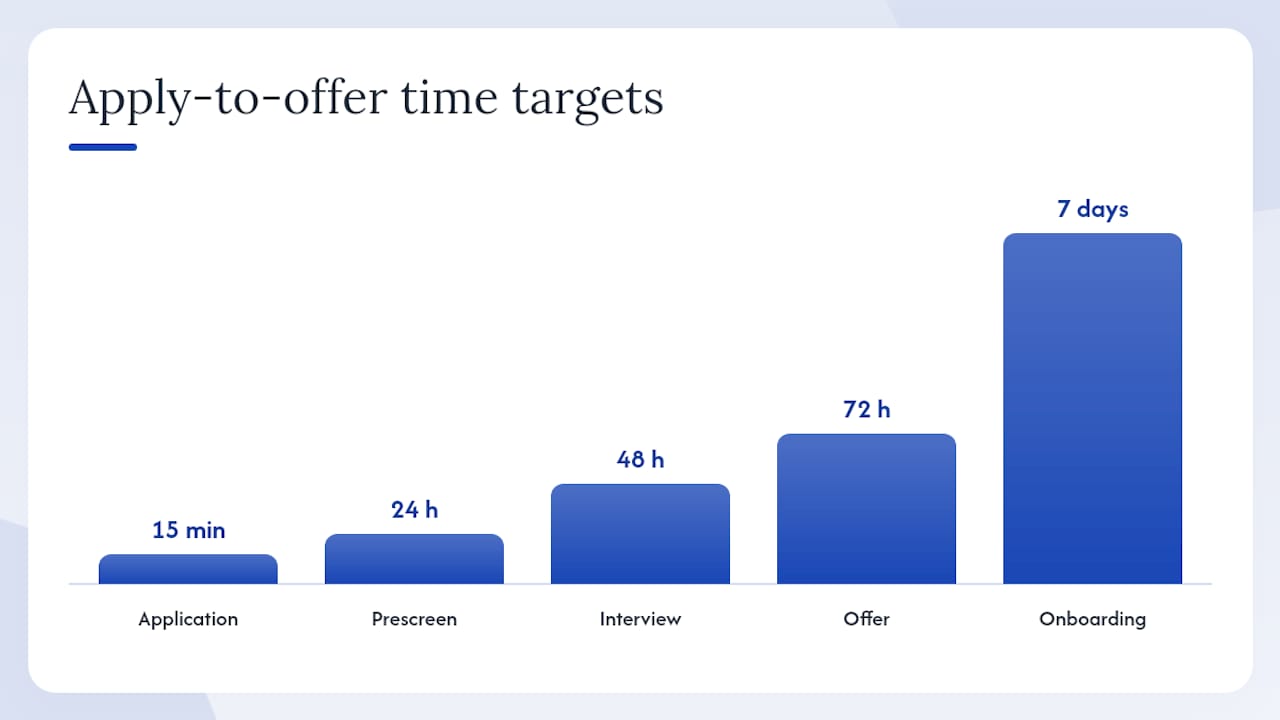
A clean apply-to-offer process for warehouse roles runs in five stages. Each stage has a time target, an owner, and a defined handoff.
Stage 1: Application (Day 0)
- Owner: Recruiter
- Action: ATS receives application, sends automated confirmation within 15 minutes
- Gate: Knockout filter checks shift availability and work authorization
- Handoff: Qualified candidates enter prescreen queue automatically
Stage 2: Prescreen (Day 0–1)
- Owner: Recruiter
- Action: Five-question phone screen using the rubric above; notes logged in ATS immediately
- Target: Complete within 24 hours of application
- Handoff: Pass candidates receive automated scheduling link for structured interview
Stage 3: Interview (Day 1–2)
- Owner: Hiring manager (with recruiter scorecard)
- Action: 20–30 minute structured interview using the five-dimension scorecard; practical task check where legally permissible and role-relevant
- Target: Complete within 48 hours of application
- Handoff: Hiring manager submits scorecard; recruiter prepares offer if score clears threshold
Stage 4: Offer (Day 2–3)
- Owner: Recruiter
- Action: Pre-approved offer template sent via e-signature; verbal confirmation call same day
- Target: Offer out within 72 hours of application
- Handoff: Signed offer triggers onboarding checklist automatically
Stage 5: Onboarding (Day 1–30)
- Owner: Operations + HR
- Action: Day-one safety orientation, buddy assignment, 7-day and 30-day check-ins
- Target: Candidate productive on floor by end of week one
- Handoff: 30-day retention check triggers recruiter review of hire quality
The hiring manager workspace in Jobsai Enterprise keeps each stage visible to all owners, reducing the “where is this candidate?” back-and-forth that kills timelines.
Pro Tip: For seasonal surges, pre-approve a batch of offer letters before the peak begins. When you have 40 offers to send in a week, a template with pre-filled pay rates and start dates cuts processing time from hours to minutes.
How to measure warehouse recruiting efficiency
Tracking the right numbers tells you where the process breaks down before it becomes a crisis.
Core KPIs and formulas
| KPI | Formula | Reporting Cadence |
|---|---|---|
| Time-to-fill | Date offer accepted minus job posting date | Weekly |
| Time-to-offer | Date offer sent minus application date | Weekly |
| Cost-per-hire | Total recruiting spend divided by hires made | Monthly |
| Offer acceptance rate | Number of offers accepted divided by number of offers made | Weekly |
| 30-day retention | 30-day retention | Monthly |
| 90-day retention | 90-day retention | Monthly |
Benchmark: For high-volume warehouse roles, a time-to-offer under 72 hours is achievable. Offer acceptance rates below 70% usually signal a pay or communication problem, not a sourcing problem.
Running a 30/60/90-day quality check
At 30 days, compare retention by sourcing channel. If referrals retain at a meaningfully higher rate than job board hires, shift sourcing budget accordingly. At 60 days, check whether early quits cite onboarding gaps or schedule issues. At 90 days, review which hiring managers have the strongest retention and ask what they do differently in interviews and onboarding.
These three checkpoints, run consistently, turn anecdotal feedback into process improvements.
Common pitfalls that kill recruiter efficiency
Over-specifying job requirements
Listing “2 years of warehouse experience required” for an entry-level pick-and-pack role shrinks your candidate pool without improving hire quality. Audit every requirement. If it is not a genuine gate, remove it.
Quick fix: Replace experience requirements with demonstrated behaviors (“able to maintain pace in a timed environment”) and test for them in the practical assessment.
Slow response after application
Candidates applying for hourly warehouse work are often applying to five or more roles simultaneously. A 48-hour silence after application is enough to lose them. Automated response systems solve this without adding recruiter workload.
Quick fix: Set up an immediate application confirmation and a prescreen scheduling link that goes out within 15 minutes of application receipt.
Misaligned expectations between recruiter and hiring manager
When a hiring manager rejects candidates the recruiter considered strong, the problem is usually a misaligned definition of “qualified.” This creates rework cycles that waste days.
Quick fix: Before posting a role, run a 15-minute intake meeting with the hiring manager using a structured intake form. Agree on the top three must-haves and document them in the ATS.
Pro Tip: Review the AI in recruiting guide before automating any screening step. Knowing which decisions to keep human prevents the most common automation mistakes.
Weak onboarding that undoes good hiring
A well-screened candidate who quits in week two because no one showed them where to clock in is a recruiting failure, not an operations failure. Onboarding is part of the hiring process.
Quick fix: Build a 30-day onboarding checklist that includes a day-one buddy, a 7-day check-in call, and a 30-day performance conversation. Assign ownership to a specific person, not “HR.”
Legal note: Any physical task check used in screening must be job-related, consistently applied, and compliant with the Americans with Disabilities Act. Consult legal counsel before adding physical assessments to your process.
How to build a stronger recruiting team through training
Recruiter skill gaps are often invisible until they show up as bad hires or long time-to-fill numbers. The most effective training programs for warehouse recruiting teams focus on three areas: structured interviewing technique, bias awareness in screening, and data literacy for KPI tracking.
Structured interviewing is the highest-leverage skill. Recruiters who know how to build and use a behavioral question bank, score candidates consistently, and document decisions defensibly produce better hires and create less legal exposure. Short, role-specific training sessions (two to three hours, not a full-day seminar) with practice interviews and calibration exercises work better than generic HR certification courses for this audience.
Bias awareness training matters more now that AI tools are part of the screening process. Recruiters need to understand not just interpersonal bias, but how algorithmic tools can reflect historical patterns in hiring data. Pairing this training with a regular audit of your ATS screening outputs keeps the process honest.
Data literacy is the third gap. Many warehouse recruiters track time-to-fill informally but cannot tell you their offer acceptance rate or 90-day retention by sourcing channel. A two-hour session on reading your ATS dashboard and connecting KPIs to process decisions pays back quickly. Pair it with a weekly 15-minute team standup where one KPI is reviewed and one process question is asked.
Diversity and inclusion strategies that widen your candidate pool
A narrow sourcing strategy is often the root cause of a shallow candidate pool. If you post only to the same two job boards and rely on the same staffing agency, you will keep hiring from the same demographic slice of the labor market, which limits both your reach and your resilience during tight labor markets.

Widening the pool starts with where you post. Community colleges, workforce development boards, re-entry programs, and veteran employment services all connect to candidate populations that are motivated, often underrepresented in warehouse hiring, and frequently overlooked. Many of these channels are free or low-cost.
Job description language also filters candidates before they apply. Phrases like “must be able to work independently” or “fast-paced environment” can read as exclusionary to candidates who have been told those environments are not for them. Plain, specific language (“lift up to 50 lbs, stand for 8-hour shifts, work in a team of 10”) describes the job without signaling who belongs in it.
Structured interviews and scorecards, covered earlier, also serve a D&I function. When every candidate is evaluated on the same dimensions with the same questions, the process is less susceptible to affinity bias. Calibration sessions, where two or more interviewers compare scores and discuss discrepancies, catch the gaps that individual reviewers miss.
Finally, AI-driven matching tools can help surface candidates whose resumes might be deprioritized by keyword-heavy screening, provided the matching criteria are built around actual job requirements rather than historical hire profiles. Review your matching criteria annually.
Using data analytics to predict and prevent recruiting bottlenecks
Most recruiting teams react to bottlenecks after they appear. A role sits open for three weeks, someone escalates, and the team scrambles. Predictive analytics shifts that posture from reactive to planned.
The starting point is funnel analysis. Map your pipeline stage by stage: how many applicants reach prescreen, how many pass, how many complete the interview, how many receive offers, how many accept. When a stage shows a drop-off rate significantly higher than your baseline, that is your bottleneck. Fix the stage, not the volume.
Seasonal pattern data is particularly useful for warehouse teams. If your data shows that applications drop in November and December (when competitors are also hiring), you can build your talent pool in September and run proactive outreach before the competition heats up. This is where a recruiting CRM earns its keep: segmented talent pools let you reactivate warm candidates with a single bulk message rather than starting from zero.
Source quality analytics tell you which channels produce candidates who actually stay. Cost-per-hire by channel is a useful metric, but 90-day retention by channel is more useful. A job board that produces cheap hires who quit in week three costs more than a referral program that produces slightly more expensive hires who stay for a year.
The workflow automation layer in a modern ATS captures this data automatically. The key is reviewing it on a set cadence (weekly for pipeline metrics, monthly for retention and cost) and connecting what you see to a specific process change.
Key Takeaways
The most effective warehouse recruiter efficiency strategies combine fast, structured processes with targeted automation and consistent measurement, producing shorter time-to-offer, lower cost-per-hire, and stronger 90-day retention.
| Point | Details |
|---|---|
| Speed is a competitive advantage | An apply-to-offer target of about two to three days is achievable and wins candidates who are actively comparing offers. |
| Automate communication first | Status updates and scheduling automation reduce drop-off without introducing screening bias. |
| Structured scorecards reduce rework | A five-dimension interview scorecard eliminates misaligned hiring manager feedback and speeds decisions. |
| Measure five KPIs weekly | Time-to-fill, time-to-offer, cost-per-hire, offer acceptance rate, and 90-day retention reveal bottlenecks before they escalate. |
| Jobsai Enterprise accelerates every stage | AI screening, bulk outreach, workflow automation, and recruiting CRM map directly to the tactics in this guide. |
What efficiency actually feels like on a high-volume warehouse team
The conversation about warehouse recruiter efficiency strategies tends to focus on metrics, and rightly so. But the day-to-day experience of a team that has actually implemented these changes is worth describing, because it looks different from what most recruiters expect.
The biggest shift is not speed. It is attention. When automated tools handle status updates, scheduling, and offer routing, recruiters stop spending their mornings clearing an inbox of “where do I stand?” messages. That time goes somewhere more useful: a 15-minute call with a hiring manager to calibrate on a tricky role, a proactive outreach to a talent pool before a seasonal surge, a check-in with a new hire at day seven.
A realistic post-implementation week for a warehouse recruiter managing 20 open roles might look like this: Monday is pipeline review and KPI check. Tuesday and Wednesday are prescreens and interviews, with scheduling handled by the ATS. Thursday is offer processing and onboarding handoffs. Friday is talent pool maintenance and sourcing for the following week’s anticipated openings. No emergency scrambles. No candidate ghosting because no one followed up. No hiring manager calling to ask why a role has been open for three weeks.
That is not a utopian scenario. It is what happens when the process is designed rather than inherited. The tools matter, but the design matters more. Automation without a clear workflow just moves the chaos faster.
Jobsai Enterprise cuts the time between strategy and execution
Knowing the right warehouse hiring strategies and having the infrastructure to run them consistently are two different problems. Jobsai Enterprise solves the second one.
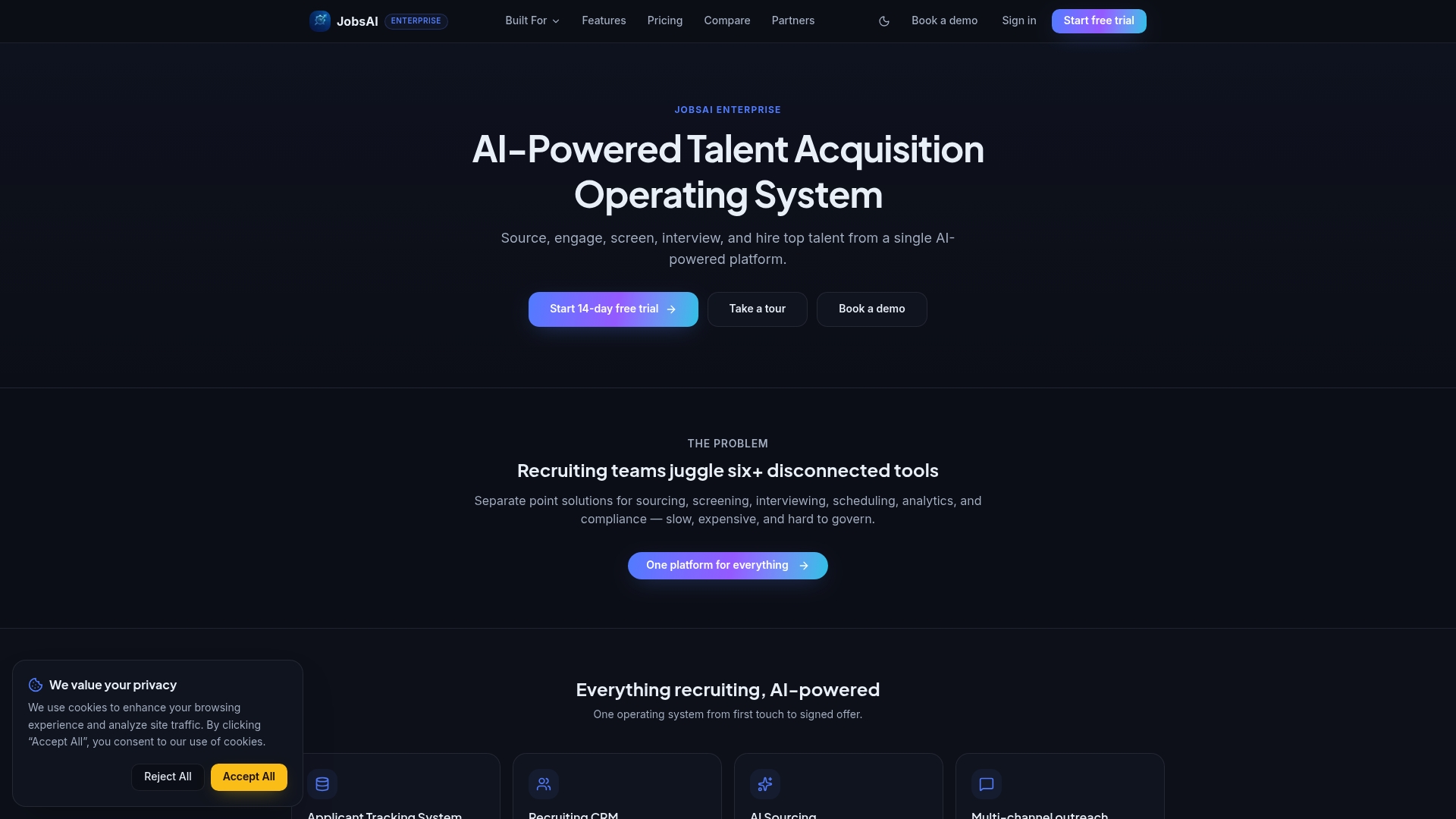
The platform maps directly to the tactics in this guide. AI screening ranks and filters applicants against your prescreen rubric automatically, so recruiters review a short list of qualified candidates rather than a raw pile of resumes. Bulk outreach via email, SMS, and WhatsApp reactivates your talent pool in minutes before a seasonal surge. Workflow automation handles status updates, scheduling, and offer routing without recruiter intervention. The recruiting CRM keeps every candidate relationship organized so no warm lead goes cold. Offer letter generation with e-signature routing cuts the time-to-offer stage from hours to minutes.
For staffing firms and corporate HR teams running high-volume talent acquisition, the executive dashboard surfaces the five KPIs covered in this guide in real time, so you can see bottlenecks before they become escalations.
See how it fits your workflow at Jobsai Enterprise pricing, or take a walkthrough at app.jobsai.work.
What the data actually says: a recruiter’s perspective
The efficiency conversation in warehouse recruiting has a blind spot. Most guides focus on tools and timelines, which are real levers. But the single biggest driver of recruiter inefficiency in high-volume warehouse teams is not a missing tool. It is an unclear definition of a qualified candidate that no one has written down.
When the hiring manager’s mental model of “the right person” differs from the recruiter’s, every step in the process generates rework. Resumes get rejected without explanation. Offers get delayed while someone “checks with the team.” Candidates accept competing offers while the internal conversation continues. The ATS did not cause that. The intake process did.
The teams that get the most out of automation are the ones that did the unglamorous work first: writing down what “qualified” means for each role, building a scorecard everyone agrees on, and running a 15-minute intake meeting before every new requisition. Automation then accelerates a process that already works. Without that foundation, it accelerates a process that produces the wrong hires faster.
The practical implication: before you invest in any new tool, spend one hour with your hiring managers and write down the three non-negotiable criteria for each of your top five roles. That document will do more for your time-to-fill than any software purchase.
Useful sources and further reading
- How to maximize recruitment efficiency with AI | IBM
- Hiring hacks to improve your recruitment process | Built In
- How to hire warehouse workers | Instawork
- Warehouse Hiring — Workforce, Challenges & Recruiting Guide | HRHelperG
- Best Practices for Warehouse Managers to Streamline Hiring | Crown Personnel
- Top things employees want in their next job | Gallup
- How to Improve Recruiter Response Time in 2026 | JobsAI Enterprise
- JobsAI Enterprise — AI-Powered Talent Acquisition Operating System | JobsAI Enterprise
FAQ
What is the 70/30 rule in recruiting?
The 70/30 rule suggests that recruiters should spend roughly 70% of their time on proactive sourcing and relationship-building, and 30% on reactive tasks like processing inbound applications. In practice, most warehouse recruiting teams operate in reverse, which is why automation for the reactive tasks matters.
How do you improve recruitment efficiency in warehouse hiring?
Start with the three fastest wins: rewrite job descriptions to lead with pay and shift details, automate candidate status updates and scheduling, and set a firm apply-to-offer target of about two to three days. These three changes alone typically cut time-to-fill by a meaningful margin without requiring new tools.
What are the 5 C’s of hiring?
Definitions vary across sources. A common version used in structured hiring frameworks covers Competence (can they do the job?), Character (will they fit the team and culture?), Commitment (will they stay?), Communication (can they work with others?), and Compatibility (do their availability and requirements match the role?). Applying these as a scorecard framework keeps interviews consistent across hiring managers.
What KPIs matter most for warehouse recruiter efficiency?
The five most actionable KPIs are time-to-fill, time-to-offer, cost-per-hire, offer acceptance rate, and 90-day retention. Track them weekly for pipeline metrics and monthly for cost and retention. When offer acceptance falls below 70%, the problem is usually pay or slow communication, not sourcing volume.
Recommended
See it in your workflow
JobsAI Enterprise runs sourcing, AI screening, and the whole interview pipeline in one place. Book a walkthrough tailored to your team.
Book a demo