
Article
Talent Acquisition for HR Teams: A Practical Guide

Talent Acquisition for HR Teams: A Practical Guide
Talent acquisition is the proactive, strategic process of identifying, attracting, and securing the people an organization needs now and over the next one to three years. It’s not the same thing as filling a requisition. It’s the discipline behind knowing which requisitions you’ll have before they open.
If you’re starting or resetting a talent acquisition function, do these three things this week:
- Audit your last 10 hires. How many came from active sourcing versus inbound applications? That ratio tells you how reactive your current process really is.
- Map your priority roles for the next two quarters. According to LinkedIn’s Talent Blog, talent acquisition means building pipelines for roles before they’re urgent, not after.
- Pick one KPI and start tracking it now. Time-to-fill is the easiest place to begin, and platforms like JobsAI Enterprise can surface it automatically once your data is centralized.
Key Takeaways
Talent acquisition works when forecasting, structured process, and clean data replace reactive, ad hoc hiring.
| Point | Details |
|---|---|
| Definition drives strategy | Talent acquisition is proactive and long-term; recruitment is reactive and short-term, and mixing the two causes confusion over ownership. |
| Process needs six connected stages | Align, write, source, engage, evaluate, and hire/onboard each need a clear owner and deliverable. |
| KPIs must be tracked together | Time-to-fill, quality-of-hire, and retention at 6/12 months tell a fuller story than any single metric alone. |
| Compliance applies at every stage | The Fair Credit Reporting Act and DOL discrimination rules govern sourcing, screening, and background checks. |
| Platforms help once volume grows | JobsAI Enterprise consolidates ATS, CRM, and AI screening into one workspace once manual review starts slowing hiring down. |
Table of Contents
- What Is the Difference Between Talent Acquisition and Recruitment?
- What Does the Modern Talent Acquisition Process Look Like?
- Which Talent Acquisition Strategies Actually Move the Needle?
- Who Handles Talent Acquisition, and What Skills Do They Need?
- What KPIs Should Recruiters Track?
- What Tools Support a Modern Talent Acquisition Function?
- How Do You Build a Talent Acquisition Strategy in 8 Weeks?
- When Should You Bring In a Talent Acquisition Platform?
- Where Does Onboarding Fit Into the Talent Acquisition Lifecycle?
- What Legal and Compliance Rules Apply to Talent Acquisition?
- Ready to Consolidate Your Talent Acquisition Stack?
- Sources
- FAQ
What Is the Difference Between Talent Acquisition and Recruitment?
Recruitment fills the seat in front of you. Talent acquisition builds the bench for the seats you’ll need next year. LinkedIn’s Talent Blog draws this exact line: recruitment is reactive, linear, and short-term, while talent acquisition is proactive and tied to long-term workforce planning.
Here’s how the two typically split inside an organization:
- Time horizon: Recruitment thinks in weeks. Talent acquisition thinks in quarters and years.
- Trigger: Recruitment starts when a manager submits a requisition. Talent acquisition starts before that requisition exists, based on forecasted headcount.
- Scope: Recruitment often focuses on one role at a time. Talent acquisition builds pipelines for entire job families, like senior engineers or regional sales leads.
- Ownership: Generalist HR or a hiring manager often drives recruitment. A dedicated TA function, sourcer, or TA manager usually drives acquisition work.
Picture two companies hiring a data analyst. Company A posts the job, waits for applicants, and scrambles for six weeks. Company B already has a warm pool of analysts it has been nurturing through a talent pipeline, so the requisition closes in half that time. Same role, two different systems behind it.
What Does the Modern Talent Acquisition Process Look Like?
A modern process moves through six connected stages, and each one has an owner and a deliverable. Skipping a stage, or letting two teams own the same one, is usually where time-to-fill quietly balloons.
- Align with the hiring manager. The recruiter and hiring manager agree on must-haves versus nice-to-haves before anything gets posted. Deliverable: a one-page hiring scorecard.
- Write the job description. This isn’t a copy-paste job. Skills-based language performs better than vague seniority titles for both search visibility and candidate self-selection.
- Source candidates. Sourcers and recruiters pull from talent pools, referrals, and outbound outreach, not just inbound applications. This is where a talent pool management practice pays off.
- Attract and engage. Candidates get contacted, nurtured, and kept warm through the pipeline. Response time matters more here than most teams assume.
- Evaluate. Structured interviews, skills assessments, and scorecards replace gut-feel decisions. This stage is where bias creeps in if it isn’t standardized.
- Make the offer and onboard. The offer goes out, gets signed, and the new hire moves into a structured onboarding flow that sets the tone for retention.
Use this short checklist to audit any single role’s process: Does the role have a written scorecard? Is there a sourcing plan beyond job boards? Does every candidate get a response within 48 hours? Is the interview panel using the same rubric? Is there a documented onboarding plan waiting before day one?
Each handoff between stages usually depends on a tooling contract. Your ATS needs to pass candidate status to your CRM, and your CRM needs to hand a hired candidate’s data to your HRIS without someone manually re-entering it. Korn Ferry’s research on talent acquisition found that most organizations still run these handoffs on siloed systems, which is exactly where data gets lost and reporting breaks down.
Which Talent Acquisition Strategies Actually Move the Needle?
Not every strategy deserves equal investment. These are the ones with the clearest line to measurable outcomes:
- Talent forecasting. Model headcount needs against business growth plans, not just current attrition. Moves time-to-fill because you’re sourcing before the req opens.
- Talent pipelining. Keep warm relationships with qualified candidates who aren’t ready to move yet. Moves source-of-hire and cuts sourcing cost per hire.
- Employer branding. Consistent, honest messaging about what it’s actually like to work at your company. Moves application volume and, more importantly, application quality.
- Skills-based hiring. Evaluate what someone can do over where they went to school or how many years they’ve logged. Moves quality-of-hire and widens your candidate pool.
- Internal mobility. Treat current employees as a talent pool for new roles. Moves retention and cuts external hiring costs.
- Referral programs. Employees usually know people who fit the culture and the role. Moves time-to-fill and often quality-of-hire simultaneously.
- Remote and global sourcing. Removing geographic limits widens your funnel significantly. BLS research found many workers value remote flexibility as much as a pay increase, which matters directly for employer branding.
- DEI integration. Build inclusive sourcing and structured evaluation into every stage rather than treating it as a separate initiative. Moves quality-of-hire and reduces legal exposure.
Pro Tip: If your stack is fragmented across five disconnected tools, don’t start by buying a sixth. Start by defining one shared candidate ID across your existing systems. Everything else, automation, AI matching, reporting, depends on that one decision being right first.
Who Handles Talent Acquisition, and What Skills Do They Need?
A talent acquisition function typically splits across a few distinct roles, and confusing them is a common reason teams feel understaffed when they’re actually just misaligned.
- TA manager: Owns strategy, forecasting, and stakeholder relationships with department heads. Needs workforce planning skills and comfort presenting data to executives.
- Sourcer: Builds and maintains talent pipelines through outbound outreach and talent pool management. Needs Boolean search skills, persistence, and a good sense for engagement timing.
- Recruiter: Manages the candidate relationship from first contact through offer. Needs strong communication skills and comfort running structured interviews.
- Coordinator: Handles scheduling, logistics, and candidate communication. Needs organizational precision and speed.
- TA operations or product manager: Owns the tech stack, data contracts, and reporting. According to the recruiting operating system framework, this role is increasingly essential once a team adopts multiple integrated tools.
Centralized TA models put all these roles under one function serving the whole company. Embedded models place recruiters inside specific business units. Centralized works well when roles overlap across departments; embedded works better when each unit’s hiring needs are highly specialized.
What KPIs Should Recruiters Track?
A handful of metrics tell you almost everything about how healthy your pipeline is. Here’s the baseline dashboard worth building first.
| KPI | What It Tells You |
|---|---|
| Time-to-fill | Measures days from req opening to offer acceptance; a rising number usually signals sourcing or approval bottlenecks. |
| Time-to-hire | Measures days from first candidate contact to offer acceptance; isolates process speed from sourcing speed. |
| Quality-of-hire | Tracks performance and retention of hires at 90 days and one year; a low score points to weak evaluation criteria. |
| Source-of-hire | Shows which channels produce hires, not just applicants; guides where to invest sourcing budget. |
| Offer-acceptance rate | A falling rate often means compensation, timeline, or candidate experience problems. |
| Pipeline conversion rate | Shows the drop-off between each stage; a steep drop at interview usually means screening criteria are too loose upstream. |
| Retention at 6/12 months | The real test of quality-of-hire; a dip here should trigger a review of onboarding, not just sourcing. |
Recruiters need stage-level detail day to day. Hiring managers need funnel health for their open roles. Executives need trended KPIs and cost-per-hire, usually on a monthly or quarterly cadence. Set alert thresholds, like offer-acceptance dropping below 80%, so problems surface before a quarterly review instead of during one.
What Tools Support a Modern Talent Acquisition Function?
Most teams need a mix of tool classes rather than one all-in-one system, though the trend is toward consolidation.
- ATS (applicant tracking system): Manages requisitions, applications, and hiring stages. This is your system of record.
- CRM (candidate relationship management): Nurtures passive candidates and talent pools over time, distinct from active applicants in the ATS.
- Sourcing automation: Finds and ranks candidates against job requirements, cutting manual resume review significantly.
- Interview and assessment platforms: Standardize evaluation so scoring doesn’t vary wildly by interviewer.
- Onboarding integrations: Hand a hired candidate’s data cleanly into HRIS and payroll systems.
When selecting tools, prioritize data contracts and integrations over feature lists. Gartner’s review of recruiting suites notes that modern platforms increasingly bundle ATS, CRM, and AI-enabled features specifically to solve the integration problem. Also check for automated workflow capabilities and observability into pipeline health, not just automation for its own sake. Any tool touching background checks must comply with the Fair Credit Reporting Act, which governs consent and disclosure requirements for third-party screening.
How Do You Build a Talent Acquisition Strategy in 8 Weeks?
Here’s a realistic roadmap for building or refreshing your TA approach without stalling on a six-month planning cycle.
- Week 1: Discovery. Audit current hires, tools, and time-to-fill baseline.
- Week 2: Define priority roles. Pick the 3 to 5 roles with the highest business impact.
- Week 3: Build hiring scorecards. Get hiring managers to agree on must-haves in writing.
- Week 4: Set KPIs. Choose 3 to 4 metrics from the table above and assign owners.
- Week 5: Shortlist tooling. Identify gaps in your ATS, CRM, and sourcing automation.
- Week 6: Pilot sourcing. Run one active sourcing campaign on a priority role.
- Week 7: Evaluate. Compare pilot results against baseline KPIs.
- Week 8: Scale. Roll out what worked to additional roles.
Your pilot plan needs a defined scope (one role, one team), a duration (four weeks minimum), named stakeholders (hiring manager plus recruiter), and a simple evaluation rubric: did time-to-fill improve, did candidate quality hold or rise, did the hiring manager report a better experience. Small, visible wins from that pilot are what earn budget for the next phase.
When Should You Bring In a Talent Acquisition Platform?
A few signals reliably indicate it’s time to move beyond spreadsheets and disconnected point tools: hiring volume climbing past what manual review can handle, a stack scattered across four or five unconnected systems, time-to-fill creeping upward with no clear cause, candidates going silent for days without a response, or nobody being able to answer “where is this req stuck” without pulling three reports.
JobsAI Enterprise is built around exactly these signals. It combines an ATS, CRM, and AI-driven candidate sourcing and matching in one workspace, so resume screening and ranking happen automatically instead of consuming hours of manual review. Workflow automation and analytics dashboards give recruiters, hiring managers, and executives the same real-time view of pipeline health, which is the observability layer Korn Ferry’s talent acquisition research points to as the prerequisite for safely adding AI to hiring. Teams using this kind of consolidated setup typically report faster candidate follow-up and a more consistent evaluation process across roles.
Where Does Onboarding Fit Into the Talent Acquisition Lifecycle?
Talent acquisition doesn’t end when the offer is signed. The lifecycle closes with onboarding and the first year of retention, and skipping this step undoes most of the work that came before it.

A new hire’s first 90 days set the tone for whether that hard-won pipeline investment actually pays off. Structured onboarding, clear 30/60/90-day expectations, an assigned manager check-in cadence, and early access to the tools and people they need, correlates directly with the retention-at-6/12-months metric covered earlier. A hire who churns in month four erases whatever time-to-fill gains your sourcing strategy produced.
This is also where TA and HR responsibilities blend. TA typically owns the handoff, making sure candidate data, start date, and role details transfer cleanly into HRIS and payroll without manual re-entry. HR or people operations usually owns what happens after day one: benefits enrollment, culture orientation, and manager training.
Treat onboarding data the same way you treat sourcing data. If you can’t tell which sourcing channel or hiring manager produces new hires who stay past a year, you’re missing the second half of the story. Quality-of-hire isn’t just about who gets an offer accepted. It’s about who’s still there, and thriving, twelve months later. Building that feedback loop back into your sourcing and screening criteria is what turns a one-time hiring win into a repeatable strategy.
What Legal and Compliance Rules Apply to Talent Acquisition?
Every stage of talent acquisition touches employment law, and the exposure is highest at sourcing and screening, where bias can enter without anyone intending it.
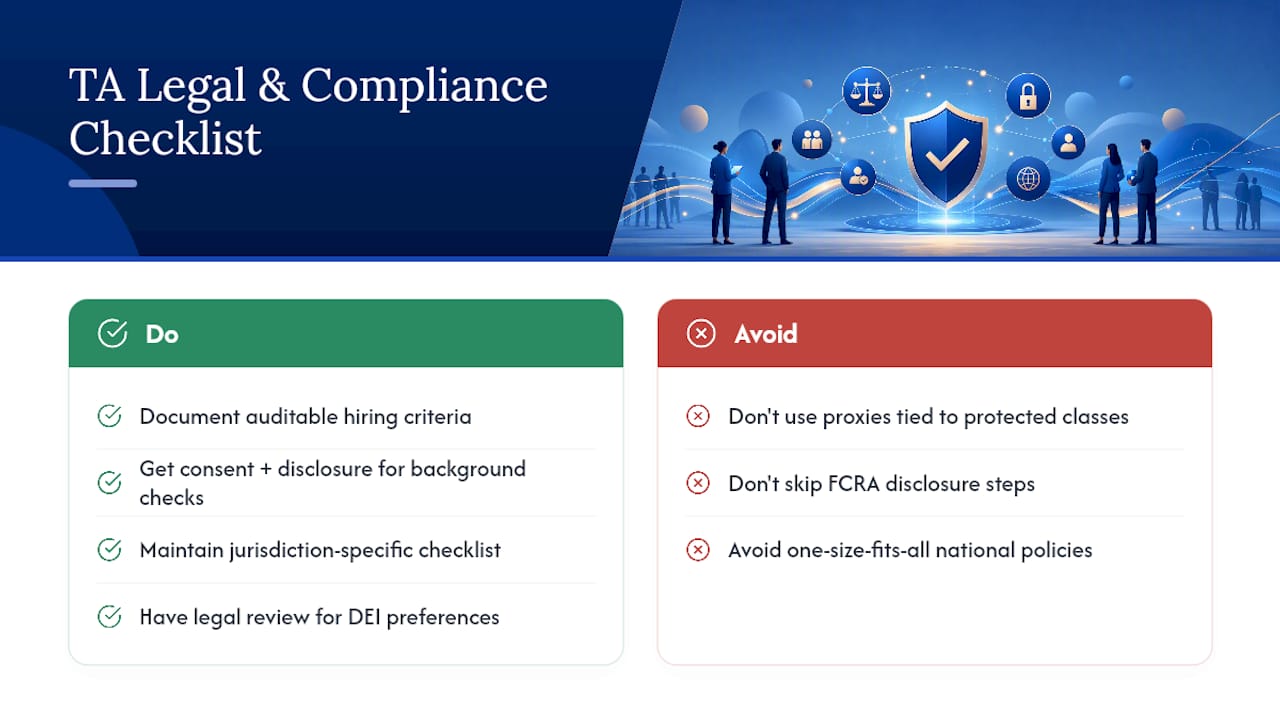
The U.S. Department of Labor’s guidance on employment discrimination sets the baseline: sourcing, screening, and selection decisions cannot discriminate based on protected characteristics like race, sex, age, disability, or national origin. This applies whether a human recruiter makes the call or an algorithm ranks candidates, so any AI-assisted screening tool needs documented, auditable criteria tied to job requirements, not proxies that correlate with protected classes.
Background checks carry their own layer of rules. The Fair Credit Reporting Act requires clear candidate consent before running a background check through a third-party reporting agency, plus proper disclosure if that report factors into a hiring decision. Skipping the disclosure step, even unintentionally, creates real legal exposure.
Beyond federal rules, many states and cities layer on additional requirements: salary history bans, ban-the-box laws restricting when criminal history can be asked about, and pay transparency mandates in job postings. These vary by jurisdiction, so a TA team hiring across multiple states needs a compliance checklist reviewed by legal counsel, not a one-size-fits-all national policy. DEI initiatives should be built with these same legal guardrails in mind: broadening a candidate pool is good practice, but any formal preference tied to a protected characteristic needs legal review first.
A Practitioner’s View on What Actually Breaks Talent Acquisition
Most TA failures aren’t strategy failures. They’re tooling failures dressed up as hiring problems. Teams chase a new sourcing tactic when the real issue is that nobody owns the data connecting their ATS to their CRM. Treat your recruiting stack like a product with an owner, then the KPIs and process checklist above will actually tell you the truth.
Ready to Consolidate Your Talent Acquisition Stack?
Most teams patching together a separate ATS, spreadsheet-based CRM, and manual resume review lose hours every week to re-entering the same candidate data three times. JobsAI Enterprise gives talent acquisition teams one workspace where AI screening, candidate ranking, workflow automation, and reporting all run against the same data, so nobody’s rebuilding a pipeline view from scratch before a Monday standup.
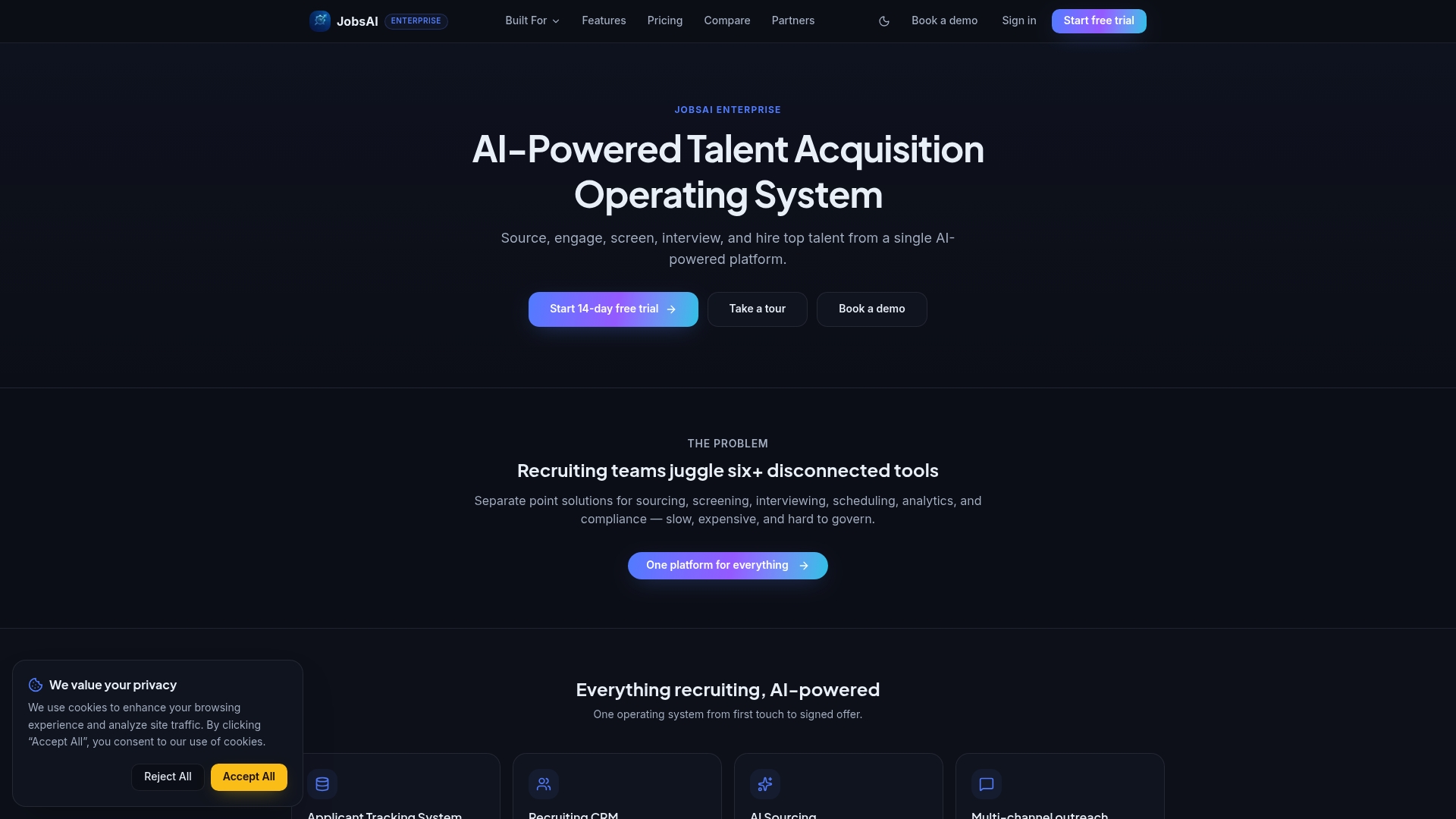
The platform’s dedicated talent acquisition build maps directly to the roles and KPIs covered in this guide, from sourcer workflows to executive dashboards. If you’re ready to see how it handles your actual pipeline, check current plans and pricing and start a trial before your next hiring push.
Sources
- U.S. Department of Labor — Discrimination (overview)
- Korn Ferry — Talent Acquisition Services
- The Recruiting Operating System: Why 2026 Belongs to TA Teams That Treat Their Stack Like Product
FAQ
What Does a Talent Acquisition Professional Actually Do?
A talent acquisition professional forecasts hiring needs, builds candidate pipelines before roles open, and manages sourcing, evaluation, and offer stages, distinct from filling one open req reactively.
Is Talent Acquisition Different From HR?
Yes. HR covers the full employee lifecycle, including benefits, compliance, and performance management, while talent acquisition focuses specifically on sourcing, attracting, and hiring new employees.
Is a Career in Talent Acquisition Hard?
It’s demanding because it blends sales-like persistence in sourcing with data analysis and stakeholder management, but it’s approachable for people coming from recruiting, sales, or HR generalist backgrounds.
What Degree Do You Need for Talent Acquisition?
Most roles list a bachelor’s degree in human resources, business, or a related field as preferred, though BLS data shows many HR specialists enter the field with relevant experience instead of a specific major.
When Should a Team Adopt a Talent Acquisition Platform Like JobsAI Enterprise?
Once hiring volume outpaces manual resume review or your stack is split across disconnected tools, a unified platform like JobsAI Enterprise typically reduces screening time and improves pipeline visibility.
Recommended
See it in your workflow
JobsAI Enterprise runs sourcing, AI screening, and the whole interview pipeline in one place. Book a walkthrough tailored to your team.
Book a demo