
Article
Direct Hire vs Contract: What U.S. Job Seekers Need to Know

Direct Hire vs Contract: What U.S. Job Seekers Need to Know
TL;DR:
- Direct hire places you on the employer’s payroll as a permanent employee, with full benefits from day one. Contract work involves a short-term, project-based engagement where workers often self-fund their benefits and taxes. Contract-to-hire offers a trial period before permanent employment, with conversion terms clearly outlined upfront.
Direct hire means you join the employer’s payroll as a permanent W-2 employee on day one, with full benefits eligibility from the start. Contract work is a time-limited engagement where you are typically classified as an independent contractor (1099) or placed by a staffing agency for a defined project or period. For most job seekers who want stability, benefits, and a clear career path, direct hire is the stronger long-term choice. For employers filling a short-term skills gap quickly, contract staffing is usually the right call.
Quick decision shortcuts:
- Choose direct hire if you need employer-paid health insurance, a retirement match, or a defined career ladder.
- Choose contract work if you want schedule flexibility, faster placement, or higher short-term hourly pay.
- Choose contract-to-hire if you want to evaluate a company before committing, or if the employer wants to reduce hiring risk.
- Hiring managers: use direct hire for core, long-tenure roles; use contract for project-based or seasonal demand spikes.
- If a contract role has no written conversion terms, treat it as contract-only until you see them in writing.
| Dimension | Direct Hire | Contract |
|---|---|---|
| Employment status & tax | W-2 employee; employer withholds taxes | 1099 contractor or agency W-2; worker often self-funds taxes |
| Pay & total compensation | Lower headline rate, but employer covers benefits | Higher hourly rate; worker self-funds benefits |
| Duration & flexibility | Permanent; structured schedule | Fixed term or project; often flexible |
| Hiring speed & employer cost | Slower; placement fee typically calculated as a percentage of first-year salary | Faster; agency markup varying by engagement duration and role, often substantial |
| Job security & career growth | High; formal progression paths | Lower; advancement depends on conversion or next contract |
| Conversion chance | N/A (already permanent) | Possible via contract-to-hire; terms vary |
Table of Contents
- What is direct hire vs contract work? Definitions that actually matter
- Advantages and disadvantages of direct hire
- Advantages and disadvantages of contract work
- Worker classification, taxes, and benefits: W-2 vs 1099 in the U.S.
- How pay actually compares when you include benefits
- How hiring and onboarding differ by model
- How contract-to-hire conversion works
- Which model fits your situation? A practical decision guide
- What to ask before accepting any offer, and red flags to watch for
- How employers choose and manage hiring models with AI tools
- The verdict: which model should you choose?
- Key Takeaways
- The trade-off nobody talks about clearly enough
- Useful sources
- FAQ
What is direct hire vs contract work? Definitions that actually matter
Direct hire means the employer brings you onto their payroll as a permanent employee from day one. You receive a W-2 at tax time, the employer withholds federal and state income taxes plus FICA, and you are immediately eligible for company benefits. Direct hire placements are typically used for leadership roles, specialized positions, and any job where long-term continuity matters.
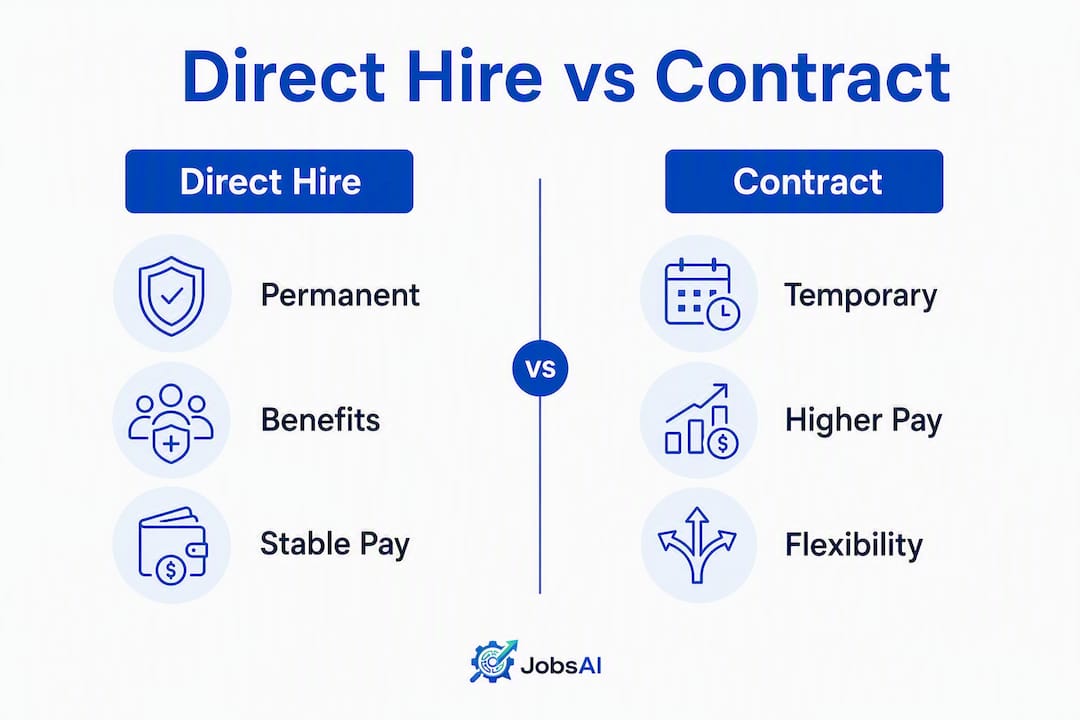
Contract work is a time-limited engagement scoped to a project or period. Contractors manage their own taxes and business operations, often filing as self-employed and receiving a 1099-NEC at year-end. Some contractors are placed by a staffing agency and receive a W-2 from that agency rather than the end client, but the engagement is still temporary by design.
Contract-to-hire is a hybrid model. You start as a contractor or agency-placed temp, and after a defined window (commonly 30–180 days), the employer has the option or obligation to convert you to a permanent direct hire. It functions as an extended working interview for both sides.
Short real-world examples:
- Software: A company hires a senior backend engineer directly onto payroll for a two-year product roadmap (direct hire); it brings in a DevOps contractor for a three-month cloud migration (contract).
- Accounting: A mid-size firm adds a permanent staff accountant through a recruiter (direct hire); it uses a temp accountant from a staffing agency during tax season (contract).
- Healthcare: A hospital system recruits a permanent nurse manager through a search firm (direct hire); it fills a coverage gap with a travel nurse placed by a healthcare staffing agency (contract).
Advantages and disadvantages of direct hire
For employees, the advantages are substantial. You receive employer-paid or employer-subsidized health insurance, paid time off, a retirement plan with potential employer match, and access to formal training programs. Career progression is structured: performance reviews, promotions, and title changes happen within a defined framework. Job security is higher because termination requires cause or a formal process in most organizations.

The trade-offs are real. Your headline hourly rate will typically be lower than a comparable contractor rate because the employer is funding your benefits package. The hiring process is also longer: structured interviews, reference checks, and offer negotiation can stretch the timeline to weeks or months.
For employers, direct hire is especially valuable for roles requiring months of training or strong cultural alignment. You capture the full return on onboarding investment because the employee is permanent from day one. Retention is higher, institutional knowledge compounds over time, and you avoid the recurring cost of re-sourcing the same role. The upfront cost is a placement fee calculated as a percentage of first-year salary if you use a recruiter, plus the ongoing operating expense of benefits. For urgent needs, the timeline is a genuine constraint.
Advantages and disadvantages of contract work
Contract roles offer workers real benefits that direct hire cannot match on every dimension.
Contract advantages for workers:
- Higher hourly rates to offset self-funded benefits and taxes.
- Faster placement: contract roles often start within days of an offer.
- Varied experience across industries, teams, and tech stacks, which builds a broad portfolio quickly.
- Schedule flexibility, especially for independent contractors who set their own hours.
Contract disadvantages for workers:
- No employer-paid health insurance, retirement match, or paid leave.
- Self-employment tax (15.3% on net earnings for independent contractors) on top of income tax.
- Income gaps between contracts and no unemployment insurance eligibility for true 1099 workers.
- Less job security and no formal career ladder within a single organization.
For employers, contract staffing delivers speed and scalability. You can bring in a specialist within days, scale headcount up for a product launch, and scale back down without the OPEX commitment of permanent benefits. The downside: agency markups of 25–60% on hourly rates add up fast on long engagements. There is also a real misclassification risk if you manage contractors too closely, and cultural alignment is weaker when someone knows their tenure is temporary.

Worker classification, taxes, and benefits: W-2 vs 1099 in the U.S.
The IRS and the Department of Labor both care deeply about how you classify workers, and getting it wrong is expensive. The IRS uses a behavioral, financial, and type-of-relationship test to determine whether a worker is an employee or an independent contractor.
| Dimension | W-2 Employee (Direct Hire) | 1099 Independent Contractor |
|---|---|---|
| Who withholds income tax | Employer | Worker (quarterly estimated payments) |
| Who pays FICA | Employer pays half; employee pays half | Worker pays full self-employment tax (15.3%) |
| Benefits eligibility | Health insurance, retirement, PTO, workers’ comp | None from client; worker self-funds |
| Unemployment insurance | Eligible (employer-funded) | Not eligible as independent contractor |
| Payroll reporting | W-2 issued by employer | 1099-NEC issued by client |
Misclassification exposes employers to back taxes, penalties, and owed benefits. The IRS can reclassify a contractor as an employee retroactively, triggering significant liability.
Pro Tip: Red flags that push a contractor toward employee classification include: requiring a fixed daily schedule, providing company-owned equipment, directing how (not just what) work is done, prohibiting the worker from taking other clients, and integrating the worker into regular team meetings as a permanent participant. Document independent-contractor relationships carefully and avoid these behaviors.
For workers, the practical effect is straightforward: a W-2 employee with a $75,000 salary, employer-paid health insurance, and a 4% retirement match has a total compensation package worth meaningfully more than the headline number. A 1099 contractor earning $50/hour must subtract self-employment tax, health insurance premiums, and unpaid time off before comparing that rate to a salaried offer.
How pay actually compares when you include benefits
The contractor’s higher hourly rate looks attractive until you run the full math. Contractor hourly premiums of 20–40% over equivalent employee rates can be largely offset by the cost of self-funding health insurance, retirement contributions, and unpaid time off.
Example calculation for a direct-hire offer at $80,000 salary:
- Employer-paid health insurance contribution: approximately $7,000/year
- 401(k) match at 4%: $3,200/year
- 15 days PTO monetized at $80,000 salary: approximately $4,615/year
- Total compensation: approximately $94,815/year
A contractor would need to earn roughly $45–47/hour on a standard 2,080-hour year just to match that total comp, before paying self-employment tax and health insurance premiums out of pocket.
Items to include in any total comp calculation:
- Employer health insurance premium contribution (medical, dental, vision)
- Employer retirement match (401k, SIMPLE IRA, pension)
- Paid time off (vacation, sick, holidays) monetized at your hourly equivalent
- Employer-paid payroll taxes (FICA employer share: 7.65%)
- Life and disability insurance premiums
- Professional development or tuition reimbursement
Pro Tip: When an employer does not disclose the benefits value, use $15,000–$20,000 as a conservative annual placeholder for a full benefits package (health, retirement, PTO) at a mid-size U.S. company. This gives you a working floor for comparison without waiting on HR to itemize every line.
How hiring and onboarding differ by model
The gap in hiring timelines between the two models is one of the most practical differences for both candidates and hiring managers.
Typical timelines:
- Contract role: Agency receives the requirement, screens candidates, and can present a shortlist within 24–72 hours. A contractor can start within days of an offer. The onboarding is lean: system access, a brief orientation, and a signed statement of work.
- Direct hire: A structured search runs two to six weeks minimum. Multiple interview rounds, reference checks, background screening, and offer negotiation follow. Onboarding includes benefits enrollment, payroll setup, compliance paperwork (I-9, W-4), and a formal training program that may run weeks.
Onboarding responsibilities by model:
- Direct hire: HR manages benefits enrollment, payroll registration, equipment provisioning, compliance training, and a structured 30/60/90-day onboarding plan.
- Contractor/agency worker: The staffing agency handles payroll and benefits for agency-placed temps. The client company provides system access and a project brief. Compliance is lighter but misclassification documentation is critical.
Hiring manager checklist before opening a req:
- Is this role core to the business for 12+ months? (Direct hire)
- Do you need someone productive within two weeks? (Contract)
- Is the scope clearly defined with a fixed end date? (Contract)
- Does the role require deep institutional knowledge or client relationships? (Direct hire)
- Is budget structured as OPEX (ongoing) or project-based? (Informs model choice)
For teams managing high-volume contract and direct-hire pipelines simultaneously, the gap between a fast contract start and a slow direct-hire process is usually lost in the handoffs between steps, not in the interviews themselves.
How contract-to-hire conversion works
Contract-to-hire is not a guarantee. It is either a “right-to-hire” (the employer has the option to convert) or a “conversion guarantee” (both parties commit to conversion if performance criteria are met). Candidates should know which one they are signing before day one.
Numbered steps hiring teams typically follow to convert a contractor:
- Confirm the conversion window is still active (check the original staffing agreement).
- Notify the staffing agency of intent to convert within the required notice period.
- Negotiate or confirm the conversion fee with the agency (often 10–20% of first-year salary if converting before the window closes).
- Agree on the new compensation structure: salary, benefits start date, and any change in hourly-to-salary conversion.
- Issue a formal offer letter with the new employment terms and a start date for W-2 status.
- Complete standard onboarding steps: benefits enrollment, payroll setup, updated compliance paperwork.
Conversion terms to clarify in writing before accepting a contract-to-hire role:
- Is this a right-to-hire or a conversion guarantee?
- What is the conversion window (number of days)?
- What conversion fee does the agency charge the employer?
- Will your pay change at conversion, and by how much?
- When do benefits begin: on conversion date or after a waiting period?
- Is there a probation period after conversion?
Pro Tip: Ask the hiring manager directly: “Is the conversion budget already approved?” A company that has not secured headcount approval for the permanent role may be using contract-to-hire as a way to delay a hiring decision, not accelerate one.
Which model fits your situation? A practical decision guide
The right choice depends on four core questions: How long is the engagement? How urgent is the start? Is the role central to the business? And what does your budget structure look like?
Scenario examples:
- Early-career developer: Contract work builds a varied portfolio fast and often pays more per hour than a junior full-time role. If the company offers contract-to-hire, it is a low-risk way to evaluate the team before committing.
- Senior engineering manager: Direct hire. The role requires institutional context, cross-functional relationships, and a long ramp. A contractor in this seat rarely has the authority or alignment to be effective.
- Cloud migration project (3 months): Contract. The scope is defined, the end date is fixed, and the skills are specialized. A direct hire for a three-month project creates unnecessary severance and offboarding risk.
- Seasonal finance staffing: Contract or agency temp. Demand is predictable but temporary; adding permanent headcount for a seasonal spike inflates fixed costs year-round.
- Contract-to-hire ideal case: A company needs a data analyst now but is uncertain whether the role will grow into a full-time function. Contract-to-hire lets both sides test the fit before a permanent commitment.
Employer decision checklist:
- Time horizon under 6 months: contract is almost always the right call.
- Role requires 3+ months of ramp before full productivity: direct hire captures more of that investment.
- Cultural fit is critical to team performance: direct hire reduces the risk of misalignment.
- Budget is project-coded, not headcount-coded: contract fits the financial structure.
- You have used the same contractor for 18–24 months: agency markups may now exceed the cost of a direct-hire placement fee, making conversion the cheaper long-term option.
What to ask before accepting any offer, and red flags to watch for
Whether you are evaluating a direct-hire offer or a contract engagement, a short list of questions protects you from surprises.
Questions for a direct-hire offer:
- What is the benefits start date? (Some employers have a 30–90-day waiting period.)
- What is the PTO policy, and is unused PTO paid out on separation?
- What does the performance review and promotion cycle look like?
- Is there a non-compete or non-solicitation clause, and what does it cover?
Questions for a contract offer:
- Who is the employer of record: the end client or a staffing agency?
- What is the payment cadence, and what happens if a timesheet is disputed?
- Are business expenses (travel, software, equipment) reimbursed?
- What are the contract renewal terms, and how much notice will you receive if it ends?
- If this is contract-to-hire, what are the written conversion terms?
Red flags to watch for:
- No written contract or statement of work before your start date.
- Vague scope with no defined deliverables or end date.
- Inconsistent payment terms or requests to invoice informally.
- A client who wants to direct your daily schedule, provide all your tools, and prohibit you from other work (misclassification risk for both parties).
- Pressure to start before paperwork is signed.
Quick verification steps:
- Request a sample contract or offer letter before accepting.
- Confirm the name of the employer of record and the payroll provider.
- Verify the point of contact for billing disputes or HR questions.
- Check that the staffing agency is a licensed business in your state.
Contract work can suit those seeking flexibility, but only when the terms are clear and in writing from the start.
How employers choose and manage hiring models with AI tools
Operationally mature hiring teams do not choose between direct hire and contract on instinct. They track three KPIs that clarify the decision: time-to-hire, two-year cost-per-role, and conversion rate for contract-to-hire placements. These metrics reveal when a direct hire is more cost-effective than rolling contractor engagements.
Common employer workflow by model:
- Direct hire: Open req approval → job posting and sourcing → recruiter or search firm engagement → screening and interviews → offer negotiation → background check → onboarding.
- Contract: Staffing agency receives requirement → agency screens and presents candidates → client interviews (often one round) → contract signed → contractor starts within days.
The difference in steps is significant. Direct hire involves more stakeholders and longer approval chains. Contract placements compress the process because the agency absorbs much of the screening and compliance work.
AI-powered platforms are changing how quickly both workflows move. Jobsai Enterprise, for example, supports both direct-hire and contract pipelines in a single workspace. Its AI candidate scoring ranks applicants against job requirements automatically, which cuts manual review time whether you are filling a permanent role or a short-term contract. For contract-to-hire scenarios, the platform’s candidate database helps teams track contractor performance data alongside the original screening scores, giving hiring managers a cleaner signal on who is worth converting. The hiring manager workspace consolidates requisitions, screening, and offer management in one place, reducing the handoff delays that typically slow direct-hire timelines.
Pro Tip: Using contract hires as an extended interview works well when the role is genuinely uncertain in scope. It becomes expensive when the role is clearly permanent but the company is avoiding headcount approval. If a contractor has been in the same seat for more than a year with no conversion discussion, the cost math has likely already flipped in favor of direct hire.
For staffing firms managing both engagement types at scale, gig and contract workforce recruitment requires a different sourcing and compliance approach than permanent placement, and the tooling needs to support both without forcing teams to switch platforms.
The verdict: which model should you choose?
Direct hire is the better long-term choice for job seekers who want stability, benefits, and career growth. Contract work is the right call when you need flexibility, faster placement, or access to higher short-term pay, and when you can absorb the cost of self-funding benefits.
Next steps for job seekers:
- Calculate total compensation for any offer you are comparing (salary + benefits value + PTO).
- Ask the five contract questions above before signing any engagement agreement.
- Request written conversion terms for any contract-to-hire role before your start date.
Next steps for hiring managers:
- Estimate the two-year cost of the role under both models (placement fee + benefits vs agency markup over 24 months).
- Decide whether the role is core to the business for 12+ months before opening a contract req.
- Set a written conversion policy and timeline before the contractor starts, not after.
Key Takeaways
Direct hire is the stronger long-term choice for job seekers who need benefits and stability; contract work wins on speed and flexibility, but only when the total compensation math and written terms are clear.
| Point | Details |
|---|---|
| Classification drives everything | W-2 employees get employer-paid benefits and tax withholding; 1099 contractors self-fund both. |
| Total comp closes the pay gap | A $80,000 salary with benefits can be worth ~$94,815 in total compensation, narrowing the contractor rate premium. |
| Misclassification is a real risk | Employers who control a contractor’s schedule, tools, or exclusivity face IRS reclassification and back-tax liability. |
| Cost crossover favors direct hire | Agency markups of 25–60% on hourly rates can exceed a one-time placement fee of 15–30% of first-year salary if a contract role runs 18–24 months. |
| Ask before you sign | Candidates should confirm conversion terms, employer of record, and payment cadence in writing before starting any engagement. |
The trade-off nobody talks about clearly enough
Most articles on this topic frame the choice as stability versus flexibility, and that framing is not wrong. But it undersells the real decision most people face: how much financial risk are you willing to carry yourself?
Contract work transfers a surprising amount of employer obligation onto the worker. Self-employment tax, health insurance, retirement savings, and income gaps between engagements are not abstract line items. For a contractor earning $50/hour, those costs can consume $15,000–$20,000 a year before you have saved a dollar for retirement. That is not a reason to avoid contract work. It is a reason to price it correctly and negotiate accordingly.
On the employer side, the instinct to default to contract staffing for every uncertain role is understandable but often short-sighted. A contractor who has been in the same seat for 18 months, knows your systems, and performs well is already functioning as a permanent employee. The only thing missing is the paperwork and the benefits. At that point, the agency markup has likely exceeded what a direct-hire placement would have cost, and you are paying a premium to avoid a commitment you have already made in practice.
The most useful thing either side can do is run the numbers honestly, put the terms in writing, and treat the engagement model as a financial and operational decision, not just a hiring convenience.
Useful sources
These are the primary sources worth consulting for legal guidance, classification rules, and compensation comparisons:
- Classification and tax rules: IRS Worker Classification 101 is the authoritative starting point for understanding employee vs independent contractor status. Use this for any question about who owes what in taxes.
- Misclassification risk and employer obligations: LegalClarity on direct hire and employment taxes covers the practical exposures employers face when contractor relationships are managed too closely.
- Direct hire definitions and benefits: Spectraforce’s direct hire guide and Clayton Personnel’s Houston employer guide both explain what direct hire means in practice and why it suits long-tenure roles.
- Contract work and contractor responsibilities: Upwork’s contract job resource explains what contractors are responsible for managing themselves.
- Total compensation comparisons: FitSmallBusiness on contract vs direct hire and 80Twenty’s cost comparison are the most useful sources for running the numbers on total comp and cost crossover.
- Candidate decision guidance: Indeed’s contract work pros and cons is a practical resource for job seekers weighing flexibility against stability.
- Contract-to-hire mechanics: IHC’s direct hire vs contract staffing guide covers conversion windows, right-to-hire terms, and staffing model structures.
This article is general information, not legal or tax advice. Confirm current IRS classification rules, state labor laws, and benefits eligibility requirements with a qualified employment attorney or tax professional before making hiring or employment decisions.
FAQ
What does it mean when a job says “direct hire”?
Direct hire means the employer is bringing you onto their own payroll as a permanent employee from day one, not through a staffing agency. You receive a W-2, are eligible for company benefits immediately (or after any stated waiting period), and are treated as a full employee from the start.
What are the main disadvantages of direct hire?
For employees, the headline hourly rate is lower than a comparable contractor rate because the employer funds your benefits. For employers, direct hire involves a longer hiring timeline and an upfront placement fee of 15–30% of first-year salary when using a recruiter.
Is direct hire better than contract work?
It depends on your priorities. Direct hire is better for long-term stability, benefits, and career growth. Contract work is better for flexibility, faster placement, and higher short-term hourly pay, provided you can self-fund benefits and manage income gaps between engagements.
Does direct hire mean there is no interview?
No. Direct hire typically involves a more structured and thorough interview process than contract roles, including multiple rounds, reference checks, and background screening. The “direct” in direct hire refers to joining the employer’s payroll directly, not to skipping the selection process.
What is contract-to-hire, and how does conversion work?
Contract-to-hire starts as a temporary engagement and includes an option or obligation to convert to permanent employment after a defined window, commonly 30–180 days. Conversion terms, including any agency fee, pay changes, and benefits start date, should be confirmed in writing before you accept the contract role.
Recommended
See it in your workflow
JobsAI Enterprise runs sourcing, AI screening, and the whole interview pipeline in one place. Book a walkthrough tailored to your team.
Book a demo