
Article
Sourcing to Screening Workflow: A Recruiter's Guide

Sourcing to Screening Workflow: A Recruiter’s Guide
TL;DR:
- The sourcing to screening workflow divides recruitment into proactive candidate discovery and evaluative filtering. Automating this sequence reduces time-to-hire and enhances candidate quality by clarifying roles and streamlining handoffs.
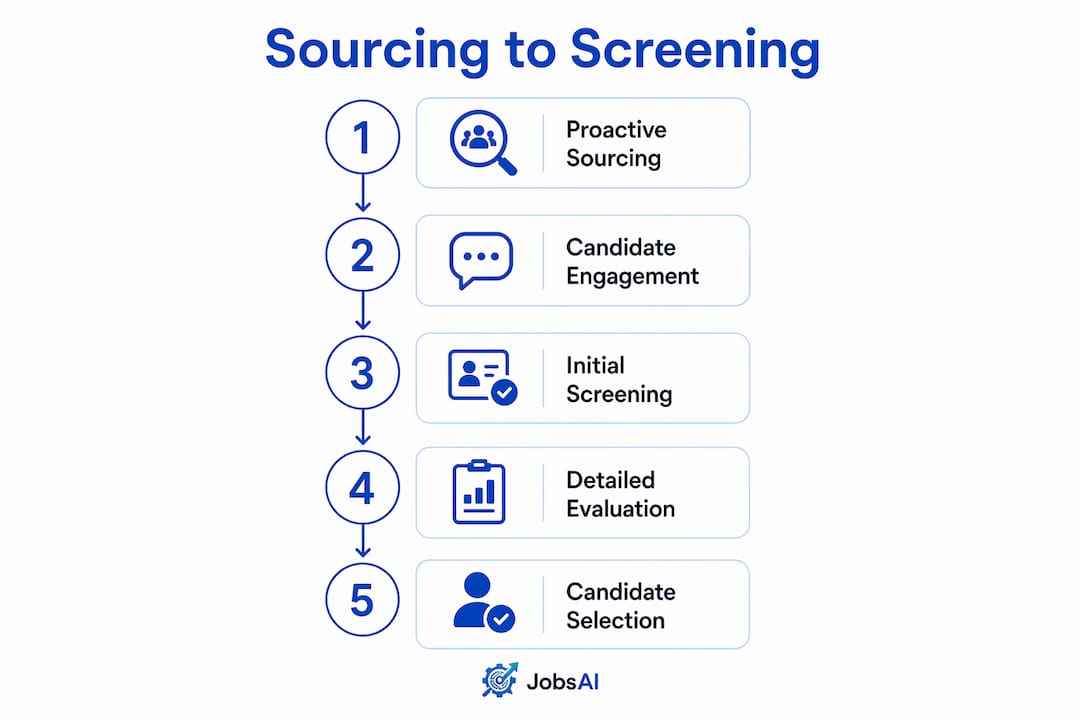
The sourcing to screening workflow is the sequential process of identifying potential candidates and evaluating them for fit before interviews begin. In recruitment, this two-stage pipeline separates proactive candidate discovery from structured evaluation, and sourcing is upstream and proactive while screening is downstream and evaluative. Recruiters who treat these as one blended activity lose clarity at every handoff. Understanding where sourcing ends and screening begins is the single fastest way to reduce wasted effort and improve the quality of candidates who reach your hiring managers.
What is sourcing to screening workflow in recruitment?
The sourcing to screening workflow is defined as the end-to-end process that moves a candidate from initial identification through structured evaluation and into the interview pipeline. Industry practitioners call this the talent acquisition funnel, and the two stages have distinct objectives, tools, and success metrics.

Sourcing is the proactive identification and engagement of both active and passive candidates. Active candidates apply on their own. Passive candidates are not job hunting but may be open to the right opportunity. Sourcing targets both groups through deliberate outreach before any formal evaluation takes place.
Screening is the evaluative step that follows. It filters the sourced pool against predefined job requirements, separating qualified candidates from those who do not meet the role’s criteria. Screening applies must-have and nice-to-have criteria to shortlist candidates for assessment and interviews. The distinction matters because mixing the two activities creates confusion about who owns each decision and what criteria apply at each stage.
Time-to-hire is usually lost in the gaps between these steps. A recruiter who sources well but screens inconsistently sends unqualified candidates to hiring managers. A recruiter who screens rigorously but sources from a narrow pool misses strong passive talent. Both stages must work together as a defined sequence.
What is sourcing in recruitment and how does it work?
Sourcing is the first stage of the workflow, and its goal is to build a qualified candidate pool before evaluation begins. The sourcing process overview includes several distinct activities, each targeting a different segment of the talent market.
Common sourcing channels include:
- LinkedIn Recruiter for professional network outreach and passive candidate identification
- Job boards such as Indeed and ZipRecruiter for active candidate capture
- Employee referrals for warm introductions with higher conversion rates
- GitHub and portfolio sites for technical roles where work samples matter
- Boolean search across databases to filter by specific skills, titles, or locations
Tools like LinkedIn Recruiter, job portals, Boolean search, and AI-assisted sourcing platforms form the standard sourcing toolkit in 2026. AI sourcing platforms extend reach by scanning multiple databases simultaneously and surfacing candidates who match a role profile without manual keyword searches. Jobsai Enterprise includes AI sourcing capabilities that automate this discovery step, reducing the time recruiters spend building initial candidate lists.
Sourcing effectiveness is measured by metrics like source-to-hire ratio, response rate by channel, and pipeline coverage. Source-to-hire ratio tells you how many sourced candidates from a given channel ultimately receive offers. A low ratio from a specific channel signals either poor targeting or weak messaging, not necessarily a bad channel.
Pro Tip: Track response rates by outreach message variant, not just by channel. A 10% improvement in response rate from LinkedIn doubles your pipeline without adding a single new sourcing channel.
How does screening differ from sourcing, and why does it matter?
Screening is reactive by design. It evaluates candidates who already exist in your pipeline rather than seeking new ones. The screening workflow explained simply: a candidate enters, criteria are applied, and a disposition is assigned. That disposition is either advance, hold, or decline.
The table below shows the core differences between sourcing and screening:
| Dimension | Sourcing | Screening |
|---|---|---|
| Objective | Build the candidate pool | Evaluate and filter the pool |
| Orientation | Proactive | Evaluative |
| Primary tools | LinkedIn, Boolean search, AI sourcing | ATS, scorecards, phone/video screens |
| Key metric | Source-to-hire ratio, response rate | Screening conversion rate, offer ratio |
| Decision type | Engage or skip | Advance, hold, or decline |
Typical screening activities include resume review, structured phone or video screens, and skills assessments. ATS and resume screeners support screening by automating pass/fail results and candidate ranking based on specific criteria and processing rules. This removes the inconsistency that comes from different recruiters applying different mental filters to the same candidate pool.
The must-have versus nice-to-have distinction is the most practical tool in screening. Must-haves are non-negotiable: a required license, a minimum years of experience, a specific technical skill. Nice-to-haves improve a candidate’s ranking but do not disqualify them. Mixing these two categories is the most common screening error, and it produces shortlists that hiring managers reject as inconsistent.
Pro Tip: Write your must-have criteria before you post the job, not after you receive applications. Criteria written after the fact tend to reflect the first strong resume you saw, not the actual role requirements.
What are the benefits of automating the sourcing to screening workflow?
Automation changes the economics of recruiting. The biggest gain is not speed. It is the reallocation of recruiter time from administrative work to actual talent evaluation.
65–75% of a recruiter’s screening time is spent on administrative tasks like scheduling and candidate disposition, not on evaluating talent. That means most of a recruiter’s day goes to logistics, not judgment. Automation reclaims that time.
The specific benefits of automating the candidate evaluation process include:
- Faster time-to-screen. A structured, automated workflow can reduce time-to-screen from 5 days to under 4 hours by eliminating manual resume triaging and automating scheduling.
- Consistent scoring. Automated scorecards apply the same weighted criteria to every candidate, removing the variation that comes from recruiter fatigue or unconscious preference.
- Reduced administrative load. Automation reduces recruiter triage time by 60–75%, freeing recruiters to focus on candidate conversations and hiring manager alignment.
- Faster candidate contact. Automating outreach and scheduling through integrations with tools like Calendly and GoodTime speeds initial candidate contact to under 4 hours.
- Audit-ready records. Every disposition and score is logged automatically, giving teams a clear record of how each candidate was evaluated.
Automation does not replace recruiter judgment. It removes the tasks that prevent recruiters from exercising judgment. AI and deterministic scoring models surface ranked candidates and flag gaps, but the recruiter still decides who advances to the hiring manager. Jobsai Enterprise is built on this principle: its AI screening ranks and scores candidates automatically, then hands a recruiter-ready package to the team for final review.
What are the key steps for implementing an effective sourcing to screening workflow?
A well-built workflow follows a defined sequence. Each step feeds the next, and skipping any step creates gaps that slow down hiring decisions.
-
Document must-have criteria with hiring managers. Before sourcing begins, align with the hiring manager on the non-negotiable requirements for the role. Write these down. Verbal agreements drift over time and create misaligned shortlists.
-
Build a weighted scorecard rubric. Building scorecard rubrics with 4–7 weighted criteria is the highest-leverage step in structured screening. Assign point values to each criterion based on its importance to the role. A rubric with vague criteria produces vague results.
-
Set up automated candidate disposition. Configure your ATS or screening platform to assign pass, hold, or decline dispositions based on scorecard results. This removes the manual step of individually reviewing every application before a human judgment is needed.
-
Wire outreach and scheduling integrations. Connect your sourcing platform to your calendar and messaging tools. Templated outreach messages and automated scheduling links reduce the time between candidate identification and first contact. Jobsai Enterprise’s workflow automation handles this connection across sourcing, screening, and scheduling in one platform.
-
Build recruiter-ready candidate packages. Before handing candidates to hiring managers, compile a summary that includes scorecard results, key qualifications, and any flags. Hiring managers make faster decisions when the evaluation work is already done. Review candidate shortlisting best practices to structure these packages effectively.
-
Establish a respectful rejection process. Automated disposition should include timely, professional decline messages for candidates who do not advance. Candidate experience affects employer brand, and a slow or silent rejection process damages both.
Pro Tip: Audit your scorecard rubric after every 20 hires. If your top-scoring candidates are not performing well on the job, the rubric weights need adjustment. Treat the rubric as a living document, not a one-time setup.
Key Takeaways
The sourcing to screening workflow is the most controllable variable in reducing time-to-hire and improving the consistency of candidate evaluation across every role.
| Point | Details |
|---|---|
| Sourcing is proactive | Sourcing builds the candidate pool before any evaluation criteria are applied. |
| Screening is evaluative | Screening filters the pool using must-have criteria and weighted scorecards to produce a shortlist. |
| Automation cuts admin time | Automating triage and scheduling reclaims 60–75% of recruiter time spent on non-evaluation tasks. |
| Rubrics drive consistency | A scorecard with 4–7 weighted criteria is the single highest-leverage step in structured screening. |
| Handoffs determine speed | Clear recruiter-to-hiring-manager handoffs with packaged candidate summaries reduce decision delays. |
What I’ve learned from watching this workflow evolve
I spent years watching recruiting teams treat sourcing and screening as one continuous activity. The result was always the same: hiring managers received inconsistent shortlists, recruiters burned out on administrative work, and time-to-hire stretched well past what the business needed.
The shift that made the biggest difference was not the technology. It was the discipline of separating the two stages before choosing any tool. Teams that documented their must-have criteria and built weighted rubrics first got dramatically more value from automation than teams that automated a broken process.
The honest challenge with automation is that it surfaces a problem most teams would rather not see: their screening criteria were never clearly defined in the first place. Automation makes vague criteria visible because the system cannot apply judgment where there are no rules. That discomfort is productive. It forces the conversation between recruiters and hiring managers that should have happened before the first job posting went live.
The next wave of improvement I see coming is not smarter AI scoring. It is better candidate engagement between sourcing and screening. The gap where candidates go silent or withdraw is still largely unaddressed by most workflows. Teams that solve that gap with structured, timely outreach will see offer acceptance rates improve significantly, regardless of what scoring model they use.
My advice for recruiters adopting new workflow technology: map your current process on paper before you configure anything. The gaps will be obvious, and you will configure the tool to fix the actual problem rather than to replicate the broken process faster.
— Hippolyte A.
How Jobsai Enterprise supports your sourcing to screening workflow
Jobsai Enterprise is an AI-powered talent acquisition operating system built for recruiting teams that need to move faster without sacrificing evaluation quality.
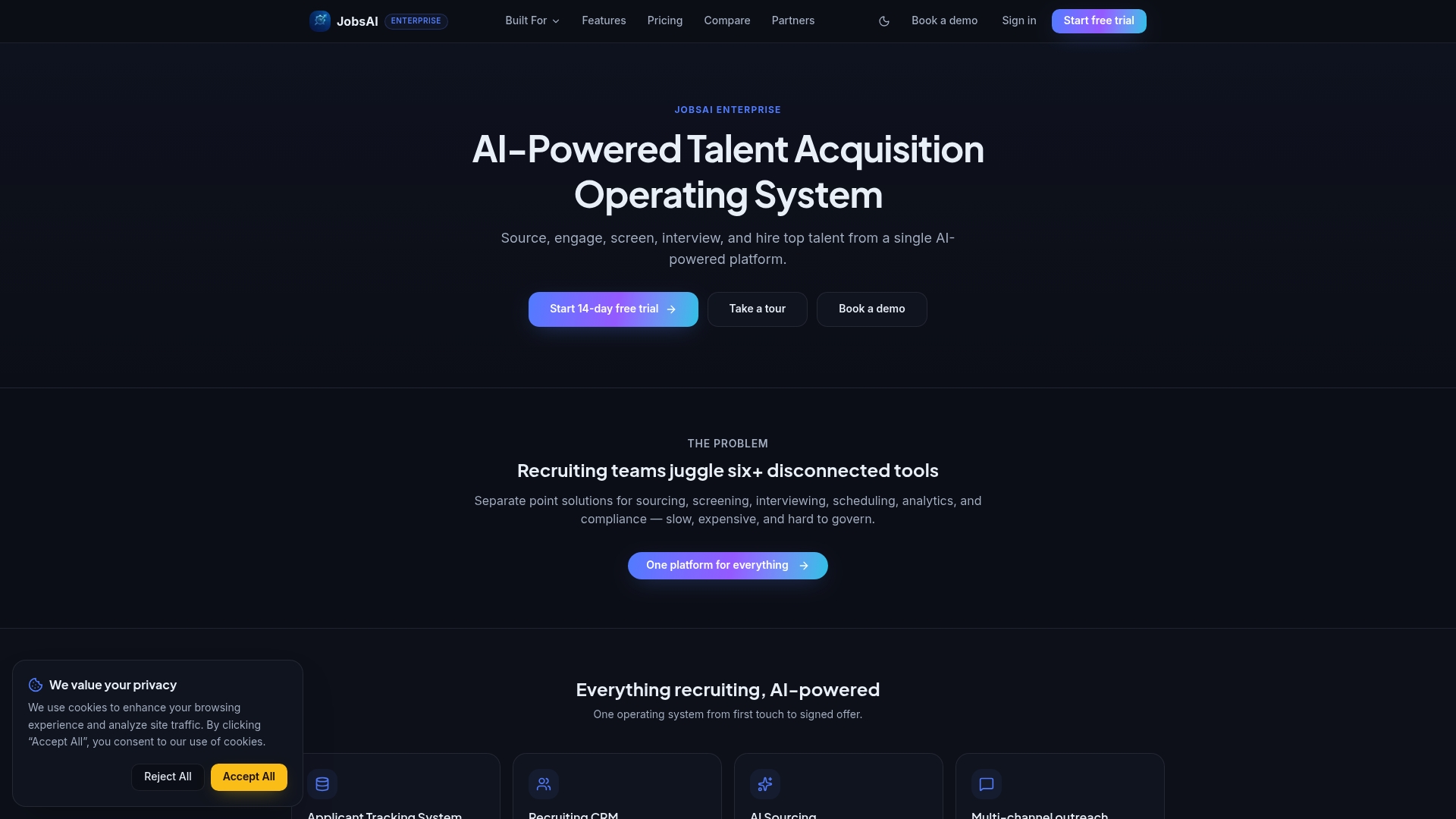
The platform handles AI sourcing, automated candidate scoring, structured screening, and hiring manager handoffs in one connected system. Recruiters get ranked candidate lists with scorecard results already attached. Hiring managers get clear, packaged summaries instead of raw application stacks. Explore the built-for recruiting teams page to see how Jobsai Enterprise fits your specific workflow, or review AI candidate scoring to understand how the ranking model works. If you are ready to compare plans, the pricing page covers all tiers.
FAQ
What is the sourcing to screening workflow?
The sourcing to screening workflow is the sequential recruitment process of proactively identifying candidates and then evaluating them against job criteria before interviews begin. Sourcing builds the pipeline; screening filters it.
How is sourcing different from screening?
Sourcing is proactive and focused on finding candidates, while screening is evaluative and focused on filtering them. Sourcing is upstream; screening is downstream and applies specific criteria to determine who advances.
How long does the screening process take without automation?
Without automation, screening a candidate pool typically takes up to 5 days due to manual resume review and scheduling. Automated workflows reduce that to under 4 hours by eliminating manual triaging.
What criteria should a screening scorecard include?
A screening scorecard should include 4–7 weighted criteria aligned to the role’s must-have requirements. Rubrics with weighted criteria enforce consistency and reduce the influence of recruiter bias or fatigue.
What tools are used in the sourcing stage?
Standard sourcing tools include LinkedIn Recruiter, job boards, Boolean search, employee referral programs, and AI-assisted sourcing platforms. Technical roles also use GitHub and portfolio sites to evaluate candidates before outreach.
Recommended
See it in your workflow
JobsAI Enterprise runs sourcing, AI screening, and the whole interview pipeline in one place. Book a walkthrough tailored to your team.
Book a demo