
Article
High-Volume Recruiting Challenges: A Practical Playbook

High-Volume Recruiting Challenges: A Practical Playbook
The challenges that break high-volume hiring campaigns are predictable: candidate drop-off, screening bottlenecks, eroding quality of hire, scheduling chaos, and onboarding overload. Each one compounds the others. A slow screening process gives candidates time to accept another offer, which drives up drop-off, which forces recruiters to over-source, which buries the team in resumes they can’t screen fast enough.
Three levers fix most of it: streamlined process design, targeted automation, and warm talent pools you can activate before the next spike hits.
- Drop-off and ghosting between application and interview
- Screening overload that slows time-to-fill
- Quality of hire eroding under speed pressure
- Scheduling and interview logistics eating recruiter hours
- Onboarding bottlenecks that stall new-hire productivity
Pro Tip: Set a prompt response SLA for every candidate touchpoint to reduce drop-off. PeopleScout’s research on high-volume hiring ties delayed follow-up directly to higher drop-off.
Key Takeaways
High-volume recruiting breaks down at predictable points, and fixing sourcing, screening, and onboarding as a connected system solves more than adding recruiters ever will.
| Point | Details |
|---|---|
| Drop-off is a speed problem | Faster response times and shorter applications cut candidate ghosting more than better sourcing alone. |
| Automate low-judgment tasks first | Resume parsing, ranking, scheduling, and bulk messaging free recruiters for decisions that need human judgment. |
| Track stage-specific KPIs | Time-to-fill, offer-acceptance rate, and 90-day retention each expose a different failure point. |
| Build pipelines before spikes hit | Warm talent pools and re-engagement campaigns prevent scrambling when demand surges. |
| Protect recruiter capacity structurally | Requisition caps and turnaround SLAs prevent burnout better than adding headcount to a broken process. |
Table of Contents
- What Is High-Volume Recruiting?
- Core Operational Challenges That Derail High-Volume Hiring
- How Do You Fix Each Stage of the Hiring Funnel?
- Which Tasks Should You Automate First?
- How Do You Scale Recruiting Up and Down?
- How Do You Protect Recruiter Capacity While Scaling?
- Your Step-by-Step High-Volume Hiring Checklist
- Why Most High-Volume Hiring Advice Gets the Priority Order Wrong
- Sources
- FAQ
What Is High-Volume Recruiting?
High-volume recruiting, also called mass hiring or bulk hiring, means filling a large number of similar roles in a compressed window, often weeks rather than months. It’s a different discipline than one-off recruiting, not just a bigger version of it.
You’ll recognize it in a few recurring scenarios: a retailer staffing up for the holiday rush, a warehouse operator opening a new distribution center, a call center scaling after a contract win, or any employer with a high-turnover role like delivery driver or seasonal associate that needs constant refilling.
Scale is the defining trait. Filling three sales positions calls for careful, individualized sourcing. Filling 200 warehouse roles in six weeks calls for a repeatable system: standardized screening, batch scheduling, and communication that doesn’t depend on one recruiter remembering every candidate’s name. Treating the two the same way is where most high-volume campaigns start to break down. According to Talogy’s overview of high-volume recruitment, the shift from individualized recruiting to mass hiring requires rethinking sourcing, screening, and process design as a connected system rather than three separate tasks.
Core Operational Challenges That Derail High-Volume Hiring
Candidate drop-off is the most expensive problem in mass hiring, and it’s rarely about the candidate losing interest. It’s usually about your process being too slow. A candidate who applies to five warehouse jobs on the same day accepts whichever one responds first. Every extra day between application and offer is a day a competitor can win that candidate away, and that delay shows up directly in inflated time-to-fill and cost-per-hire numbers.
Screening overload hits next. When 300 applications arrive for 20 openings, manual resume review becomes the bottleneck. Recruiters either slow down (and lose candidates to drop-off) or speed up by skimming, which introduces inconsistency: one recruiter’s “qualified” is another’s “pass.” That inconsistency is where quality of hire starts to erode.

Quality erosion is subtle because it doesn’t show up until 60 or 90 days later, when a hire who was rushed through screening turns out to be a poor fit and quits. Rehiring that role costs the same time and money as the original hire, except now you’re doing it under even more time pressure.
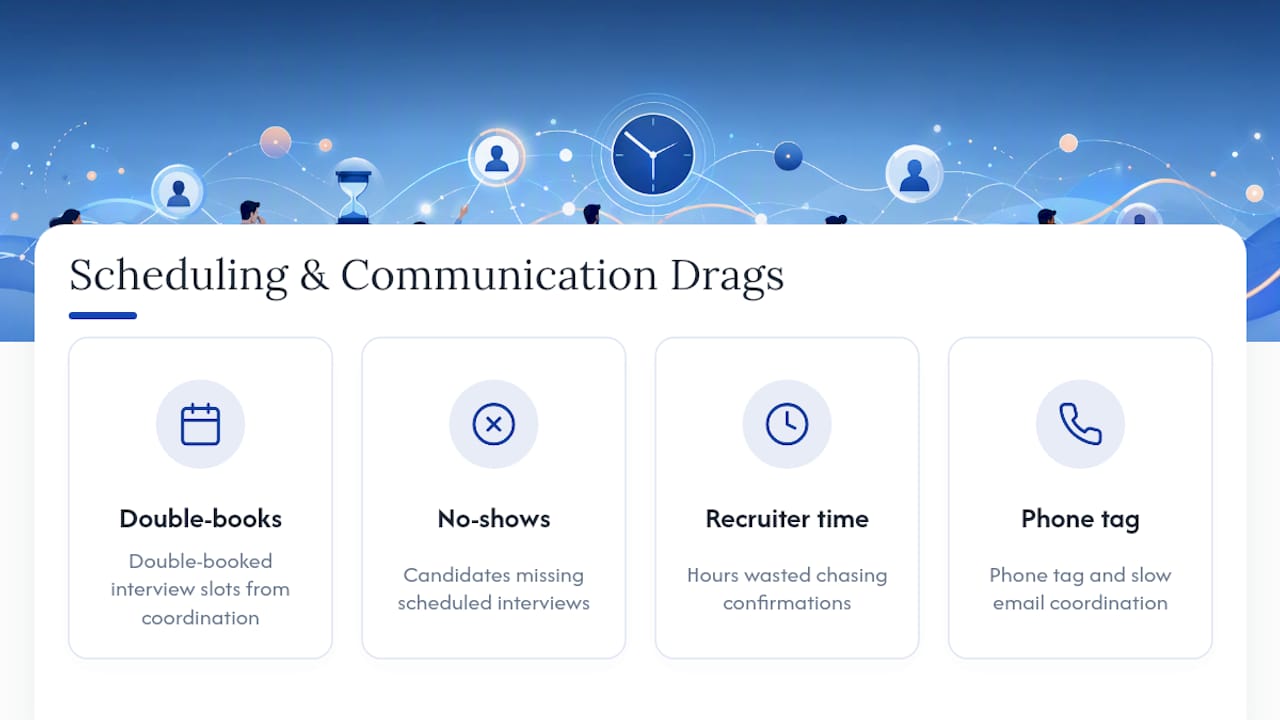
Scheduling and logistics create a different kind of drag. Coordinating interview slots across dozens of candidates and multiple hiring managers, by phone or email, generates double-booked slots, no-shows, and wasted recruiter hours chasing confirmations. FactoHR’s guide on mass recruitment lists scheduling chaos alongside slow communication as one of the most common operational failures in bulk hiring.
Onboarding bottlenecks close out the funnel. Paper-based I-9 verification, manual benefits enrollment, and one-at-a-time orientation sessions don’t scale to 50 or 100 new hires starting the same week. Every hour spent on paperwork is an hour not spent on training, which pushes back the day a new hire becomes fully productive.
Underneath all of it sits recruiter burnout. Adding headcount to a broken process just multiplies the same inefficiencies across more people. A team of ten recruiters manually screening resumes is still manually screening resumes. Fixing the workflow matters more than adding bodies to it.
How Do You Fix Each Stage of the Hiring Funnel?
Every stage of high-volume hiring has a specific failure mode, and each one has a specific fix. Treating the funnel as a set of connected checkpoints, rather than one long process, is what makes the fixes actually work.
- Sourcing. Widen beyond job boards. Employee referral programs, proactive talent pools built from past applicants, and community partnerships give you a warm bench before you need it, instead of starting cold every time a req opens.
- Application design. Long applications kill conversion. Micro-apps that capture name, phone, and role interest up front, then collect detailed information later in the funnel, cut abandonment sharply because candidates commit in stages instead of all at once.
- Screening. Replace open-ended resume review with structured pre-screen questions and short, timed assessments scored against a consistent rubric. This is where the recruiter’s time gets spent on the candidates worth a real conversation, not on sorting 300 applications by hand.
- Interviewing. Group interviews and structured scorecards let one hiring manager evaluate multiple candidates in a single session, using the same criteria for everyone, which is also your best defense against inconsistent, subjective hiring decisions.
- Scheduling and communication. Automated schedulers that let candidates pick their own slot, backed by SMS confirmations and templated status updates, eliminate most of the phone tag that burns recruiter hours.
- Offers and onboarding. Batch offer letter templates with e-signature, paired with digital onboarding paperwork and group orientation sessions, compress a process that used to take days into one that takes hours.
Each stage needs its own KPI, not just an overall time-to-fill number. Time-to-fill still matters as the headline metric, but offer-acceptance rate tells you if your offer stage is losing candidates you already won, and 90-day retention tells you whether your screening and onboarding stages actually selected for fit. A campaign that hits its time-to-fill target but posts a weak 90-day retention rate hasn’t succeeded. It’s just deferred the cost to month three.
Which Tasks Should You Automate First?
Automate the tasks that are repetitive, high-volume, and low in judgment: resume parsing, initial candidate ranking against job requirements, interview scheduling, and bulk status-update messaging. These are the tasks that consume recruiter hours without requiring recruiter judgment, which makes them the highest-return automation targets in any high-volume campaign.
Before adopting any tool, run it against a short checklist:
- Does it integrate cleanly with your existing ATS or HRIS, or will it create a second system to maintain?
- Can it handle your actual application volume without slowing down during peak weeks?
- Does it give you reporting on time-to-fill, cost-per-hire, and drop-off by stage, not just a dashboard of vanity metrics?
- Does it support candidate messaging by email, SMS, or WhatsApp, since that’s usually where drop-off happens?
- Does it include anti-bias safeguards and an audit trail, so screening decisions can be reviewed and defended?
Automation carries real risk if you skip validation. A ranking model trained on the wrong signals can systematically filter out qualified candidates, and that risk sits close to the anti-discrimination obligations laid out in EEOC’s federal-sector statutes and regulations. Audit a sample of automated screening decisions regularly, and set a human review threshold for any candidate the system rejects near the borderline.
Pro Tip: Never let automation make the final rejection call on a candidate near your cutoff score. Route borderline cases to a human reviewer, and log the reason for every override.
This is the exact gap Jobsai Enterprise was built to close. The platform combines AI resume screening and candidate ranking with recruiting CRM, bulk outreach, and interview scheduling in one workspace, so recruiters spend their time on judgment calls instead of data entry. Teams using structured shortlisting workflows typically see manual review time drop because the ranking and messaging steps run in parallel instead of in sequence.
How Do You Scale Recruiting Up and Down?
Forecasting is the difference between a hiring campaign you plan and one you react to. Pull your historical turnover rate for the role, layer in business signals like a new store opening or a seasonal sales forecast, and back into a hiring number with a buffer for drop-off and no-shows built in.
- Build talent pools during slow periods, not scramble mode. Past applicants who were qualified but not selected are often ready to reengage months later with a short outreach campaign.
- Run re-engagement campaigns on a set cadence rather than only when a req opens, so your pipeline isn’t starting from zero every time.
- Consider a blended model, internal recruiters plus an RPO or staffing partner, when volume spikes beyond what your core team can absorb without burning out.
- Set governance checkpoints for any external partner: shared KPIs, a shared ATS view, and a weekly sync on pipeline health.
A typical seasonal campaign runs backward from the start date: talent pool activation eight weeks out, job postings and sourcing at six weeks, screening and interviewing running through weeks four and five, offers by week three, and onboarding scheduled to land the week before the role needs to be productive.
How Do You Protect Recruiter Capacity While Scaling?
Team design matters as much as tooling. Segmenting roles by funnel stage, one recruiter owns intake and requisition setup, another owns sourcing, another owns screening and interviews, keeps any single person from being the bottleneck for the entire pipeline.
- Set requisition caps per recruiter so no one is juggling more open roles than they can realistically screen and schedule for.
- Establish turnaround SLAs for each stage, such as a 24-hour screening response, so delays get caught immediately rather than discovered at week three.
- Block scheduled focus time for screening and interviews separately from open availability for candidate calls, so recruiters aren’t constantly context-switching.
- Build a short-term surge plan before you need it: a temporary RPO engagement, a hiring event team, or pre-built scheduling templates that can go live within a day.
- Run a short daily pipeline dashboard review instead of a long weekly meeting, catching stalled candidates before they become a drop-off statistic.
Your Step-by-Step High-Volume Hiring Checklist
- Pre-launch (one to two weeks out). Forecast headcount, finalize job descriptions, confirm sourcing channels, and load ATS templates and scorecards.
- Launch day. Publish the micro-application, activate SMS confirmations, and set automated screening triggers to run as soon as applications land.
- Interview window. Administer timed assessments, run group interviews on a fixed schedule, and use pre-built offer letter templates ready to send the same day.
- Onboarding week. Send digital paperwork in advance, run group orientation sessions, and schedule 30-day and 90-day check-ins per SHRM’s onboarding research, which links structured early check-ins to stronger retention. New hires still need Form I-9 verification completed per USCIS requirements, even when onboarding is otherwise digital.
- Post-campaign review. Pull time-to-fill, cost-per-hire, offer-acceptance rate, and 90-day retention, then identify where drop-off actually happened before running the next cycle.
Pro Tip: Run the post-campaign review within a week of the last start date, while the data and recruiter memory are both still fresh.
Why Most High-Volume Hiring Advice Gets the Priority Order Wrong
Most guidance on this topic leads with technology, as if the right software fixes a broken process on its own. It doesn’t. Automation applied to a disorganized funnel just processes the disorganization faster.
The teams that actually solve high-volume recruiting fix sequencing first: shorter applications, faster screening turnaround, and scheduling that doesn’t depend on phone tag. Only after that sequence is tight does automation compound the gain instead of masking the gap.
The most underrated lever in the entire funnel is the offer-to-onboarding handoff. Everyone optimizes sourcing and screening because those numbers are visible early. Fewer teams notice that a clumsy onboarding process quietly erases the retention gains a good screening process just bought them. If you can only fix one thing this quarter, fix the week between offer acceptance and first day. That’s where a rushed hire either becomes a stable one or walks in already regretting the decision.
Sources
- EEOC — Federal sector: statutes and regulations
- USCIS — I-9, Employment Eligibility Verification
- PeopleScout — Strategies for overcoming high-volume hiring challenges
- Talogy — What is high-volume recruitment?
FAQ
What Are the Biggest Challenges in Recruitment?
The biggest challenges in high-volume recruitment are candidate drop-off, screening bottlenecks, inconsistent quality of hire, scheduling logistics, and onboarding delays, each of which drives up time-to-fill and cost-per-hire if left unaddressed.
What Are the 5 C’s of Recruitment?
Definitions vary by source, but a common version covers candidate experience, communication, consistency, compliance, and cost, all of which matter more at scale because a single weak point affects hundreds of candidates instead of one.
What Is Considered High-Volume in Recruiting?
There’s no single fixed threshold, but high-volume recruiting typically means filling dozens to hundreds of similar roles within a few weeks, a scale that requires standardized screening and batch processing rather than individualized recruiting.
What Is the 70/30 Rule in Hiring?
The 70/30 rule generally refers to spending roughly 70% of hiring effort on proactive sourcing and pipeline building and 30% on reactive, req-by-req recruiting, though exact ratios vary by organization and role type.
How Can You Reduce Candidate Ghosting in High-Volume Hiring?
Shortening the application, responding within 24 hours, and automating scheduling confirmations all reduce ghosting because most drop-off happens when candidates lose patience waiting for the next step.
Recommended
See it in your workflow
JobsAI Enterprise runs sourcing, AI screening, and the whole interview pipeline in one place. Book a walkthrough tailored to your team.
Book a demo