
Article
Recruiting Tips for High-Turnover Industries: Hire Faster, Cut Churn

Recruiting Tips for High-Turnover Industries: Hire Faster, Cut Churn
The fastest way to stop the revolving door in high-turnover roles is to hire for role-fit, cut time-to-hire, and lock in a structured first-90-day experience. Most early exits are predictable and preventable. The tactics below give you a prioritized plan you can start this week.
Your 3-step action plan:
- Today: Shorten your application to under 5 minutes and add two pre-screen questions that filter for schedule fit and basic role requirements.
- This week: Activate a referral bump (even a small, same-week incentive) and audit your hiring workflow for steps that add days without adding value.
- Within 30 days: Deploy a structured scorecard for every interview, launch a talent pool for your most-filled roles, and set up a 30/60/90 onboarding checklist for managers.
The highest-impact levers, in order of urgency:
- Pipeline: Build warm candidate pools before you need them, not after a vacancy opens.
- Speed: Reduce time-to-hire to a few days for hourly and entry-level roles.
- Screening: Filter for resilience and role-fit, not just availability.
- Onboarding: Structured check-ins in the first 30 days cut early attrition more than any perk.
Pro Tip: If you can only fix one thing this week, fix your application. A long, desktop-only form is the single biggest drop-off point in hourly hiring.
Table of Contents
- How do you build an always-on talent pipeline for high-volume roles?
- What process changes actually cut time-to-hire in high-volume hiring?
- Which screening methods predict who will actually stay?
- How do structured interviews and scorecards improve hiring consistency?
- What should you tell candidates upfront to reduce early drop-offs?
- What does an effective onboarding plan look like for high-churn roles?
- Which KPIs should you track to actually reduce turnover?
- Fast operational fixes by sector
- Your 30/60/90-day hiring playbook
- How Jobsai Enterprise supports a high-volume hiring pilot
- Key Takeaways
- What actually works in high-churn recruiting (and what wastes your time)
- Jobsai Enterprise helps you run these tactics at scale
- Useful sources
- FAQ
How do you build an always-on talent pipeline for high-volume roles?
Reactive hiring, posting when a seat opens, is the root cause of most high-turnover recruiting problems. By the time you post, screen, and extend an offer, your best candidates have already accepted elsewhere. The fix is a pipeline that runs continuously, so you are always hiring from warm leads.
Practical sourcing channels to prioritize:
- Referral programs: Offer small, fast incentives. A modest gift card paid the same week a referral starts outperforms a larger bonus paid after a long delay. Speed of reward matters more than size in hourly contexts.
- Silver-medalist tracking: Every finalist who did not get the role is a pre-screened candidate. Tag them in your system and re-engage before your next opening goes live.
- Seasonal rehire lists: For retail, hospitality, and manufacturing, past seasonal workers are your highest-conversion source. Maintain a simple opt-in list, and reach out 6–8 weeks before peak season.
- Talent communities: Proactive pipelining consistently outperforms reactive job boards in speed and cost-efficiency when sustained with light-touch engagement.
- Community partnerships: Workforce development boards, community colleges, and vocational programs are underused. A standing relationship with one local program can deliver a steady stream of pre-vetted candidates.
- Mobile-first applications: If your apply flow takes more than 5 minutes on a phone, you are losing candidates before they finish. Simplify to name, contact, availability, and two qualifying questions.
Pipeline hygiene matters as much as sourcing. Set a monthly cadence to re-engage dormant candidates, remove stale contacts, and update your talent pool with new sourcing activity. A pipeline that is not maintained becomes a list, not a resource.
Pro Tip: For referral programs in high-turnover contexts, pay the incentive the moment the referred hire completes their first shift, not at 30 or 90 days. That single change typically doubles referral submission rates.

What process changes actually cut time-to-hire in high-volume hiring?
Time-to-hire is usually lost in the gaps between steps, not in the steps themselves. A 10-day hiring process often has 3 days of actual work and 7 days of waiting. Fixing the gaps is faster and cheaper than adding headcount.
SLA targets to set and enforce:
- Application acknowledgment: within 2 hours (automated is fine)
- Initial phone screen or pre-screen review: within 24–48 hours
- Interview scheduled: within 48–72 hours of screen
- Offer extended: within 3–5 business days of first contact
- Onboarding paperwork sent: same day as offer acceptance
Tactics to compress the timeline:
- Same-day hiring events: For high-volume roles, batch 8–12 candidates into a 2-hour event. Screen, interview, and extend conditional offers the same day.
- Pre-screen questions: Two or three pass/fail questions (schedule availability, physical requirements, commute range) eliminate unqualified applicants before a recruiter spends time on them.
- Dedicated scheduling slots: Block two interview windows per week on every hiring manager’s calendar. Scheduling delays are the most common bottleneck.
- Batch interviews: Group similar roles and run panel or back-to-back interviews on the same day to reduce per-hire recruiter hours.
AI-powered automation can handle candidate communications, scheduling confirmations, and status updates at scale, freeing your team to focus on the conversations that actually require human judgment. Chatbots that answer FAQs and confirm interview times reduce candidate drop-off noticeably, particularly for roles where candidates are applying to multiple employers simultaneously.
Quick process audit checklist:
- [ ] Is your application completable on mobile in under 5 minutes?
- [ ] Does every applicant receive an acknowledgment within 2 hours?
- [ ] Are interview slots pre-blocked on hiring manager calendars?
- [ ] Is there a clear owner for each step in the workflow?
- [ ] Are conditional offers going out the same day as final interviews?
Pro Tip: The biggest scheduling bottleneck is usually the hiring manager, not the recruiter. Pre-blocking two standing interview windows per week removes the back-and-forth entirely.
Benchmark: Leisure and hospitality sectors can experience annual turnover rates above 70%, compared with a national average around 40%. At that rate, a slow hiring process is not just inconvenient — it means seats stay empty longer than your business can absorb.
Which screening methods predict who will actually stay?
Resumes tell you what someone has done. They rarely tell you whether that person will still be there in 90 days. For high-churn roles, role-fit and resilience are stronger predictors of early retention than prior experience, and assessments outperform unstructured interviews for surfacing those signals.
Assessment types worth using early in the process:
- Short personality scales (3–5 questions): Target resilience and integrity specifically. These correlate better with early retention than broad culture-fit questions and add minimal friction when kept brief.
- Work-sample tasks: A 60-second scenario relevant to the role (handling a difficult customer, prioritizing a task list, reading a simple SOP) reveals capability and engagement simultaneously.
- Cognitive micro-tasks: For roles with safety or accuracy requirements, a short timed task is more predictive than a resume review.
- Pass/fail pre-screen checkpoints: Set clear thresholds before you start screening. If a candidate cannot work the required schedule or does not meet a physical requirement, no interview should be scheduled.
How to combine signals into a simple framework:
- Pass/fail gate: Schedule availability, location, and any non-negotiable physical or certification requirements. Fail here means no further review.
- Priority tier: Resilience score, work-sample result, and any role-specific skill check. High scores here move to the top of the interview queue.
- Interview confirmation: Behavioral questions that validate what the assessment flagged, not repeat the same questions.
The goal is not to make screening harder. It is to make it faster and more accurate, so you spend interview time on candidates who are genuinely likely to succeed and stay. For more on building a tight shortlist, the candidate shortlisting best practices guide from Jobsai Enterprise covers the practical mechanics in detail.

How do structured interviews and scorecards improve hiring consistency?
Structured interviews with standardized questions and rubrics increase predictive validity and candidate satisfaction compared with unstructured conversations. The practical benefit for high-turnover hiring is consistency: every candidate is evaluated on the same criteria, decisions are faster, and you can defend them.
What a scorecard for a high-turnover role should include:
- Must-have attributes: Schedule flexibility, reliability, physical or technical requirements specific to the role.
- Behavioral anchors: One or two past-behavior questions per attribute (e.g., “Tell me about a time you had to adjust your schedule on short notice”).
- Numeric scoring: A simple 1–4 scale per attribute. Avoid 1–10 scales; they create false precision and slow calibration.
- Pass threshold: A minimum total score that triggers an offer recommendation. Set this before interviews begin, not after.
- Interviewer notes field: A single line for the specific example the candidate gave. This is what you reference in calibration.
Sample scorecard layout:
| Attribute | Question type | Score (1–4) | Anchor example |
|---|---|---|---|
| Schedule reliability | Behavioral | 1–4 | Specific past example given |
| Role-fit / capability | Work sample or situational | 1–4 | Task result or scenario response |
| Resilience under pressure | Behavioral | 1–4 | Specific past example given |
| Communication clarity | Observed during interview | 1–4 | Interviewer notes |
| Total | /16 | Pass threshold: 10+ |
Interviewer calibration does not need to be complicated. A 20-minute session before the first hiring cycle, where interviewers score the same practice response and compare notes, closes most of the consistency gap. Run a second calibration after the first 10 hires and adjust anchors where scores diverged.
Scorecards also speed decisions. When every interviewer uses the same rubric, the debrief becomes a 5-minute comparison of scores rather than a 30-minute debate about gut feelings.
What should you tell candidates upfront to reduce early drop-offs?
Most early resignations trace back to a mismatch between what the candidate expected and what the job actually is. Transparent job descriptions that include schedules, workload, and pay details reduce that gap before the hire is made. The fix is not complicated, but it requires discipline in how you write and communicate.
What to include in every job post for a high-turnover role:
- Exact shift patterns (e.g., “Tuesday–Saturday, 10 AM–6 PM, with rotating Sunday coverage”)
- Physical or emotional demands stated plainly (“standing for 6+ hours,” “handling escalated customer calls”)
- Pay band, not just “competitive pay”
- Realistic progression path (e.g., “most team leads are promoted from this role within 12–18 months”)
- What the first week actually looks like
Candidate touchpoints that reduce drop-off:
- Immediate automated acknowledgment after application (within 2 hours)
- A single point of contact named in every communication
- A clear timeline stated at the start (“You’ll hear from us within 48 hours”)
- A 60-second video preview of the work environment, posted to the job listing or sent post-offer
Small friction points compound. A mobile-friendly apply flow, a chatbot that answers shift-schedule questions instantly, and a confirmation text the morning of an interview each reduce no-show rates in ways that are measurable within a few hiring cycles.
Pro Tip: In your offer call, walk the candidate through their first week’s schedule specifically. Candidates who know exactly what Monday morning looks like show up at a higher rate and stay longer through the first month.
What does an effective onboarding plan look like for high-churn roles?
Structured onboarding and manager check-ins in the first 30–90 days materially reduce early churn. Manager behavior is one of the strongest drivers of whether a new hire stays or leaves, which means onboarding is not just an HR function. It is a manager accountability system.
Core elements of a short, effective onboarding for hourly or high-churn roles:
- Role clarity on day one: the new hire knows their schedule for the first two weeks, who their direct supervisor is, and what success looks like in 30 days.
- A buddy or peer mentor assigned before the first shift.
- At least one “quick win” task in the first week, something the new hire can complete and feel competent doing.
- Predictable shift scheduling for the first 30 days. Unpredictable schedules in the first month are a top-cited reason for early exits.
30/60/90 manager checklist:
- Day 1–7: Confirm schedule, introduce buddy, complete safety/compliance training, set 30-day goal.
- Day 14: First check-in. Ask: “What’s going well? What’s harder than expected?” Document the answer.
- Day 30: Formal 30-day review. Confirm role clarity, address any friction points, recognize one specific contribution.
- Day 60: Mid-point check. Assess skill development, flag any attendance or engagement signals early.
- Day 90: 90-day review. Evaluate performance against initial goal, discuss growth path, confirm schedule preferences going forward.
Manager training cues to reinforce:
- Spot burnout early: watch for increased call-outs, shorter responses in check-ins, or withdrawal from team interactions.
- Recognition does not need to be formal. A specific, timely “I noticed you handled that well” is more effective than a monthly award.
- Logistical supports matter: transportation stipends, predictable shift-swap processes, and clear PTO policies reduce the practical friction that drives early exits.
Pro Tip: Set a 14-day retention flag in your ATS or HRIS. If a new hire misses a shift or goes quiet in the first two weeks, that is your signal to intervene, not wait for the 30-day review.
Which KPIs should you track to actually reduce turnover?
Tracking the right metrics turns anecdotal turnover concerns into fixable process problems. The KPIs below are the ones that connect directly to decisions you can make, not just numbers to report.
Primary metrics to monitor:
- First-90-day attrition rate: The clearest signal of hiring and onboarding quality. High attrition indicates problems in screening or onboarding.
- Time-to-fill: Measures pipeline health and process efficiency.
- Offer acceptance rate: Low acceptance usually signals compensation or candidate experience problems.
- Quality of hire at 6–12 months: Connects recruiting decisions to business outcomes.
- Pipeline conversion rate: The share of sourced candidates reaching the offer stage.
- Cost-per-hire: Useful for CFO conversations when paired with quality-of-hire data.
Benchmark reference:
Industry turnover rates vary widely, with leisure and hospitality sectors experiencing annual turnover rates above 70%, compared with a national average around 40% according to the Bureau of Labor Statistics. This serves as a baseline for setting realistic targets.
CFO-friendly framing: Report TA metrics as business outcomes, not operational counts. “We reduced first-90-day attrition by X%, avoiding an estimated $Y in replacement costs” lands differently than “we filled 40 roles.” Quality of hire at 12 months, pipeline conversion, and source ROI are the figures that unlock budget.
Fast operational fixes by sector
High-turnover recruiting challenges are not identical across industries. The tactics below are sector-specific and deployable within a week.
Retail
- Publish shift windows (not just “flexible hours”) in every job post. Candidates who know they will work Tuesday through Saturday from the start are less likely to leave when the schedule is confirmed.
- Cross-train new hires in two departments within the first 30 days. Variety reduces monotony-driven attrition.
- Run local hiring events tied to store hours, not 9-to-5 office schedules. Saturday morning events consistently outperform weekday postings for hourly retail roles.
Hospitality
- Build a seasonal rehire pipeline. Contact past seasonal staff 6–8 weeks before peak season with a direct re-engagement message, not a generic job posting.
- Include realistic job previews in the offer process: a short video or written walkthrough of a typical shift, including the physical pace and customer volume.
- Make tips and piece-rate visibility part of the compensation conversation upfront. Candidates who understand their total earning potential accept offers at higher rates.
Call centers
- Right-size workloads before hiring. Attrition driven by burnout cannot be solved by faster hiring. Audit call volume per agent and adjust targets before the next hiring cycle.
- Use skill-based routing to match agent strengths to call types. Mismatched routing is a leading cause of early burnout in call center environments.
- Offer micro-schedules for peak coverage windows. Part-time or split-shift options expand your candidate pool and reduce full-time burnout simultaneously.
Manufacturing
- Address ergonomic friction in the first two weeks. New hires who experience physical discomfort early rarely make it to 90 days. A brief ergonomic orientation on day one is a low-cost, high-impact retention lever.
- Provide transportation stipends or coordinate carpool options for facilities with limited transit access.
- Write clear SOPs for every task a new hire will perform in their first two weeks. Ambiguity about “how we do things here” is a top-cited frustration in manufacturing onboarding.
Your 30/60/90-day hiring playbook
This is the implementation sequence. Work through it in order and measure at each milestone.
30-day quick wins:
- Shorten your application to 5 minutes or less on mobile.
- Add two pass/fail pre-screen questions to every high-volume role.
- Launch or increase a referral incentive with same-week payout.
- Set up automated acknowledgment for every application within 2 hours.
- Block two standing interview windows per week on every hiring manager’s calendar.
60-day process changes:
- Deploy a structured scorecard for every interview in your top three highest-volume roles.
- Run a 20-minute interviewer calibration session with all hiring managers.
- Activate a talent pool for your most frequently filled positions.
- Audit your job posts for schedule transparency, pay bands, and realistic previews.
- Implement a 14-day new hire check-in as a standard manager task.
90-day scale:
- Build a metrics dashboard tracking first-90-day attrition, time-to-fill, and offer acceptance rate.
- Pilot automation for scheduling and candidate communications on your highest-volume role.
- Roll out manager training on early retention signals and recognition routines.
- Review pipeline conversion by source and cut low-performing channels.
- Present a CFO-friendly report: cost avoided, quality-of-hire trend, and pipeline ROI.
Quick wins you can do today:
- Remove any application step that does not directly qualify or disqualify a candidate.
- Send a re-engagement message to your silver-medalist list from the last 90 days.
- Add a specific shift example to your top job posting right now.
How Jobsai Enterprise supports a high-volume hiring pilot
Jobsai Enterprise is an AI-powered talent acquisition operating system built for exactly the kind of high-volume, high-churn hiring described in this article. It handles the tasks that slow teams down, so recruiters can focus on the decisions that require human judgment.
Feature-to-tactic mapping:
- AI screening and ranking: Jobsai Enterprise automatically scores and ranks applicants against your job requirements, cutting manual resume review time significantly. Pair this with your pass/fail pre-screen questions to surface the right candidates faster. See how AI screening works in practice.
- Talent pools and candidate database: Build and maintain warm pipelines for your most-filled roles. Jobsai Enterprise’s candidate pool management lets you tag silver medalists, track seasonal rehires, and re-engage past candidates without manual list management.
- Workflow automation: Automate acknowledgments, scheduling confirmations, and status updates. The workflow automation feature handles the communication cadence that keeps candidates engaged while your team focuses on interviews and offers.
- Hiring manager workspace: Hiring managers get a clean, focused view of shortlisted candidates with scores and notes attached. The hiring manager workspace removes the back-and-forth between recruiter and manager that adds days to every hire.
A 30/60/90 pilot using Jobsai Enterprise:
| Phase | What to configure | What to measure |
|---|---|---|
| Days 1–30 | Set up AI screening for top 2 roles; activate automated acknowledgment; import silver-medalist list into talent pool | Time-to-first-screen, application-to-interview conversion |
| Intermediate period | Deploy structured scorecards in hiring manager workspace; run calibration session; activate talent pool outreach | Offer acceptance rate, interviewer consistency scores |
| Later period | Run full metrics dashboard; review pipeline conversion by source; assess first-30-day retention for pilot hires | First-90-day attrition trend, cost-per-hire vs. baseline |
A team running this pilot on a high-volume hourly role would expect to see faster time-to-first-screen, fewer manual steps per hire, and a measurable reduction in early attrition as screening quality improves. The AI sourcing guide covers the sourcing configuration in detail for teams starting from scratch.
For teams exploring external support on automation implementation, Streamline AI offers workflow automation services that complement in-house recruiting operations.
Key Takeaways
Reducing early churn in high-turnover industries requires three things working together: a warm pipeline, a fast and structured hiring process, and a manager-led onboarding sequence in the first 90 days.
| Point | Details |
|---|---|
| Pipeline before vacancy | Build talent pools and referral programs continuously, not when a seat opens. |
| Speed is a retention lever | Target offers within 3–5 days of first contact; slow hiring loses candidates to competitors. |
| Screen for fit, not just availability | Short resilience and role-fit assessments predict early retention better than resume review alone. |
| Onboarding is the last hiring step | Structured 30/60/90 check-ins and manager accountability reduce first-90-day attrition measurably. |
| Jobsai Enterprise for high-volume pilots | Jobsai Enterprise automates screening, talent pools, and communications so teams can run faster, more consistent hiring cycles. |
What actually works in high-churn recruiting (and what wastes your time)
The conventional wisdom on reducing turnover leans heavily on perks: better pay, sign-on bonuses, free lunches. Those things matter at the margins, but they rarely fix the core problem. Most early exits in high-churn roles happen because the hire was wrong for the role from the start, or because the first two weeks were chaotic enough to make leaving feel rational.
The tactics that actually move the needle are less glamorous. A shorter application form. A pre-screen question that filters out schedule mismatches before anyone wastes time on an interview. A manager who checks in at day 14 instead of waiting for the 90-day review. These are not exciting interventions, but they are the ones that show up in retention data.
There is also a real risk in over-automating too early. AI screening and workflow automation are genuinely useful for high-volume hiring, but they work best when the underlying criteria are well-defined. If your job requirements are vague or your scorecard is not calibrated, automation will just surface the wrong candidates faster. Get the human process right first, then automate the repetition.
The other common mistake is treating onboarding as an HR checklist rather than a manager responsibility. The research is clear: manager behavior in the first 30 days is one of the strongest predictors of whether a new hire stays. Training managers to check in early, recognize specific contributions, and address friction before it becomes a resignation is the highest-leverage investment most teams are not making.
Jobsai Enterprise helps you run these tactics at scale
High-volume hiring in fast-paced industries does not have to mean constant manual work. Jobsai Enterprise gives recruiting teams and staffing agencies the tools to screen faster, keep pipelines warm, and automate the follow-up that candidates expect but teams rarely have time to deliver consistently.
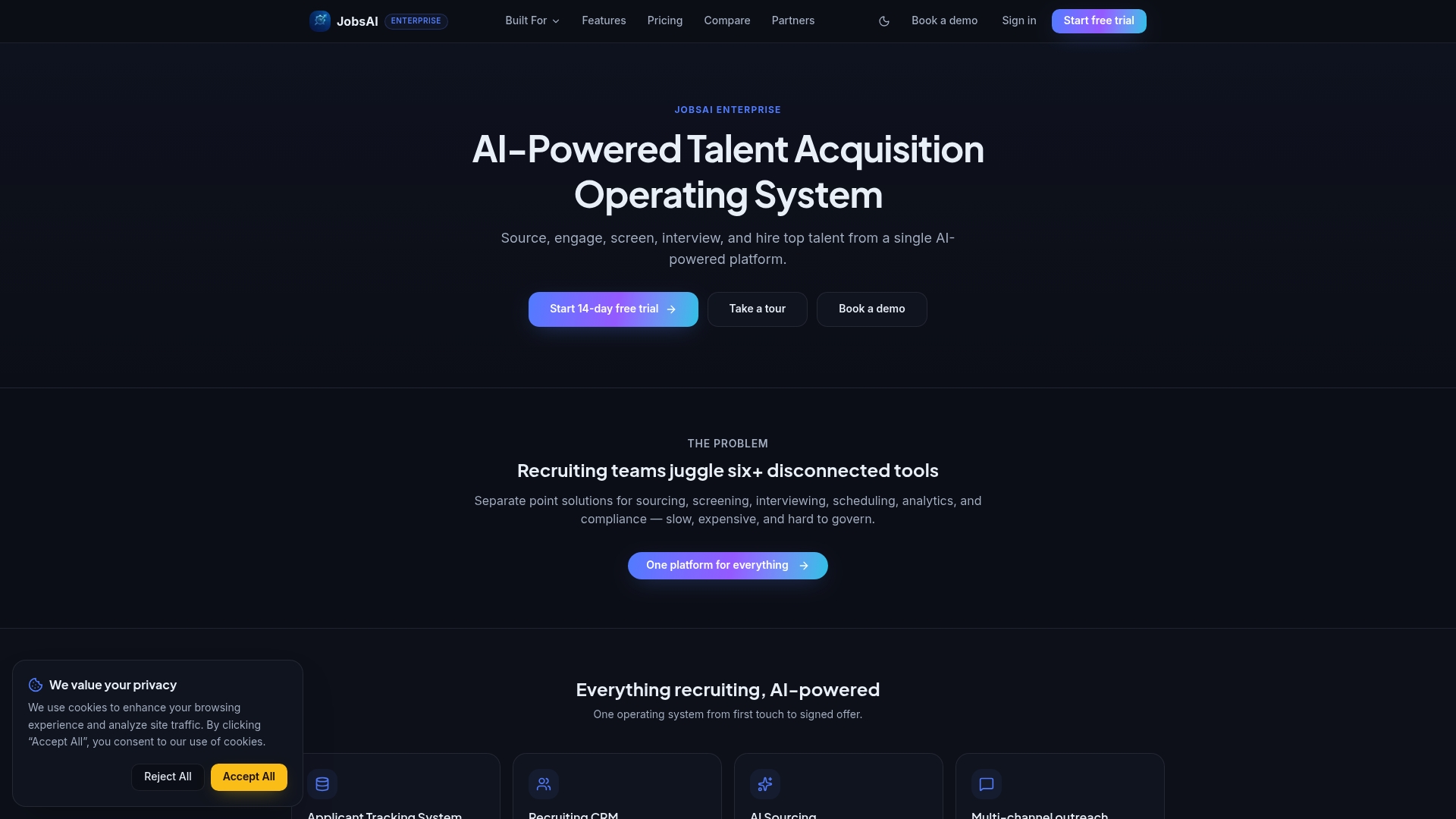
The practical starting point: run a 30-day pilot on your highest-volume role. Configure AI screening against your pass/fail criteria, activate automated candidate communications, and track time-to-first-screen against your current baseline. Most teams see a measurable reduction in manual review time within the first two weeks. To see exactly who Jobsai Enterprise is built for and how it maps to your hiring context, the product overview is a good first stop. Ready to see the workflow in action? Take the product tour or review pricing options to find the right fit for your team.
Useful sources
- Recruitment for High-Turnover Roles: What Works Best? (Upsilon Jobs) — Practical guidance on transparent job descriptions, realistic previews, and pipeline tactics for high-churn industries.
- Optimizing Talent Acquisition with AI in High-Churn Industries (Autod AI) — Use cases for AI screening, automated scheduling, and predictive retention analytics.
- Talent Acquisition Strategy: The CHRO Playbook for 2026 (Jobful) — Benchmarks on talent community ROI, time-to-fill reduction, and CFO-friendly TA reporting.
- 5 Recruitment Strategies to Improve Employee Retention (Test Partnership) — Framework for assessing role-fit, resilience, and integrity as retention predictors.
- A Guide to Structured Interviewing for Better Hiring Practices (Google re:Work) — Evidence base for structured interviews and rubric design.
- Hiring Elements End-to-End Hiring Roadmap (OPM) — Federal hiring roadmap covering job analysis, structured assessment design, and SOP development.
- Recruiting Strategies to Reduce Employee Turnover (Walden University) — Academic overview of evidence-based recruiting strategies linked to retention outcomes.
- AI in Recruiting: What to Automate, and What to Keep Human (Jobsai Enterprise) — Practical guidance on balancing automation and human judgment in high-volume hiring.
FAQ
What is the biggest driver of turnover in high-churn industries?
Mismatch between candidate expectations and actual job conditions is the leading cause of early exits. Transparent job posts that include exact schedules, physical demands, and pay bands reduce this gap before the hire is made.
How fast should you hire for hourly and entry-level roles?
Target an offer within 3–5 business days of first contact. Candidates in high-turnover industries are typically applying to multiple employers at once, and a slow process means losing qualified candidates to faster-moving competitors.
Do structured interviews actually improve retention?
Yes. Structured interviews with standardized questions and scoring rubrics increase predictive validity compared with unstructured conversations, meaning the candidates you select are more likely to succeed and stay in the role.
How can Jobsai Enterprise help reduce early attrition?
Jobsai Enterprise automates resume screening, candidate ranking, and follow-up communications, so hiring teams can move faster and more consistently. Faster, better-matched hires combined with structured workflows reduce the early-attrition risk that comes from rushed or inconsistent hiring decisions.
What metrics matter most for high-turnover hiring?
First-90-day attrition, time-to-fill, and offer acceptance rate are the three most actionable metrics. Together they identify whether your problem is in screening, process speed, or candidate experience, and point directly to the fix.
Recommended
- Where teams lose time-to-hire — and how to win it back | JobsAI Enterprise
- Why Hiring Teams Lose Candidates: A 2026 Guide | JobsAI Enterprise
- US Staffing Industry Benchmarks 2026: Hiring Manager’s Guide | JobsAI Enterprise
- AI in recruiting: what to automate, and what to keep human | JobsAI Enterprise
See it in your workflow
JobsAI Enterprise runs sourcing, AI screening, and the whole interview pipeline in one place. Book a walkthrough tailored to your team.
Book a demo