
Article
Candidate Sourcing Playbook: Strategies That Fill Roles Faster

Candidate Sourcing Playbook: Strategies That Fill Roles Faster
Candidate sourcing is the proactive work of finding, engaging, and pipelining potential hires before they ever apply. It’s not the same as recruiting, which picks up once someone is already in the funnel, screening, interviewing, and negotiating offers.
You can start improving your results this week with three moves: run a 30-minute intake call with the hiring manager to nail down must-haves versus nice-to-haves, build one targeted search using a specific boolean string or platform filter, and send a three-touch personalized outreach sequence instead of a single generic message.
- Run a 30-minute intake before you open a single search tab.
- Build one search string tied to a real requirement, not a job title guess.
- Send a three-touch sequence, spaced over 5 to 7 days, referencing something specific about the candidate.
Pro Tip: Mention one detail from a candidate’s actual work, a GitHub repo, a conference talk, a specific project, in your first line. Generic outreach gets ignored; specific outreach gets replies.
Key Takeaways
Candidate sourcing succeeds when recruiters pair a repeatable intake-to-handoff workflow with personalized, multi-channel outreach and the right mix of AI-assisted and human-led tactics.
| Point | Details |
|---|---|
| Sourcing is not recruiting | Sourcing covers discovery and engagement before application; recruiting handles screening and offers after. |
| Personalization drives replies | Highly personalized outreach lands reply rates in the 25 to 40% range, well above generic templates. |
| Sequence beats one-off searches | Run intake, persona, search, outreach, and handoff as a repeatable system rather than a per-role scramble. |
| AI speeds discovery, not rapport | AI-sourced candidates were up to 2.9x more likely to be hired in 2026 data, but the follow-up message still needs a human touch. |
| Jobsai Enterprise unifies the stack | Jobsai Enterprise combines AI discovery, talent pools, outreach automation, and structured handoffs in one workspace for teams scaling sourcing volume. |
Table of Contents
- What Does Candidate Sourcing Mean for Recruiters?
- Which Sourcing Tactics Should You Run First?
- What Tools Do You Need to Source Candidates Well?
- How Do You Write Outreach That Actually Gets Replies?
- What’s a Repeatable Sourcing Workflow That Scales?
- What Does 2026 Data Say About AI-Assisted Sourcing?
- What Sourcing Mistakes Cost You the Most Time?
- A Recruiter’s Take on Making Sourcing Actually Work
- How Jobsai Enterprise Fits Into Your Sourcing Playbook
- Sources
- FAQ
What Does Candidate Sourcing Mean for Recruiters?
Candidate sourcing covers the front half of hiring: mapping the talent market, building search strings, reaching out, and keeping a pipeline warm. It’s distinct from recruiting, which handles screening, interviewing, and offers once someone applies or responds. Sourcing is discovery and engagement; recruiting is evaluation and closing.
The core components are market mapping (who exists and where), search execution (boolean strings, platform filters, niche communities), outreach (the messages that start conversations), and pipeline building (keeping warm leads organized for future openings).
Sourcing should be your primary tactic in a few specific situations:
- Hard-to-fill or niche technical roles where the applicant pool is thin.
- Passive candidates who aren’t actively job hunting but might move for the right opportunity.
- High-volume roles you’ll need to fill repeatedly, where a warm pipeline saves months later.
- Diversity hiring mandates that require deliberate, expanded channel strategies rather than default job board postings.
If your applicant flow is already strong for a role, lean on recruiting workflows. If it’s thin, sourcing has to do the heavy lifting.
Which Sourcing Tactics Should You Run First?
Not every tactic deserves equal time. Here’s the order that gets results fastest, based on how mature sourcing teams sequence their work.
- Intake and persona building. Spend 30 minutes with the hiring manager before touching a search tool. Nail down the two or three non-negotiable requirements and write a one-paragraph candidate persona. Skipping this step is the single biggest cause of wasted search hours.
- ATS and internal database rediscovery. Before sourcing externally, search your own applicant tracking system for past candidates who fit. This is often the fastest, cheapest win, and it’s frequently ignored.
- Boolean and X-ray search. Build precise strings for LinkedIn, Google, and GitHub. For a backend engineer with Kubernetes experience, try:
site:github.com "kubernetes" "golang" location:"Austin". For LinkedIn, combine job titles with skills and exclude recruiters:("senior backend engineer" OR "staff engineer") AND "kubernetes" -recruiter. - Niche communities and platforms. Job boards work for generic roles. Specialized talent often lives in places like Stack Overflow, niche Slack or Discord communities, or industry-specific forums. Conference speaker lists and open-source contribution histories frequently outperform generic job boards for senior or specialized searches.
- Referrals and alumni networks. Ask current employees for two names each. Referral-based sourcing produces high-quality hires at a lower cost per hire when it’s structured with clear incentives and tracked systematically, rather than left as an informal, occasional ask.
- Event and sponsorship sourcing. Meetups, hackathons, and industry conferences put you in front of people who aren’t browsing job boards. Sponsoring a niche event often produces better candidates per dollar than boosting a job post.
- Talent pools and pipelining. Every strong candidate who isn’t right for today’s role goes into a tagged pipeline for tomorrow’s. Review these pools monthly, not just when a new requisition opens.
- AI-assisted discovery. Use AI sourcing tools to surface candidates who match role requirements based on skills and experience patterns, not just keyword matches. This is where volume gets manageable without sacrificing relevance.
- Employer-targeted mapping. Identify five to ten companies with talent profiles similar to your ideal candidate and map their teams directly. This works especially well when you’re trying to poach from a specific competitor or adjacent industry.
For a public-talk-based InMail, keep it short: “Saw your talk on distributed caching at [event], particularly the point about cache invalidation at scale. We’re solving a similar problem at [company] and I think you’d find the role interesting. Open to a 15-minute call?”
A multi-channel approach, combining LinkedIn, GitHub, Google X-ray, company career pages, and niche communities, reduces time-to-fill and improves candidate fit compared to relying on a single channel.
Pro Tip: Batch your searches. Spend one focused hour building five to ten qualified profiles before writing a single message, then write all your outreach in one sitting using a shared template with personalized swap-in lines. This keeps quality high without turning every message into a 20-minute writing project.
What Tools Do You Need to Source Candidates Well?
The sourcing tech stack breaks into a handful of categories, and matching the right tool to the right problem matters more than buying the biggest platform available.
- ATS/CRM systems organize candidates through the funnel and store historical applicant data for rediscovery. Essential for any team hiring more than a handful of roles per quarter.
- Talent intelligence and sourcing databases (platforms like LinkedIn Recruiter and SeekOut) aggregate profiles across the web and let you filter by skills, experience, and availability signals. These matter most for high-volume technical or specialized searches where manual boolean work would take too long.
- Email finders and contact enrichment tools fill in the gap between “found a great profile” and “can actually reach this person.” Critical when your primary channel (LinkedIn, GitHub) doesn’t offer direct messaging, or when InMail credits run dry.
- Outreach sequencers (like Gem) manage multi-touch campaigns across email and other channels, track opens and replies, and let you A/B test messaging at scale.
- Automation and AI agents handle repetitive discovery and initial-touch tasks, freeing recruiter time for higher-value conversations.
- Candidate enrichment tools add context, current role, tenure, skills inferred from public work, that make your first outreach message sharper.
Data accuracy and recruiter-specific workflows matter more than raw database size when you’re comparing tools in any of these categories.
For teams that want fewer logins and less manual stitching, Jobsai Enterprise brings AI-powered candidate discovery, structured talent pools, outreach automation, and downstream workflow tools like resume screening and interview scheduling into one workspace, so the handoff from “sourced” to “screened” to “hired” happens without exporting spreadsheets between five different platforms.

How Do You Write Outreach That Actually Gets Replies?
Personalization beats polish every time. A message referencing a candidate’s specific project, talk, or repo consistently outperforms a well-written generic template. Keep it short, make one clear ask, and match your follow-up cadence to the channel.
Three templates worth stealing:
- Short cold note (LinkedIn, first touch): “Your work on [specific project] caught my eye, particularly [specific detail]. We’re building something similar at [company] and I think the problem set would interest you. Worth a quick chat?” Use this for passive candidates with a visible public portfolio.
- Referral-based note (when a mutual connection exists): “[Mutual connection] mentioned you’d be a strong fit for a role we’re filling. They spoke highly of your work on [project/team]. Open to hearing more?” Use this when warmth already exists; skip the cold-open entirely.
- Warm follow-up (second or third touch, no reply yet): “Following up in case this got buried, no pressure either way. Happy to share more detail on the role or just point you to someone else if timing’s off.” Use this to close the loop without sounding pushy.
Sequencing checklist:
- Three to four touches total, spaced 3 to 5 days apart.
- Vary the channel: start on LinkedIn, follow up by email if you have it.
- Stop after the fourth touch. Persistence past that point reads as spam, not interest.
Reply rates vary widely by role and channel, but practitioner benchmarks generally put targeted outreach response rates between 15% and 35%, with highly personalized, source-specific messages landing at the top of that range, often in the 25 to 40% band.
Pro Tip: Reference different signals depending on where you found someone. For GitHub, mention a specific repo or commit pattern. For conference speakers, mention their talk topic. For referrals, lead with the connection’s name. The signal you cite should match the channel you’re sourcing from.
What’s a Repeatable Sourcing Workflow That Scales?
Sourcing works best as a system, not a series of one-off scrambles every time a requisition opens. The strongest teams run the same repeatable sequence every time: intake, persona, search, outreach, nurture, handoff.
- 30-minute intake with the hiring manager to lock requirements and deal-breakers.
- Persona documentation, a one-paragraph profile of the ideal candidate’s background and motivators.
- Search execution across two to three channels matched to the role type.
- Batch outreach using templates with personalized swap-in details.
- Follow-up cadence per the sequencing checklist above.
- Structured handoff to the recruiter or hiring manager with full context, not just a name and resume.
Track these KPIs at each stage:
- Prospects identified: raw count of qualified profiles found per search session.
- Outreach sent: total messages sent across all touches.
- Response rate: percentage who reply at all, positive or negative.
- Positive response rate: percentage who reply with interest.
- Screen-to-interview: percentage of screened candidates who advance.
- Interview-to-offer: conversion rate from interview to offer stage.
- Source-of-hire: which channel actually produced the eventual hire.
Test in small batches of 10 to 15 outreach messages before scaling a template, and hold a brief calibration round with the hiring manager after the first five candidates surface, so you catch persona mismatches early rather than after fifty wasted searches.
What Does 2026 Data Say About AI-Assisted Sourcing?
AI-assisted sourcing is measurably changing recruiter capacity. Industry data from 2026 shows median time-to-fill for nonexecutive roles dropped to 39 days, down from 44 the prior year, and AI-discovered candidates were up to 2.9 times more likely to be hired than candidates found through manual search alone.
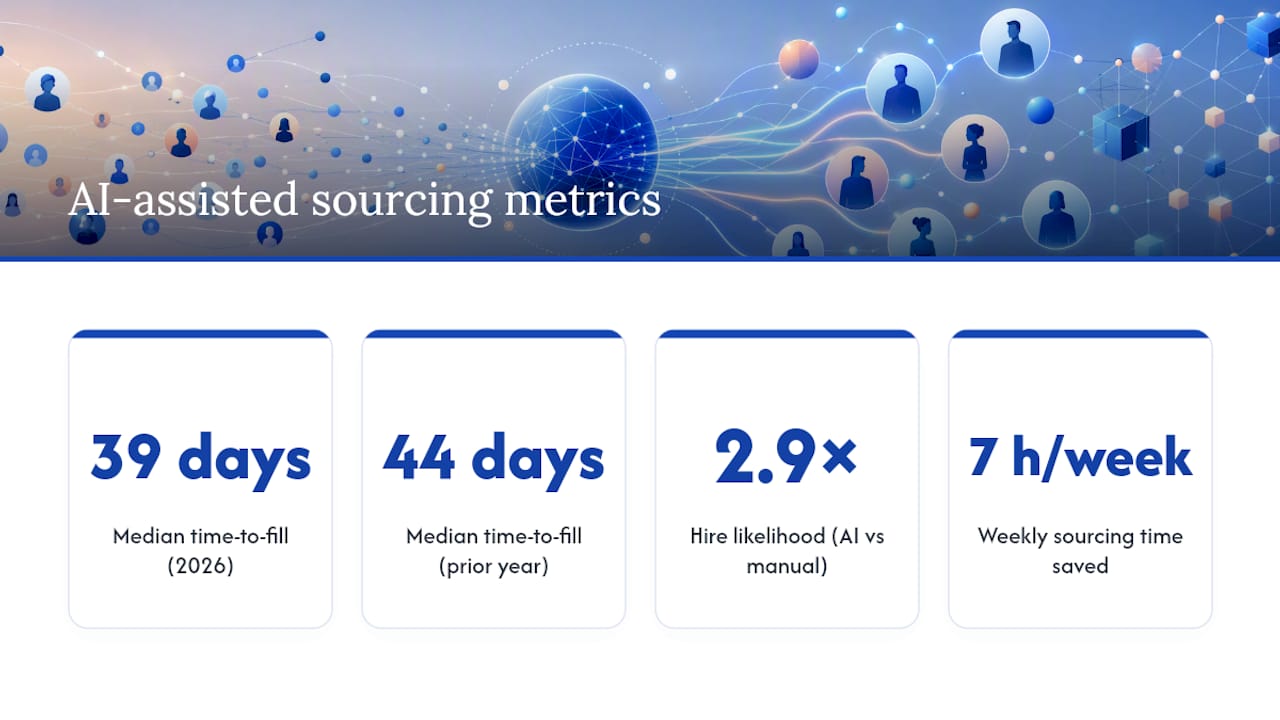
Employers using AI sourcing assistants reported saving roughly 7 hours per week on manual sourcing tasks. That’s nearly a full workday recruiters can redirect toward calibration calls, higher-touch outreach, or pipeline nurturing instead of scrolling search results.
The catch: AI discovery finds candidates faster, but it doesn’t write the message that gets them to reply. Pairing AI-assisted discovery with genuinely personalized outreach keeps response rates high while cutting the hours spent finding people in the first place.
Pro Tip: Let AI handle volume, initial matching, and enrichment. Keep the first message and the follow-up tone human. That split is where most teams get the productivity gain without the reply-rate drop.
What Sourcing Mistakes Cost You the Most Time?
Most sourcing failures aren’t strategic, they’re operational. The most common ones:
- Random prospecting with no intake brief, leading to searches that don’t match what the hiring manager actually wants.
- Poor handoffs where context about why a candidate looked promising gets lost between sourcer and recruiter.
- Stale data, reaching out to candidates whose information is a year old and no longer accurate.
- Skipping follow-up after the first message goes unanswered, when a second touch often gets the reply.
- Over-automation, sending templated messages with zero personalization, which tanks reply rates fast.
For diversity in sourcing, pick channels deliberately by role rather than defaulting to the same network every time, use blind resume review where your process allows it, and track source-of-hire by channel so you can measure whether your expanded outreach is actually producing diverse hires, not just diverse outreach attempts.
On compliance, keep data minimization and consent front of mind: only store candidate data you actually need, and honor removal requests promptly. These aren’t optional housekeeping items, they’re baseline expectations for responsible sourcing.
A Recruiter’s Take on Making Sourcing Actually Work
The teams that get sourcing right treat it like an operating rhythm, not a scramble. One recruiting team that shifted from ad-hoc searches to a documented intake-to-handoff process saw their positive response rate roughly double within two hiring cycles, not because the messages got cleverer, but because the searches got sharper and the follow-up stopped falling through the cracks.
The tactical takeaway: fix your intake process before you touch a search tool. Everything downstream depends on it.
How Jobsai Enterprise Fits Into Your Sourcing Playbook
Jobsai Enterprise cuts the manual grind out of this playbook without replacing the judgment calls that actually land hires. AI-powered discovery surfaces candidates matched to your persona, talent pools keep warm leads organized by role instead of scattered across spreadsheets, and built-in outreach automation handles sequencing so your team focuses on writing the personal first line instead of tracking who’s due for touch three.
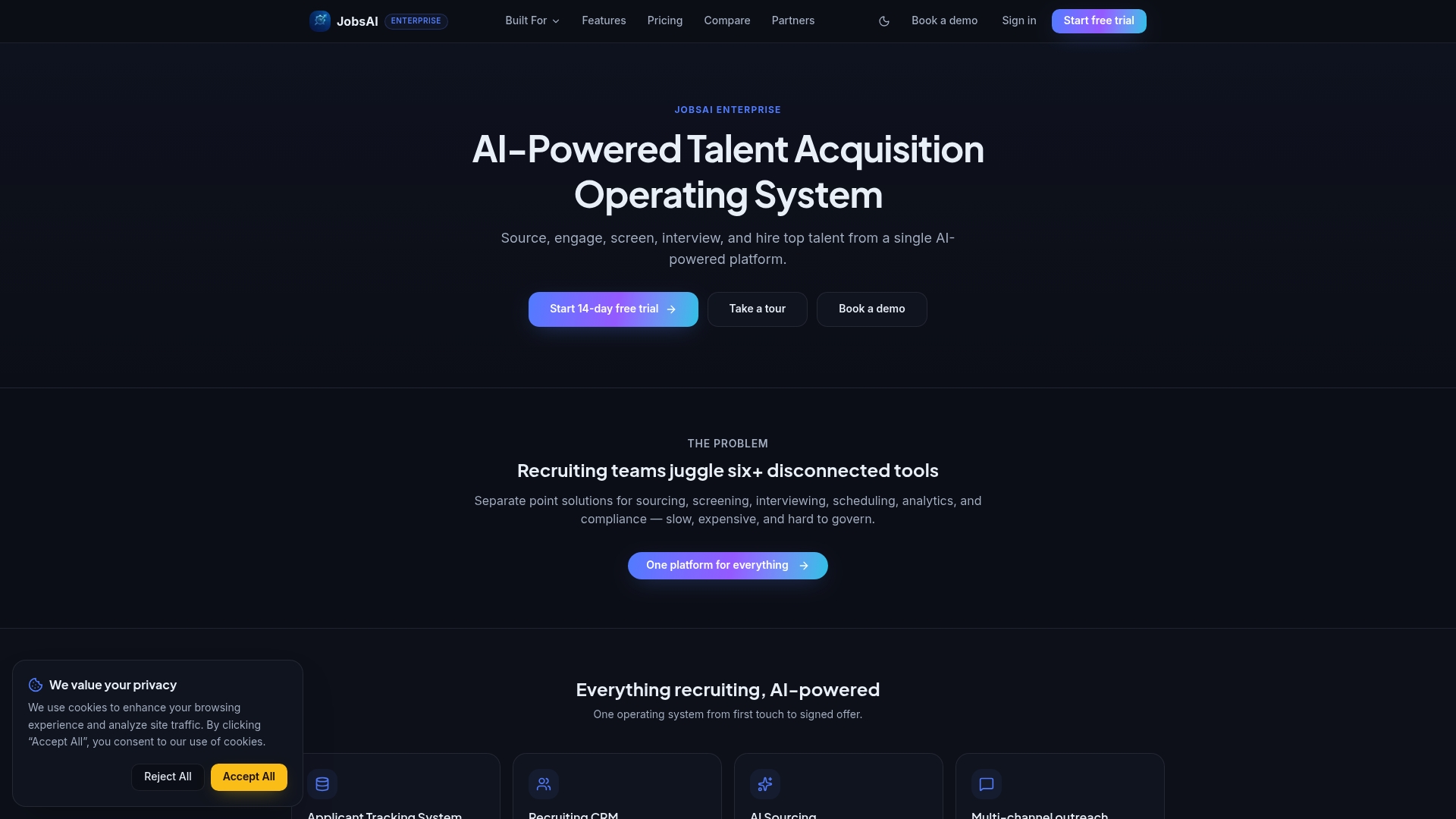
Structured handoffs move candidates from sourced to screened without losing the context a recruiter needs, and analytics dashboards surface response rate and source-of-hire automatically instead of requiring a manual spreadsheet audit every Friday. This setup benefits agencies and in-house teams running high volume the most, since the time saved on manual tracking compounds fast across dozens of open roles.
If you’re evaluating whether AI screening fits your current stack, the AI screening guide walks through how matching and ranking work end to end, or you can take the product tour to see the full workflow from intake to offer in one workspace.
Sources
- How to Source Candidates: Workflow, Boolean Search, Outreach, KPIs
- 10 Sourcing Strategies in Recruitment That Work in 2026
- How to Source Candidates in 2026: A Practical Guide for Recruiters | ProfileSpider Blog
- Side-by-Side Review of Top Recruiting Sourcing Tools | DISHER Talent Solutions
- Candidate Sourcing: Your Ultimate 2025 Guide (+Tips & Strategies)
FAQ
What does candidate sourcing mean?
Candidate sourcing is the proactive process of identifying, researching, and engaging potential candidates, often passive ones, before they apply to a role. It sits upstream of recruiting, which handles the screening and interview stages.
What is the best tool for sourcing candidates?
The right tool depends on your hiring volume and role complexity. Talent intelligence platforms like LinkedIn Recruiter or SeekOut work well for high-volume technical searches, outreach sequencers like Gem help scale personalized campaigns, and unified platforms like Jobsai Enterprise combine sourcing with downstream screening and workflow tools in one place.
What is the difference between recruiting and sourcing?
Sourcing focuses on finding and engaging candidates, often before they’ve applied. Recruiting picks up from there, managing screening, interviews, and offer negotiation.
What does “candidate source” mean on a job application?
On a job application, “candidate source” refers to the channel that brought the applicant into the process, such as a job board, referral, LinkedIn outreach, or a sourced pipeline from a previous search.
Recommended
- Candidate Shortlisting Best Practices for Hiring Teams | JobsAI Enterprise
- Why Recruiters Miss Qualified Candidates: 2026 Guide | JobsAI Enterprise
- Candidate Follow-Up Best Practices for Recruiters | JobsAI Enterprise
- Recruiting Tips for High-Turnover Industries: Hire Faster, Cut Churn | JobsAI Enterprise
See it in your workflow
JobsAI Enterprise runs sourcing, AI screening, and the whole interview pipeline in one place. Book a walkthrough tailored to your team.
Book a demo