
Article
Salary Disclosure Law: A Guide for Employees and Employers

Salary Disclosure Law: A Guide for Employees and Employers
A salary disclosure law requires employers to share pay information — typically a salary range or total compensation figure — at defined points in the hiring or employment process. No single federal law governs this in the United States; pay-transparency rules are primarily state and local and differ by what must be disclosed, when, and which employers are covered.
Here is what that means for you right now:
- If you are a job seeker or employee: Check whether your state has a pay-transparency law. If it does, you may have the right to see a salary range before or during the hiring process, and your employer cannot retaliate against you for asking.
- If you are an employer: Confirm whether your headcount and the position’s work location trigger a posting or disclosure obligation, then document how you set the range.
- If you need to file a complaint: Most states route complaints through the state Department of Labor or Attorney General’s office. New York applicants can use the NY DOL salary complaint form directly.
Key Takeaways
Salary disclosure laws are state-driven, trigger-based obligations that require employers to share pay ranges at defined points in hiring, and employees in covered states have enforceable rights to that information.
| Point | Details |
|---|---|
| No federal law exists | Pay-transparency rules are state and local; compliance obligations vary by jurisdiction, not a single national standard. |
| Triggers determine the obligation | Disclosure may be required at job posting, before an offer, on request, or upon promotion, depending on the state. |
| Size thresholds matter | Coverage ranges from 1+ employee (Colorado, D.C.) to 30+ employees (Minnesota); confirm your state’s threshold before assuming coverage. |
| “Good faith” range is a legal standard | Massachusetts and New York require ranges that reflect what the employer actually intends to pay, not a placeholder band. |
| Enforcement is real and growing | States including New York, California, and Colorado have active enforcement programs; penalties apply per violation and can compound across multiple postings. |
Table of Contents
- What is salary disclosure law, and how does it differ from related rules?
- Which U.S. states require salary disclosure?
- What must employers actually disclose?
- When must employers disclose, and who is covered?
- How are pay-disclosure laws enforced, and what are your remedies?
- Common exceptions and edge cases
- Practical checklists for employees and employers
- How salary disclosure laws interact with privacy and confidentiality
- Challenges and controversies around salary disclosure
- Enforcement actions and compliance risks in practice
- Public-facing disclosures vs. internal pay transparency policies
- Salary disclosure laws are reshaping how employers and candidates negotiate
- Sources
- FAQ
What is salary disclosure law, and how does it differ from related rules?
Pay-transparency laws and salary disclosure laws refer to the same family of rules: statutes that require employers to share compensation information with applicants or employees at specific moments. Their primary policy goals are to reduce information asymmetry between employers and workers and to narrow persistent pay gaps, particularly those tied to gender, race, and ethnicity.
These laws are often confused with two related but distinct concepts. Salary-history bans prohibit employers from asking candidates what they earned at previous jobs. Pay-secrecy rules (or anti-discussion clauses) restrict employees from sharing their own pay with coworkers. Salary disclosure laws work in the opposite direction: they place an affirmative obligation on the employer to share information, rather than restricting what either party can ask or say.
There is no enacted federal salary disclosure law. Congressional proposals have been introduced that would amend the Fair Labor Standards Act to require employers to disclose wage ranges and define “wage range” as an anticipated good-faith range, but none has become law. Until federal legislation passes, compliance obligations come entirely from state and local statutes, which vary considerably in scope, triggers, and enforcement.
States adopt these laws for a clear reason: applicants who know the pay range before negotiating tend to negotiate more effectively, which research links to narrower pay gaps over time. Employers sometimes push back on the grounds that wide posted ranges can create internal equity friction when current employees see ranges that differ from their own pay.
Pro Tip: If you are an HR professional operating across multiple states, treat each state’s law as a separate compliance track. A single national job-posting template almost never satisfies every jurisdiction’s requirements simultaneously.
Which U.S. states require salary disclosure?
The table below covers the major jurisdictions with active pay-transparency or salary disclosure requirements. Several additional states and municipalities have introduced or are considering legislation, so check your state labor agency for the most current status.
State approaches vary considerably: some require pay ranges in every public job posting, while others require disclosure only at certain hiring stages or on request. Enforcement mechanisms split similarly, with some states allowing private lawsuits and others limiting enforcement to a state agency or attorney general.
Several cities and counties have their own ordinances that may apply even when the state does not have a statewide law. New York City’s local law, for example, predates New York State’s statewide rule. Always verify whether a municipal ordinance applies to your specific worksite.
What must employers actually disclose?
The most common disclosure requirement is a pay range: a minimum and maximum salary or hourly rate the employer reasonably expects to pay for the role. Some states go further and require disclosure of total compensation, which can include bonuses, commissions, equity, and benefits.
Common disclosure types across state laws include:
- Minimum and maximum salary or hourly rate (the baseline in most states)
- Pay scale, which some statutes define as the range set for a particular job classification
- Total compensation, including bonuses, equity grants, and non-cash benefits (required in Colorado and Washington, among others)
- Commission or piece-rate statements, where a role is paid primarily on commission
The statutory definition of “pay range” matters for compliance. Massachusetts defines “pay range” as the annual salary or hourly wage range the employer reasonably and in good faith expects to pay for the position. That “good faith” standard means the range must reflect what the employer actually intends to offer, not a placeholder spanning the entire salary band for a job family. New York Labor Law Section 194-b similarly requires that the compensation or range listed in a job advertisement reflect the actual compensation for the advertised opportunity.
Colorado and California both require disclosure of the pay scale, but Colorado additionally requires employers to list benefits and other compensation elements in job postings, making it one of the more demanding disclosure regimes in the country.
Pro Tip: Document the specific inputs you used to set a posted range: market survey data, internal equity analysis, budget approval, and the date the range was approved. That paper trail is your primary defense if a regulator or plaintiff questions whether your range was set in good faith.
When must employers disclose, and who is covered?
Pay-transparency obligations are trigger-based. The operative requirement depends on when in the hiring or employment lifecycle the disclosure must occur, not on a blanket ongoing obligation.
Common disclosure triggers:
- Job posting or advertisement: The most common trigger. The range must appear in the posting itself, visible to all applicants before they apply.
- Before compensation discussion: Some statutes require disclosure before any conversation about pay begins, even if no formal offer has been made.
- After interview / before offer: A narrower trigger used in a few jurisdictions, requiring disclosure once the employer has decided to move a candidate forward.
- On request: Employees or applicants can ask for the range at any time, and the employer must respond. Massachusetts requires this for current employees seeking a range for their own position.
- Upon hire, promotion, or transfer: Several states, including Massachusetts and New York, require disclosure when an employee moves into a new role internally.
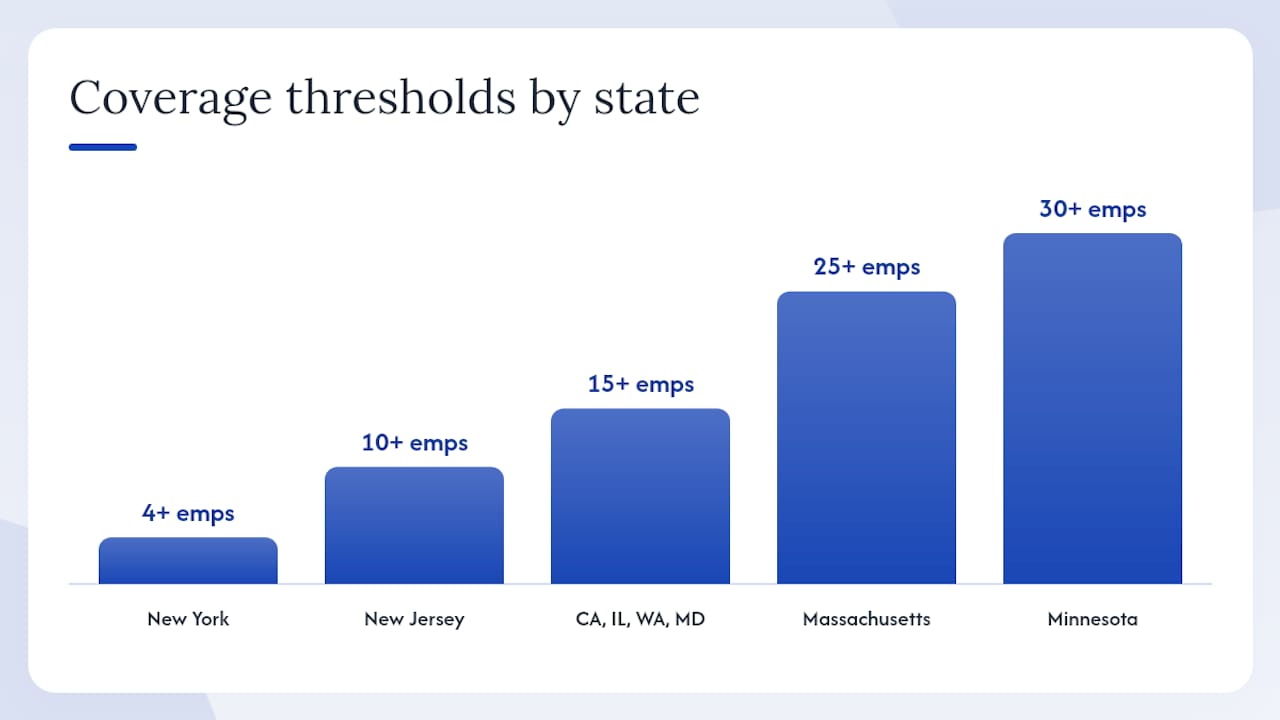
Coverage thresholds vary by state. New York covers employers with four or more employees; California, Illinois, Washington, and Maryland set the threshold at 15; Massachusetts at 25; Minnesota at 30; and New Jersey at 10. Colorado and D.C. cover employers of any size.
Remote work adds a layer of complexity. In Massachusetts, the AGO’s FAQ clarifies that remote workers count toward the employer-size threshold only if their primary place of work is Massachusetts. New York’s coverage applies to positions performed “at least in part” in New York, which can pull in remote roles where the employee works from a New York location even occasionally.
Third-party job boards and staffing agencies are generally required to include the pay range when they post on behalf of an employer, provided the employer has supplied it. The obligation to provide the range sits with the employer; the obligation to include it in the posting sits with whoever controls the advertisement.
How are pay-disclosure laws enforced, and what are your remedies?
Enforcement varies more than the disclosure requirements themselves. Here is how the process typically works and what remedies are available.
- Document the violation. Save a screenshot or copy of the job posting (with date and URL), any written communication about compensation, and any denial of a range request. Note the date of each event.
- Identify the right agency. Most states route complaints through the state Department of Labor or Attorney General’s office. In New York, file with the NY DOL or, for NYC-specific roles, the NYC Commission on Human Rights. In Massachusetts, file with the Attorney General’s office.
- File the complaint. Most agencies provide an online form. Include the employer’s name, the position, the date of the violation, and your supporting documentation.
- Understand your remedies. Agency-led enforcement typically results in civil penalties against the employer. Some states, including New York and California, also allow private civil actions, meaning you can sue the employer directly for damages. Others, like Colorado, limit enforcement to the state agency.
- Anti-retaliation protections apply. New York Labor Law Section 194-b explicitly prohibits retaliation against employees or applicants who exercise rights under the law. Most other state laws include comparable protections. If you are demoted, terminated, or otherwise penalized for asking about pay or filing a complaint, that retaliation is itself a separate violation.
Civil penalties for first-time violations range from a few hundred dollars to several thousand dollars per violation depending on the state. Repeat violations typically carry higher penalties. Where private suits are allowed, plaintiffs may also recover attorney’s fees and, in some states, compensatory or punitive damages.
Common exceptions and edge cases
Not every employer or every role falls under these laws. The most common exceptions include:
- Small-employer carveouts: If your employer falls below the state’s headcount threshold, the posting or disclosure requirement may not apply.
- Independent contractors: Most state pay-transparency laws cover employees, not independent contractors. If you work as a 1099 contractor, check whether the specific statute extends to your engagement.
- Commission-only roles: New York allows employers to satisfy the disclosure requirement for commission-only positions by posting a general commission statement rather than a specific dollar range, where the statute permits this approach.
- Collective bargaining agreements: Some states exempt positions covered by a CBA, particularly where the pay is set by the agreement itself.
- Confidentiality and security exceptions: A narrow set of roles (certain government or security-sensitive positions) may be exempt from public posting requirements under specific statutory language.
Many of these exceptions are narrowly written. When a role sits on the edge of an exception, the safer compliance posture is to disclose rather than rely on an exemption that may not hold up under agency scrutiny. If the situation is genuinely ambiguous, agency guidance or employment counsel is the right next step.
Practical checklists for employees and employers
For employees and applicants
- Confirm your state has an active pay-transparency law and that your employer meets the size threshold.
- Check the job posting for a listed pay range before applying. If none appears, note whether your state requires one.
- Request the range in writing so you have a record. A simple one-line request works: “Could you share the pay range for this role? My understanding is that [State] law requires disclosure.”
- If you are a current employee seeking your own position’s range, submit the request in writing to HR.
- Document everything: save job postings, emails, and any verbal statements about compensation.
- If the employer refuses or retaliates, file a complaint with your state DOL or AGO using the agency’s online form.
For employers
- Audit every active job posting to confirm it includes the required pay range for each covered jurisdiction.
- Set ranges using documented inputs: market data, internal equity analysis, and budget approval. Record the date the range was approved.
- Update your ATS and job-board templates to include a pay-range field that cannot be published blank for covered roles. Guidance on compliance workflows in recruiting can help structure this process.
- Train hiring managers and recruiters on when and how to disclose ranges, including for internal promotions and transfers.
- Establish a documented process for responding to employee range requests, including a response timeline and who owns the response.
- Review third-party job board postings to confirm the range appears there as well.
- Maintain version-controlled records of each posting, including the range, the date it was posted, and the rationale for the range.
Pro Tip: Keep your ATS job-posting templates and job-board integrations synchronized. A range that appears in your internal system but not in the third-party posting is still a violation. Platforms like Jobsai Enterprise can automate this sync and log the range and rationale at the time of posting, creating an audit trail without manual effort.
A compliant job-posting example: “Salary range: $72,000–$90,000 annually. This range reflects the compensation we reasonably and in good faith expect to offer for this role based on current market data and internal equity.”
How salary disclosure laws interact with privacy and confidentiality
Pay-transparency obligations and privacy laws generally operate on separate tracks, but they can create friction in specific situations. Salary disclosure laws require employers to share pay-range information publicly or on request. Privacy laws, by contrast, typically protect individual employee data: a specific employee’s salary is personal information that employers should not disclose to third parties without consent.
The key distinction is that disclosure laws require sharing a range, not an individual’s pay. Posting that a role pays $80,000–$100,000 does not reveal what any specific employee earns. Employers sometimes conflate the two, treating a range disclosure as a privacy risk when it is not.
Confidentiality agreements present a related issue. Some employers include clauses that prohibit employees from discussing their own compensation. Under the National Labor Relations Act, most private-sector employees have the right to discuss wages with coworkers as a protected concerted activity. A confidentiality clause that restricts this discussion is generally unenforceable for non-supervisory employees, regardless of what the agreement says. Pay-transparency laws reinforce this by creating an affirmative right to information that cannot be waived by contract.
The growing patchwork of state and local pay-transparency laws also intersects with pay-data reporting obligations in some states. California, for example, requires covered employers to submit annual pay-data reports to the Civil Rights Department. These reports contain aggregated data by race, ethnicity, and sex, not individual salaries, which keeps them on the right side of individual privacy protections.
Challenges and controversies around salary disclosure
Pay-transparency laws enjoy broad public support among workers, but they have generated real debate among employers and researchers.
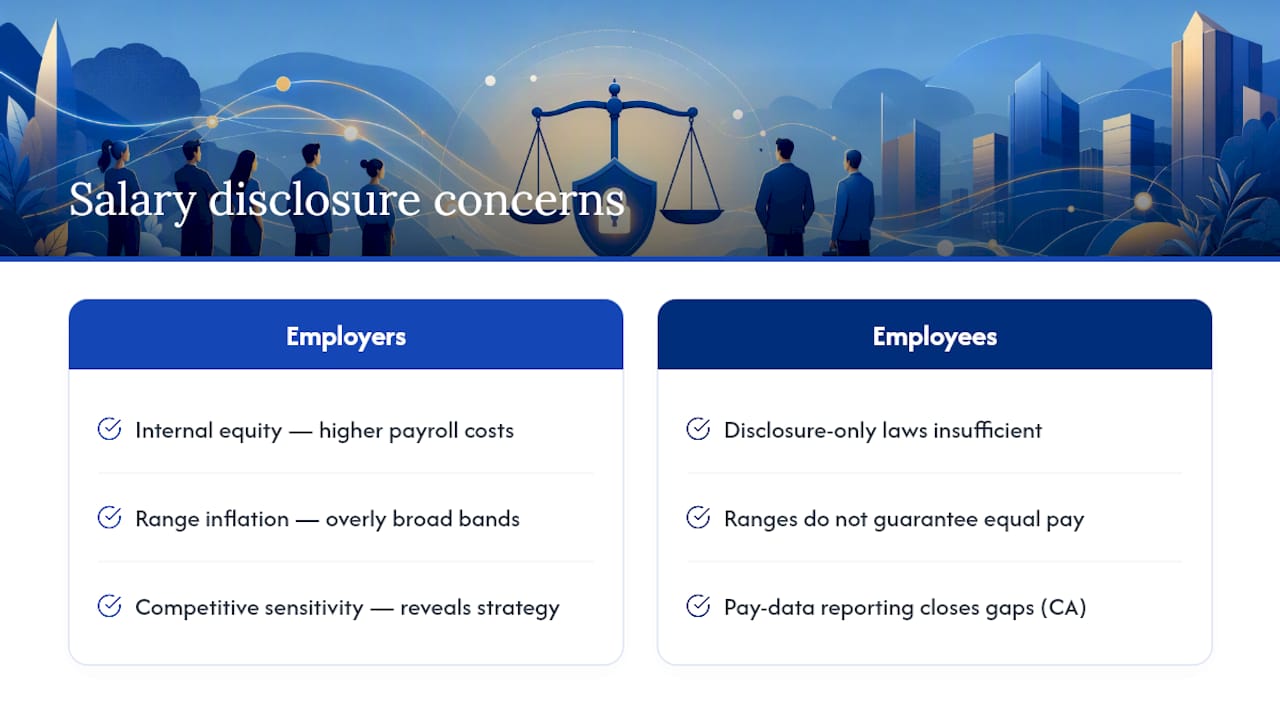
Internal equity friction is the most commonly cited employer concern. When a current employee sees a posted range for their own role that is higher than their current pay, it creates pressure to adjust compensation across the board. For employers with large workforces, that can mean significant unplanned payroll costs. Some employers respond by widening ranges to the point of meaninglessness, posting bands so broad that the disclosure conveys little useful information.
Range inflation is the flip side of that problem. A posted range of $50,000–$150,000 technically satisfies a disclosure requirement but tells applicants almost nothing about what the employer actually intends to pay. Several state agencies have signaled that ranges must be set in good faith, which pushes back against this practice, but enforcement of range quality is still developing.
Competitive sensitivity is another concern, particularly for smaller employers who worry that disclosing pay ranges gives larger competitors insight into their compensation strategy. This concern is more acute in specialized or niche industries where salary data is not widely available through public surveys.
On the employee side, some advocates argue that disclosure-only laws do not go far enough. Knowing a range exists does not guarantee equal pay within that range, and without pay-data reporting requirements, it is difficult to audit whether employers are actually closing pay gaps. States like California that combine posting requirements with pay-data reporting address this more directly than states that require only a range in the job posting.
Enforcement actions and compliance risks in practice
Enforcement activity under pay-transparency laws has been building as the laws mature. New York’s DOL has issued guidance and fielded complaints since the state law took effect in September 2023. California’s Civil Rights Department has pursued employers for failing to include pay scales in job postings and for submitting incomplete pay-data reports.
Colorado, as one of the earliest adopters of mandatory pay disclosure through its Equal Pay for Equal Work Act, has seen enforcement actions against employers who posted positions without pay ranges or who excluded Colorado applicants from job postings to avoid the requirement. That last tactic, sometimes called “geo-blocking,” drew significant attention and led several states to clarify that remote-eligible roles cannot be excluded from disclosure requirements simply because the employer wants to avoid compliance.
Illinois’ Equal Pay Act salary transparency amendment covers employers with more than 15 employees and carries civil penalties for non-compliance. First-time violations in Illinois typically result in a notice and opportunity to cure, but repeat violations move to direct financial penalties.
The practical compliance risk for multi-state employers is cumulative. A single job posting that goes out across multiple states without a pay range can trigger violations in several jurisdictions simultaneously, each with its own penalty structure. For high-volume hiring teams posting dozens of roles per week, that exposure adds up quickly without a systematic approach to posting compliance.
Public-facing disclosures vs. internal pay transparency policies
There is an important distinction between what the law requires and what a thoughtful pay-transparency strategy looks like internally.
Public-facing disclosures are what the law mandates: a pay range in a job posting, a range provided to an applicant on request, or a range shared with an employee upon promotion. These are compliance obligations with defined triggers, covered employers, and enforcement consequences.
Internal pay transparency policies go further. They might include sharing salary bands with all employees, publishing the criteria used to place employees within a band, or providing managers with guidance on how to explain pay decisions. None of this is typically required by law, but it addresses the internal equity friction that public disclosures can surface.
The two tracks require different workflows. Public disclosures need to be consistent, documented, and legally defensible. Internal policies need to be equitable, clearly communicated, and supported by manager training. Employers who invest only in the compliance track often find that posting a range publicly without addressing internal equity creates more employee relations problems than it solves.
For recruiting teams managing job descriptions and postings at scale, the practical step is to build the pay range into the job description template itself, so it flows automatically into every posting channel without requiring a separate compliance review for each role.
Salary disclosure laws are reshaping how employers and candidates negotiate
Salary disclosure laws represent the most significant structural shift in hiring transparency in decades. Here is the part that often gets underestimated: these laws do not just change what employers post. They change the negotiating dynamic for every candidate who walks into an interview.
Before pay-transparency laws, compensation negotiation was almost entirely asymmetric. Employers knew the budget; candidates guessed. That information gap consistently worked against candidates who were less experienced at negotiating, which research links to persistent pay gaps across gender and racial lines. A posted range does not eliminate negotiation, but it puts both parties in the same room with the same basic information.
What I find more interesting is the internal pressure these laws create. When a company posts a range of $90,000–$120,000 for a new hire and a five-year employee in the same role is earning $88,000, that is not a legal problem. But it is a retention problem, and it surfaces the moment the employee sees the posting. Employers who treat pay-transparency compliance as a legal checkbox without addressing internal equity are solving the wrong problem.
For recruiting and HR teams, the operational implication is clear: compliance workflows and ATS job-posting templates need to be updated now, not when a complaint arrives. Technology can help, but the foundation has to be a documented, defensible pay-setting process that can withstand scrutiny from a regulator or a skeptical employee.
Sources
- Pay Transparency Laws: The Good, the Bad, and the Ugly?
- Pay Transparency in Massachusetts
- Pay Transparency | Department of Labor - NY.Gov
- Mandatory Pay Disclosure Laws (Boston College Law Review Note)
- H.R. 1599 (bill text) — Proposed amendments to FLSA regarding wage disclosures
This article is general information, not a substitute for advice from a qualified lawyer. Consult a qualified legal professional about your own circumstances before acting on anything here.
FAQ
In what states is it illegal not to disclose salary in a job posting?
Colorado, California, Washington, New York, Illinois, Minnesota, New Jersey, Maryland, Massachusetts, and the District of Columbia all require covered employers to include pay ranges in job postings, with varying employer-size thresholds and effective dates.
Can HR share an individual employee’s salary with others?
HR can share a pay range for a position, but disclosing a specific employee’s individual salary to third parties without that employee’s consent raises privacy concerns and is generally not required or advisable under pay-transparency laws.
Can an employer tell employees not to discuss their own pay?
For most private-sector, non-supervisory employees, the National Labor Relations Act protects the right to discuss wages with coworkers as a protected concerted activity. A confidentiality clause that restricts this is generally unenforceable, regardless of what an employment agreement says.
Does a salaried employee have to be paid if they work any part of a week?
Under the federal Fair Labor Standards Act, exempt salaried employees must generally receive their full weekly salary for any week in which they perform work, with limited exceptions for full-day absences for personal reasons, illness, or disciplinary suspensions.
Do remote employees trigger pay-transparency obligations?
It depends on the state. In Massachusetts, remote workers count toward the employer-size threshold only if their primary place of work is Massachusetts. In New York, a role performed “at least in part” in New York is covered, which can include remote employees working from a New York location.
Recommended
See it in your workflow
JobsAI Enterprise runs sourcing, AI screening, and the whole interview pipeline in one place. Book a walkthrough tailored to your team.
Book a demo