
Article
Canada's GDPR Equivalent: PIPEDA Explained for Privacy Officers

Canada’s GDPR Equivalent: PIPEDA Explained for Privacy Officers
Canada does not have a direct GDPR equivalent. The closest federal law is PIPEDA (the Personal Information Protection and Electronic Documents Act), a principles-based private-sector privacy statute enforced by the Office of the Privacy Commissioner of Canada (OPC). The European Commission has confirmed that Canada provides an adequate level of protection for EU-to-Canada data transfers to organizations subject to PIPEDA — but adequacy is not equivalence. PIPEDA compliance alone does not satisfy GDPR obligations such as records of processing activities (ROPA), data protection impact assessments (DPIAs), 72-hour breach notification, or the right to erasure.
Three things to know before you read further:
- PIPEDA is Canada’s federal private-sector privacy law. It applies to commercial activities and federally regulated organizations. Quebec, British Columbia, and Alberta have substantially similar provincial laws that replace PIPEDA in those provinces for intra-provincial matters.
- The EC adequacy decision simplifies EU-to-Canada data transfers for organizations subject to PIPEDA, but it does not cover every recipient or every data category. Transfers outside PIPEDA’s scope still need standard contractual clauses (SCCs) or another transfer mechanism.
- Bill C-27 (the proposed Consumer Privacy Protection Act, or CPPA) is the reform to watch. It would replace PIPEDA with a more prescriptive regime, narrowing several gaps with the GDPR, but it had not yet received Royal Assent as of mid-2026.
Pro Tip: If your organization processes personal data of EU residents, treat the GDPR as directly applicable regardless of where you are based. Canada’s adequacy status eases the transfer mechanism question, but it does not substitute for GDPR-specific controls on the EU side.
Key Takeaways
Canada’s GDPR equivalent is PIPEDA, but adequacy is not equivalence: organizations processing EU personal data must implement GDPR-specific controls regardless of their PIPEDA compliance posture.
| Point | Details |
|---|---|
| Adequacy ≠ equivalence | The EC adequacy decision covers EU-to-Canada transfers to PIPEDA-subject organizations, but does not substitute for GDPR-specific controls. |
| GDPR applies directly | If you process EU residents’ personal data, GDPR obligations apply regardless of where your organization is based. |
| Key GDPR gaps in PIPEDA | PIPEDA lacks ROPA, DPIAs, a general erasure right, portability, and the 72-hour breach notification clock. |
| Bill C-27 / CPPA to watch | Canada’s proposed CPPA would replace PIPEDA with a more prescriptive regime; it had not received Royal Assent as of mid-2026. |
| Jobsai Enterprise | Built for talent acquisition teams managing cross-border hiring, with audit logs, configurable retention, and compliance center features that support both PIPEDA and GDPR documentation requirements. |
Table of Contents
- How do PIPEDA and GDPR compare side by side?
- What PIPEDA actually covers — and where it stops
- What GDPR covers — the essentials in plain language
- Where PIPEDA and GDPR differ most in practice
- Cross-border transfers, adequacy, and when you still need SCCs
- Enforcement, penalties, and breach notification compared
- Practical compliance checklist for HR and recruiting teams
- How to decide whether GDPR, PIPEDA, or both apply
- A practitioner’s note on what audits actually find
- Jobsai Enterprise supports your cross-border compliance workflow
- Sources
- FAQ
How do PIPEDA and GDPR compare side by side?
The table below maps the eight most compliance-critical axes. Where the two regimes diverge, the practical consequence is noted.
| Axis | PIPEDA | GDPR |
|---|---|---|
| Scope / territorial reach | Private-sector commercial activities in Canada; federally regulated employers | Any organization processing EU residents’ data, regardless of location |
| Lawful bases / consent | Consent-based model with limited statutory exceptions; no “legitimate interests” balancing test | Six lawful bases (Art. 6): consent, contract, legal obligation, vital interests, public task, legitimate interests |
| Individual rights | Access and correction; no general erasure right; no portability right | Access, rectification, erasure (Art. 17), portability (Art. 20), restriction, objection, no automated decision-making |
| Controller vs. processor | No formal controller/processor distinction; accountability principle applies to the organization | Separate obligations for controllers and processors; Art. 28 processor contracts required |
| Breach notification | Report to OPC and notify individuals when “real risk of significant harm”; no fixed clock | Notify supervisory authority within 72 hours (Art. 33); notify individuals without undue delay |
| Enforcement & fines | OPC can investigate and recommend; courts may order compliance; fines up to CAD $100,000 | Up to €20 million or 4% of global annual turnover, whichever is higher |
| Cross-border transfers | Adequacy decision covers EU-to-Canada transfers to PIPEDA-subject organizations | Requires adequacy decision, SCCs, binding corporate rules, or another Art. 46 mechanism |
| DPO requirement | No mandatory Data Protection Officer | Mandatory DPO for public authorities, large-scale systematic monitoring, or large-scale sensitive data processing |
Legiscope’s comparison makes clear that PIPEDA compliance does not automatically satisfy GDPR requirements. The structural gaps — no ROPA, no DPIA mandate, no erasure right, no 72-hour clock — are the ones most likely to surface in a cross-border audit.
Pro Tip: The European Commission’s adequacy finding is a determination about the protection level for transferred data, not a legal statement that PIPEDA and the GDPR are identical statutes. Never use adequacy as a shortcut to skip GDPR-specific controls.
What PIPEDA actually covers — and where it stops
PIPEDA applies to private-sector organizations that collect, use, or disclose personal information in the course of commercial activity anywhere in Canada. Federally regulated employers (banks, airlines, telecommunications companies) are also subject to PIPEDA for employee data. Organizations operating entirely within Quebec, British Columbia, or Alberta fall under those provinces’ substantially similar laws for intra-provincial activities, though PIPEDA still governs inter-provincial and international flows.
PIPEDA’s framework rests on ten Fair Information Principles drawn from the Canadian Standards Association Model Code:
- Accountability: Designate someone responsible for compliance.
- Identifying purposes: State why you are collecting data before or at the time of collection.
- Consent: Obtain meaningful consent, which can be express or implied depending on sensitivity.
- Limiting collection: Collect only what you need for the stated purpose.
- Limiting use, disclosure, and retention: Use data only for the purpose collected; retain only as long as necessary.
- Accuracy: Keep personal information accurate, complete, and up to date.
- Safeguards: Protect data with security appropriate to its sensitivity.
- Openness: Make your privacy policies and practices readily available.
- Individual access: Give individuals access to their own information and the ability to challenge its accuracy.
- Challenging compliance: Provide a process for individuals to raise concerns with your designated privacy officer.
For HR and recruiting teams, PIPEDA has a practical gap worth noting: it does not apply to employee data for provincially regulated employers. A staffing agency operating only within Ontario, for example, is not subject to PIPEDA for its own employees’ data, though it is subject to PIPEDA when handling candidate data in the course of commercial recruiting activity.
For a cloud-based ATS vendor processing candidate data on behalf of a Canadian recruiter, this accountability principle functions similarly to a processor relationship under the GDPR, but without the formal Art. 28 contract requirement. The practical fix is to include data processing terms in your vendor agreements regardless, since the OPC expects it.
Pro Tip: Quebec’s Law 25 (Act to Modernize Legislative Provisions Respecting the Protection of Personal Information) narrows several PIPEDA gaps. It requires express consent for sensitive data, mandates privacy impact assessments for new technology projects, and introduces a portability right. If you operate in Quebec, your obligations are materially closer to the GDPR than PIPEDA alone would suggest.
What GDPR covers — the essentials in plain language
The GDPR applies to any organization that processes personal data of EU residents, regardless of where that organization is located. If you post job listings targeting EU applicants, use an ATS that stores EU candidate resumes, or monitor the behavior of EU residents online, the GDPR applies to you directly. This extraterritorial reach is the single most important thing for North American organizations to internalize.
The GDPR’s prescriptive framework includes obligations that have no direct parallel in PIPEDA:
- Six lawful bases (Art. 6): Consent, contract, legal obligation, vital interests, public task, and legitimate interests. Each requires documentation.
- Special categories (Art. 9): Health data, biometric data, racial or ethnic origin, and similar sensitive categories require explicit consent or a specific exemption.
- Records of processing activities (Art. 30): Controllers with 250 or more employees must maintain a written ROPA; smaller organizations must maintain one for high-risk or regular processing.
- Data protection impact assessments (Art. 35): Required before high-risk processing, including large-scale profiling or systematic monitoring.
- 72-hour breach notification (Art. 33): Notify the relevant supervisory authority within 72 hours of becoming aware of a breach, with a description of the nature, scope, and likely consequences.
- Erasure and portability (Arts. 17, 20): Individuals can request deletion of their data and receive it in a portable format under defined conditions.
- EU representative (Art. 27): Non-EU organizations subject to the GDPR must designate an EU-based representative unless they qualify for an exemption.
For recruiting teams, the practical implications are concrete. Processing a resume from a candidate in Germany requires a documented lawful basis (usually contract performance or legitimate interests with a balancing test). Storing that resume in a U.S.- or Canada-hosted ATS after the role is filled requires a retention policy and a deletion workflow. Automated resume screening tools that make or significantly influence hiring decisions may trigger Art. 22 obligations around automated decision-making.
Where PIPEDA and GDPR differ most in practice
The consent model is the sharpest operational divergence. PIPEDA centers almost everything on consent, with limited exceptions for law enforcement, journalistic purposes, and similar carve-outs. The GDPR treats consent as just one of six equally valid lawful bases, and it sets a high bar for consent to be freely given, specific, informed, and unambiguous. For recruiting, this matters: sourcing a candidate’s resume from LinkedIn and adding them to your ATS may be defensible under PIPEDA’s implied consent framework, but under the GDPR it likely requires a legitimate interests assessment (LIA) with documented balancing.
Individual rights are where the gap is widest. PIPEDA gives individuals the right to access their personal information and request corrections. The GDPR adds:
- The right to erasure (“right to be forgotten”) under Art. 17
- The right to data portability under Art. 20
- The right to restriction of processing under Art. 18
- The right to object to processing, including profiling, under Art. 21
- Rights related to automated decision-making under Art. 22
Handling a GDPR erasure request from a former EU candidate requires a documented process, a response within one month, and a record of the outcome. PIPEDA has no equivalent obligation, so organizations that have built their request-handling workflows around PIPEDA alone will have gaps.
The controller/processor distinction is another structural difference. PIPEDA’s accountability principle holds the collecting organization responsible for data it transfers to third parties, but it does not require a formal written contract with specific minimum clauses. The GDPR’s Art. 28 requires a written processor agreement covering subject matter, duration, nature and purpose of processing, type of personal data, and the processor’s obligations. For any ATS, HRIS, or payroll vendor processing EU personal data, that contract is mandatory.
Here is a short checklist of documents the GDPR requires that PIPEDA typically does not:
- Records of processing activities (ROPA) for each processing activity
- Documented lawful basis for each processing purpose
- Legitimate interests assessments (LIAs) where legitimate interests is the chosen basis
- DPIA for high-risk processing activities
- Art. 28 processor agreements with every vendor handling EU personal data
- Breach response playbook aligned with the 72-hour notification clock
- EU representative designation (Art. 27) for non-EU organizations in scope
Pro Tip: Build your ROPA in a spreadsheet or GRC tool before anything else. It forces you to map every data flow, identify every vendor, and document every lawful basis. Everything else in GDPR compliance flows from that inventory.
Cross-border transfers, adequacy, and when you still need SCCs
The European Commission confirmed that Canada provides an adequate level of protection for EU personal data transferred to organizations subject to PIPEDA. In practice, this means a French company can send customer or candidate data to a Canadian organization covered by PIPEDA without needing to put SCCs in place. That is a meaningful operational simplification.

The adequacy decision has limits, though. As Dentons explains, the recipient must be subject to PIPEDA. Organizations operating under provincial laws that are not covered by the adequacy decision, or entities that fall outside PIPEDA’s scope entirely (such as non-commercial organizations), cannot rely on adequacy. Employee data transferred from an EU subsidiary to a Canadian parent may also fall outside the decision’s scope depending on the structure of the relationship.
When adequacy does not apply, the standard transfer mechanisms are:
- Standard contractual clauses (SCCs): The European Commission’s 2021 SCCs are the most common tool. They require a transfer impact assessment (TIA) to confirm the destination country’s law does not undermine the protections.
- Binding corporate rules (BCRs): Used for intra-group transfers; require supervisory authority approval and are resource-intensive to implement.
- Derogations (Art. 49): Available in limited circumstances, such as explicit consent or performance of a contract. Not suitable as a primary transfer mechanism for ongoing, systematic transfers.
For a Canadian ATS vendor processing EU candidate data, the practical documentation checklist looks like this:
- Confirm the vendor is subject to PIPEDA (not solely a provincial law).
- If adequacy applies, document that reliance in your transfer records.
- If adequacy does not apply, execute the 2021 SCCs and complete a TIA.
- Include data processing terms in the vendor contract regardless of the transfer mechanism used.
Pro Tip: For cross-border hiring workflows, review your cross-border talent acquisition guide to map where EU candidate data enters your pipeline and which transfer mechanism covers each flow.
Enforcement, penalties, and breach notification compared
The breach notification gap is where the two regimes diverge most sharply in operational terms. Under PIPEDA, you must report a breach to the OPC and notify affected individuals when there is a “real risk of significant harm.” There is no fixed reporting clock. Under the GDPR, the clock starts the moment you become aware of a breach: you have 72 hours to notify the relevant supervisory authority, regardless of whether you have completed your investigation.
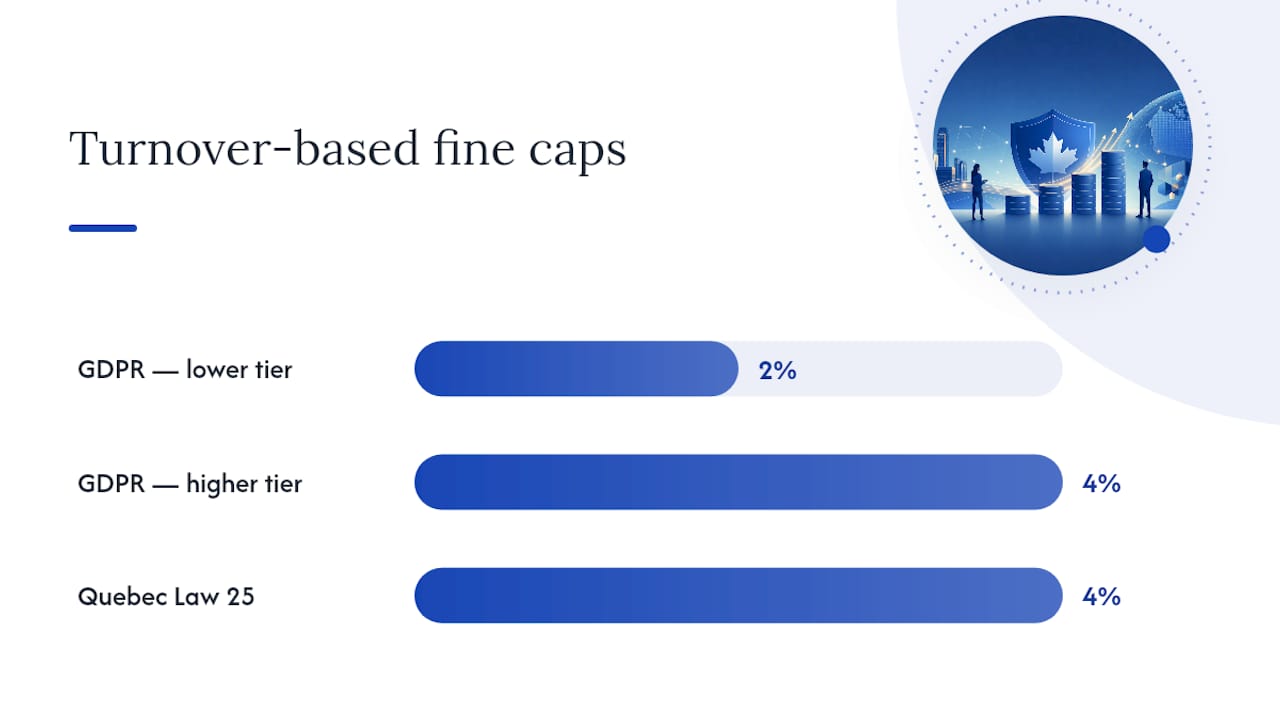
GDPR fines operate on two tiers. Less serious violations (inadequate records, failure to notify a breach) carry penalties up to €10 million or 2% of global annual turnover. More serious violations (processing without a lawful basis, violating data subject rights) carry penalties up to €20 million or 4% of global annual turnover, whichever is higher. PIPEDA’s maximum fine is CAD $100,000 per violation. Quebec Law 25 adds administrative penalties up to CAD $25 million or 4% of worldwide turnover for the most serious violations, bringing Quebec’s enforcement profile much closer to the GDPR’s.
A practical incident response timeline comparison:
- Detection: Identify and contain the breach; same starting point under both regimes.
- Assessment (PIPEDA): Determine whether there is a “real risk of significant harm” before deciding to report. No fixed deadline.
- Assessment (GDPR): Begin assessment immediately; the 72-hour supervisory authority notification clock runs from awareness, not from completion of the assessment.
- Supervisory authority notification (GDPR): File with the relevant data protection authority within 72 hours, even if the investigation is incomplete. Include what is known and flag what is still under review.
- Individual notification (both): Notify affected individuals without undue delay once the risk threshold is met. GDPR requires this “without undue delay” after the supervisory authority notification.
- Documentation: Both regimes require records of the breach and the response. GDPR requires a written internal record regardless of whether the breach meets the notification threshold.
The 72-hour clock is the single biggest operational change for organizations moving from a PIPEDA-only posture to GDPR compliance. Most breach playbooks built around PIPEDA assume days or weeks for assessment. GDPR requires a preliminary notification within three days, with the option to supplement later.
Practical compliance checklist for HR and recruiting teams
Whether you are a Canadian staffing firm sourcing EU candidates or a U.S. recruiting agency with a Canadian client base, the steps below give you a structured starting point.
- Map your data flows. Identify every system that holds personal data: ATS, HRIS, payroll, background check vendors, email platforms. Note where EU personal data enters and exits.
- Classify your data subjects. Separate candidates, employees, contractors, and clients. Each category may trigger different obligations under PIPEDA and the GDPR.
- Determine which laws apply. If you process EU residents’ data, GDPR applies directly. If you receive EU data into Canada, check whether the Canadian recipient is subject to PIPEDA for adequacy to apply.
- Build or update your ROPA. Document every processing activity: purpose, lawful basis, data categories, retention period, recipients, and transfer mechanisms.
- Document your lawful bases. For each processing purpose, record which of the six GDPR lawful bases you rely on. For consent-based processing, keep records of when and how consent was obtained.
- Run a DPIA for high-risk activities. Automated resume screening, large-scale candidate profiling, and AI-assisted hiring decisions are likely to require a DPIA under Art. 35.
- Update your processor contracts. Every vendor handling EU personal data needs an Art. 28-compliant agreement. Review existing contracts and add data processing addenda where missing.
- Revise your breach playbook. Build a 72-hour notification workflow with clear roles, escalation paths, and a template for supervisory authority notification.
- Designate an EU representative if required. Non-EU organizations subject to the GDPR that do not have an EU establishment must appoint an Art. 27 representative.
- Review candidate-facing notices. Privacy notices for EU candidates must state the lawful basis, retention period, and rights available. Implied consent is not sufficient for GDPR purposes.
For recruiting teams specifically:
- Collect only the data fields you need for the role. A resume, contact details, and work authorization status are usually sufficient at the screening stage.
- Use clear, specific consent language when sourcing candidates through outreach campaigns. Bundled or pre-ticked consent does not meet the GDPR standard.
- Build erasure and portability request workflows into your ATS. A candidate in Germany can request deletion of their profile; you need a process to honor that within one month.
- Retain candidate records only as long as your documented retention policy allows. For unsuccessful candidates, a 6-to-12-month retention period is common practice, but document the rationale.
Pro Tip: When reviewing your AI screening configuration, document what the tool does, what data it processes, and how its output influences hiring decisions. That documentation is the foundation of both a DPIA and an Art. 22 disclosure if candidates ask.
How to decide whether GDPR, PIPEDA, or both apply
Four diagnostic questions get you to a defensible answer quickly:
- Where are your data subjects located? EU residents trigger GDPR regardless of where you are based.
- What categories of data do you process? Special-category data (health, biometrics, ethnicity) raises the compliance bar under both regimes.
- Do you offer goods or services to EU residents, or monitor their behavior? Either triggers GDPR extraterritorial reach.
- Is your organization subject to PIPEDA or a substantially similar provincial law? If yes, the EC adequacy decision may cover EU-to-Canada transfers to your organization.
If you process EU personal data, treat GDPR as directly applicable and implement GDPR-specific controls: ROPA, documented lawful bases, DPIAs for high-risk activities, Art. 28 processor contracts, and a 72-hour breach playbook. If you receive EU data into Canada, adequacy may cover the transfer mechanism, but confirm the Canadian recipient is subject to PIPEDA and that the data category is within the decision’s scope.
Quick wins for most organizations: update candidate consent and privacy notices, execute SCCs with any vendor where adequacy does not apply, and run a DPIA for any AI-assisted screening or profiling tool. Longer-term: commission a legal review of your full data map, remediate any Art. 28 gaps in vendor contracts, and assign a named individual to own breach response.
Pro Tip: For U.S.-Canada cross-border hiring, the W-9 vs. TD1 compliance guide covers the tax and classification side of the equation. Pair it with this privacy checklist for a complete cross-border compliance picture.
A practitioner’s note on what audits actually find
The most common gap I see in ATS and HR system audits is not a missing privacy policy. It is the absence of a documented lawful basis for each processing activity and a breach response playbook that accounts for the 72-hour GDPR clock. Organizations that built their compliance posture around PIPEDA’s principles-based model often have solid consent language and reasonable safeguards, but they have never mapped their processing activities to specific GDPR articles, and their incident response procedures assume days of internal review before any external notification.
The pragmatic fix is not a full compliance overhaul. Start with the highest-risk flows: EU candidate sourcing, cross-border payroll data, and any AI-assisted screening tool that influences hiring decisions. Document the lawful basis for each, add a DPIA for the AI tools, and update your breach playbook with a 72-hour escalation path. Those three steps address the majority of audit findings in recruiting and HR contexts. Prioritize the flows where EU personal data is most concentrated and most sensitive. Everything else can follow in a structured remediation plan.
Jobsai Enterprise supports your cross-border compliance workflow
Recruiting teams handling EU and Canadian candidate data need more than a checklist. They need a platform where data controls, audit trails, and retention policies are built into the workflow rather than bolted on afterward. Jobsai Enterprise is purpose-built for talent acquisition teams managing high-volume, cross-border hiring, with configurable candidate intake, data retention settings, and audit logs that support both PIPEDA accountability requirements and GDPR documentation needs.
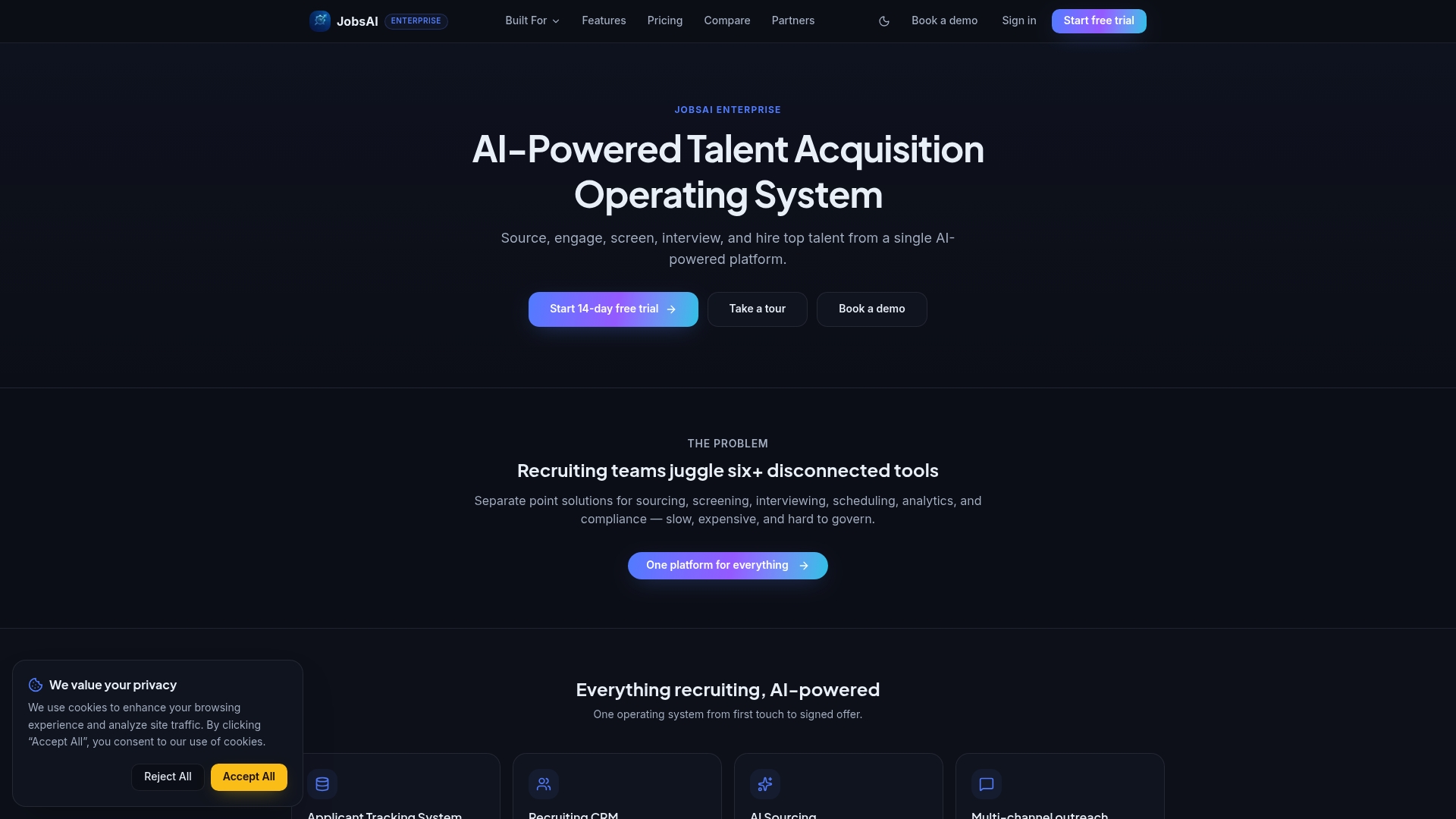
The platform’s compliance center gives privacy officers visibility into candidate data flows, consent records, and processing activities across the full recruiting pipeline. For teams running AI-assisted screening, Jobsai Enterprise logs the inputs and outputs that a DPIA or Art. 22 disclosure would require. Take a product tour to see how the compliance and data management features work in practice, or review the Security & Trust page for a full overview of the platform’s data protection controls.
Sources
The sources below are the primary references for this guide. Each serves a distinct purpose.
- PIPEDA requirements in brief - Office of the Privacy Commissioner of Canada
- Personal Information Protection and Electronic Documents Act
- European Commission press release — adequacy decisions
- Eur-Lex — General Data Protection Regulation text
- Canada’s PIPEDA remains “adequate” under the GDPR: what it means for business - Dentons Data
- PIPEDA vs GDPR: What Canadian Businesses Must Know - Legiscope
The European Commission reassesses adequacy decisions periodically. Bill C-27 / CPPA remains on the legislative watchlist and could affect Canada’s adequacy status or introduce new obligations once enacted. Check the OPC and European Commission sites for updates before finalizing your compliance posture.
This article is general information, not a substitute for advice from a qualified lawyer. Consult a qualified legal professional about your own circumstances before acting on anything here.
FAQ
Does Canada have a law equivalent to the GDPR?
Canada does not have a direct GDPR equivalent. PIPEDA is the federal private-sector privacy law, and the European Commission has granted Canada an adequacy decision for transfers to PIPEDA-subject organizations, but the two statutes differ significantly in structure, rights, and enforcement.
Are GDPR and CCPA the same?
No. The GDPR is an EU regulation with broad extraterritorial reach and prescriptive obligations including ROPA, DPIAs, and 72-hour breach notification. The CCPA (California Consumer Privacy Act) is a U.S. state law with a narrower scope, different rights framework, and distinct enforcement mechanism. Neither is equivalent to the other or to PIPEDA.
Does Canadian data need to be stored in Canada?
PIPEDA does not require data localization. Organizations subject to PIPEDA may store personal data outside Canada, but they remain accountable for its protection and must use contractual or other means to ensure comparable safeguards with third-party processors.
Is Canada subject to HIPAA or PIPEDA?
Canada is not subject to HIPAA, which is a U.S. federal law governing health information in the U.S. healthcare system. Canadian organizations handling health information are subject to PIPEDA at the federal level and to provincial health privacy laws (such as Ontario’s PHIPA or Alberta’s HIA) where applicable.
Does Canada have stricter privacy laws than the U.S.?
At the federal level, Canada’s PIPEDA is generally considered more comprehensive than U.S. federal privacy law, which has no single equivalent statute. However, U.S. state laws such as the CCPA and Virginia’s CDPA introduce rights and obligations that approach PIPEDA’s scope in specific contexts. Quebec’s Law 25 is the Canadian provincial law closest in structure to the GDPR.
Recommended
See it in your workflow
JobsAI Enterprise runs sourcing, AI screening, and the whole interview pipeline in one place. Book a walkthrough tailored to your team.
Book a demo