
Article
W-9 vs. TD1 for US-Canada Cross-Border Hiring

W-9 vs. TD1 for US-Canada Cross-Border Hiring
TL;DR:
- Collect a W-9 from U.S. persons, a TD1 from Canadian employees, and W-8 forms for non-U.S. contractors paid by a U.S. company. Proper form collection before payment helps ensure compliance and avoids withholding errors. Automating workflows and escalation procedures reduces risks and simplifies cross-border hiring processes.
Collect a W-9 only from U.S. persons; collect a TD1 only from employees paid on Canadian payroll; use W-8 forms for non-U.S. contractors paid by a U.S. company. That single rule covers the vast majority of US-Canada cross-border hiring situations. Here is the quick breakdown:
- U.S. person (citizen, resident alien, or U.S. entity) hired as a contractor: Request a signed Form W-9 before the first payment. Without it, you must apply backup withholding.
- Canadian resident contractor working remotely for a U.S. company: Request Form W-8BEN (individual) or W-8BEN-E (entity). Canada has no W-9 equivalent. Do not send a W-9 to a Canadian contractor.
- Canadian employee onboarded to Canadian payroll: Collect the federal TD1 and the applicable provincial TD1 at hire. These forms set payroll source deductions, not U.S. tax reporting.
If you are unsure whether a worker qualifies as a U.S. person, ask for documentation before the first pay run and escalate to payroll counsel if the answer is ambiguous.
Table of Contents
- What is Form W-9 and when should you request it?
- What is the TD1 and when does it belong in an employee file?
- How do W-9, W-8BEN, and TD1 compare side by side?
- Which form should you collect? A step-by-step decision flow
- Common hiring scenarios: which forms to request
- Employer checklist and sample request wording
- Red flags that require immediate escalation
- Key Takeaways
- Where automation actually changes the outcome
- Jobsai Enterprise helps you collect the right forms at the right time
- Authoritative sources for IRS and CRA forms
- FAQ
What is Form W-9 and when should you request it?
Form W-9 is the IRS’s standard request for a taxpayer identification number (TIN) and certification from a U.S. person. “U.S. person” covers U.S. citizens, resident aliens, partnerships, corporations, and other entities formed under U.S. law. When a worker or vendor falls into any of those categories, a signed W-9 is what you collect before cutting a check.
The form itself is short: name, business name if applicable, federal tax classification, TIN (Social Security Number or Employer Identification Number), and a certification signature. The official W-9 PDF is the canonical version; always use the current IRS revision rather than a third-party copy.
Why the W-9 matters operationally: without a valid, signed W-9 on file, you are required to apply backup withholding at the current IRS rate on payments to that payee. A missing or incorrect TIN triggers the same obligation. At year-end, payments to U.S. persons are reported on Form 1099 (1099-NEC for nonemployee compensation, 1099-MISC for other payments), and the W-9 is the source document for the payee’s TIN on that return.
The Instructions for the Requester of Form W-9 also address FATCA: certain payees may claim exempt-payee status or FATCA exemption codes on the W-9, which affects your reporting obligations. For most straightforward contractor relationships, those codes are not in play, but you should know they exist before assuming every W-9 is identical.
Pro Tip: Build a W-9 request into your offer or contractor agreement so the form arrives before the first invoice. Chasing a TIN after payment has already been made creates both a backup-withholding exposure and a 1099 correction headache.
Employer action: verify the TIN against IRS records using the TIN Matching program, keep the signed original in a secure file, and treat any W-9 with a missing or obviously incorrect TIN as a red flag requiring immediate follow-up.
What is the TD1 and when does it belong in an employee file?
The TD1, formally called the Personal Tax Credits Return, is a Canadian Revenue Agency form that employees complete to tell their employer how much income tax to deduct from each paycheck. As Rippling’s glossary puts it concisely, it determines how much income tax to deduct from pay. It has no U.S. equivalent in function or purpose.
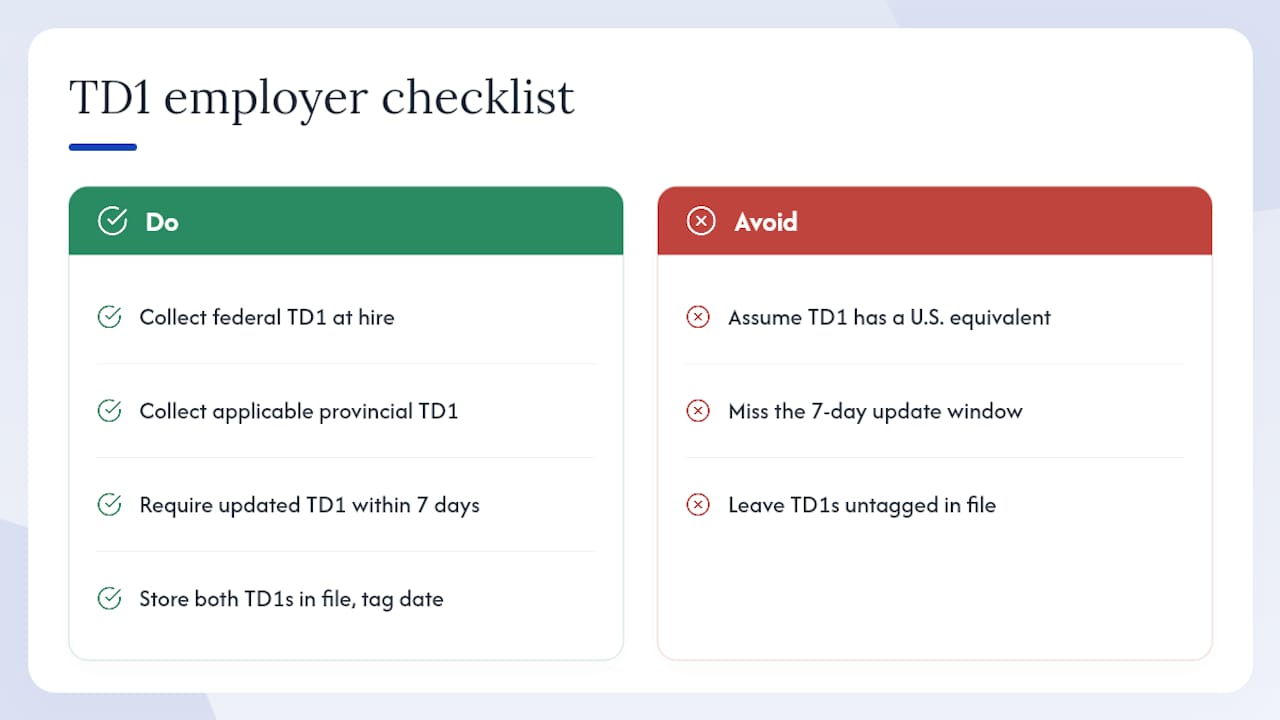
According to the CRA’s employer guidance, you must collect a completed federal TD1 when an individual starts work and within 7 days of any change that affects their personal tax credit amounts. Most provinces and territories also have their own TD1 form, and you need both the federal and the applicable provincial version for each employee on Canadian payroll.
The TD1 sets the basic personal amount the employee claims, plus any additional credits (disability, tuition, caregiver amounts, and so on). If an employee does not return a TD1, you default to the basic personal amount only, which typically means higher source deductions than the employee may expect. That default protects you from under-withholding, but it can create friction with new hires who expected a larger net paycheck.
Payroll reporting consequences flow from the TD1 as well. Canadian employers remit source deductions to the CRA and report employment income on a T4 slip at year-end. The CRA Employers’ Guide (T4001) covers the full deduction, remittance, and reporting cycle in detail.
Pro Tip: Store the federal and provincial TD1 together in the employee’s digital file, tagged to the hire date. When a worker’s personal situation changes mid-year (new dependent, disability credit), the 7-day update window is easy to miss without a calendar prompt tied to the file.
How do W-9, W-8BEN, and TD1 compare side by side?
Canada has no direct W-9 equivalent. That single fact resolves most of the confusion HR teams encounter in US-Canada cross-border hiring. The table below maps the three forms you will actually encounter.
| Dimension | Form W-9 | Form W-8BEN / W-8BEN-E | Form TD1 |
|---|---|---|---|
| Purpose | Provide TIN for U.S. information reporting | Certify foreign status; claim treaty benefits | Set personal tax credits for Canadian payroll withholding |
| Who completes it | U.S. persons (citizens, resident aliens, U.S. entities) | Non-U.S. individuals (W-8BEN) or entities (W-8BEN-E) | Canadian employees on Canadian payroll |
| When to collect | Before first payment to a U.S. contractor or vendor | Before first payment to a non-U.S. payee with U.S.-source income | At hire; within 7 days of a credit change |
| Effect on withholding | Prevents backup withholding; no U.S. withholding on most payments | Reduces or eliminates 30% default withholding under treaty | Determines Canadian source deduction amount |
| Reporting outcome | Form 1099 (NEC, MISC) | Form 1042-S | Canadian T4 / T4A |
| Employer action | Verify TIN, keep signed copy, file 1099 | Verify foreign status, apply treaty rate if applicable, file 1042-S | Calculate source deductions, remit to CRA, file T4 |
Per IRS guidance on Form W-8BEN, non-U.S. payees use W-8 variants to certify their foreign status and, where applicable, claim reduced withholding rates under a tax treaty. The U.S.-Canada tax treaty does reduce or eliminate withholding on many categories of income, but the W-8BEN is still required to activate that treaty position. Without it, you default to 30% withholding on U.S.-source income paid to a foreign person, reported on Form 1042-S.
A practical guide from Dua LLP confirms the operational rule: collect W-8BEN from Canadian contractors, W-9 from U.S. persons, and confirm which W-8 variant applies before the first payment.
Which form should you collect? A step-by-step decision flow
The decision comes down to two questions: Is this worker a U.S. person? And will they be paid through Canadian payroll?
-
Determine worker classification. Is this person an employee or an independent contractor? Employee status affects which forms are mandatory and whether you need to register for payroll in Canada.
-
Determine tax residency. Ask the worker directly and request supporting documentation (passport, visa, Social Security Number, or Canadian SIN). Do not assume based on location alone.
-
If the worker is a U.S. person (citizen, resident alien, or U.S. entity): Collect a signed W-9 before the first payment. File Form 1099 at year-end. No Canadian payroll registration is needed unless the worker physically works in Canada and triggers Canadian nexus.
-
If the worker is a non-U.S. person with U.S.-source income: Collect Form W-8BEN (individual) or W-8BEN-E (entity). Apply the treaty withholding rate if the worker claims it on the W-8. Report on Form 1042-S. For cross-border talent acquisition, document the treaty position in the worker’s file.
-
If the worker is a Canadian employee on Canadian payroll: Collect federal TD1 and the applicable provincial TD1 at hire. Register for a Canadian payroll account with the CRA if you do not already have one. Remit source deductions and file T4 slips at year-end.
-
If the worker is a contractor paid in Canada but not on Canadian payroll: Consult payroll counsel. Depending on the nature of the work and the Canada-U.S. tax treaty, you may have withholding obligations under Canadian law even for contractor payments.
-
Escalate when: the worker’s residency is unclear, they claim U.S. person status but have only a foreign TIN, or the work location and tax residency do not match. Pause payment until the status is confirmed.
When hiring U.S. gig workers or contractors, the W-9 collection step is the same regardless of how the engagement is structured.
Common hiring scenarios: which forms to request
| Scenario | Forms to Collect | Withholding Required? | Year-End Reporting |
|---|---|---|---|
| U.S. citizen in the U.S., independent contractor | W-9 | No (unless backup withholding triggered) | Form 1099-NEC |
| U.S. citizen living in Canada, contractor | W-9 | No U.S. withholding; Canadian tax obligations may apply | Form 1099-NEC; consult CRA rules |
| Canadian resident contractor, remote work for U.S. company | W-8BEN | 30% default; reduced under U.S.-Canada treaty if W-8BEN filed | Form 1042-S |
| Canadian entity contractor (corporation) | W-8BEN-E | 30% default; treaty may reduce or eliminate | Form 1042-S |
| Canadian employee on Canadian payroll | TD1 (federal + provincial) | Yes, Canadian source deductions via CRA | Canadian T4 |
| Dual-status or cross-border telecommuter | W-8BEN or W-9 + TD1 depending on residency | Varies; escalate to payroll counsel | 1042-S and/or T4; case-specific |
Dual-status and telecommuter situations are the ones most likely to generate errors. A worker who lives in Canada but crosses the border to work in the U.S. part-time may have income sourced in both countries, which means both U.S. and Canadian reporting obligations can apply simultaneously. The safe approach is to collect evidence of residency, the correct IRS and CRA forms, and get payroll counsel involved before the first paycheck clears.
Employer checklist and sample request wording
A structured onboarding checklist prevents the most common compliance gaps. Use this as a starting point and adapt it to your onboarding system.
At offer acceptance:
- Confirm worker’s tax residency and classification (employee vs. contractor)
- Send the appropriate tax form request (W-9, W-8BEN/W-8BEN-E, or TD1 instructions)
- Include the request in the offer letter or e-signature package so the form arrives before day one
Before the first pay run:
- Confirm signed form received and TIN/SIN recorded
- Verify TIN using IRS TIN Matching (for W-9) or confirm foreign TIN format (for W-8)
- For Canadian payroll: confirm federal and provincial TD1 on file; register CRA payroll account if not already active
- Flag any missing or inconsistent forms for payroll review before processing
Record retention:
- Store signed W-9 and W-8 forms for at least 4 years after the year the relationship ends (IRS standard)
- Store TD1 forms for 6 years from the end of the tax year they apply to (CRA standard)
- Link stored forms to the worker’s payroll record in your HR system
A new hire onboarding checklist can help you build a complete document collection workflow that covers tax forms alongside I-9, direct deposit, and benefits enrollment.
Sample email wording for W-9 request:
Sample email wording for W-8BEN request:
Pro Tip: Add a conditional logic prompt in your ATS or onboarding platform: if the worker selects “non-U.S. person” during profile setup, the system automatically routes the W-8BEN request instead of the W-9. That single automation eliminates the most common form mismatch in cross-border hiring.
Red flags that require immediate escalation
Most tax form issues are straightforward to resolve if you catch them before the first payment. These situations should go to your payroll lead or cross-border tax counsel immediately.
- Work location and claimed residency do not match — A worker who says they are a U.S. person but is physically working in Canada full-time may have Canadian payroll obligations regardless of citizenship.
The consequences of getting this wrong are concrete: backup withholding applied incorrectly creates overpayment issues; incorrect 1099 or 1042-S reporting triggers IRS notices; ignoring Canadian payroll obligations when they exist exposes you to CRA penalties and interest. Per employer-of-record guidance on U.S.-Canada hiring differences, payroll setup differences between U.S. states and Canadian provinces add another layer of complexity that makes early escalation the lower-risk path.
Pro Tip: Set a payroll hold flag in your HR system for any worker whose tax form status is unresolved at the 48-hour mark before payroll processing. A hold is far easier to release than a corrected 1042-S.
Key Takeaways
The core rule for US-Canada cross-border hiring: W-9 is for U.S. persons, W-8BEN or W-8BEN-E is for non-U.S. payees with U.S.-source income, and TD1 is for employees on Canadian payroll.
| Point | Details |
|---|---|
| W-9 = U.S. persons only | Collect a signed W-9 before the first payment to any U.S. citizen, resident alien, or U.S. entity. |
| Canada has no W-9 equivalent | Canadian contractors provide W-8BEN (individual) or W-8BEN-E (entity) to certify foreign status and claim treaty benefits. |
| TD1 governs Canadian payroll | Collect federal and provincial TD1 at hire; default to the basic personal amount if the employee does not return the form within 7 days. |
| Missing forms trigger withholding | A missing W-9 triggers backup withholding; a missing W-8 triggers 30% default withholding on U.S.-source payments to foreign persons. |
| Jobsai Enterprise automates collection | Jobsai Enterprise’s onboarding workflows can prompt the correct tax form by worker type and flag missing documents before payroll runs. |
Where automation actually changes the outcome
The most common failure point in cross-border tax form compliance is not ignorance of the rules. It is the gap between knowing which form to collect and actually collecting it before the first paycheck. That gap is where errors accumulate.
The practical fix is to embed the tax form decision into the onboarding workflow itself, not treat it as a separate administrative task. When a hiring manager creates an offer in your ATS, the system should ask for the worker’s residency status and automatically route the correct form request. A U.S. contractor gets a W-9 prompt; a Canadian contractor gets a W-8BEN prompt; a Canadian employee gets TD1 instructions. The form arrives with the offer letter, not three days after the worker has already started.
One internal control that cross-border HR teams commonly add: a payroll checkpoint that blocks the first pay run if the tax form field in the worker’s record is empty or flagged as unverified. That single gate prevents the majority of backup-withholding and 1042-S errors. It also creates an audit trail showing that the employer made a good-faith effort to collect the correct documentation, which matters if the IRS or CRA ever asks.
For dual-status workers and telecommuters, automation helps with collection but does not replace judgment. Those cases still need a human review, and usually a cross-border tax advisor, before the payroll classification is locked in.
Jobsai Enterprise helps you collect the right forms at the right time
Tax form compliance in cross-border hiring is a workflow problem as much as a knowledge problem. Jobsai Enterprise’s onboarding and workflow automation lets you build conditional prompts directly into the offer and onboarding sequence, so the correct tax form request goes out automatically based on the worker’s residency and classification.
With Jobsai Enterprise, your team can configure the Hiring Manager Workspace to:
- Route W-9, W-8BEN, or TD1 requests based on worker type at offer stage
- Store signed forms securely in the candidate record, linked to payroll checkpoints
- Flag missing or unverified tax forms before a pay run is processed
- Generate offer letters with e-signature that include the correct tax form request in a single step
For HR teams managing high-volume cross-border hiring, that means fewer manual checks, fewer missed forms, and a clear audit trail for every worker. Start with the Jobsai Enterprise platform to see how onboarding workflows can be configured for your US-Canada hiring volume.
Authoritative sources for IRS and CRA forms
- About Form W-9
- Form W-9 (Rev.)
- Instructions for the Requester of Form W-9 (Rev. June 2026)
- Get the completed TD1 forms from the individual - Taxes
- Employers’ Guide – Payroll Deductions and Remittances - Canada.ca
- About Form W-8BEN
- Difference Between W8 and W9 Forms: Guide for Canadian Businesses | Dua LLP
- Employer of Record USA and Canada 2026: Hiring Differences | teamed.
- What Is a TD1 Form? | Rippling Glossary
FAQ
Does Canada have a W-9 equivalent?
No. Canada does not have a direct equivalent to the IRS Form W-9. Canadian contractors or vendors receiving payments from a U.S. company provide Form W-8BEN (individuals) or W-8BEN-E (entities) to certify their foreign status.
Do Canadian companies need to complete a W-9?
Only if the Canadian company is classified as a U.S. person under IRS rules, which is rare. In most cases, a Canadian entity completes Form W-8BEN-E to certify its foreign status and, where applicable, claim treaty benefits under the U.S.-Canada tax treaty.
What is the TD1 form used for in Canada?
The TD1 is the Personal Tax Credits Return that Canadian employees complete at hire to tell their employer how much income tax to deduct from each paycheck. Employers must collect both the federal TD1 and the applicable provincial TD1.
When should a U.S. employer withhold 30% from a Canadian contractor?
The 30% default withholding rate applies to U.S.-source income paid to foreign persons when no valid W-8BEN or W-8BEN-E is on file. A properly completed W-8BEN that claims the U.S.-Canada tax treaty can reduce or eliminate that withholding rate, depending on the type of income.
What happens if a worker submits a W-9 but has no U.S. TIN?
A W-9 without a valid TIN triggers mandatory backup withholding. You should not process the payment until the worker provides a correct SSN or EIN, verified through the IRS TIN Matching program. Per the Instructions for the Requester of Form W-9, a missing TIN is treated as an incomplete certification.
This article provides general information about U.S. and Canadian tax form requirements and is not legal or tax advice. Confirm current rules with the IRS, the CRA, or a qualified cross-border tax advisor before making payroll or withholding decisions.
Recommended
See it in your workflow
JobsAI Enterprise runs sourcing, AI screening, and the whole interview pipeline in one place. Book a walkthrough tailored to your team.
Book a demo