
Article
Remote Hiring Tools: US–Canada Guide for Recruiting Teams

Remote Hiring Tools: US–Canada Guide for Recruiting Teams
For US recruiting teams hiring remote candidates in Canada, the fastest compliant path is pairing an Employer of Record with an AI-powered recruiting platform like Jobsai Enterprise. Here’s where to start:
- Confirm the candidate’s province of work first. Labor law, payroll obligations, and benefits expectations are all province-determined, not federal.
- Choose your hiring model before you pick a tool. EOR, Canadian entity, or contractor each carry different cost shapes, timelines, and compliance exposure.
- Start a Jobsai Enterprise evaluation in parallel. The platform handles AI screening, offer-letter generation with e-signature, and workflow automation, so your recruiting ops don’t stall while legal sorts out the payroll structure.
The compliance risk in cross-border hiring is real, but it’s manageable. The speed advantage comes from making these decisions in the right order.
Key Takeaways
Pairing an EOR with an AI-powered recruiting platform like Jobsai Enterprise is the fastest compliant path for US teams hiring remote candidates in Canada, provided you confirm province and hiring model before issuing any offer.
| Point | Details |
|---|---|
| Confirm province first | The employee’s province determines labor law, payroll obligations, and contract terms. |
| EOR is fastest to deploy | EORs onboard Canadian employees in days and typically charge about 10–15% of employee compensation as a fee. |
| Contractor risk is high | Misclassification in Canada triggers back taxes and statutory benefit obligations if the worker functions like an employee. |
| Province-specific contracts are required | Canadian employment is not at-will; statutory vacation (minimum two weeks / 4% of earnings) and notice rights must appear in every offer. |
| Jobsai Enterprise covers the recruiting layer | AI screening, offer-letter generation, e-signature, and workflow automation connect directly to your EOR or payroll provider. |
Table of Contents
- What’s the best hiring model for US employers hiring in Canada?
- What features must a remote hiring tool have for US–Canada recruiting?
- How does Jobsai Enterprise map to the US–Canada hiring checklist?
- What do US–Canada hiring actually cost, and how long does it take?
- How do you choose the right vendor for cross-border hiring?
- What compliance mistakes get US employers in trouble when hiring Canadians?
- How do you hire your first Canadian remote employee in 6 steps?
- What cross-border hiring actually teaches you
- Jobsai Enterprise cuts your time-to-hire without cutting corners on compliance
- Sources
- FAQ
What’s the best hiring model for US employers hiring in Canada?
Non-Canadian employers have three practical options: register directly with the CRA as a nonresident employer, engage an Employer of Record, or hire independent contractors. Each option lands differently on cost, speed, and risk.
| Hiring model | Setup time | Cost shape | Payroll responsibility | Termination liability | Compliance risk |
|---|---|---|---|---|---|
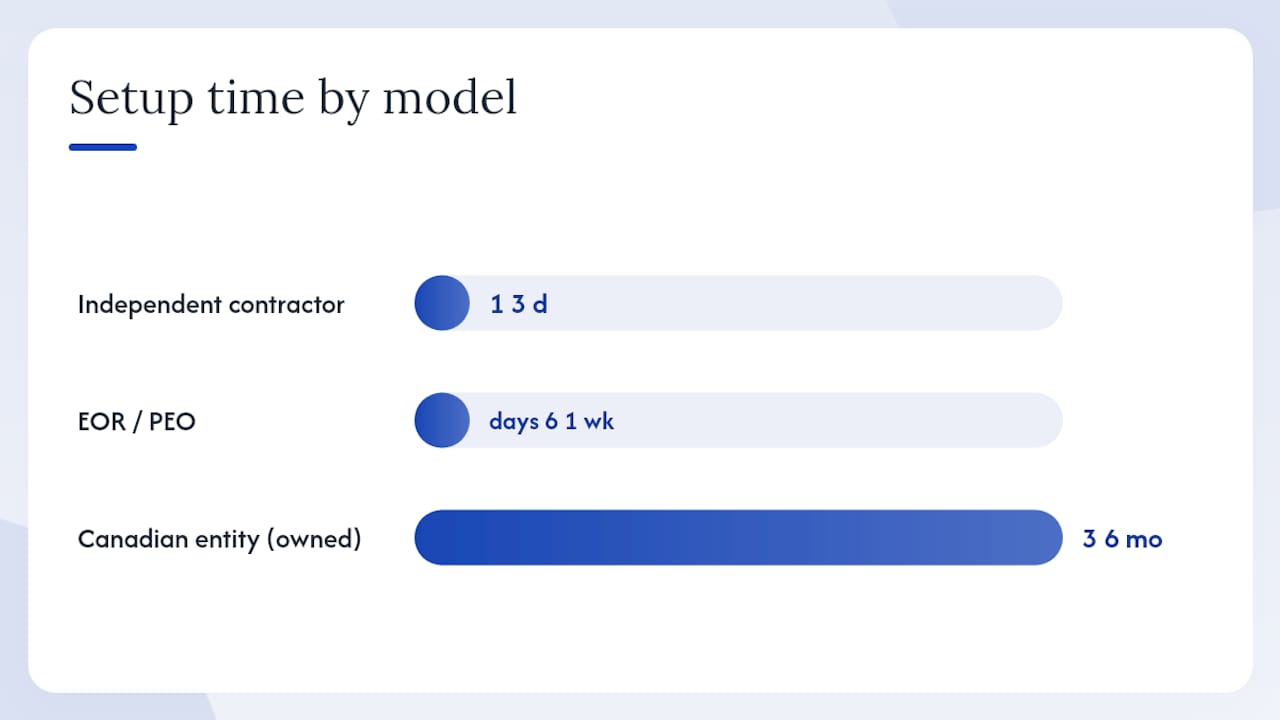
| Independent contractor | 1–3 days | Low fixed cost | Contractor’s own | Minimal (contract terms) | High misclassification risk |
| EOR / PEO | Days to 1 week | 10–15% of employee compensation | EOR handles it | EOR manages statutory notice | Medium (depends on EOR entity) |
| Canadian entity (owned) | 3–6 months | High upfront, lower per-hire at scale | Employer’s own | Full statutory exposure | Low when managed correctly |
EORs can onboard a Canadian employee in days and typically charge an estimated fee percentage of employee compensation. That speed is the main reason most US teams start there. The contractor route looks cheaper upfront, but misclassification in Canada carries real penalties if the worker functions like an employee in practice, including back taxes and statutory benefit obligations.
Timeline at a glance: EOR: days. CRA nonresident registration: 4–8 weeks. Canadian entity: 3–6 months.
Pro Tip: When evaluating EOR providers, ask directly whether they operate a wholly owned Canadian entity. EORs that rely on third-party partner networks carry higher audit exposure and may not fully eliminate Permanent Establishment risk for your company.
What features must a remote hiring tool have for US–Canada recruiting?
Recruiting platforms solve sourcing and workflow friction. They do not replace payroll or legal compliance. The features below are what separate a tool that works for cross-border hiring from one that creates gaps.
Require these first:
- Province selector at the offer stage that triggers the correct contract template and payroll onboarding checklist automatically
- Localized contract templates covering statutory vacation (minimum two weeks / 4% of earnings) and province-specific termination notice
- Payroll and EOR integrations so candidate data flows directly into your payroll provider without manual re-entry
- Canadian eligibility screening that surfaces work authorization status early in the pipeline
- Data residency controls that meet PIPEDA requirements for Canadian candidate data
Core recruiting features to demand:
- AI screening and candidate ranking that cuts manual resume review time
- ATS and recruiting CRM in a single workspace
- Interview automation (AI voice or avatar) for high-volume screening
- Bilingual support or translation workflows for Quebec candidates (Bill 101 compliance applies to employment communications)
- Background-check integrations that cover Canadian criminal record checks
- Bulk outreach via email, SMS, or WhatsApp for candidate engagement across time zones
Integrated HR, payroll, and time systems reduce duplicate entry and can produce both T4 and W-2 outputs when configured correctly. That integration capability is a procurement requirement, not a nice-to-have.
How does Jobsai Enterprise map to the US–Canada hiring checklist?
Jobsai Enterprise covers the recruiting layer end-to-end and connects to the payroll and EOR layer through integrations. Here’s how the feature map works in practice:
- AI screening and ranking shortlists Canadian candidates against job requirements automatically, cutting the time your team spends on manual review
- Offer-letter generator with e-signature produces consistent, auditable offers that can incorporate province-specific terms
- Workflow automation triggers onboarding tasks, payroll enrollment steps, and compliance checkpoints in sequence
- Talent pools and candidate database let you build a Canadian talent pipeline before a role opens
- Client portals with white labeling keep hiring managers and external stakeholders aligned without extra email chains
- Integrations with ATS, CRM, email, and calendar connect Jobsai Enterprise to your existing payroll or EOR provider
Scenario: first Canadian hire for a US engineering team. Post the role and run AI screening to shortlist candidates. Use interview automation for first-round screens across time zones. Confirm the candidate’s province, select the correct contract template, and generate the offer letter with e-signature. Hand off the onboarding data to your EOR via integration. The whole recruiting cycle runs inside one platform; the payroll and compliance work runs through your EOR.
Take the product tour to see how these workflows connect in a live environment.
What do US–Canada hiring actually cost, and how long does it take?
Cost surprises in cross-border hiring almost always come from the employer-side obligations that US teams don’t anticipate.
| Cost item | Typical notes |
|---|---|
| EOR fee | Typically 10–15% of employee compensation |
| Canadian entity incorporation | Legal and registration fees vary by province |
| Employer CPP contributions | Required for employees; rate set annually by CRA |
| Employer EI premiums | Required; rate set annually |
| Provincial payroll levies | Vary by province and can be specific in some provinces |
| Benefits expectations | Group health and dental are common; not always statutory but competitively expected |
| Misclassification back taxes | Can cover multiple years if audited, amount varies |
Hidden costs that catch US teams off guard: RSU and stock option tax treatment differs in Canada, provincial payroll levies vary and are easy to miss, and benefits expectations in Canada often exceed what US contractors receive. Build a headcount model comparing EOR fees against local incorporation costs for years one through three before committing to either path.
Time-to-first-hire: EOR route: as fast as one week. CRA nonresident registration: 4–8 weeks. Canadian entity: 3–6 months minimum.
How do you choose the right vendor for cross-border hiring?
Ask these 12 questions in every vendor demo or procurement call:
- Do you operate a wholly owned Canadian legal entity, or do you rely on third-party partners?
- Who owns payroll remittance responsibility to the CRA?
- Which Canadian provinces do you have active payroll registrations in?
- How do you handle Quebec-specific employment standards and Bill 101 language requirements?
- Do your contract templates include statutory vacation (2 weeks / 4%) and province-specific termination notice?
- Where is Canadian candidate and employee data stored, and does it meet PIPEDA requirements?
- What are your SLAs for payroll processing and compliance issue resolution?
- What are your support hours, and do you cover Eastern and Pacific time zones?
- Can you provide references from US companies that have hired in Canada through your platform?
- How do you handle employer CPP and EI remittances?
- What integrations do you have with Canadian benefits providers and group insurance vendors?
- How does your platform handle T4 generation at year-end?
Red flags to walk away from:
- No Canadian-specific contract templates; vendor offers to “adapt” US agreements
- Unclear or shared payroll remittance ownership
- No references for Canadian hires
- Data stored exclusively in US data centers with no Canadian residency option
- Support only available during US business hours with no French-language capability
What compliance mistakes get US employers in trouble when hiring Canadians?
The most costly errors come from two assumptions: that Canadian employment is at-will, and that US contract templates transfer cleanly across the border.
Canadian employment law is provincial. The employee’s physical province of work determines labor regulations, payroll obligations, and benefits expectations. Confirm province before issuing any offer letter. A candidate who moves from Ontario to British Columbia mid-employment changes your statutory obligations.
Statutory vacation starts at two weeks (4% of earnings) and termination notice requirements are stricter than US at-will standards. Offer letters that omit these protections are often unenforceable in Canadian courts, which exposes you to common-law notice claims that can far exceed the statutory minimum.
The single most common payroll error: running Canadian payroll from a US system without CRA registration. This triggers penalties and can create Permanent Establishment exposure even when you intended to use a contractor structure.
Practical compliance checklist for recruiters:
- Confirm province of work before drafting the offer
- Use province-specific contract templates, not US templates
- Verify CPP and EI employer contributions are set up correctly
- Check provincial payroll levy requirements for the employee’s province
- For Quebec hires, it is important to ensure contract language and HR communications comply with Bill 101 requirements.
- Document the contractor vs employee classification decision with written criteria
- Confirm data handling meets PIPEDA for any Canadian candidate data you store
For a deeper look at province-aware hiring workflows, the cross-border talent acquisition guide covers EOR models and practical checklists in detail.
How do you hire your first Canadian remote employee in 6 steps?
| Step | Owner | Timeline | Key actions |
|---|---|---|---|
| 1. Confirm province and hiring model | Legal + HR | Day 1–2 | Verify candidate’s province; choose EOR, entity, or contractor |
| 2. Select and contract your vendor/tool | Procurement + HR | Day 2–5 | Sign EOR agreement; start Jobsai Enterprise setup |
| 3. Source and screen candidates | Recruiting | Week 1–2 | Run AI screening and ranking; conduct automated first-round interviews |
| 4. Issue offer letter | HR + Legal | Week 2–3 | Use province-specific template; include statutory vacation and notice terms; collect e-signature |
| 5. Onboard and set up payroll/EOR | Payroll + HR | Week 3–4 | Transfer onboarding data to EOR; confirm CPP/EI setup; enroll in benefits |
| 6. Review and document outcomes | HR + Legal | Week 4–5 | Audit contract, payroll registration, data residency, and classification decision |
Workflow automation in Jobsai Enterprise handles the handoffs between steps 3 and 5, triggering onboarding tasks and compliance checkpoints automatically so nothing falls through the gaps.
What cross-border hiring actually teaches you
One lesson from running cross-border hiring projects stands out above the rest: the province confirmation step feels administrative, but skipping it costs weeks. A candidate who lists “Canada” as their location without specifying province can send you down the wrong contract template, the wrong payroll setup, and the wrong benefits structure. Fixing that after an offer is issued means renegotiating terms, reissuing documents, and sometimes restarting the payroll registration.
The second lesson is about benefits timing. Staging benefits enrollment to align with the first payroll cycle, rather than the offer date, prevents gaps in coverage and avoids the administrative scramble of retroactive enrollment. It’s a small operational decision that saves real time.
Jobsai Enterprise cuts your time-to-hire without cutting corners on compliance
US recruiting teams running cross-border hiring face a specific problem: the recruiting work and the compliance work have to happen in parallel, and most tools handle only one side. Jobsai Enterprise is built for talent acquisition teams that need both moving at the same time.
The platform’s AI screening ranks Canadian and US candidates against your job requirements automatically. Offer-letter generation with e-signature produces province-aware documents without manual drafting. Workflow automation triggers onboarding and payroll handoff tasks in sequence, so your EOR gets clean data on day one. Bulk outreach via email, SMS, and WhatsApp keeps candidates engaged across time zones without extra manual effort.
See the pricing and plan options or take the product tour to see how the platform fits your current hiring stack.
Sources
- Hiring Employees in Canada: Top Compliance Risks for U.S. Companies (2026 Guide) - Syndesus
- Three Options for Non-Canadian Employers Hiring Remote Employees in Canada - Ogletree
- How to hire in Canada from the US | Multiplier
FAQ
What is the fastest way to hire a remote employee in Canada?
Using an EOR is the fastest compliant path. EORs can onboard a Canadian employee in days and handle payroll, statutory benefits, and CRA remittances on your behalf.
Do US employment contracts work for Canadian remote employees?
No. Canadian employment is not at-will, and US templates typically omit statutory vacation (minimum two weeks / 4% of earnings) and province-specific termination notice requirements, making them unenforceable.
What is Permanent Establishment risk when using an EOR in Canada?
Permanent Establishment risk means the CRA could treat your company as having a taxable presence in Canada. Using an EOR reduces but may not eliminate this risk; ask whether your EOR operates a wholly owned Canadian entity rather than a partner network.
Does Jobsai Enterprise support cross-border US–Canada hiring workflows?
Yes. Jobsai Enterprise covers AI screening, offer-letter generation with e-signature, workflow automation, and integrations with payroll and EOR providers, making it a practical recruiting layer for US teams hiring in Canada.
What makes Quebec hiring different from other Canadian provinces?
Quebec has its own employment standards and Bill 101 language requirements, which apply to employment contracts and HR communications. Vendors must have Quebec-specific contract templates and bilingual support to operate there compliantly.
Recommended
See it in your workflow
JobsAI Enterprise runs sourcing, AI screening, and the whole interview pipeline in one place. Book a walkthrough tailored to your team.
Book a demo