
Article
Candidate Shortlisting Software Comparison 2026

Candidate Shortlisting Software Comparison 2026
TL;DR:
- Jobsai Enterprise is the recommended solution for staffing and recruiting teams needing fast, explainable AI shortlisting in 2026. It features candidate ranking with visible reason codes, native ATS integrations, and a structured pilot program to validate results. The platform fully meets key evaluation criteria and helps mitigate bias risks while delivering measurable ROI.
For recruiting agencies, staffing firms, and corporate TA teams that need speed, explainability, and deep integrations, Jobsai Enterprise is the recommended shortlisting solution in 2026.
- AI candidate ranking with visible reason codes, so every shortlist decision is defensible
- Native integrations with major ATS, HRIS, and calendar platforms, reducing manual data entry
- A structured pilot program that lets your team validate results before full rollout
According to Capterra, candidate management features are adopted by 90% of recruiting software buyers, confirming that shortlisting capability is now a baseline expectation, not a differentiator. What separates the tools is how they shortlist and whether you can explain it.
Table of Contents
- Which hiring teams need a dedicated shortlisting solution?
- Which features actually drive better shortlisting outcomes?
- How Jobsai Enterprise maps to the evaluation checklist
- AI shortlisting risks, bias management, and U.S. regulatory considerations
- What does the ROI math look like for shortlisting software?
- Real-world outcomes from shortlisting software deployments
- Key Takeaways
- What most shortlisting pilots get wrong
- Jobsai Enterprise covers the full checklist, with a pilot you can start this week
- Sources and further reading
- FAQ
Which hiring teams need a dedicated shortlisting solution?
Not every team needs enterprise-grade shortlisting software today. The right moment to evaluate depends on where your bottleneck actually sits.
High-volume hiring (100+ applications per role): Manual triage is the bottleneck. You need automated ranking and structured screening to keep pipelines moving without burning out your recruiters.
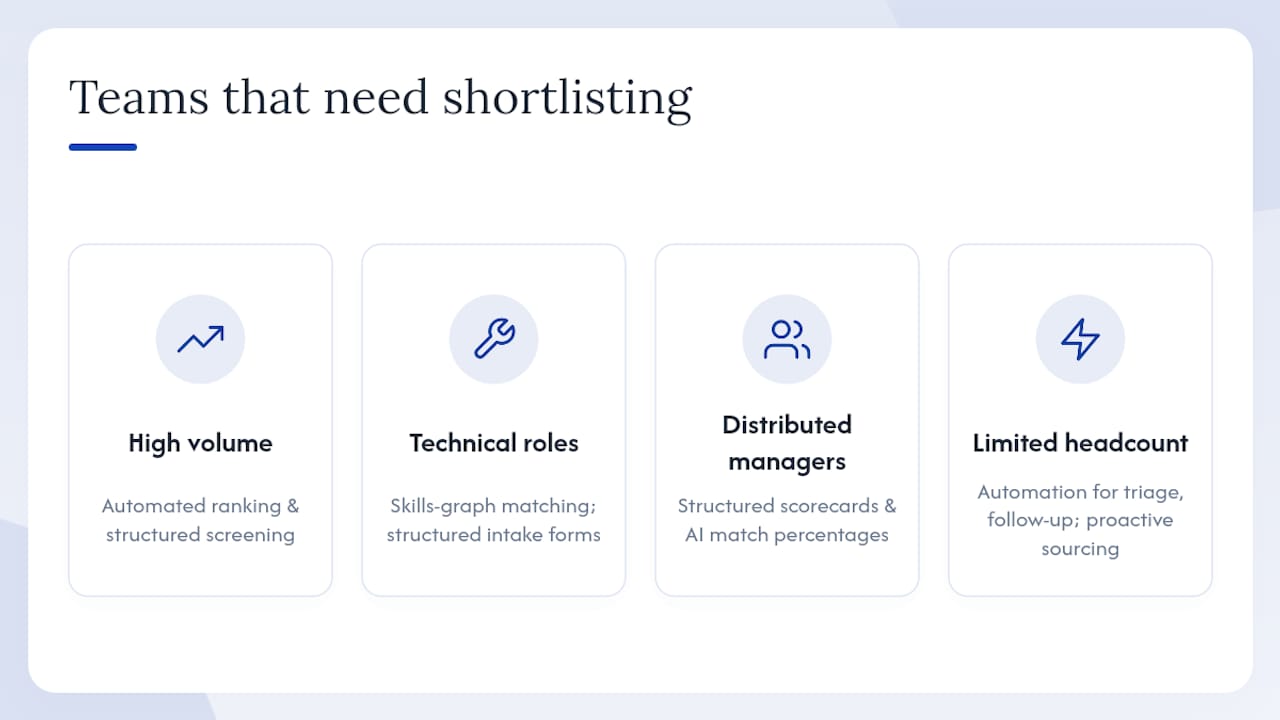
Specialist or technical roles: Keyword matching fails here. Skills-graph matching and structured intake forms that capture role-specific requirements are what improve shortlist quality for engineering, data, and niche professional roles.
Distributed hiring managers: When five managers are reviewing the same pipeline with no shared scoring rubric, you get inconsistent decisions. Structured scorecards and AI match percentages fix that.
Limited recruiter headcount: A two-person TA team handling 40 open roles needs automation for triage and follow-up, not just an ATS. Proactive sourcing and bulk outreach become critical.
If none of these apply, a basic ATS with built-in screening may be enough for now. If two or more apply, a dedicated candidate selection platform is worth evaluating this quarter.
Which features actually drive better shortlisting outcomes?
The features that consistently move the needle are not always the ones vendors lead with.
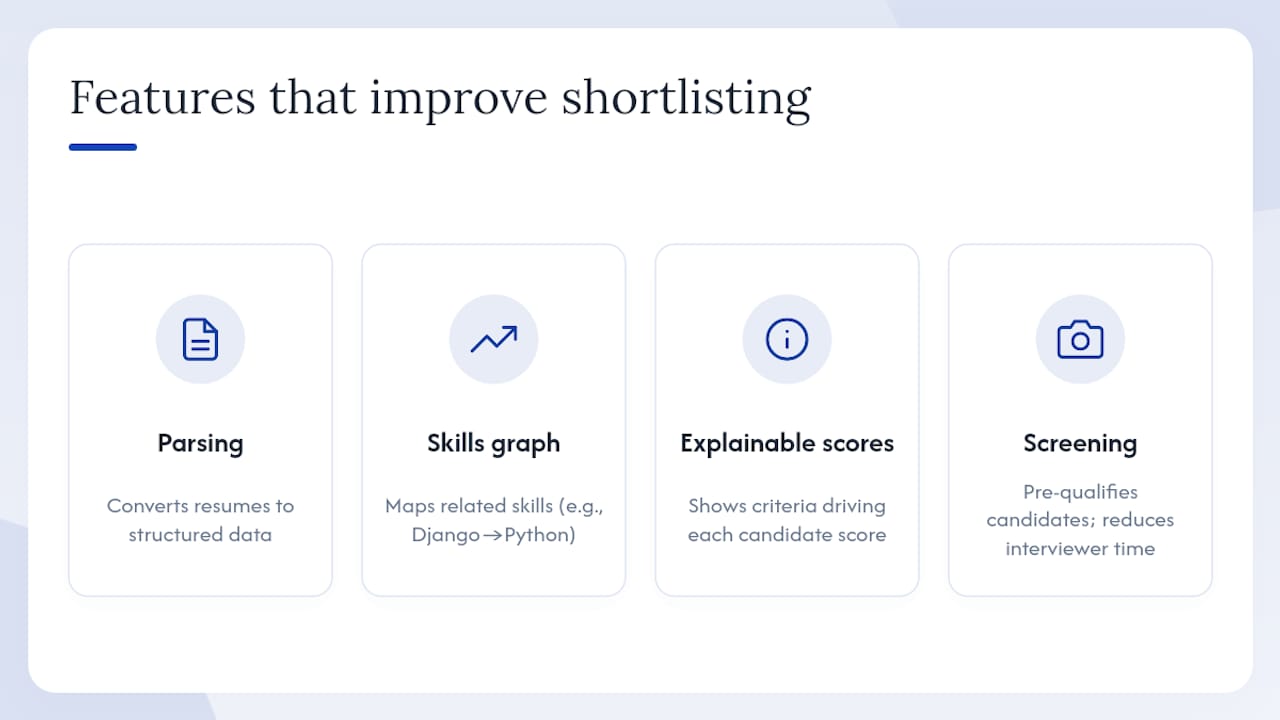
Resume parsing and skills extraction converts unstructured resumes into structured data. Quality varies significantly across vendors. Weak parsers miss skills listed in non-standard formats, which skews rankings before the AI even runs.
Skills graph and ontology matching goes beyond keyword frequency. When a job requires “Python” and a resume says “Django,” a skills graph connects the two. This matters most in technical hiring, where candidates rarely mirror job description language exactly. Skills-graph matching reduces weak shortlists caused by inconsistent job requirements.
Explainable candidate ranking shows hiring managers the specific criteria driving each score. Structured interview kits paired with AI match percentages improve interviewer consistency and recruiter-manager alignment, particularly in distributed teams.
Structured screening questions and one-way video add a qualification layer before the first live interview. For graduate programs and hourly high-volume roles, this alone can cut interviewer hours by a meaningful margin.
Interview scheduling automation removes the back-and-forth that stalls pipelines. Time-to-hire is often lost in the gaps between steps, not in the steps themselves.
On the UX side: scorecards that hiring managers can reuse across similar roles, and a hiring manager workspace that requires minimal training, are what determine whether a tool gets adopted or abandoned after the pilot.
How Jobsai Enterprise maps to the evaluation checklist
Jobsai Enterprise covers every criterion in the checklist above within a single platform.
| Evaluation criterion | Jobsai Enterprise capability |
|---|---|
| Explainable AI scoring | Candidate ranking with visible reason codes and configurable scoring weights |
| ATS write-back | Native integrations with major ATS and HRIS platforms |
| Skills-aware matching | AI resume screening matched against structured job requirements |
| Structured screening | Role-specific screening questions built into intake workflows |
| Bias and compliance controls | Audit logs, access controls, and compliance management built in |
| Pilot / shadow mode | Free trial and structured pilot program available |
| Security | SOC 2 compliance, encryption at rest and in transit, role-based access |
| Pricing transparency | Published pricing tiers with optional premium add-ons |
Beyond shortlisting, the platform includes a recruiting CRM for candidate pipelining, AI voice and avatar interview automation, bulk outreach via email, SMS, and WhatsApp, offer letter generation with e-signature, and white-labeled client portals for staffing agencies. Admin burden is reduced through workflow automation that handles repetitive tasks across the hiring funnel.
For talent acquisition teams managing high-volume pipelines, the unified workspace means recruiters are not switching between five tools to move a candidate from application to offer.
AI shortlisting risks, bias management, and U.S. regulatory considerations
The biggest risk in AI shortlisting is not the algorithm. It is deploying it before your team has the governance structure to catch problems early.
U.S. employers face growing scrutiny under Title VII and state-level AI hiring laws, particularly in New York City, where Local Law 144 requires bias audits for automated employment decision tools. Explainability is not just a product feature; it is a compliance requirement in an increasing number of jurisdictions.
A practical governance checklist:
- Run shadow testing on historical requisitions before going live
- Monitor shortlist outcomes by demographic group for adverse-impact signals
- Set human-in-the-loop thresholds: any candidate within a defined score band gets human review
- Require reason codes for every AI ranking decision
- Keep audit logs accessible for at least 12 months
- Engage legal and compliance stakeholders before the pilot starts, not after
Pro Tip: Calibrate your scoring model on roles where you have strong historical outcome data first. Starting with a role where you know what “good” looks like gives you a ground truth to validate against. The AI scoring guide from Jobsai Enterprise walks through how to configure and audit scoring weights responsibly.
Over-automating before your team has the maturity to interpret AI outputs is where most shortlisting pilots fail. The tools are ready. The governance frameworks often are not. Build the audit habit before you scale the automation. Understanding how AI hiring bias works is the first step toward deploying it responsibly.
What does the ROI math look like for shortlisting software?
A straightforward ROI calculation: (recruiter hours saved per month × recruiter hourly rate) + value of faster time-to-hire. For a team of five recruiters each saving four hours per week on manual screening, at a fully loaded cost of $50 per hour, that is $4,000 per month in recovered capacity before accounting for any improvement in hire quality or time-to-fill.
Entry-level recruiting software plans average around $200 per month, while premium and enterprise tiers commonly reach $900 or more per month. Enterprise talent intelligence platforms can be significantly more expensive annually., which is why matching spend to your actual hiring volume matters.
For technical recruiting teams, some sourcing-focused platforms start at $99 per month, while SMB-focused screening tools offer entry tiers from $39 to $49 per month on annual plans.
| Scenario | Monthly cost range | Primary ROI driver |
|---|---|---|
| SMB (under 50 hires/year) | $39–$200 | Screening time reduction |
| Mid-market (50–500 hires/year) | $200–$900 | Pipeline velocity and consistency |
| Enterprise (500+ hires/year) | $900–$4,000+ | Volume triage and compliance |
The break-even point for most mid-market teams is typically within the first two months of active use, assuming the pilot is scoped correctly and adoption is high.
Real-world outcomes from shortlisting software deployments
A mid-size staffing agency piloting AI shortlisting on high-volume light industrial roles reduced their time-to-shortlist from four days to under 24 hours across a 60-day pilot. The primary driver was automated resume parsing combined with structured screening questions that filtered unqualified applicants before any human review.
A corporate TA team at a regional healthcare network used structured scorecards paired with AI match percentages, similar to the approach documented in Workable user reviews, to align five distributed hiring managers on a single scoring rubric. Interviewer agreement on candidate quality improved noticeably, and the team reported fewer late-stage rejections.
Key metrics tracked in both cases:
- Time-to-shortlist (days from application to recruiter review)
- Interview-to-offer conversion rate
- Recruiter hours spent per filled role
The teams that saw the fastest gains were not the ones with the most sophisticated AI configurations. They were the ones that defined their success metrics before the pilot started and held to them. Measurement discipline matters more than model complexity in the first 90 days.
For teams considering AI-driven hiring efficiency, the consistent finding is that structured intake and explainable outputs drive adoption more reliably than raw AI capability.
Key Takeaways
Jobsai Enterprise meets every core criterion in the 2026 shortlisting evaluation checklist: explainable AI scoring, deep ATS integrations, structured screening, SOC 2 compliance, and a structured pilot program.
| Point | Details |
|---|---|
| Explainability is non-negotiable | Require visible reason codes from every vendor; audit logs are a compliance requirement in growing U.S. jurisdictions. |
| Match spend to volume | Entry-level plans start around $200/month; enterprise tiers reach $900+/month. Overspending on unused features is the most common pilot failure. |
| Run a 90-day shadow pilot | Start with 2–3 roles, define KPIs before launch, and calibrate scoring weights before routing live candidates. |
| Measure three KPIs | Track time-to-shortlist, interview-to-offer rate, and recruiter hours saved per cycle to quantify ROI. |
| Jobsai Enterprise | Covers the full checklist in one platform, with a free trial and structured pilot support for recruiting agencies and TA teams. |
What most shortlisting pilots get wrong
The conventional advice is to evaluate AI shortlisting tools on feature lists and integration depth. That is the right starting point, but it misses the factor that determines whether a deployment actually sticks: whether your hiring managers trust the output enough to act on it.
A tool can have excellent AI and still fail if recruiters cannot explain a ranking to a hiring manager, or if the scoring model was never calibrated against your actual job requirements. The pilot phase is not just a technical validation. It is a trust-building exercise between the tool, the recruiter, and the hiring manager.
My practical advice: negotiate a shadow mode period as a hard requirement before any contract. Use that period to collect disagreements, not just agreements. Every time a hiring manager overrides an AI ranking, that is a calibration signal. Teams that treat those overrides as data points rather than failures end up with far more accurate models by week eight.
Stakeholder buy-in also matters more than most vendors will tell you. Legal and compliance need to be in the room before the pilot starts, not after the first adverse-impact question surfaces. And the recruiter who will use the tool daily should be part of the vendor evaluation, not just the TA director.
Jobsai Enterprise covers the full checklist, with a pilot you can start this week
Faster shortlists, fewer manual reviews, and a hiring process your team can actually defend. Jobsai Enterprise is built for recruiting agencies, staffing firms, and corporate TA teams that need AI shortlisting to work in production, not just in a demo.
The platform covers every criterion in the evaluation checklist above: explainable AI scoring with reason codes, native ATS and HRIS integrations, structured screening workflows, SOC 2 compliance, and a free trial that lets you validate results before committing. See which teams Jobsai Enterprise is built for and whether your use case fits.
Ready to see the numbers for your team? Review pricing and plan options or take a guided product tour to see the shortlisting workflow in action.
Sources and further reading
- Best Recruiting Software
- 8 Best AI Recruitment Tools in 2026 (Compared) | Technova
- Top Enterprise Candidate Ranking AI Tools: Features, Evaluation, and 90-Day Deployment Guide
- Best AI Screening Tools for Technical Recruiting (2026) | Recruiting Tools Review
- Best Candidate Matching Software | 2026 Edition
- Candidate Screening Software: 12 Best Tools Compared (2026) | Hirevire Blog
- Workable Reviews
FAQ
What is candidate shortlisting software?
Candidate shortlisting software automates the process of ranking and filtering job applicants based on defined criteria, using resume parsing, skills matching, and structured screening to surface the most qualified candidates faster than manual review.
How much does candidate shortlisting software cost in 2026?
Entry-level plans average around $200 per month, while premium and enterprise tiers commonly reach $900 or more per month. Some SMB-focused tools start as low as $39 per month on annual plans.
Does Jobsai Enterprise offer a free trial or pilot program?
Yes. Jobsai Enterprise offers a free trial and a structured pilot program that lets recruiting teams validate AI shortlisting results in shadow mode before routing live candidates.
What compliance risks should U.S. employers watch for with AI shortlisting?
U.S. employers should monitor for adverse impact under Title VII and comply with local AI hiring laws such as New York City’s Local Law 144, which requires bias audits for automated employment decision tools. Explainability and audit logs are the primary controls.
What KPIs should you track during a shortlisting software pilot?
Track time-to-shortlist, interview-to-offer conversion rate, and recruiter hours saved per filled role. Define baseline values before the pilot starts so you have a clear comparison at the 90-day mark.
Recommended
See it in your workflow
JobsAI Enterprise runs sourcing, AI screening, and the whole interview pipeline in one place. Book a walkthrough tailored to your team.
Book a demo