
Article
Bilingual Candidate Screening Strategies That Actually Hold Up

Bilingual Candidate Screening Strategies That Actually Hold Up
Six actions separate reliable bilingual screening from guesswork: define the exact skill and proficiency level the role needs, translate that requirement into a job description that attracts rather than filters out good candidates, run a short validated assessment instead of trusting self-reported fluency, add a brief live language screen, score everything against a standardized rubric, and calibrate your raters so two interviewers reach the same conclusion. Copy this into your hiring playbook now:
- Define required proficiency by skill (speaking, listening, reading, writing) using an ILR-style scale
- Use a short validated assessment, not a resume claim
- Run a 3 to 5 minute live language screen
- Apply one standardized scoring rubric across every candidate
- Calibrate raters against sample-anchor profiles
- Document the decision and file it in your ATS
Workforce data from the Bureau of Labor Statistics shows why this matters at scale, and jurisdictions like Quebec have made loose language requirements a legal liability, not just a hiring inefficiency.
Key Takeaways
Reliable bilingual hiring depends on defining the exact proficiency level required, testing it with a validated method, and scoring every candidate against the same calibrated rubric.
| Point | Details |
|---|---|
| Define skill by type | Speaking, listening, reading, and writing are separate skills; test only what the role actually needs. |
| Use a proficiency scale | Map requirements to ILR-style labels like entry, conversational, professional, and near-native. |
| Validate, don’t self-report | Run a short live screen or standardized test instead of trusting resume claims. |
| Standardize and calibrate | Use one rubric across candidates and norm raters periodically to keep scoring consistent. |
| Scale with safeguards | Jobsai Enterprise applies standardized rubrics, language parity, and audit logs while keeping human review on borderline calls. |
Table of Contents
- What Bilingual Skills and Proficiency Level Does the Role Actually Need?
- How Do You Write Job Descriptions That Attract Bilingual Talent?
- Which Screening Methods and Tools Actually Validate Language Skill?
- How Should Interviews Test Real Bilingual Job Performance?
- How Do You Build Fair Benchmarks and Scoring Rubrics?
- When Should You Bring in a Staffing Agency or Language-Testing Vendor?
- What Does a Copy-Ready Bilingual Screening Rubric Look Like?
- The Trade-Off Recruiters Underestimate
- Screen Bilingual Candidates Faster Without Losing the Rubric
- Sources
- FAQ
What Bilingual Skills and Proficiency Level Does the Role Actually Need?
Most job postings ask for “bilingual” as if it were one skill. It’s four: speaking, listening, reading, and writing, and a role rarely needs all four at the same level. A call center agent needs strong speaking and listening but can get by with basic reading. A contracts reviewer needs near flawless reading and writing but may never speak the second language aloud. Conflating the four is how hiring teams end up rejecting qualified candidates or advancing people who can’t do the actual job.
The ILR scale gives you a standard vocabulary for this. You don’t need the full government-grade version, but borrowing its logic keeps requirements testable instead of vague.
| Level label | What it looks like on the job | Typical use case |
|---|---|---|
| Entry/survival | Handles greetings, basic transactions, simple scripted exchanges | Retail floor support, basic front desk |
| Conversational | Manages unscripted conversation, troubleshoots common issues | Customer service calls, sales follow-up |
| Professional | Handles nuanced discussion, writes clear business documents | Account management, HR generalist work |
| Near-native/legal | Produces or reviews precise technical or legal language | Compliance, contracts, clinical documentation |
Write skill statements, not adjectives:
- “Answer inbound Spanish support calls using troubleshooting scripts” beats “must be fluent in Spanish”
- “Translate policy documents to French with legal accuracy” beats “bilingual preferred”
- Flag domain vocabulary explicitly. A conversational speaker can still stumble on regulatory or technical terms, so require a work sample when the job touches specialized language.
How Do You Write Job Descriptions That Attract Bilingual Talent?
A posting that buries “bilingual required” in a bullet list, with no explanation of what that means day to day, filters out strong candidates who assume they don’t qualify. Be specific about what’s required versus preferred, and say what proof you’ll accept.
Three snippets you can adapt directly:
- “Must speak and understand conversational Spanish for daily customer calls; written Spanish is a plus but not required.”
- “Bilingual French/English required for this role; candidates can demonstrate proficiency through a short writing sample or a prior work reference.”
- “Reading and writing proficiency in Mandarin at a professional level is required for contract review; speaking ability is not evaluated for this position.”
For sourcing, go where bilingual candidates actually look: language-specific job boards, community and cultural organizations, bilingual employee resource groups, targeted social campaigns in the relevant language, and staffing partners with existing bilingual pipelines. Internal referral programs tend to outperform cold sourcing here because bilingual employees usually know other bilingual professionals in their network.
Pro Tip: Write postings mobile-first and keep the application under five minutes. Bilingual candidates often apply from a phone during a break, and a clunky ten-field form loses them before they finish reading your requirements.
Which Screening Methods and Tools Actually Validate Language Skill?
Self-reported fluency on a resume tells you almost nothing. Generative AI tools now make it trivial for a candidate to polish a cover letter or LinkedIn summary in a second language they don’t actually speak well, which is exactly why an on-the-spot spoken or written exercise matters more than it did a few years ago.
Three methods, ranked by validity and cost:
- Validated language assessments (phone OPI style or short adaptive tests) give the strongest signal and the most consistent scoring, at the cost of vendor fees and a few extra days in the pipeline.
- Structured live mini-screens, run by a trained interviewer with a fixed script, offer a solid middle ground: fast, cheap, but only as reliable as your rater calibration.
- Ad-hoc language checks dropped into a general interview (“Oh, can you say that in Spanish?”) are the weakest option. They’re inconsistent across candidates and nearly impossible to defend if a rejected candidate challenges the decision.
If you’re buying or configuring a screening tool, require:
- Language parity: the same task, the same difficulty, in every language you test
- Consistent rubrics applied identically across languages
- Mobile support for candidates screening from a phone
- ATS integration so scores land in the same record as the rest of the application
- Bias-aware scoring that flags outlier ratings for review
A usable live-screen script: greet the candidate in the target language, ask them to describe their most recent relevant job in two to three sentences, pose one troubleshooting scenario specific to the role, and ask them to summarize back what they’d tell a customer. Five minutes, same four steps, every candidate. For a writing sample, give a short prompt like “write a two-sentence email letting a customer know their order is delayed” and score it against the same rubric you use for speaking.
Automation safeguards worth building in before you scale any of this: keep an audit log of every automated score, set a human review threshold for borderline results, notify candidates when a step is automated, and anonymize non-essential details where the tool allows it.
How Should Interviews Test Real Bilingual Job Performance?
The best bilingual interview tasks mirror the actual job, not an abstract fluency test. A customer support hire should handle a mock call. A compliance hire should read a short regulatory passage and summarize the risk. A sales hire should draft a follow-up email in the second language under a time limit.
Task types worth building into your process:
- Role-play a customer call with a scripted complaint and an unscripted follow-up question
- Translate a short internal memo, then ask the candidate to localize (not just translate) it for tone
- Draft a two-paragraph client email addressing a specific scenario, timed at ten minutes
- Read a one-page document and summarize the three key points out loud
Match task difficulty to proficiency level. An entry-level customer support prompt might be a simple product question; a compliance-track prompt should involve ambiguous or conflicting information the candidate has to untangle.
Keep the interview scriptable: same prompts, same time limits, same rubric, for every candidate in a given role. Score language accuracy and job competency separately, then combine them using a weighting that reflects the role. A customer support hire might weight language 60/40 over technical skill; a compliance hire might flip that ratio entirely.
How Do You Build Fair Benchmarks and Scoring Rubrics?
A rubric only works if two different raters land on the same score for the same candidate. That takes structure, not just a shared spreadsheet.
Start with a compact template: rows for each competency (language accuracy, task completion, tone/professionalism, technical accuracy), a 1 to 5 scale per row, and a weighting that reflects what the job actually needs. Set your pass threshold before you see a single candidate. Something like “average score of 3.5 or higher, with no single row below 2” keeps the bar consistent instead of shifting based on who interviewed last.
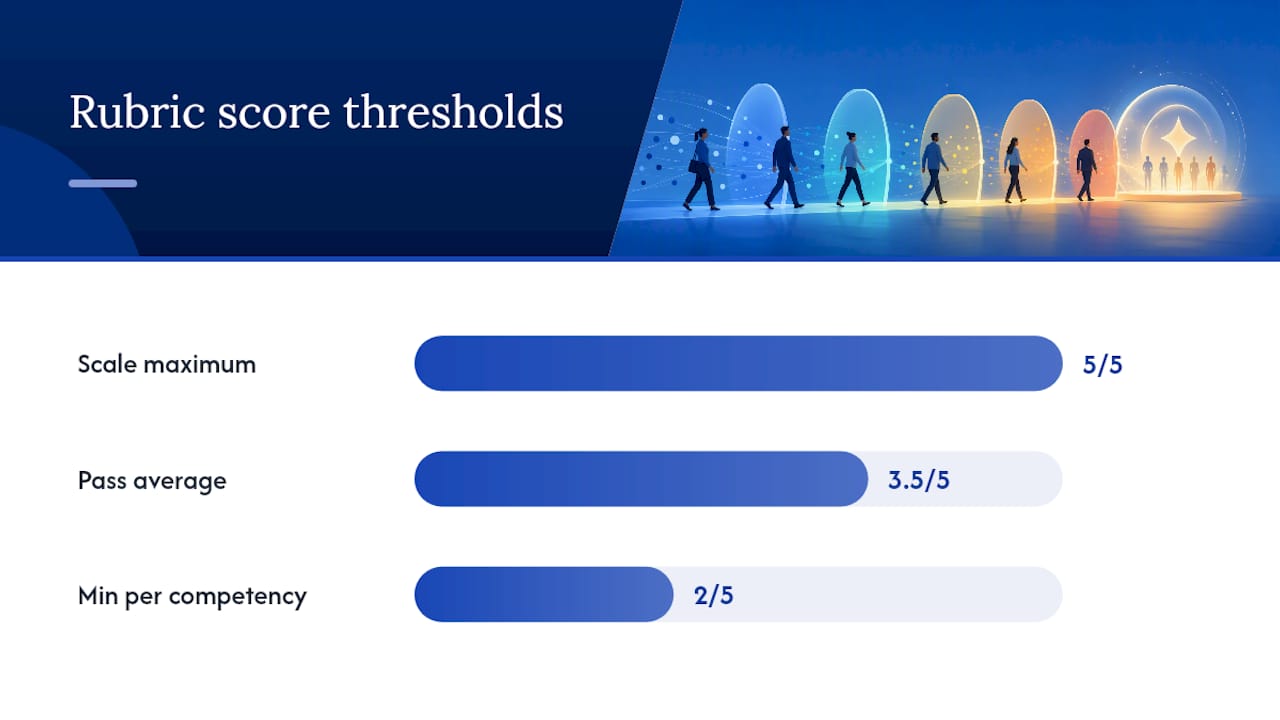
Calibrate raters with a norming session: give every interviewer the same recorded or sample response, have them score independently, then compare and discuss where scores diverged. Repeat this periodically using anonymized real hires, especially after a rater has been out of rotation for a while.
Bias mitigation basics that are easy to skip under time pressure:
- Anonymize resume details that aren’t essential to the language evaluation
- Never penalize accent when the rubric is scoring comprehension and task completion, not pronunciation
- Use at least two raters for any subjective task, like a role-play or writing sample
- Document the reasoning behind every pass/fail decision, not just the score
Pro Tip: Keep documentation to one sentence per decision, something like “Scored 4.2 average, strong on task completion, minor gaps in written formality” filed directly in the candidate’s ATS record. It takes ten seconds and saves you when a decision gets questioned months later.
When Should You Bring in a Staffing Agency or Language-Testing Vendor?
Low-volume, highly specialized roles (a single compliance hire needing near-native legal French, for example) often make more sense to outsource to a vendor with existing validated instruments than to build in-house. High-volume roles, like a call center hiring dozens of bilingual agents a quarter, usually justify investing in your own standardized process and tooling instead of paying per-candidate vendor fees indefinitely.
If you do evaluate a vendor, ask:
- What evidence backs their assessment’s validity, and across which languages?
- Do they guarantee language parity in task difficulty across the languages you need?
- How do they calibrate and re-certify their raters over time?
- What’s their data security posture for candidate assessment records?
- Does their tool integrate with your ATS, and what’s typical turnaround time?
Before signing a contract, pilot on a small sample and track completion rate, interview-to-offer ratio, and early performance correlation for hires who came through the vendor’s process.
What Does a Copy-Ready Bilingual Screening Rubric Look Like?
Here’s a compact rubric you can adapt by adjusting the weights per role.
A candidate scoring 4.5 on speaking, 3.0 on writing, 4.0 on task completion, and 3.5 on vocabulary lands at roughly 3.9, clearing a 3.5 threshold even with one softer row.
The six-step workflow: write the skill-specific job brief (hiring manager), post with clear language requirements (recruiter), source through targeted channels (recruiter), run the validated screen and live mini-screen (screening team or vendor), score against the rubric with two raters (hiring panel), then generate the offer once scores and technical evaluation both clear threshold (hiring manager). Adapt rubric weights per role before you launch it, not after your first batch of candidates comes through.
The Trade-Off Recruiters Underestimate
Most teams treat bilingual screening as a speed problem to solve with more interviews. It’s actually a validity problem. The baseline that works for most hiring teams: define the required skill precisely, run a short validated assessment, add a live three-minute check, score it against a calibrated rubric. Automation earns its keep in the standardized test and the audit trail; a human still needs to sit in on the live screen and the final call, because that’s where accent bias and rushed judgment creep back in.
Screen Bilingual Candidates Faster Without Losing the Rubric
Every safeguard covered above (parity across languages, calibrated raters, documented decisions) gets harder to maintain by hand once volume climbs past a handful of roles a month. Jobsai Enterprise builds those safeguards into the screening layer itself: standardized scoring rubrics that apply the same weighting to every candidate, language-parity testing so a Spanish task and an English task carry equal difficulty, and calibrated rater workflows that flag when one interviewer’s scores drift from the norm.
The platform keeps an audit log on every automated score and routes borderline candidates to human review instead of letting an algorithm make the final call, which matters if you ever need to defend a hiring decision. It also runs on a mobile-first candidate experience and connects directly to your existing ATS, so scores land in one record instead of scattered across spreadsheets and email threads. If your team already uses structured interviews, pairing them with consistent scoring templates closes most of the gap between what looks fair and what actually holds up.
The lowest-friction way to see whether this fits your hiring volume: run a pilot on a single bilingual role and compare it against your current process. Check pricing or see what the platform is built for before you commit a full hiring cycle to it.
Sources
- Govtilr
- U.S. Bureau of Labor Statistics
- Bill 96 & hiring process in Quebec: Can employers require knowledge of a language other than French? — Lexpert
FAQ
What Is the Bilingual Hiring Requirement in Quebec?
Quebec’s Charter of the French Language requires employers to justify any job requirement for a language other than French and limits when that requirement can be imposed at all. Bill 96 reinforces that employers must document necessity and reasonable alternatives to avoid legal challenge.
How Do I List Bilingual Skills on a Resume?
State the specific languages and the skills you have in each, such as “bilingual English/Spanish: professional speaking and writing proficiency,” rather than the single word “bilingual.” Hiring teams that follow strong screening practices will verify this claim with a short assessment regardless of what’s written.
What Are the Most Effective Bilingual Recruitment Strategies?
The strongest approach combines a clearly defined proficiency requirement, sourcing through language-specific channels and community organizations, a validated screening method instead of self-report, and a standardized rubric scored by calibrated raters. Platforms like Jobsai Enterprise can apply that rubric consistently across every candidate while flagging borderline scores for human review.

Are Bilingual Candidates More Likely to Get Hired?
Bilingual candidates often have an advantage for roles where multilingual skill directly affects job performance, such as customer service or roles serving diverse markets, but that advantage only holds when the required proficiency is defined and tested. A vague “bilingual preferred” posting without validation tends to produce inconsistent, hard-to-defend hiring decisions either way.
Recommended
See it in your workflow
JobsAI Enterprise runs sourcing, AI screening, and the whole interview pipeline in one place. Book a walkthrough tailored to your team.
Book a demo