
Article
How Staffing Agencies Fill Skilled Trades Roles

How Staffing Agencies Fill Skilled Trades Roles
TL;DR:
- Staffing agencies fill skilled trades positions faster by using specialized networks, multi-step vetting, and AI-driven screening. They build warm pipelines and streamline hiring with quick decision-making, reducing time-to-fill. AI tools further automate screening and communication, enhancing placement efficiency and quality.
How staffing agencies fill skilled trades positions effectively
Staffing agencies place skilled tradespeople through a structured, multi-step process that combines hands-on vetting, specialist recruiter networks, and AI-powered hiring tools. The result is faster placements without cutting corners on quality or compliance. Here is what that process looks like in practice:
- Multi-layered vetting: Recruiter interviews, certification and license verification, background checks, drug screening, and aptitude testing all happen before a candidate reaches a hiring manager.
- Specialized recruiter networks: Recruiters embedded in specific trade verticals maintain relationships with electricians, welders, pipefitters, and machinists long before a job order comes in.
- AI-powered screening: Platforms like Jobsai Enterprise automate applicant ranking and resume matching, cutting the time recruiters spend on manual review.
- Hiring manager collaboration: Tight coordination between recruiters and hiring managers speeds decision-making and reduces candidate drop-off.
- Active talent pipelines: Top agencies keep warm candidate pools ready, so urgent openings get filled in days, not weeks.
Table of Contents
- What the skilled trades vetting process actually looks like
- Why specialized recruiters and hiring manager collaboration matter
- How AI tools help agencies manage skilled trades hiring at scale
- Best practices for agencies that want to place tradespeople faster
- Key Takeaways
- FAQ
What the skilled trades vetting process actually looks like
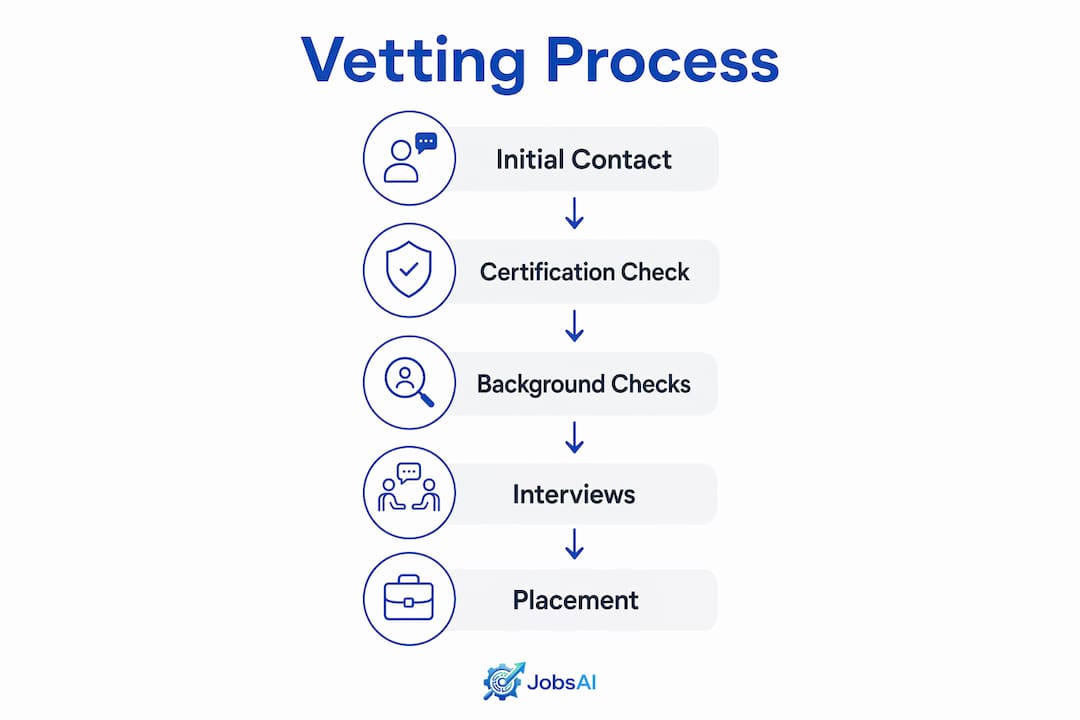
The skilled trades recruitment process follows a clear sequence, and each step serves a specific purpose. Skipping any of them creates risk for the employer and the agency.
- Initial recruiter interview. A recruiter reviews work history, preferred environments, schedule, and location. This conversation also surfaces soft-fit factors like jobsite culture and project type preferences.
- Skills and certification verification. Depending on the trade, this means confirming OSHA cards, journeyman licenses, equipment certifications, or state-specific credentials. No placement moves forward without this step.
- Background and drug screening. Most jobsite clients require both. Staffing agencies handle this directly, removing the administrative burden from the employer.
- Personality and aptitude testing. Cultural fit and project-specific temperament matter on a jobsite. Agencies use structured assessments to validate these factors before making a match.
- Candidate matching and interview scheduling. When a role fits, the agency coordinates the interview or, in some cases, moves directly to placement. Speed here is not optional: standard corporate hiring timelines are poorly suited to trades, where a qualified candidate can accept another offer within 48 hours.
- Offer and pre-start confirmation. Pay, shift, location, PPE requirements, and reporting instructions are confirmed before day one. No surprises for the worker or the client.
Why specialized recruiters and hiring manager collaboration matter
Specialized staffing agencies build candidate networks within specific trade verticals over years, not weeks. A recruiter who has spent three years placing ironworkers knows which candidates are reliable, which certifications are current, and which workers are quietly open to a move. That embedded knowledge is something a generalist recruiter cannot replicate quickly.
The other side of the equation is the hiring manager. When clients stay engaged and respond to candidate submissions within hours rather than days, fill rates improve noticeably. Employers who delay decision-making lose qualified candidates rapidly due to market competition.

The practical implication: agencies that build a feedback loop with their clients, sharing candidate notes and getting quick approvals, consistently outperform those that treat the process as a one-way handoff. Referrals and personal networks remain a top source of hires in skilled trades communities, which means a recruiter’s reputation within a trade vertical is a genuine competitive asset.
How AI tools help agencies manage skilled trades hiring at scale
AI-powered platforms change the math on skilled trades staffing by handling the repetitive, time-consuming steps that slow recruiters down. Jobsai Enterprise is built specifically for this: it screens and ranks applicants automatically, matches resumes against job requirements, and organizes hiring workflows in one place.
- Automated applicant ranking: Candidates are scored against role requirements the moment they apply, so recruiters review a prioritized shortlist rather than a raw pile of resumes.
- Resume-to-requirement matching: The system flags certification gaps and skills mismatches before a recruiter spends time on a call.
- Centralized workflow management: Recruiter notes, candidate status, and hiring manager feedback live in one platform, reducing the back-and-forth that typically slows placements.
- Compliance tracking: Certification expiration dates and license status can be monitored within the system, keeping agencies audit-ready.
- Faster candidate communication: Automated follow-up keeps candidates engaged during the vetting process, reducing drop-off between application and offer.
Stat to know: Employing AI platforms reduces administrative burdens and accelerates skilled trades staffing by automating resume screening, ranking, and communications, freeing recruiters to focus on relationship-building and placements.
For agencies managing high-volume trades hiring, the AI screening capabilities in Jobsai Enterprise translate directly into more placements per recruiter per week. You can also explore how AI tools are reshaping recruiter workflows across staffing verticals for additional context on time-to-placement gains.
Best practices for agencies that want to place tradespeople faster
Speed and quality are not mutually exclusive in skilled trades staffing. The agencies that consistently fill roles quickly follow a few specific practices.
- Keep pipelines warm year-round. Top agencies network continuously within trade communities before openings arise, not after. Reactive sourcing almost always means a slower fill.
- Simplify the application process. Skilled tradespeople prefer mobile-first, low-friction applications. A lengthy form or a desktop-only portal loses candidates before they even start.
- Compress internal approvals. Time-to-hire is usually lost in the gaps between steps. Agencies that pre-align with clients on offer parameters before a candidate is identified move significantly faster at the close.
- Run referral programs actively. Tradespeople trust each other. A structured referral program taps into that trust and surfaces passive candidates who would never respond to a job board ad.
- Use contingent offers. Starting workers pending background clearance, rather than waiting for full results, can cut time-to-fill for trades roles without meaningful risk when the candidate has already cleared the recruiter interview and skills verification.
Pro Tip: Set up contingent offer templates in your hiring platform so offers can go out within hours of a verbal agreement. Candidates who receive a written offer the same day are far less likely to accept competing offers overnight.
Key Takeaways
Staffing agencies fill skilled trades roles fastest when they combine specialized recruiter networks, structured multi-step vetting, and AI-powered tools that automate screening and centralize workflows.
| Point | Details |
|---|---|
| Multi-step vetting is non-negotiable | Certification checks, background screening, and aptitude testing all happen before placement. |
| Recruiter specialization drives quality | Recruiters embedded in trade verticals access candidates generalists cannot reach. |
| Hiring manager speed matters | Delays in client decision-making cost agencies qualified candidates within days. |
| AI reduces manual workload | Platforms like Jobsai Enterprise automate ranking, matching, and candidate communication. |
| Warm pipelines beat reactive sourcing | Continuous networking before openings arise is what separates fast fills from slow ones. |
FAQ
How do staffing agencies vet skilled trades candidates?
Agencies use a multi-layered process: recruiter interviews, certification and license verification, background checks, drug screening, and aptitude testing. Each step validates a different dimension of candidate fit before placement.
Why use a staffing agency for skilled trades hiring?
Specialized agencies maintain trade-specific candidate networks and handle all screening and compliance verification, reducing the employer’s administrative workload and speeding time-to-fill.
How fast can a staffing agency fill a skilled trades role?
With a warm pipeline and an engaged hiring manager, placements can happen within days. Offers and interviews sometimes occur the same day, with start dates contingent on background clearance.
What role does AI play in skilled trades staffing?
AI platforms like Jobsai Enterprise automate resume screening, applicant ranking, and candidate communications, letting recruiters focus on relationship-building and faster placements rather than manual review.
What makes skilled trades hiring different from standard corporate recruiting?
The candidate pool is smaller, certifications are non-negotiable, and qualified tradespeople move fast. Standard corporate hiring timelines do not work here; speed and mobile-friendly processes are required to stay competitive.
Recommended
See it in your workflow
JobsAI Enterprise runs sourcing, AI screening, and the whole interview pipeline in one place. Book a walkthrough tailored to your team.
Book a demo