
Article
How Professional Services Bill Rate Works: 2026 Guide

How Professional Services Bill Rate Works: 2026 Guide
TL;DR:
- Your bill rate is the hourly price charged to clients, calculated by dividing loaded labor cost by one minus the target gross margin. Monitoring all components of loaded cost and realistic billing hours ensures accurate pricing and preserves profit margins throughout delivery.
Your bill rate is the hourly price you charge a client, and the formula is straightforward: bill rate = loaded labor cost ÷ (1 − target gross margin). Get that math wrong and you are not protecting a margin — you are subsidizing the client.
Three inputs drive every calculation:
- Loaded labor cost: base pay plus employer payroll taxes (FICA, FUTA, SUTA), benefits, workers’ compensation, and an allocation for non-billable time
- Target gross margin: typically 25%–40% for U.S. professional services firms
- Billing model: hourly, fixed-fee, retainer, or value-based — each changes how you apply the rate
Fixed-fee projects often exceed estimated hours, which can silently erode margin unless you build in a contingency. That single statistic is why understanding the full mechanics of how professional services bill rate works matters before you quote a single client.
Table of Contents
- How does a bill rate work in professional services?
- What components should go into a correct bill rate?
- How do you calculate a bill rate step by step?
- Which billing model fits your firm’s margin goals?
- How do you protect margins during delivery?
- What should you check before quoting a client?
- What tools and KPIs help you track bill rates in flight?
- Key Takeaways
- Why bill-rate math is a leadership discipline, not a finance task
- FAQ
How does a bill rate work in professional services?
The bill rate is what the client pays per hour (or effective hour). The pay rate is what the worker earns. The gap between the two funds employer taxes, insurance, benefits, overhead, and profit. Confuse those layers and your pricing model is built on guesswork.
Four terms worth keeping distinct:
- Pay rate: — gross wages paid to the worker
Markup and margin diverge in ways that matter. A 30% markup on a $70 loaded cost gives you a $91 bill rate and a 23% gross margin. A 30% margin target on that same $70 cost gives you a $100 bill rate. Quoting from the wrong formula leaves $9 per hour on the table.
Accurate bill rates affect every team in the firm. Sales needs them to quote profitably. Finance needs them for revenue recognition. Project managers need them to flag burn-rate risk. Procurement uses them to benchmark vendor spend.
Pro Tip: Monitor loaded labor cost continuously during delivery, not only at quoting. Scope creep and utilization drops erode margin in real time, and catching them early is far cheaper than renegotiating after the fact.
What components should go into a correct bill rate?
The bill rate must cover employer taxes, insurance, benefits, overhead, non-billable time, and still deliver profit — base pay alone is never the right input.
| Component | Typical Line Items | How to Calculate |
|---|---|---|
| Base pay | Annual salary or hourly wage | Direct from offer letter or payroll |
| Employer payroll taxes | FICA, FUTA, SUTA | Multiply gross wages by applicable rates |
| Benefits | Health, dental, vision, retirement match | Annual cost ÷ 12 per employee |
| Workers’ comp & E&O insurance | Policy premium allocated per role | Annual premium ÷ headcount or hours |
| Recruiting & onboarding | Job ads, recruiter time, training | Amortized over expected tenure |
| Equipment & software | Laptop, licenses, tools | Annual cost ÷ billable headcount |
| Allocated overhead | Rent, ops, management, G&A | Total overhead ÷ billable FTEs |
| Non-billable time | Admin, sales support, PTO, training | Factored into billable-hours denominator |
The billable-hours assumption is where most firms make their first mistake. Many senior independents bill only 18–24 hours per week — using 2,000 annual hours as the denominator locks in underpricing from day one. For enterprise delivery teams, realistic annual billable hours typically fall between 800 and 1,600 depending on role and firm structure.
Bill rates also vary significantly by specialty and geography. Coastal markets and niche expertise command meaningful premiums, so benchmarks are a useful sanity check — but your floor must still come from your own loaded cost, not from what competitors appear to charge.
How do you calculate a bill rate step by step?
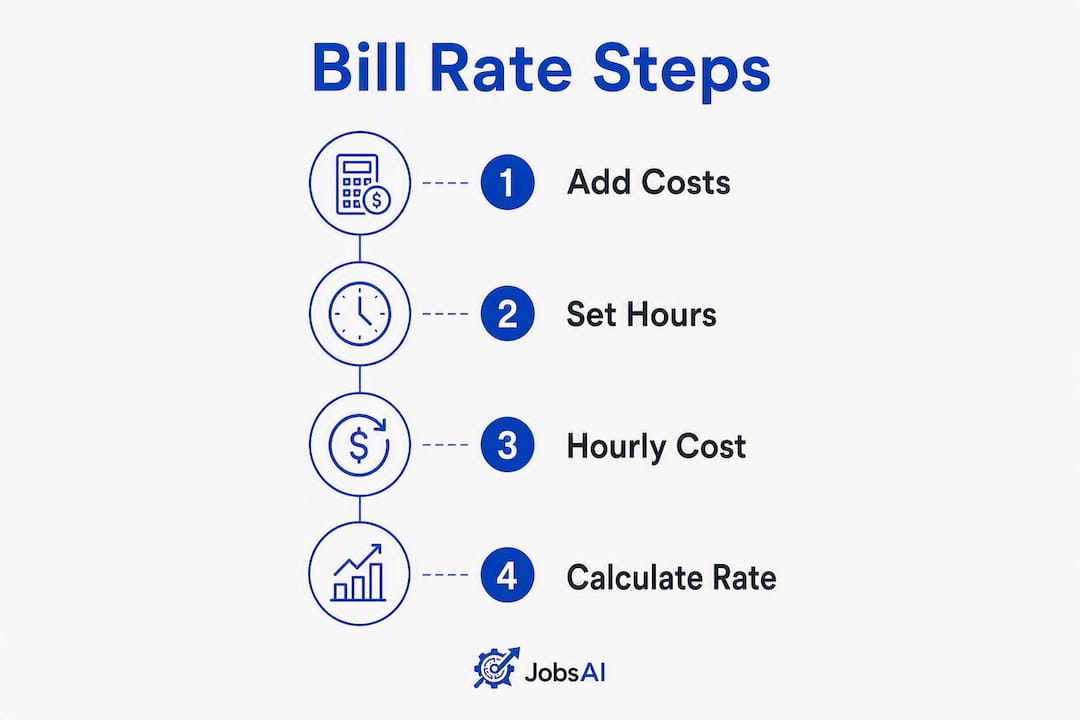
Step 1: Add up the loaded annual labor cost (base salary + benefits + employer taxes + recruiting amortization + allocated overhead).

Step 2: Set a realistic annual billable-hours figure. Use 18–24 hours/week for independents; 800–1,600 hours/year for firm employees depending on role.
Step 3: Loaded hourly cost = loaded annual cost ÷ annual billable hours.
Step 4: Bill rate = loaded hourly cost ÷ (1 − target gross margin).
Worked example A: mid-market consulting senior
| Input | Amount |
|---|---|
| Annual billable hours (1,200) | 1,200 hrs |
| Target gross margin (30%) | 30% |
Worked example B: independent consultant
An independent billing 20 hours/week (1,040 hours/year) with a loaded annual cost of $104,000 and a 35% margin target:
- Loaded hourly cost is calculated by dividing loaded annual cost by annual billable hours; bill rate is then calculated from loaded hourly cost and margin target
Common pitfalls: using 2,000 hours as the denominator, forgetting to include non-billable time in the overhead allocation, and omitting benefits from the loaded cost entirely. Each error compresses your effective margin without you realizing it until the project closes.
Pro Tip: Build your spreadsheet with a dedicated cell for billable-hours assumption and make it easy to change. Running sensitivity scenarios (1,000 vs. 1,200 vs. 1,400 hours) takes 30 seconds and shows you exactly how utilization risk flows into your rate.
Which billing model fits your firm’s margin goals?
The same loaded-cost formula applies across all models, but each model shifts who bears the risk and how margin is earned.
- Hourly: Predictable margin per hour billed; typical project-level margins run a healthy moderate percentage before overhead, with smaller firm-level net margins. Revenue ceiling is tied to available hours.
- Fixed-fee: Client gets cost certainty; you absorb scope risk. Because fixed-fee projects typically run about 22% over estimated hours, build a 22% contingency into every estimate and include a change-order clause.
- Retainer: Predictable cash flow for both sides. Price by estimating monthly hours at your loaded hourly cost, then apply your margin. Works best for ongoing advisory or support relationships.
- Value-based: Anchor fees to client outcomes rather than inputs. When outcomes are measurable, value-based engagements can yield 30%–50% higher margins versus equivalent hourly work. The 5-to-15 rule is a practical anchor: price fixed-scope work at 5%–15% of the value you create; for value-based pricing, fees often represent 10%–25% of expected client benefit.
Value-based pricing only works when the benefit is measurable in dollars. Without a clear metric, clients default to hourly comparisons and the value anchor disappears.
How do you protect margins during delivery?
Pricing is positioning. Set your floor using loaded cost, then anchor to client value when you can. Once the project is live, margin protection becomes an operational discipline.
Contract clauses that protect you:
- Scoped deliverables with explicit exclusions
- Change-order process with pre-approved rates and written approval before work begins
- Acceptance criteria tied to milestones, not calendar dates
- Milestone invoicing (never bill only at project close)
- Late payment and invoice dispute resolution terms
Operational monitoring:
- Track actual vs. planned hours weekly, not monthly
- Watch burn rate (hours consumed vs. budget remaining) as your primary early-warning KPI
- Set a utilization floor; when a resource drops below it, investigate before the next invoice cycle
- Review and index rates at least annually — inflation and market shifts erode real margins silently
State your fee and stop talking. Negotiating against your own number before the client responds is one of the most common margin leaks in professional services. Silence after quoting is not awkward — it is professional.
Pro Tip: Frame your rate as the client’s ROI, not your input hours. “This engagement typically returns $X in [outcome] for a fee of $Y” is a stronger anchor than “we charge $Z per hour.” Clients who understand the value comparison push back less on rate.
What should you check before quoting a client?
Run through this list before submitting any price:
- Scope is written down and the client has signed off on the definition
- You have confirmed who has budget authority on the client side
- Contract includes change-order language, acceptance criteria, and milestone invoicing
- Billable-hours assumption is realistic for this specific engagement
- Loaded costs are current (not from last year’s model)
- A 10%–20% contingency buffer is included in fixed-fee estimates
- Insurance and compliance requirements (E&O, W-9, contractor classification) are confirmed
- Invoicing schedule and payment terms are agreed before work starts
Negotiation red flags to watch:
- Vague or shifting scope with no written definition
- Procurement demanding unilateral rate caps with no scope adjustment
- Client requests to reclassify W-2 workers as 1099 without discussing the cost implications — worker classification affects IRS payroll tax obligations and changes your loaded cost model
- No measurable outcome metric when the client wants value-based pricing
- Stakeholder turnover mid-negotiation, which often resets agreed terms
When you spot these flags, pause and address them in writing before proceeding. Scope ambiguity at quoting becomes margin erosion at delivery.
What tools and KPIs help you track bill rates in flight?
Build a spreadsheet (or system record) with these fields for every billable resource:
| Field | Purpose |
|---|---|
| Role / title | Segment by cost tier |
| Base pay | Starting point for loaded cost |
| Employer taxes % | Apply IRS and state rates |
| Benefits $ (annual) | Health, retirement, other |
| Loaded annual cost | Sum of all above |
| Assumed billable hours | Your realistic denominator |
| Loaded hourly cost | Loaded annual ÷ billable hours |
| Target margin % | Firm or engagement-level target |
| Computed bill rate | Loaded hourly ÷ (1 − margin) |
| Billing model | Hourly / fixed / retainer / value |
| Contract ID | Link to SOW or MSA |
KPIs to monitor every billing cycle: utilization rate, planned vs. actual hours, burn rate, time-to-invoice, write-offs, and effective hourly rate post-project-close. Effective hourly rate (total revenue ÷ actual hours worked) is the single most honest measure of whether your bill rate held.
Connecting time tracking, project management, and billing in one place reduces the manual reconciliation that causes margin leakage. Jobsai Enterprise’s workflow automation reduces non-billable administrative time in staffing and recruiting workflows, which directly improves the utilization denominator in your rate model. Firms looking to reduce delivery overhead can also apply business process optimization principles to identify where hours are lost before they hit the invoice.
Key Takeaways
Accurate bill rates require a realistic loaded labor cost, a defensible billable-hours assumption, and continuous margin monitoring throughout delivery — not just at the quoting stage.
| Point | Details |
|---|---|
| Use the correct formula | Bill rate = loaded hourly cost ÷ (1 − target gross margin); never use base pay as the input. |
| Set a realistic hours denominator | Many independents bill 18–24 hours/week; enterprise roles range 800–1,600 hours/year. |
| Buffer fixed-fee estimates | Fixed-fee projects typically run about 22% over estimated hours; it is advisable to add a 22% contingency buffer in estimates. |
| Anchor to client value | Use the 5-to-15 rule: price fixed-scope work at 5%–15% of value created. |
| Monitor margin in flight | Track utilization, burn rate, and effective hourly rate every billing cycle to catch erosion early. |
Why bill-rate math is a leadership discipline, not a finance task
Most pricing failures in professional services are not caused by bad math. They are caused by treating the bill rate as a one-time calculation rather than a living operational number. Firms set a rate at proposal time, win the work, and then lose track of whether the actual delivery hours match the model. By the time the project closes, the effective margin is 10 points below what was quoted — and no one flagged it in time.
The firms that protect margin consistently do two things differently. First, they build their floor on realistic billable hours, not optimistic ones. Second, they review rates on a fixed cadence — quarterly at minimum — and index them to inflation and market movement rather than waiting for a client renewal to force the conversation.
Automation and reporting are the practical next step. When time tracking, billing, and workflow data live in the same system, margin leakage becomes visible before it becomes a problem. That visibility is what turns pricing from a spreadsheet exercise into a genuine competitive advantage.
FAQ
What is the difference between bill rate and pay rate?
The pay rate is what the worker earns; the bill rate is what the client pays. The difference covers employer taxes, benefits, overhead, and profit margin.
How do you calculate a loaded labor cost?
Add base pay, employer payroll taxes (FICA, FUTA, SUTA), benefits, workers’ compensation, recruiting amortization, and allocated overhead to get the total loaded annual cost.
Why should you avoid using 2,000 hours in your bill rate calculation?
Many professionals bill far fewer than 2,000 hours annually. Using that figure as the denominator understates your loaded hourly cost and locks in underpricing from the start.
What is a reasonable gross margin target for professional services?
Gross margin targets typically fall between 25% and 40% at the project level for U.S. professional services firms, with firm-level net margins around 10%–15% for well-managed hourly engagements.
When does value-based pricing make sense?
Value-based pricing works when the client benefit is measurable in dollars and your fee represents a clear percentage of that benefit — typically 10%–25%. Without a measurable outcome, clients revert to hourly comparisons.
Recommended
See it in your workflow
JobsAI Enterprise runs sourcing, AI screening, and the whole interview pipeline in one place. Book a walkthrough tailored to your team.
Book a demo