
Article
Compare Candidates Quickly: 10–20 Minute Rubric for Hiring Teams

Compare Candidates Quickly: 10–20 Minute Rubric for Hiring Teams
The fastest reliable way to compare candidates quickly is a weighted rubric applied through a side-by-side scorecard, populated first by AI-assisted parsing and closed out with a five to ten minute human validation pass. This combination lets a hiring team rank a short-list with repeatable scores in minutes, not hours. Some platforms build this exact sequence into their screening tools, but you can run the same process with a spreadsheet and a clear set of weights.
TL;DR:
- AI can quickly parse resumes and generate initial scores, but human validation remains essential for bias mitigation and accuracy.
- Use a five-criterion scorecard with predetermined weights to ensure consistent, objective comparisons across all candidates.
- Reconcile missing or inconsistent data immediately and review only the top 10 to 15 candidates to save time and improve reliability.
- For close calls, prioritize the highest-weighted criterion or use a short follow-up question instead of subjective impressions.
- Standardize processes with automated parsing and scoring tools to streamline evaluations, but maintain a structured review to ensure fairness.
Table of Contents
- What Fields Should You Compare Side-By-Side?
- Which Templates Make Rapid Screening Easier?
- What Can AI Reliably Do During a Fast Comparison?
- How Do You Run a 10 to 20 Minute Comparison?
- How Should You Document and Audit the Decision?
- What Ties and Close Calls Actually Need
- Why Fast Hiring Decisions Still Need a Human Check
- See How Jobsai Enterprise Speeds Up Candidate Comparisons
- Sources
- FAQ
What Fields Should You Compare Side-By-Side?
A quick comparison only works if every candidate is scored against the same fixed set of fields. Pick criteria that map to what the role actually requires, not everything on a resume.
Focus on these core objective fields:
- Role-fit score: a single number derived from how closely the resume and stated experience match the job description.
- Must-have skills: the two or three non-negotiable competencies, scored as present, partial, or absent.
- Outcomes and impact: what the candidate actually produced in past roles, not just their title or tenure.
- Assessment results: scores from any technical test, writing sample, or case exercise.
- Interview ratings: numeric scores from each interviewer, not just written impressions.
- Availability and compensation fit: whether timing and salary expectations align with the role’s constraints.
Behavioral evidence and culture fit deserve a spot on the sheet too, but they need to be captured as observable behaviors, not vague gut feelings. “Gave a specific example of resolving a conflict with a peer” is scoreable. “Seemed like a good fit” is not.
Some of this is easy to automate. Skill extraction, tenure calculation, and keyword matching against a job description are exactly the tasks parsing tools handle well. Behavioral judgment and culture fit still need a human reviewer. Before you score anything, normalize job titles across resumes, standardize your rating scale, and flag any field where evidence is missing rather than guessing. A simple checklist and consistent framework reduces the ad-hoc judgment calls that make comparisons inconsistent between reviewers.
Which Templates Make Rapid Screening Easier?
Two templates cover almost every hiring scenario: one for the first screening pass, one for the final round.
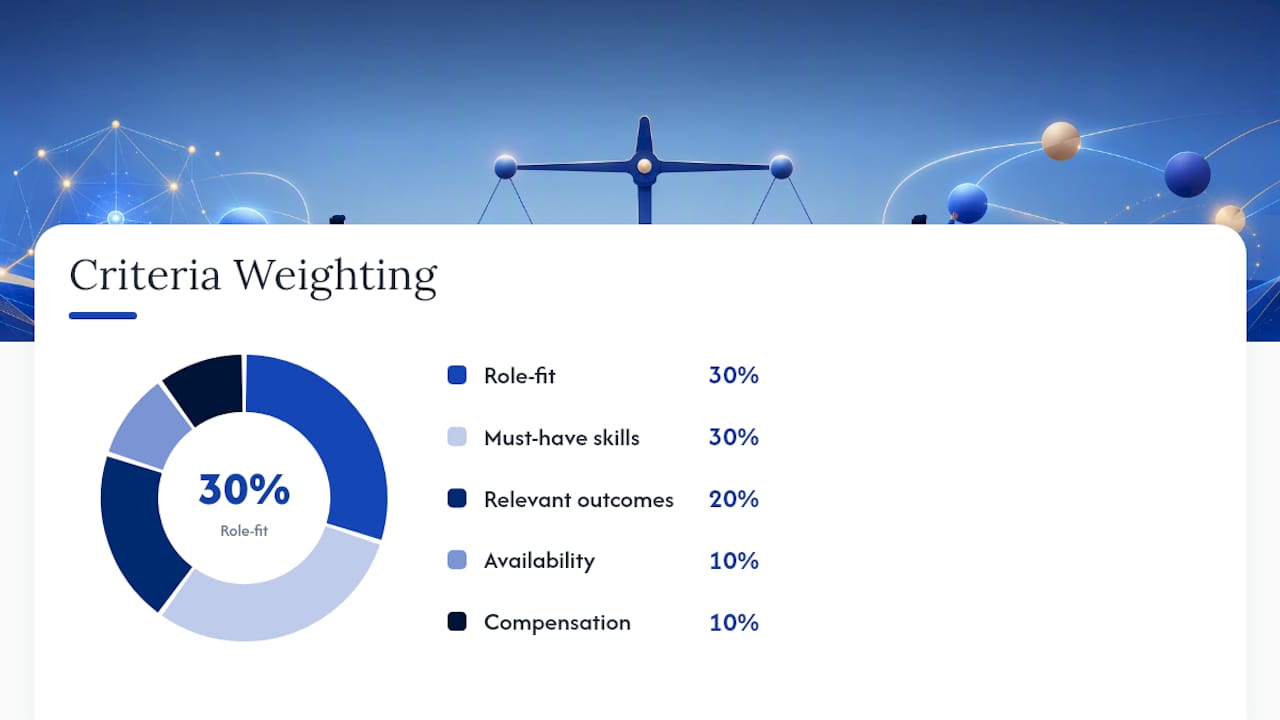
- Template A, the 5-criteria rapid screening scorecard. Score each candidate 1 to 5 on role-fit, must-have skills, relevant outcomes, availability, and compensation fit. Weight role-fit and must-have skills at 30% each, outcomes at 20%, and availability plus compensation at 10% each. Multiply each score by its weight and sum the results for a single ranked total.
- Template B, the 8-field interview comparison sheet. Add interviewer ratings, culture-fit notes, assessment scores, and reference check status to the five fields above. Give each interviewer a dedicated column so you can see where reviewers agree and where they diverge, plus a notes field for the specific evidence behind each score.
- Standardize the scale before anyone starts scoring. A 1 to 5 scale with written anchors (“3 equals meets expectations with one gap”) keeps reviewers calibrated. Without anchors, one person’s 4 is another person’s 2.
- Reconcile missing or inconsistent data immediately. If a reviewer skips a field, mark it as missing rather than assuming a zero. If two interviewers score the same candidate three points apart on the same criterion, flag it for a two-minute conversation before finalizing rank.
Pro Tip: Build your rubric before you look at a single resume. Deciding weights after you’ve already fallen for a candidate is how bias sneaks back into a process built to prevent it.
Neutral, structured criteria paired with a side-by-side comparison interface removes most of the guesswork from ranking a short-list, because every candidate is evaluated against the identical set of anchors.
What Can AI Reliably Do During a Fast Comparison?
AI earns its place in candidate comparisons on a narrow set of tasks it does well, fast. Resume parsing, matching a candidate’s stated experience against a job description, generating a concise summary of a long resume, and scoring structured assessments are all jobs that AI handles reliably and quickly. Batch-parsing resumes and normalizing extracted skills across a whole candidate comparison pipeline cuts the time-per-candidate dramatically, which matters most when you’re screening dozens of applicants for one opening.
AI also has predictable blind spots. It can over-weight resume phrasing that mimics the job description’s own language, rewarding candidates who are better at keyword matching than at the actual job. It can carry vocabulary bias from training data. And its scoring logic is often opaque unless the platform exposes the reasoning behind each score.
The mitigation is simple: keep the rubric transparent, and audit the top results by hand.
- Batch-parse every resume into the same structured fields.
- Auto-score against your weighted rubric.
- Human-validate only the top 10 to 15 candidates rather than the entire pool.
That batch-parse, auto-score, human-validate pattern typically takes a few minutes per candidate for the automated stage, with the human review concentrated on the shortlist that actually matters. Jobsai Enterprise’s AI scoring and top-picks feature runs this exact pattern, surfacing ranked candidates while leaving the final call with the reviewer. Presenting scores alongside the source evidence behind each one, rather than a bare number, is what makes a fast AI-assisted score defensible later.
How Do You Run a 10 to 20 Minute Comparison?
A tight, repeatable process beats an open-ended review every time. Here’s the sequence to run on a short-list of five to eight candidates.
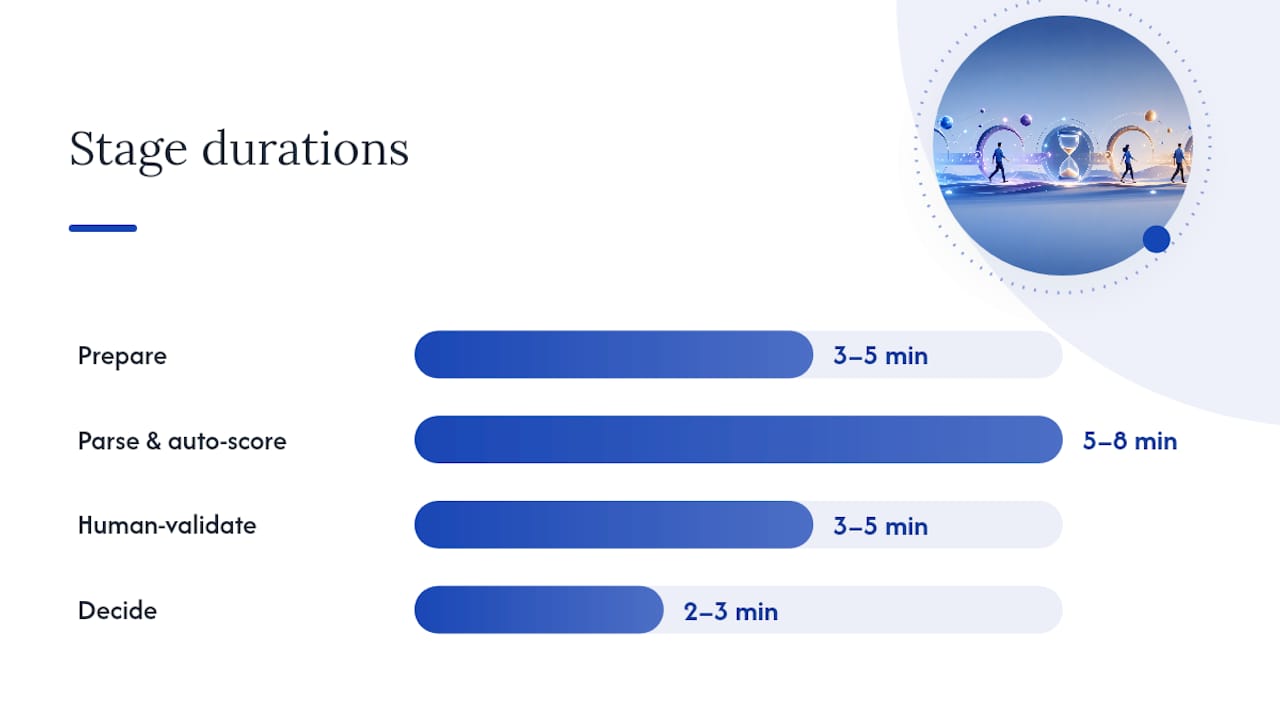
- Prepare (3 to 5 minutes). Pull the job description, confirm your rubric weights, and gather resumes, assessment results, and interview notes into one workspace.
- Parse and auto-score (5 to 8 minutes). Run resumes through a parsing tool, populate your scorecard template, and let the auto-score generate a first ranked pass.
- Human-validate (3 to 5 minutes). Spot-check the top three to five scores against actual evidence. Correct anything the automated pass clearly got wrong.
- Decide (2 to 3 minutes). Finalize the shortlist, write one sentence of reasoning per candidate, and assign an owner for next steps.
For high-volume roles, run steps one and two across the entire applicant pool, then apply the full 20-minute process only to your top 10. For senior or highly specialized roles, add a fifth step: a quick reference check on your top two before extending an offer.
Pro Tip: Set a timer for each stage the first few times you run this. Comparisons expand to fill whatever time you give them, and a scorecard doesn’t need an hour to be accurate.
How Should You Document and Audit the Decision?
A fast decision still needs a paper trail, especially if a candidate or a compliance review ever asks why one person got the offer over another.
- Export a one-page PDF for stakeholders who need the ranked summary without the underlying detail.
- Export a CSV for HR records and audit purposes, since it preserves every field and score for later reference.
- Capture who scored what, and when. Minimal metadata, reviewer name, timestamp, and a one-line evidence note per score, is enough to reconstruct the decision months later.
- Run a quick bias check before sign-off. Scan for outlier scores from a single reviewer or a pattern where one interviewer consistently rates certain candidate profiles lower than everyone else does.
- Handle candidate data carefully. Strip unnecessary personal details before sharing a comparison sheet outside the immediate hiring team.
Jobsai Enterprise’s shortlisting best practices guide walks through reviewer alignment in more detail if your team is scaling this across multiple open roles at once.
What Ties and Close Calls Actually Need
When two candidates land within a point of each other on the final scorecard, resist the urge to just pick the one you liked better in conversation. Go back to the single highest-weighted criterion, usually role-fit or the must-have skill, and let that field break the tie. If it’s still even, add a short structured follow-up question to both candidates rather than deciding on impression alone. Weighting criteria by role importance also solves a lot of ties before they happen: a senior technical role should weight assessment scores heavily, while a customer-facing role should weight communication-based interview ratings higher. An external evaluation criteria framework built around role-specific weighting is a useful model if you’re building your first rubric from scratch.
Why Fast Hiring Decisions Still Need a Human Check
Speed and fairness aren’t opposites, but they only stay compatible when someone is actually watching the process. The real risk with quick comparisons isn’t that they’re too fast. It’s that teams skip the validation step because the automated score feels authoritative enough on its own. It rarely is. A rubric that looks objective on paper can still bake in bias if nobody checks whether the weights themselves favor one kind of background over another.
Scoring tools are useful precisely because they save time on the parsing and matching work, not because they remove the need for a reviewer’s judgment on the final call. If your team hasn’t run a structured comparison process before, pilot it on a single low-risk, high-volume role before rolling it out across every requisition you own. You’ll learn more from one real hiring cycle than from any amount of planning in advance.
— Hippolyte A.
See How Jobsai Enterprise Speeds Up Candidate Comparisons
Everything in this workflow, resume parsing, weighted scoring, side-by-side scorecards, exportable reports, and shared reviewer workspaces, can be offered as a single connected system instead of a spreadsheet you rebuild every time you hire.
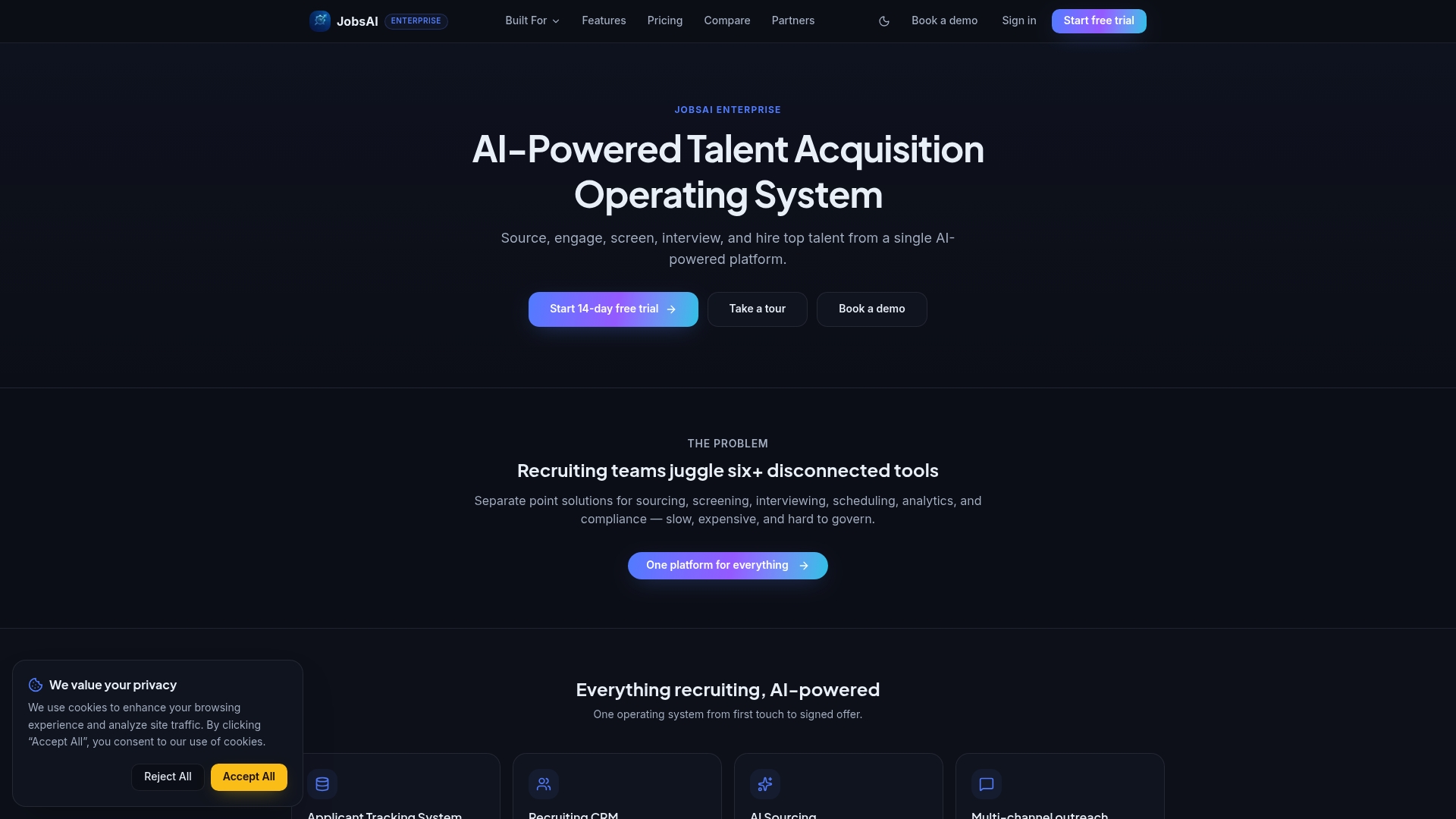
Instead of manually parsing resumes and building a new scorecard for every requisition, teams can get ranked candidates, evidence-backed scores, and a shared workspace where every reviewer’s input lands in one place. That means less time spent assembling comparisons and more time spent actually talking to your top candidates. The hiring manager workspace keeps everyone’s scores and notes in one auditable view, and the AI screening engine handles the parsing and matching so your first human review starts with a ranked shortlist instead of a stack of raw resumes. If you want to see the actual workflow before committing to anything, take the product tour or check current pricing to find the plan that fits your hiring volume.
Sources
- Know Your Candidates.Vote With Confidence.
- BallotLens
- How to Compare Job Candidates Objectively - Talent Insights
FAQ
What Is the Fastest Way to Compare Candidates Quickly?
A weighted rubric applied through a side-by-side scorecard, fed by AI-assisted resume parsing and closed with a short human validation pass, is the fastest reliable method available.
How Many Criteria Should a Rapid Screening Scorecard Have?
Five criteria are typically enough for an initial screen: role-fit, must-have skills, outcomes, availability, and compensation fit, each weighted based on what matters most for the role.
Can AI Score Candidates Without Human Review?
AI can reliably parse resumes and generate initial fit scores, but it can also over-weight resume phrasing and carry hidden bias, so a human should always validate the top-ranked candidates before a final decision.
How Do You Handle a Tie Between Two Top Candidates?
Break the tie using your single highest-weighted criterion first, and if scores remain even, add one structured follow-up question rather than deciding on impression alone.
What Should You Export for an Auditable Hiring Decision?
Export a one-page PDF summary for stakeholders and a full CSV with reviewer names, timestamps, and evidence notes for HR and compliance records.
Recommended
See it in your workflow
JobsAI Enterprise runs sourcing, AI screening, and the whole interview pipeline in one place. Book a walkthrough tailored to your team.
Book a demo