
Article
5 Part Candidate Scorecard Playbook for Hiring Teams With Automation

5 Part Candidate Scorecard Playbook for Hiring Teams With Automation
A candidate scorecard is a standardized evaluation form that lets hiring teams score job-specific competencies against anchored definitions, so every interviewer measures the same things the same way. The result is a comparison you can defend, not just a gut feeling you write down after the fact. Hiring managers, recruiters, and interview panels all use the same scorecard for a given role, which is what makes the scores comparable across candidates and interviewers in the first place.
TL;DR:
- Scorecards are most valuable for roles involving repetitive hiring processes where consistency enhances decision accuracy.
- Using a scale of 1 to 4 with behavioral anchors reduces interviewer disagreement and bias more effectively than broader rating systems.
- Structuring the process with clear job analysis, interviewer training, and calibration sessions improves consistency and score validity across the team.
- Automation tools that prompt immediate scorecard completion and flag score gaps help maintain high-quality, comparable evaluations in high-volume hiring.
- Customizing scorecards by role and focusing on observable, role-specific competencies yields more precise assessments than generic or narrative methods.
Table of Contents
- What Is a Candidate Scorecard, and When Should You Use One?
- What Should Go on an Interview Scorecard? (Template Fields)
- How Do You Score and Weight Interview Criteria?
- How Do You Roll Out Interview Scorecards Across Your Team?
- What Are the Common Pitfalls and Bias Risks With Scorecards?
- How Do Scorecards Compare to Other Evaluation Methods, and How Do You Personalize Them by Role?
- How JobsAI Enterprise Handles Scorecards in Practice
- When Do Scorecards Deliver the Most Value?
- Scale Your Scorecard Process With JobsAI Enterprise
- Sources
- FAQ
What Is a Candidate Scorecard, and When Should You Use One?
A scorecard differs from a generic evaluation form in one key way: it ties every score to a specific, predefined competency instead of asking “how did they do overall?” A rubric defines the scale (what a 3 looks like versus a 5); the scorecard is the document that applies that rubric to a real candidate, role by role. HBR’s research on hiring decisions found that pairing structured evaluation with scorecards reduces bias and produces measurably better hires than unstructured impressions.
You’ll get the most value from a scorecard in situations where consistency across interviewers actually matters:
- Initial phone or video screens, where you’re deciding who advances
- Technical interviews, where skill claims need to be checked against evidence
- Final panel rounds, where multiple interviewers need to reconcile different impressions
- Take-home task reviews, where a rubric keeps grading consistent across reviewers
Any role you hire for repeatedly is a strong candidate for a formal scorecard. A one-off executive search may not need the same rigor.
What Should Go on an Interview Scorecard? (Template Fields)
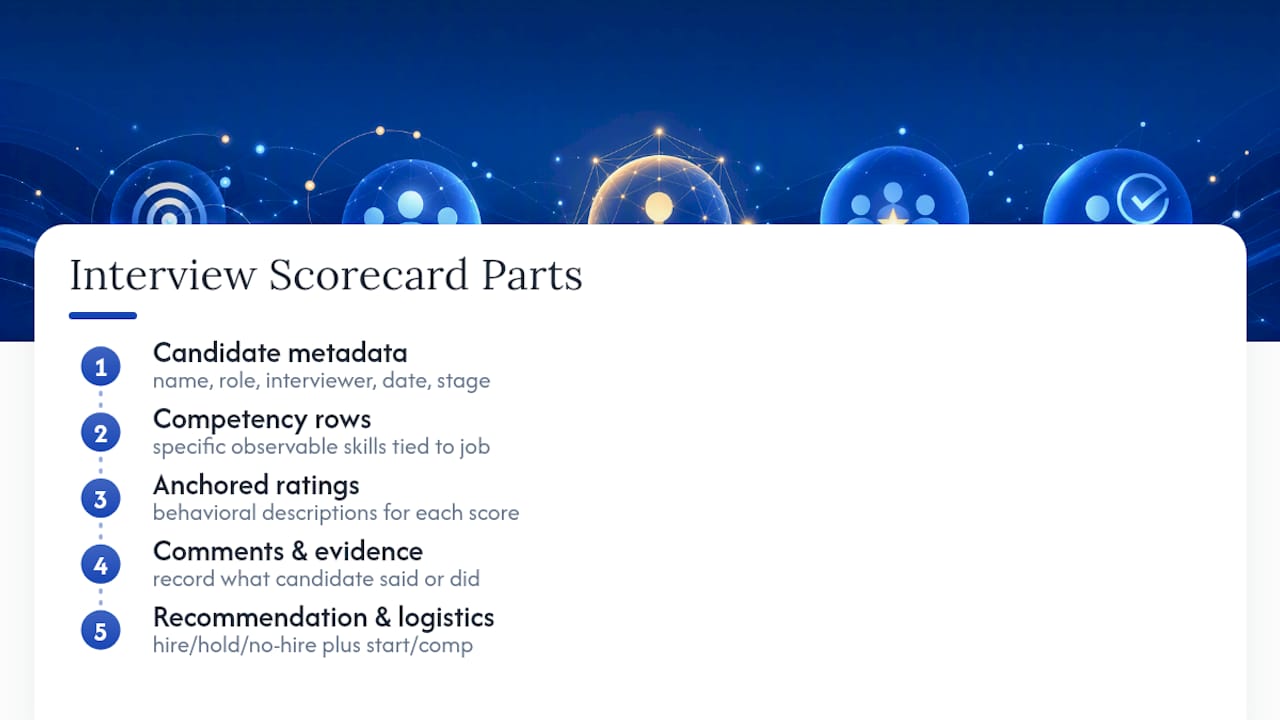
An effective scorecard is built from five parts, and skipping any one of them weakens the whole system. Start with candidate metadata: name, role, interviewer, date, and interview stage. That header matters more than it looks. Without it, scorecards get lost or misattributed once you’re comparing a dozen candidates across three rounds.
Next come the competency rows, the heart of the document. Each row names one specific, observable skill or trait tied directly to the job description, never a vague trait like “culture fit” on its own. Good rows look like “debugs a production issue under time pressure” or “handles a difficult client conversation,” not “communication skills.”
Each competency row needs a rating column with anchored definitions, meaning the scorer isn’t picking a number in a vacuum. A 4 should describe an actual behavior, not just “excellent.” Beside the rating, a comments and evidence box forces the interviewer to write down what the candidate actually said or did, which is what makes the score defensible later.
Finally, close with an overall recommendation: hire, no hire, or a hold with a reason. Most well-built scorecards use five to seven competencies plus a fit assessment and a note on logistics (start date, compensation expectations, work authorization). Beyond seven or eight rows, interviewers start rushing through them, and scoring quality drops. The 4 Corner Resources guide to interview scoring sheets reflects this same pattern across the templates it reviewed: shorter, evidence-anchored forms outperform long checklists.
How Do You Score and Weight Interview Criteria?
The scale you choose matters less than most hiring teams assume, but it isn’t arbitrary. A 1 to 4 scale (below expectations, meets some, meets, exceeds) tends to produce more reliable scoring across different interviewers than a 1 to 5 or 1 to 10 scale, mainly because it forces a real decision instead of letting people default to a “safe” middle number. Fewer options means less room for interviewers to disagree on what the difference between a 6 and a 7 even means.
Behavioral anchors are what make any scale usable. Instead of describing a 3 as “good,” describe what a candidate actually needs to say or do to earn that score. For a customer-support role, a 4 might read: “gave a specific example of de-escalating an angry customer and described the resolution.” A 1 might read: “could not describe a relevant example when prompted twice.” HBR’s guide to removing bias from interviews makes the same point: anchors tied to observable behavior cut down on the guesswork that lets personal bias creep in.
Weighting comes next, and it should reflect what actually predicts success in the role, not what’s easiest to measure. A simple approach:
- Identify two or three must-have competencies (the ones that, if missed, mean no hire regardless of other scores)
- Set a minimum threshold on those specific rows, such as “no score below a 3 on technical competency”
- Weight the remaining competencies evenly unless you have hard evidence one matters more
Pro Tip: Resist the urge to add more scale points to capture nuance. Clarity beats granularity almost every time, a 1 to 4 scale that everyone interprets the same way beats a 1 to 10 scale that six interviewers use six different ways.
How Do You Roll Out Interview Scorecards Across Your Team?
Rolling out structured interview scoring works best as a sequence, not a single memo to the hiring team.
- Start with job analysis. Map the actual tasks of the role to the competencies you’ll score, rather than pulling generic categories from an old job description. OPM’s job analysis guidance treats this step as the foundation of any valid selection tool, and skipping it is the most common reason scorecards end up measuring the wrong things.
- Write questions tied to each competency, with a defined anchor for what a strong answer sounds like, before the first interview happens.
- Train interviewers and run a calibration session. Have two or three interviewers score the same recorded or role-played answer independently, then compare notes on where and why they diverged. Pilot the whole system on a single role before rolling it out company-wide.
- Set operational rules. Decide when the scorecard gets filled out (immediately after the interview, not at the end of the day), who compiles the panel’s scores, and how ties or big score gaps between interviewers get resolved.
- Measure outcomes and iterate. Track whether higher scorecard scores actually correlate with on-the-job performance six months later, and adjust competencies or anchors if they don’t.
Structured interviews are the single change most likely to make this whole system work, because a scorecard applied to an unstructured, free-flowing conversation produces scores that aren’t comparable across candidates in the first place.
Pro Tip: Pilot on your highest-volume role first. That’s where inconsistent scoring costs you the most time and the most good candidates, and it’s where a calibration session pays off fastest.
What Are the Common Pitfalls and Bias Risks With Scorecards?
Scorecards fail most often for one simple reason: the interviews behind them aren’t consistent. As Joe Scotto notes in Indeed’s guide to interview scoring sheets, a scoring sheet only works when it’s paired with a structured interview. If one candidate gets asked five behavioral questions and another gets a loose, unstructured chat, the resulting scores aren’t measuring the same thing, no matter how well-designed the form is.
Bias creeps in through specific, avoidable channels:
- Vague competency wording like “culture fit” or “executive presence,” which invites interviewers to score their own comfort level rather than a job-relevant skill
- Letting interviewers see prior scores or resumes before writing their own independent evaluation
- Rating “communication style” in ways that quietly penalize accents, disability-related speech differences, or non-native English speakers
Mitigations are straightforward: use identical structured questions for every candidate, have interviewers submit scores before comparing notes with the panel, and run periodic calibration to catch drift. Keep a documented audit trail, since anchored comments are what let you defend a decision later. The EEOC’s discussion of automated and structured selection tools stresses regular auditing of any structured assessment for disparate impact, a good habit even for a simple paper scorecard.
How Do Scorecards Compare to Other Evaluation Methods, and How Do You Personalize Them by Role?
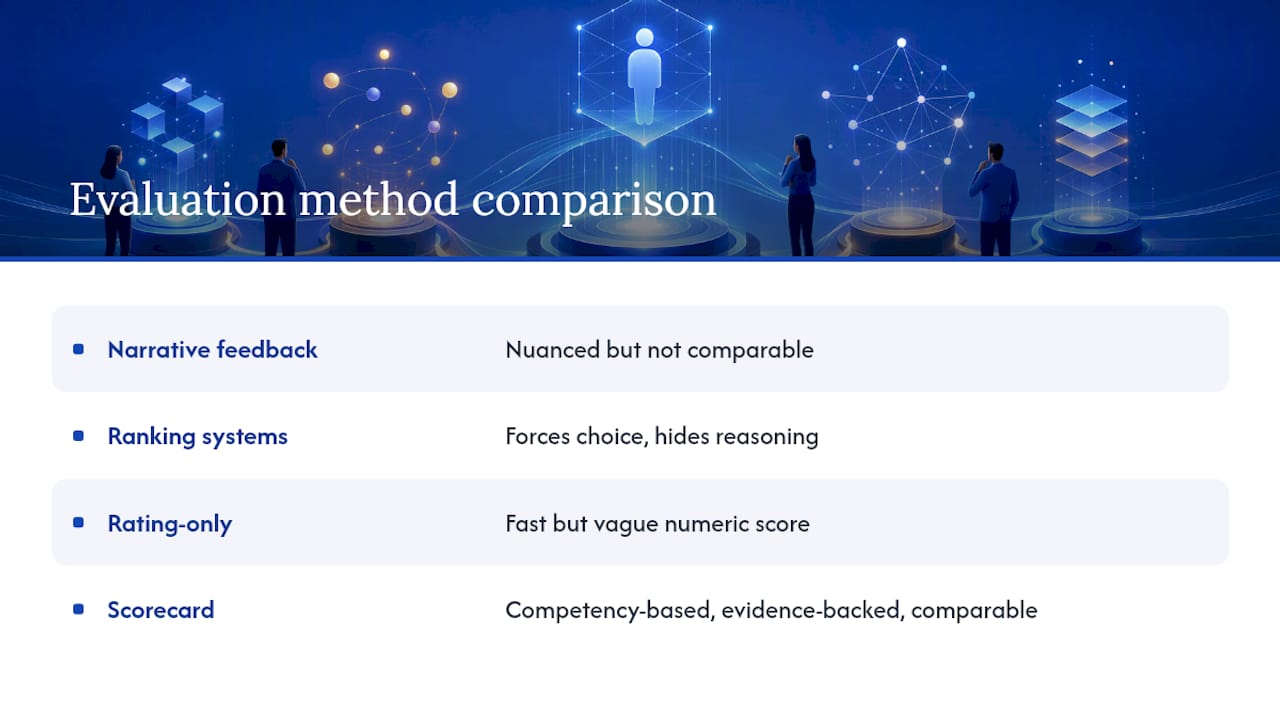
Narrative feedback (a paragraph of free-form impressions) captures nuance but produces almost nothing you can compare across candidates. Ranking systems force a decision but hide the reasoning behind it. Rating-only systems (a single 1 to 10 “how’d they do” number) are fast but just as vague as narrative feedback dressed up as a number. A well-built scorecard beats all three because it forces specific, evidence-backed judgments on named competencies, and it produces a paper trail if a hiring decision is ever questioned.
Customizing scorecards by role or department matters more than most teams realize. An engineering scorecard should weight system-design thinking and code quality; a sales scorecard should weight discovery questions and objection handling; a support role should weight de-escalation and written clarity. Departments should agree on a shared template structure so cross-functional panels can read any scorecard quickly, while letting each hiring manager swap in the three or four competencies specific to that job. A framework for evaluation criteria built around a specific role, rather than a generic checklist, tends to produce sharper, more defensible scores.
When multiple interviewers each fill out their own scorecard, the compiled result belongs at the center of the final hiring meeting. Rather than averaging scores blindly, walk through each competency, flag where scores diverge by more than one point, and have the diverging interviewers explain their evidence before the group reaches a decision.
How JobsAI Enterprise Handles Scorecards in Practice
Recruiting teams running high interview volume tend to lose scorecards the same way they lose everything else at scale: someone forgets to fill one out, or three interviewers score inconsistently and nobody notices until the debrief meeting stalls. An operating system built for high-volume hiring addresses this by automating the parts that are easy to skip.
In practice, that looks like:
- Automated prompts that remind interviewers to complete a scorecard immediately after each interview, rather than at the end of the week
- AI-assisted scoring that flags gaps between interviewer ratings before the panel meets
- Consolidated comparison dashboards showing every candidate’s scores side by side, competency by competency
Consistency like transcript-based scoring tools demonstrate, letting every reviewer work from the same evidence, is exactly the kind of automation that reduces missing or conflicting scorecards. Teams adopting this kind of workflow should watch time-to-decision and score-to-hire correlation as the two metrics that show whether the system is actually working.
When Do Scorecards Deliver the Most Value?
Scorecards earn their keep when you’re hiring the same role repeatedly and the outcome is measurable, high volume plus a clear success metric equals high ROI. For a one-time senior hire where fit is genuinely hard to define numerically, a well-run conversation among trusted interviewers can outperform a rigid form. The improvement most teams skip: revisit your competency list every two quarters and drop anything that hasn’t predicted a good hire yet.
— Hippolyte A.
Scale Your Scorecard Process With JobsAI Enterprise
JobsAI Enterprise is built for the exact problem this article describes: getting consistent, evidence-backed scores out of a hiring process that moves too fast for anyone to fill out a form by hand every time.
For recruiting agencies, staffing firms, and corporate HR teams running dozens of interviews a week, the platform layers AI candidate scoring, side-by-side comparison dashboards, and workflow automation on top of your existing interview stages, so a missing scorecard stops being the reason a good candidate slips through. It connects to your ATS and calendar tools, pulls evidence into a consistent view for every interviewer on the panel, and gives hiring managers one dashboard instead of a folder of loose PDFs.
If your team is hiring at volume and losing time reconciling scattered scorecards, take a product tour or check current pricing plans to see how it fits your hiring workflow.
Sources
For deeper guidance, see the EEOC’s discussion of automated selection tools, OPM’s job analysis framework, and HBR’s scorecard research. These sources were selected with U.S. hiring teams and compliance requirements in mind.
- The Ultimate Guide to Interview Scoring Sheets (With Template) — Indeed / Reviewed by Joe Scotto
- Job analysis — OPM
- A scorecard for making better hiring decisions — HBR
- EEOC meeting transcript: Navigating employment discrimination, AI and automated systems
FAQ
What Are the 5 C’s of Interviewing?
Definitions vary across hiring guides, but a common version covers competence, character, communication, culture fit, and commitment, each scored against specific, observable evidence rather than a general impression.
What Is the Biggest Red Flag to Watch for in an Interview?
Vague or evasive answers to direct behavioral questions, especially an inability to give a specific example when asked twice, are widely flagged as a strong warning sign, and scorecards help catch this by requiring evidence in the comments field rather than a gut score.
What Is the Purpose of a Scorecard in Recruitment?
A scorecard standardizes how interviewers evaluate candidates against the same job-specific competencies, producing scores that are comparable across candidates and defensible if a hiring decision is ever questioned.
What Is a Scorecard in HR?
In HR, a scorecard is a structured evaluation document, used during interviews or performance reviews, that scores specific competencies against anchored definitions instead of relying on open-ended impressions. Some platforms automate the collection and comparison of these scores across high-volume hiring pipelines.
Recommended
See it in your workflow
JobsAI Enterprise runs sourcing, AI screening, and the whole interview pipeline in one place. Book a walkthrough tailored to your team.
Book a demo