
Article
Best Lighthousehiring.ai Alternatives for Recruiters in 2026

Best Lighthousehiring.ai Alternatives for Recruiters in 2026
What are the top AI recruiting software alternatives to Lighthouse Hiring?
Strong lighthousehiring.ai alternatives are platforms that combine AI-driven screening, structured workflows, and transparent scoring, addressing different recruiting needs from high-volume hourly hiring to enterprise talent acquisition. Choosing among them comes down to your team’s size, budget, ATS stack, and how much you care about explainable AI scoring.
AI recruiting platforms in 2026 are no longer just resume parsers. The best ones handle candidate ranking, interview scheduling, bias auditing, and CRM functions in a single workflow. That shift matters because time-to-hire is usually lost in the gaps between steps, not within any single step.
Here is a quick-reference comparison of the leading platforms:
| Platform | Best for | Key AI features | Pricing model | ATS integration | User experience |
|---|---|---|---|---|---|
| Greenhouse | Structured hiring at scale | AI screening, scorecards | Subscription, tiered | Wide native integrations | Clean, process-driven |
| HireVue | AI video interviews | Video AI, scheduling | Enterprise subscription | Broad ATS support | Interview-focused UI |
| Paradox (Olivia) | High-volume, hourly hiring | AI chatbot, scheduling | Custom pricing | Strong ATS connectors | Conversational, mobile-first |
| Workable | Mid-market all-in-one | AI sourcing, video interviews | Per-seat subscription | 200+ integrations | Accessible, fast setup |
| Manatal | Budget-conscious teams | AI scoring, drag-and-drop pipeline | Low monthly subscription | Key ATS integrations | Simple, modern |
| Humanly.io | Screening and scheduling automation | Conversational AI, DEI filters | Custom pricing | ATS agnostic | Chat-forward interface |
| TurboHire | Structured AI hiring | Resume ranking, analytics | Subscription tiers | API-based integrations | Workflow-centric |
| Rebecca AI | Automated outreach and sourcing | AI sourcing, personalized messaging | Usage-based | CRM and ATS connectors | Outreach-focused |
| TuraHire | SMB and growing teams | AI matching, pipeline management | Tiered plans | Core ATS support | Lightweight, intuitive |
| Phenom | Enterprise talent experience | AI career sites, CRM, internal mobility | Enterprise subscription | Deep enterprise ATS ties | Experience-layer platform |
| Jobsai Enterprise | Staffing firms and hiring teams | AI screening, ranking, workflow automation | Subscription | Workflow-native | Unified, efficient |
Key standouts at a glance:
- Greenhouse leads on structured hiring discipline and ATS breadth.
- HireVue is the go-to for organizations that rely on video-based AI interviews.
- Paradox excels when you’re filling hundreds of hourly roles fast.
- Manatal offers the lowest entry cost with credible AI scoring for smaller teams.
- Humanly.io stands out for conversational screening with built-in DEI filters.
- Jobsai Enterprise is purpose-built for staffing agencies and hiring teams that need a unified AI operating system, not just a point solution.
Verified reviews across these platforms consistently flag AI transparency as a top trust signal. Recruiters want to know why a candidate ranked first, not just that they did.
Table of Contents
- How do these platforms compare on features, pricing, and integrations?
- How do you choose the right AI recruiting software for your organization?
- How Jobsai Enterprise serves staffing firms and hiring teams
- Which platform wins on AI recruiting capabilities?
- How does customer support compare across AI recruiting platforms?
- What do user reviews say about these platforms?
- How reliable are these vendors over the long term?
- Jobsai Enterprise cuts hiring time without adding complexity
- Key Takeaways
- FAQ
How do these platforms compare on features, pricing, and integrations?
Functional differences between these platforms are sharper than their marketing suggests. Grouping them by primary capability helps cut through the noise.

AI screening and ranking
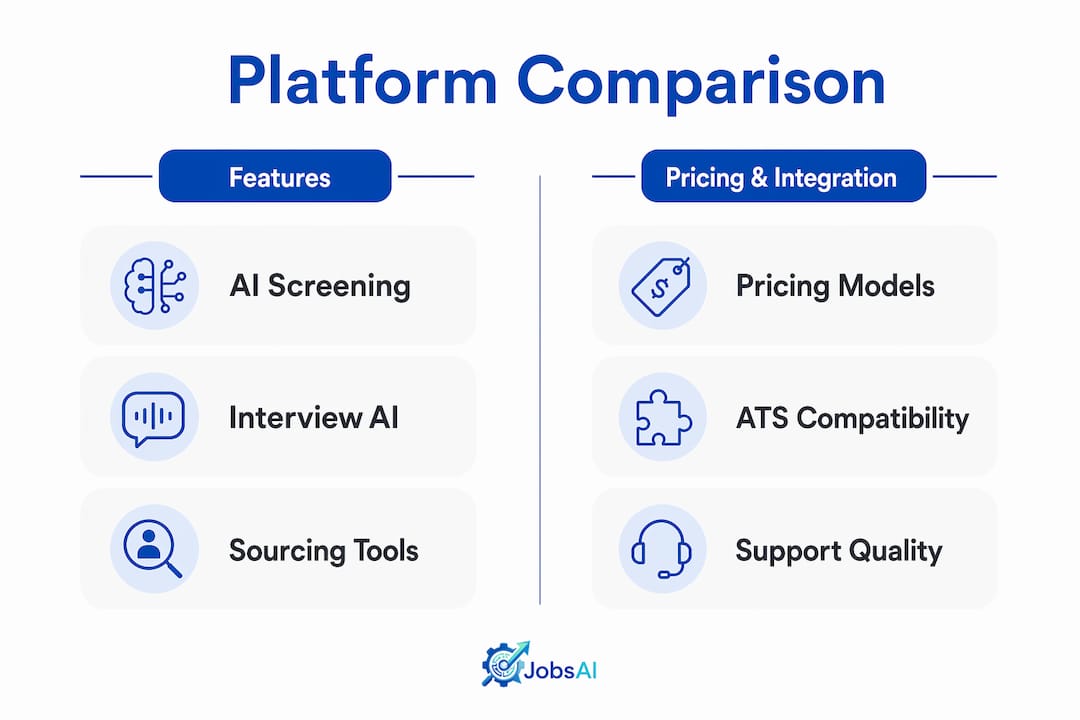
Greenhouse and Jobsai Enterprise both automate resume screening against job requirements, but they approach it differently. Greenhouse wraps AI scoring inside a structured scorecard framework, which works well for teams that already have defined hiring rubrics. Jobsai Enterprise matches resumes to job requirements and ranks candidates automatically, reducing the manual review load for staffing firms handling high applicant volumes. Manatal takes a lighter approach: its AI scoring is straightforward and visible, which is why budget-conscious teams gravitate toward it.

Interview and scheduling AI
HireVue and Paradox own this category. HireVue’s AI analyzes video interview responses and generates structured assessments, making it a strong fit for enterprise hiring teams that conduct thousands of interviews per quarter. Paradox’s Olivia chatbot handles scheduling, screening, and candidate Q&A conversationally, which is why it dominates high-volume hourly hiring. Humanly.io sits between these two: it automates screening conversations and scheduling without requiring a full video interview infrastructure.
Sourcing and outreach
Rebecca AI and TurboHire focus heavily on sourcing. Rebecca AI uses AI to personalize outreach at scale, which helps recruiting teams that rely on outbound candidate engagement. TurboHire adds structured ranking on top of sourcing, giving hiring managers a clearer view of where each candidate stands. Phenom takes a broader approach, building AI into the entire candidate experience from career site to offer, which suits large enterprises managing employer brand alongside recruiting volume.
Pricing structures
Pricing models across these platforms vary widely. Manatal and Workable publish transparent per-seat pricing, which makes budgeting predictable for smaller teams. HireVue, Paradox, and Phenom operate on custom enterprise contracts, so expect a sales conversation before you see a number. TuraHire and TurboHire offer tiered subscription plans suited to growing teams that need room to scale without committing to enterprise-level spend upfront. Rebecca AI uses usage-based pricing, which can be cost-effective for teams with variable hiring volume.
ATS integration depth
Wide ATS compatibility directly affects how quickly a new platform gets adopted. Workable connects with a wide range of tools, which is one reason mid-market teams adopt it quickly. Greenhouse has deep native integrations with major enterprise ATS systems. Paradox and HireVue both offer strong ATS connectors, though enterprise deployments often require IT involvement. Manatal and TuraHire cover the core integrations most SMB teams need without the complexity of enterprise API work.
Data privacy and compliance
Bias auditing is becoming a baseline expectation, not a premium feature. Platforms like Humanly.io and Greenhouse have invested in DEI-oriented filtering and auditable scoring. Phenom’s enterprise-grade compliance infrastructure suits organizations operating across multiple jurisdictions. For staffing agencies, where candidate data flows between clients and systems, compliance standards around data handling are worth scrutinizing closely before signing any contract.
| Platform | Pricing transparency | Bias auditing | Data compliance | ATS breadth |
|---|---|---|---|---|
| Greenhouse | Subscription, quote-based | Yes | Strong | Very wide |
| HireVue | Custom enterprise | Partial | Enterprise-grade | Broad |
| Paradox | Custom | Partial | Strong | Strong |
| Workable | Published per-seat | Basic | GDPR compliant | 200+ tools |
| Manatal | Published monthly | Basic AI scoring | Standard | Core integrations |
| Humanly.io | Custom | Yes, DEI filters | Strong | ATS agnostic |
| TurboHire | Tiered subscription | Yes | Standard | API-based |
| Rebecca AI | Usage-based | Basic | Standard | CRM and ATS |
| TuraHire | Tiered plans | Basic | Standard | Core ATS |
| Phenom | Enterprise custom | Yes | Enterprise-grade | Deep enterprise |
| Jobsai Enterprise | Subscription | Yes | Strong | Workflow-native |
How do you choose the right AI recruiting software for your organization?
The right platform is the one that fits how your team actually hires, not the platform with the longest feature list. Start with these practical criteria before you book a demo.
Evaluation criteria for recruiters:
- Use case alignment: Does the platform solve your primary bottleneck? Sourcing, screening, scheduling, and interview assessment are distinct problems. A tool built for video interviews won’t fix a sourcing gap.
- AI transparency: Can you see why a candidate was ranked first? Explainable AI scoring is now a compliance requirement in many jurisdictions, not just a nice feature.
- Bias auditing: Does the vendor offer documented bias testing? Platforms with auditable AI differentiate themselves by supporting fair hiring practices and reducing legal exposure.
- ATS integration: Will this platform talk to your existing stack without a six-month IT project? Confirm native connectors before committing.
- Pricing fit: Match the pricing model to your hiring volume. Usage-based pricing suits variable hiring; per-seat subscriptions suit steady-state teams.
- Vendor support: What does onboarding look like? Enterprise platforms with poor implementation support create adoption problems that outlast the contract.
- User experience: A platform your recruiters don’t use is a platform that doesn’t work. Prioritize interfaces that match your team’s workflow, not the vendor’s ideal workflow.
Pro Tip: Before evaluating any AI recruiting platform, ask the vendor for a sample scoring explanation on a real job description. If they can’t show you why the AI ranked a candidate, that’s a gap in transparency you’ll feel every time a hiring manager asks you to justify a shortlist.
Onboarding and implementation
Implementation timelines vary more than vendors admit. Workable and Manatal are typically live quickly for small teams, while Greenhouse, HireVue, and Phenom enterprise deployments often require longer timelines, depending on integration complexity and internal change management. TurboHire and TuraHire sit in the middle, with structured onboarding that suits growing teams without dedicated IT resources.
Understanding how AI hiring bias works before you deploy any platform is worth the time. Knowing where bias can enter the scoring pipeline helps you ask better questions during vendor evaluation and set up the right auditing checkpoints after go-live.
How Jobsai Enterprise serves staffing firms and hiring teams
Jobsai Enterprise is built as an AI-powered talent acquisition operating system, not a single-function tool. It screens and ranks candidates automatically by matching resumes against job requirements, which cuts the manual review time that bogs down high-volume recruiting. The platform organizes the entire hiring workflow in one place, from initial application through candidate communication and final decision.
For staffing firms, the unified workflow matters more than any individual feature. Staffing agencies manage multiple clients, multiple job orders, and multiple candidate pools simultaneously. Jobsai Enterprise handles that complexity by keeping candidate data, ranking, and communication in a single system rather than spread across disconnected tools.
What Jobsai Enterprise delivers:
- Automated candidate screening matched to specific job requirements
- AI-driven ranking that surfaces the strongest candidates first
- Centralized candidate communication to reduce follow-up gaps
- Workflow organization that keeps hiring managers and recruiters aligned
- Faster, more consistent hiring decisions across the team
Enterprise hiring teams benefit from the same consistency at larger scale. When every recruiter on a team uses the same AI scoring criteria, the quality of shortlists becomes more predictable and easier to defend to hiring managers. That consistency is where Jobsai Enterprise earns its place alongside the more established names in this category.
Which platform wins on AI recruiting capabilities?
Comparing AI capabilities across these platforms reveals a clear tiering. Phenom and Greenhouse operate at the top of the enterprise tier, with deep AI integration across sourcing, screening, and talent experience. HireVue leads specifically on AI-powered interview assessment. Paradox leads on conversational AI for high-volume scheduling.
Mid-market platforms like Workable and Manatal offer credible AI screening without the enterprise price tag. Workable’s AI sourcing pulls candidates from a broad network, while Manatal’s AI scoring is visible and easy to interpret, which helps smaller teams build recruiter confidence in AI-generated rankings.
Humanly.io and TurboHire occupy a practical middle ground. Humanly.io’s conversational AI handles screening and scheduling with DEI filters built in. TurboHire adds structured ranking and analytics on top of sourcing, giving hiring managers data to back their decisions. Rebecca AI and TuraHire are more specialized: Rebecca AI focuses on outbound sourcing and personalized outreach, while TuraHire targets SMBs that need AI matching without enterprise complexity.
Jobsai Enterprise’s AI capability centers on resume matching and candidate ranking, with workflow automation that keeps the process moving after the initial screen. For staffing agencies that process large applicant volumes across multiple client accounts, that combination addresses the core bottleneck directly.
Understanding how AI detects active hiring signals is increasingly relevant as platforms add sourcing intelligence on top of screening. The best platforms in 2026 don’t just rank inbound applicants; they identify candidates who are likely to be open to a conversation before you reach out.
How does customer support compare across AI recruiting platforms?
Customer support quality is one of the most underweighted factors in platform selection, and one of the most consequential after you’ve signed. Enterprise platforms like Greenhouse, HireVue, and Phenom typically assign dedicated customer success managers to large accounts, which helps with complex implementations but doesn’t always translate to fast response times for day-to-day questions.
Workable and Manatal are known for responsive support at the SMB level. Workable offers live chat and email support with relatively fast turnaround, which matters when a recruiter hits a workflow issue mid-hiring sprint. Manatal’s support is similarly accessible, with documentation that covers most common setup questions without requiring a support ticket.
Paradox and Humanly.io both lean on structured onboarding programs to get teams productive quickly. The logic is that a well-configured deployment reduces support demand later. That works when the onboarding is thorough, but teams that skip steps during implementation tend to generate more support requests in the first 90 days.
TurboHire, TuraHire, and Rebecca AI offer support structures that vary by plan tier. Higher-tier subscribers typically get faster response times and access to dedicated support contacts. For growing teams, it’s worth confirming what support level comes with your specific plan before signing, not after.
What do user reviews say about these platforms?
Verified reviews across platforms consistently surface a few recurring themes. Greenhouse earns high marks for its structured hiring process and ATS reliability, though some reviewers note that its configuration complexity requires a dedicated admin. HireVue reviews are generally positive for enterprise use cases, with praise for AI interview consistency, but smaller teams sometimes find the platform more than they need.
Paradox reviews highlight speed and candidate experience as standout strengths. Recruiters filling hourly roles report that Olivia’s chatbot handles scheduling and screening with minimal human intervention, which is exactly what high-volume hiring demands. Workable reviews tend to emphasize ease of setup and the breadth of integrations, with occasional criticism of reporting depth at the enterprise level.
Manatal consistently receives positive reviews for its price-to-feature ratio. Recruiters at smaller agencies and growing companies cite the AI scoring visibility as a genuine differentiator: they can see the score and the reasoning, which builds confidence in the shortlist. Humanly.io reviews focus on the quality of its conversational AI and the DEI filtering capability, with some users noting that customization requires vendor support rather than self-service configuration.
Recruiters increasingly demand clarity on how AI decisions are made. Platforms that can’t explain their scoring in plain language are losing ground in reviews, regardless of how accurate the underlying model is. That trend is reshaping which platforms get recommended in peer communities and HR forums.
How reliable are these vendors over the long term?
Vendor reliability comes down to three things: financial stability, product roadmap consistency, and how the platform handles problems when they arise. Greenhouse and HireVue are established players with years of enterprise deployments behind them. Both have navigated multiple product generations and maintained customer bases through platform transitions, which is a meaningful signal of organizational stability.
Workable has been in the market long enough to have a documented track record across economic cycles. Its consistent product updates and published changelog give customers visibility into where the platform is heading. Phenom’s enterprise focus and continued investment in AI talent experience features suggest a clear long-term direction, though its pricing and complexity put it out of reach for most teams outside the enterprise tier.
Manatal, TurboHire, and TuraHire are newer entrants with shorter track records. That doesn’t disqualify them, but it does mean you’re taking on more platform risk. Checking whether the vendor has published case studies, named customer references, and a clear support escalation path is worth the extra diligence before committing to a multi-year contract.
Rebecca AI and Humanly.io are growing platforms with active development cycles. Both have attracted enough customers to demonstrate product-market fit, but neither has the decade-long enterprise track record of Greenhouse or HireVue. For teams comfortable with a newer platform in exchange for more flexibility and responsiveness, that trade-off can work well.
Jobsai Enterprise is purpose-built for the staffing and hiring team use case, with a product roadmap focused on AI screening, ranking, and workflow automation. Its workflow automation capabilities are designed to grow with the teams using them, which matters for staffing agencies that expect their client roster and job volume to increase over time.
Jobsai Enterprise cuts hiring time without adding complexity
Recruiters evaluating lighthousehiring.ai alternatives often find themselves choosing between platforms built for enterprise scale and tools that lack the depth to handle real hiring volume. Jobsai Enterprise sits in a different position: it’s built specifically for staffing firms and hiring teams that need AI to do the heavy lifting on screening and ranking, without the implementation overhead of an enterprise suite.
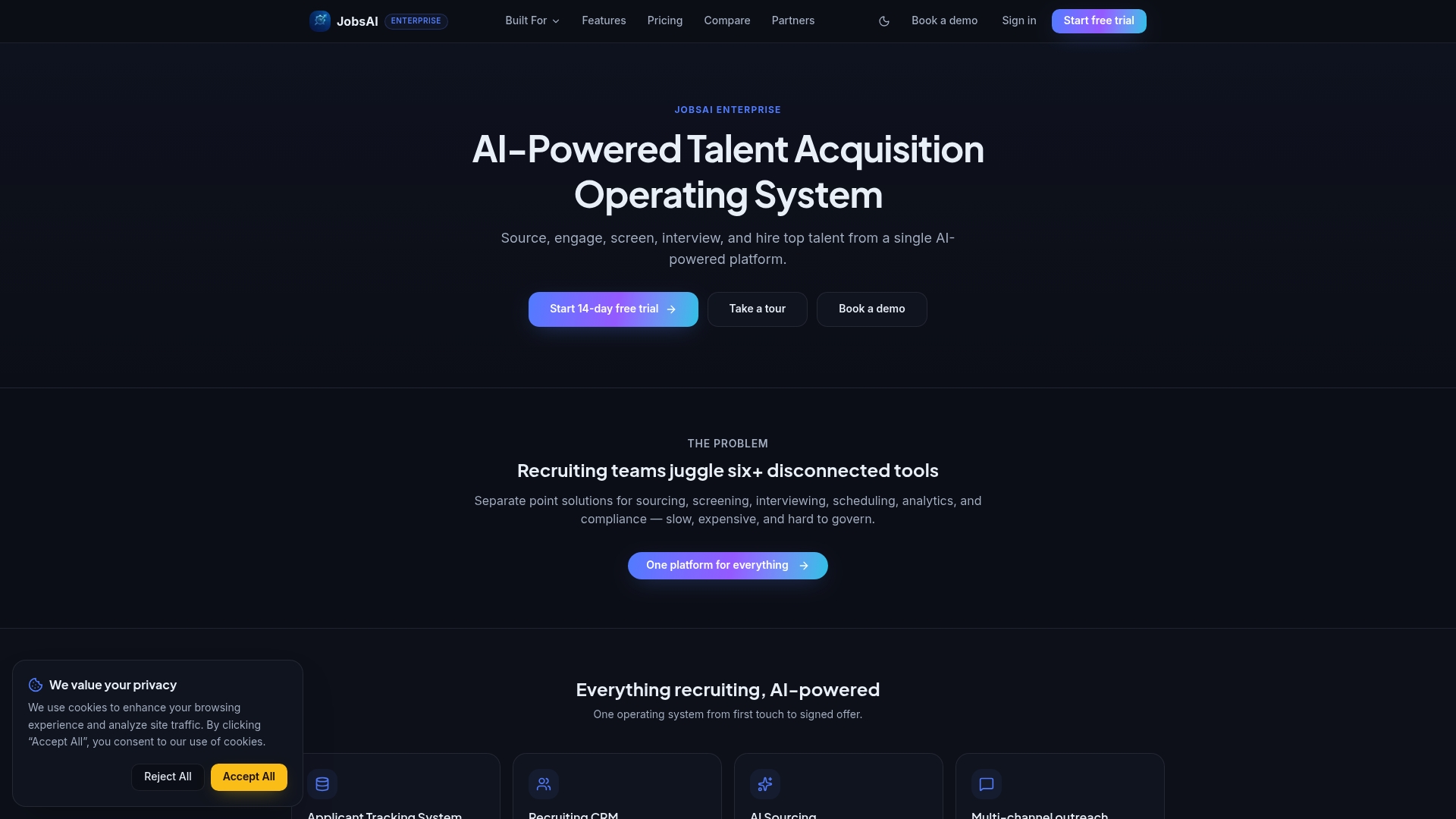
The practical difference shows up in daily recruiting work. Jobsai Enterprise screens applicants automatically, ranks them against job requirements, and organizes the entire candidate pipeline in one place. Recruiters spend less time on manual review and more time on the conversations that actually move candidates forward. For staffing agencies managing multiple client accounts, that efficiency compounds across every open role.
If you’re ready to see how AI screening and ranking work in practice, explore Jobsai Enterprise to find the plan that fits your team’s hiring volume and workflow. Pricing details are available at Jobsai Enterprise pricing for teams ready to compare costs directly.
Key Takeaways
The strongest AI recruiting platform for your team is the one that matches your hiring volume, ATS stack, and need for AI transparency, not the one with the most features.
| Point | Details |
|---|---|
| AI transparency is now a baseline | Recruiters should prioritize platforms that explain candidate rankings, not just produce them. |
| Pricing models vary by team size | Per-seat subscriptions suit steady hiring; usage-based pricing fits variable volume. |
| ATS integration drives adoption | Wide native integrations reduce setup time and improve recruiter workflow efficiency. |
| Bias auditing separates platforms | Tools with documented bias auditing support fair hiring and reduce compliance risk. |
| Jobsai Enterprise fits staffing teams | It automates screening, ranking, and workflow management in one system built for staffing firms and hiring managers. |
FAQ
What are the best lighthousehiring.ai alternatives in 2026?
The leading alternatives include Greenhouse, HireVue, Paradox, Workable, Manatal, Humanly.io, TurboHire, Rebecca AI, TuraHire, Phenom, and Jobsai Enterprise. Each fits a different use case, from high-volume hourly hiring to enterprise talent acquisition.
How do I choose between AI recruiting platforms?
Start with your primary bottleneck: sourcing, screening, scheduling, or interview assessment. Then confirm ATS compatibility, pricing fit, and whether the platform offers explainable AI scoring before committing.
Does AI recruiting software support bias auditing?
Bias auditing is now a standard feature on enterprise platforms like Greenhouse, Humanly.io, and Phenom. Smaller platforms vary: always ask the vendor for documentation on how their AI is tested for bias before you sign.
What is the difference between Teal and Simplify in recruiting tools?
Teal and Simplify are job search tools built for candidates, not recruiting platforms for hiring teams. They help job seekers organize applications and track opportunities, which is a different function from what AI recruiting software like Greenhouse, Manatal, or Jobsai Enterprise provides to recruiters.
Which AI recruiting platforms work best for staffing agencies?
Staffing agencies benefit most from platforms that handle multiple client accounts, high applicant volumes, and centralized candidate communication. Jobsai Enterprise is built specifically for staffing firm workflows, combining AI screening, ranking, and pipeline management in a single system.
Recommended
See it in your workflow
JobsAI Enterprise runs sourcing, AI screening, and the whole interview pipeline in one place. Book a walkthrough tailored to your team.
Book a demo